Quick answer: “Flame retardant” and “fire retardant” are the same thing, used interchangeably in everyday English — both mean a chemical that reduces how fast a material burns. “Flame resistant” is different: it describes the result, not the chemical. A material can be flame resistant by treatment (flame retardant added) or flame resistant by nature (some fibers just don’t burn easily). If you are buying additives for plastics, the word you want is “flame retardant” — that’s the industry term, and it’s what we sell.
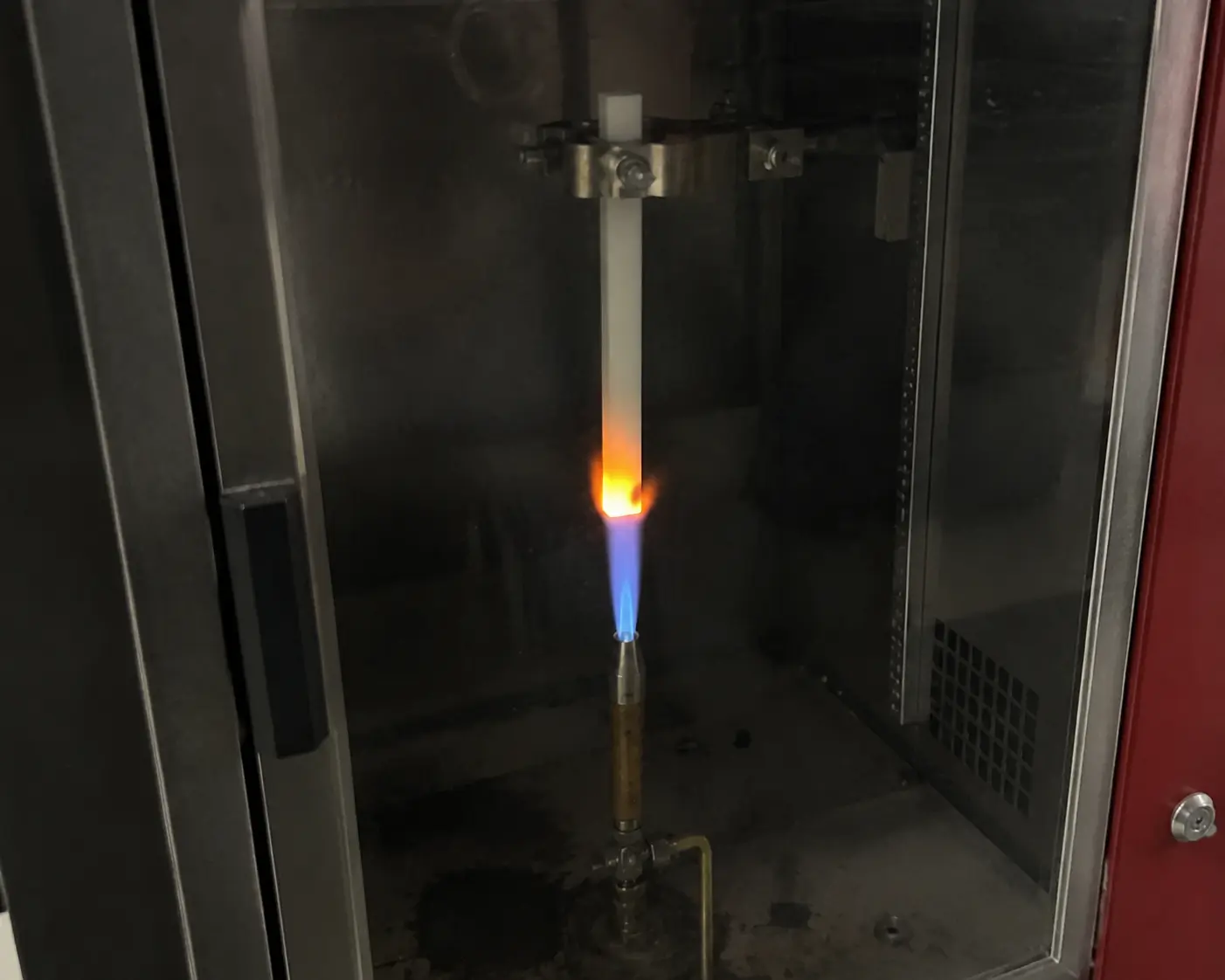
We get this question from buyers who are new to the industry, and it’s a fair one — English uses “flame” and “fire” almost interchangeably, and then adds a third word, “resistant,” that sounds like it should mean something different but often doesn’t. Here’s the plain breakdown, plus where it actually matters for your RFQ.
Flame retardant vs fire retardant: no real difference
Both terms describe a chemical that slows or stops combustion. “Flame retardant” is the more common term in plastics, electronics and cable industries — UL94, the standard everyone in our world tests to, uses “flame” throughout. “Fire retardant” shows up more in construction and textiles — fire-retardant treated wood, fire-retardant coatings, NFPA 701 fabric testing. Same mechanism, same goal, different industry habit. If you search either term for plastic additives, you’ll find the same suppliers and the same chemistry.
| Term | What it means | Where it’s used |
|---|---|---|
| Flame retardant | A chemical/additive that reduces flammability | Plastics, electronics, cable, masterbatch |
| Fire retardant | Same thing, different industry habit | Construction, textiles, coatings, wood |
| Flame resistant | A property — the material doesn’t sustain a flame | Protective clothing, fabrics, finished materials |
| Fireproof | Marketing word, not a real technical claim | Avoid using it in specs — nothing is truly fireproof |
Flame retardant vs flame resistant: the real distinction
This is the pair that actually matters. ASTM D123 draws the line clearly: flame retardant is the treatment; flame resistant is the outcome. A textile industry example makes it concrete — a cotton shirt treated with a flame retardant chemical becomes flame resistant. A Nomex garment is flame resistant by the fiber’s own molecular structure, with no chemical treatment at all. Both end up “flame resistant.” Only one got there via a “flame retardant.”
In plastics, the distinction mostly collapses in practice. A resin compounded with a flame retardant additive is described as “flame retardant plastic” — not “flame resistant plastic.” Industry convention here favors “flame retardant” as both the chemical and the resulting compound. You will not see much daylight between the two terms in a polymer RFQ.
What this means for your RFQ
Practically, use “flame retardant” when you’re sourcing additives, masterbatch, or compounded plastics — that is the term suppliers, UL94, and IEC 60332 all use, and it’s what turns up the right results. A few terms worth knowing so you don’t waste time on the wrong search:
- “Fireproof” is not a real spec. Nothing is fireproof; everything has a failure temperature. If a datasheet uses the word, read past it to the actual UL94 class and LOI number.
- “Fire retardant treated wood/textile” is a different industry entirely — different standards (NFPA 701, ASTM E84), different suppliers, not something we make.
- “Flame resistant clothing” (welding jackets, arc-flash PPE) is a personal protective equipment market, unrelated to plastic compounding.
If your part is a plastic, cable, or masterbatch application, “flame retardant” is the correct term and the one to use talking to any supplier, us included. For how to actually pick a system once you’re speaking the right language, see our guide on how to choose flame retardants for plastics, and the halogen-free vs halogenated trade-off in halogen-free vs halogenated flame retardants.
What Rectivas actually supplies
To be direct about our lane: we supply flame retardant additives and flame retardant masterbatch for plastics, polymers and cable compounds — powder, compound and pellet forms that go into a resin before or during processing. We do not make fire-retardant wood treatments, textile finishes, or personal protective clothing. If your project is one of those, the terminology in this article should at least point you toward the right kind of supplier faster.
Send us the resin, target UL94 class and application, and we will match a flame retardant system and prove it in our partner factory’s burn lab. Request a quote to start.
FAQ
Is “flame retardant” the same as “fire retardant”?
Yes, functionally — both describe a chemical that slows or stops combustion. “Flame retardant” is the standard term in plastics and electronics; “fire retardant” is more common in construction and textiles. Same mechanism, different industry habit.
What’s the difference between flame retardant and flame resistant?
Flame retardant is the chemical treatment; flame resistant is the resulting property. A material can become flame resistant through a flame retardant additive, or be flame resistant naturally through its own fiber or polymer structure — no treatment involved. In plastics compounding, both terms are used almost interchangeably for the finished material.
Is “fireproof plastic” a real thing?
No — “fireproof” isn’t a recognized technical term or test standard. Every plastic has a failure point under enough heat. Ask for the actual UL94 class and LOI (limiting oxygen index) instead of relying on marketing language like “fireproof” or “fire safe.”
Which term should I use when requesting a quote for plastic additives?
Use “flame retardant additives” or “flame retardant masterbatch” — that is the term the plastics and cable industry uses, and it is what UL94 and IEC 60332 reference. “Fire retardant” will usually get understood the same way, but “flame resistant” can pull results for finished protective clothing instead of raw additives.
Final Thoughts
Read past the word to the actual class. A datasheet saying “fire retardant” without a UL94 rating, a thickness and an LOI figure has told you nothing you can put in a file. When you are ready to specify rather than describe, our additive systems and masterbatch range are organised by resin and target standard, which is the only way the question can actually be answered.
—— Rectivas Materials 团队 技术工程师老陈