Quick answer: A flame retardant distributor resells stocked product with local warehousing, small minimums and fast delivery; a manufacturer formulates, produces and tests the material itself, offering lower per-kilogram pricing, custom grades and direct technical accountability. Below roughly 500 kg per order or when you need material tomorrow, a distributor earns their margin. At recurring container-scale volume, or the moment your spec needs any customisation, factory-direct wins on both cost and problem-solving speed.
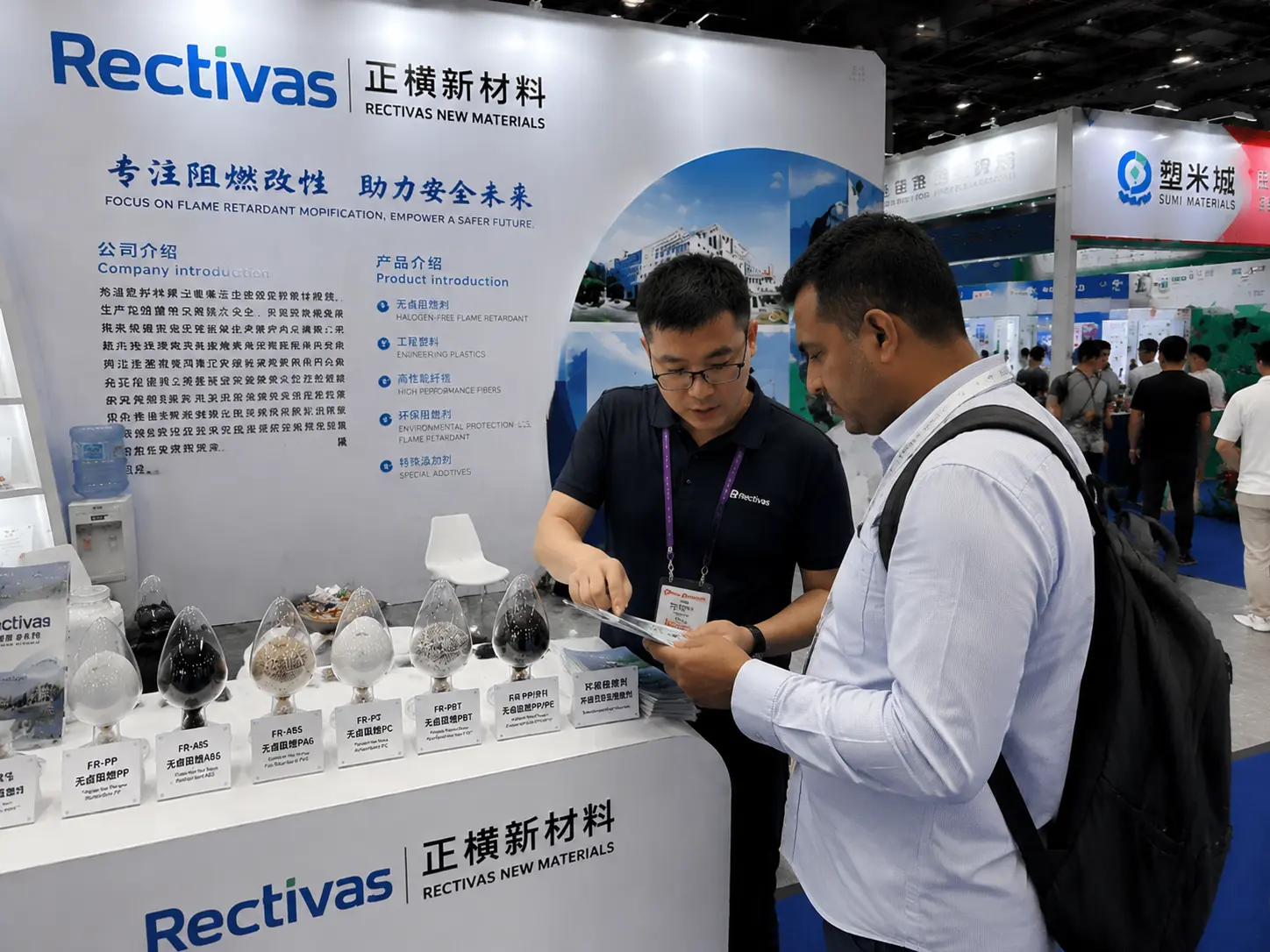
I run business development at Rectivas, so you might expect this article to end with “always buy from the factory.” It won’t. We sell through trading partners in several markets ourselves, and there are purchasing situations where I would genuinely point a buyer to a distributor. But there are also situations where staying with one quietly costs you 15–30% and a layer of technical blindness — and most buyers have never sat down and worked out which situation they are in. Let’s do that.
What Each Party Actually Does
| Distributor / Trader | Manufacturer (factory direct) | |
|---|---|---|
| Role | Buys in bulk, stocks locally, resells in smaller lots | Formulates, compounds, tests and ships its own product |
| Minimum order | Often 25–500 kg | Typically 500 kg–1 ton for standard grades |
| Lead time | Days (from local stock) | 2–5 weeks including production and sea freight |
| Price structure | Factory price + freight + duty + 10–30% margin | Factory price; you carry freight and import |
| Technical depth | Catalogue-level; escalates real questions upstream | Formulation lab, burn testing, can modify the grade |
| Customisation | Only what’s in stock | Carrier resin, loading, particle size, packaging — all negotiable |
| Traceability | Depends on how well they keep lot records | Direct: batch → production record → COA/TDS/SDS |
When a Distributor Is the Right Call
Q: Is buying through a distributor a mistake? Not at all — in four specific situations it is clearly the better decision.
- Trial and development quantities. You need 50 kg to run a line trial. No factory’s economics work at that size for a one-off; a distributor’s do.
- Emergency cover. Your line goes down Thursday, you need material Monday. Local stock beats any factory lead time, always.
- One-off or rarely repeated jobs. If flame retardant is 2% of your purchasing and appears twice a year, the overhead of qualifying an overseas supplier isn’t worth the saving.
- Credit and consolidation. Some distributors bundle your FR with ten other additives on one invoice with 60-day terms. That working-capital service has real value.
When Factory-Direct Wins — and by How Much
Q: How much does the distributor layer cost at volume? On recurring container-scale orders, typically 15–30% versus factory-direct pricing — before counting the technical costs.
The money is the visible part. Three less visible costs push serious buyers direct:
- The technical telephone game. When your V-0 part starts failing at 1.6 mm, a distributor relays your question to the factory and relays the answer back — each cycle takes days and loses detail. Buying direct, that conversation happens between your engineer and the formulation lab that built the grade. We have solved dosing problems in a single video call that had bounced through a trader’s inbox for three weeks.
- The relabelling blind spot. Some traders rebrand product, which means you don’t actually know who made your material, whether two “different” quotes are the same factory, or whether the SDS matches the batch. For a safety-critical additive that ends up in your UL file, that opacity is a genuine audit risk.
- No path to customisation. The moment you need a different carrier resin, a finer particle cut for film, or a dust-suppressed grade, a stocked catalogue can’t help. Factory-direct, that request is Tuesday morning’s work — our production setup, MOQ tiers and OEM options are laid out on the flame retardant manufacturer page, and the equivalent for pellet concentrates on the flame retardant masterbatch manufacturer page.
How to Tell Who You’re Actually Talking To
“Manufacturer” is the most abused word in B2B chemicals — plenty of traders’ websites show factories they’ve never set foot in. Five checks that cost you one email each:
- Ask for the production address and offer to visit or video-call the plant. A real factory says yes in one reply. We host client audits routinely; the hesitation itself is the answer.
- Ask whose name is on the SDS and test reports. Our reports carry Rectivas’ name and are issued against our batches by an accredited third-party laboratory. A trader forwarding another company’s paperwork will show mismatched names.
- Ask a formulation question that isn’t in the TDS. “What happens to this grade at 300°C melt temperature?” A factory answers from data; a reseller stalls.
- Ask about modifying the grade. Any genuine manufacturer will discuss custom loadings and carriers. “We only supply as listed” means warehouse, not plant.
- Check certification scope. An ISO 9001 certificate names the certified activity — manufacturing versus trading — and the certified site. Read the scope line, not the logo.
The Hybrid Answer Most Growing Buyers Land On
In practice the mature setup we see among our own customers is both: a direct supply agreement with the factory for the recurring volume — qualified grade, agreed spec, scheduled containers — plus a local distributor relationship for trials and emergencies. Some of our trading partners effectively play this role, holding regional stock of the grades they represent. The point is not distributor or manufacturer; the point is knowing which chair each one sits in, and never paying a reseller margin on volume the factory would happily quote directly. What’s actually in the portfolio — additive systems by chemistry, plus custom masterbatch — starts from the flame retardant additives line and the full chemistry map on our flame retardant chemicals hub.
If you’re currently buying through a middle layer and want to know what your volume looks like factory-direct, send the grade, annual quantity and destination port — request a quote and I’ll come back with landed-cost numbers you can put next to your current invoice.
FAQ
What is the typical MOQ buying flame retardant factory-direct?
For standard grades, most factories including us work from 500 kg; custom formulations typically start at 1 ton. Sample quantities for lab and line trials ship free or at cost — the MOQ applies to production orders, not evaluation.
Are distributor prices always higher?
Per kilogram at volume, essentially always — the margin has to live somewhere. For a 100 kg spot purchase the comparison flips: the distributor’s bulk freight economics beat what you’d pay shipping a small parcel internationally.
Can a distributor provide TDS, SDS and COA documentation?
A good one forwards the manufacturer’s documents with matching batch numbers. The failure mode to watch for is relabelled product with generic or mismatched paperwork — if the name on the SDS doesn’t match the name on the bag, stop and ask why.
How do I switch from a distributor to buying direct?
Qualify before you switch: get the factory’s sample of the exact grade, run it through your normal incoming QC and a line trial, and only then move volume. Any manufacturer confident in their material will support a parallel qualification like this — we do it as standard, including matching our grade against the distributor-supplied material you’re currently running.
Final Thoughts
Both models are legitimate; they just carry different risks. A distributor gives you local stock and shorter lead times, a manufacturer gives you formulation control and batch traceability back to the line. What you should not accept is ambiguity about which one you are dealing with. We are a manufacturer – see our production capability – and we will say so plainly, including when a local distributor would serve you better on small volumes. Buyers comparing brominated offers specifically will find the Incoterm and composition traps in decabromodiphenyl ethane price comparison.
—— Rectivas Materials 团队 Leon