Quick answer: The best flame retardant for plastics depends on the application, not a universal ranking. Phosphorus-nitrogen systems are candidates for halogen-free PP, mineral hydroxides suit many low-smoke cable compounds, and reinforced nylon needs systems developed for that resin. Compare the finished compound at its required thickness, smoke performance and mechanical limits. An additive that wins a flame test can still be the wrong material for the part.
What Does “Best” Mean for a Plastic Part?
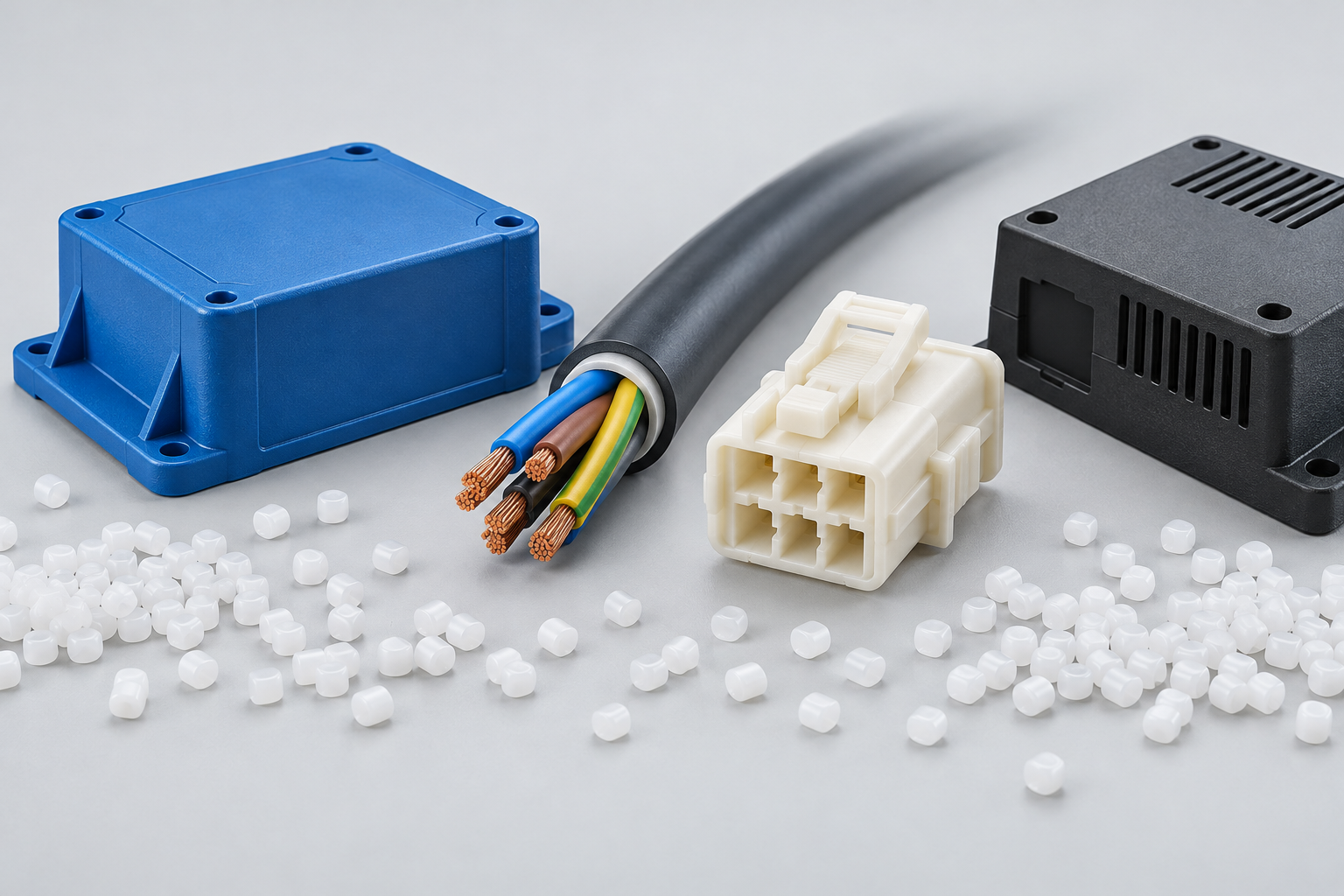
A connector must retain electrical and dimensional performance. A cable jacket must remain flexible. An enclosure may need impact strength, a particular color and a thin wall. Calling one chemical the best flame retardant across these applications hides the properties that decide whether the finished part is usable.
A more useful comparison asks which system meets the required fire performance with the smallest unacceptable change to the product. That includes processing consistency and documentation, as well as the purchase price. There may be several technically acceptable answers, each with a different compromise.
This article compares chemistry families by application. For a detailed sequence covering resin identification, standards and sampling, use the separate flame retardant selection guide. Here, the question is what each family brings to the shortlist, and what might rule it out.
Best Flame Retardant Candidates by Application
The table below is a starting map, not a recipe. A listed chemistry is a candidate for investigation; it does not guarantee a rating in every polymer grade. Filled, reinforced, recycled and blended versions of the same resin can need different formulations.
| Application | Candidate systems | Main trade-off to examine |
|---|---|---|
| Halogen-free PP molded parts | APP-based phosphorus-nitrogen intumescent packages | Char performance versus impact, flow and surface finish |
| PE/EVA low-smoke cable compounds | ATH or MDH, sometimes with other functional additives | Mineral loading versus flexibility and extrusion behavior |
| Unreinforced nylon components | Melamine cyanurate or other nylon-qualified packages | Actual resin grade, conditioning and required thickness |
| Glass-fiber-reinforced PA6/PA66 | Phosphinate-based systems designed for reinforced nylon | Glass content, electrical properties and processing stability |
| ABS electronics housings | ABS-qualified brominated systems; qualified alternative compounds | Market restrictions, impact retention and color |
| PC/ABS housings | Selected phosphate or brominated systems for the blend | Heat resistance, flow and blend composition |
| PVC cable and flexible parts | Compatible flame-retardant and smoke-suppressant packages | Plasticizer, stabilizer and smoke requirements together |
These comparisons concern additives incorporated into plastics. A treatment sold for timber, fabric or an exposed surface should not be assumed suitable for melt compounding. Its application method, durability requirements and supporting test evidence can be entirely different.
Phosphorus-Nitrogen Systems: A Candidate for Halogen-Free PP
Intumescent systems protect the polymer by developing an expanded char layer during burning. The useful product is a coordinated package: naming APP alone does not describe the complete formulation. Other components help establish the protective structure, and their balance matters.
As a manufacturer example, Clariant describes Exolit AP 766 as a phosphorus-nitrogen intumescent system for selected polyolefin applications. This supports the chemistry direction for PP; it does not establish that any APP powder can replace that formulated product.
For a molded enclosure, compare the char response with the properties needed before a fire: snap-fit behavior, surface quality and filling of thin features. A formulation that gives a convincing burn specimen but produces brittle clips has not solved the application.
The practical question is whether the complete package works in your PP grade, including its filler and pigment. Treat outdoor exposure or demanding moisture conditions as separate evidence requirements. If you need this chemistry direction, the halogen-free flame retardant additives page is the product starting point.
ATH and MDH: Useful for Mineral-Filled Cable Compounds
Aluminum hydroxide, usually called ATH, and magnesium hydroxide, or MDH, are established mineral candidates for low-smoke cable formulations. They absorb heat during decomposition and release water, while the remaining mineral material contributes to the protective residue.
Huber’s wire and cable technical brochure explains their different thermal behavior and the importance of particle characteristics and surface treatment. MDH offers a higher thermal stability window than ATH. The appropriate processing limit still needs the selected grade’s current documentation and a margin for real melt conditions.
Mineral systems can demand substantial formulation space. The comparison therefore includes elongation, extrusion pressure, surface smoothness and density. Changing particle treatment may matter as much as changing the mineral name. “ATH versus MDH” is not a complete specification.
A flexible cable jacket is also a different target from a rigid molded housing. The same mineral package may be unsuitable for the latter’s impact or appearance requirements. Low-smoke, halogen-free performance must be demonstrated in the finished formulation and applicable cable construction; it does not follow from the additive label alone.
Nitrogen and Phosphinate Systems: Nylon Needs a Closer Match
Melamine cyanurate is a familiar nitrogen-based candidate for unreinforced polyamide formulations. Glass-fiber reinforcement changes the problem, so an additive recommendation for an unfilled nylon should not be transferred automatically to a reinforced grade.
The distinction appears in an archived BASF Melapur MC technical sheet, which separates its unfilled and glass-filled applications. This is historical manufacturer guidance, not a current approval document. Obtain current product information before specifying a commercial grade.
For reinforced nylon, phosphinate-based packages are another established direction. Clariant’s Exolit OP 1312 information identifies reinforced PA6 and PA66 as intended applications. It also makes clear that results depend on polymer grade, processing conditions and reinforcement.
The important comparison is the entire connector material: flame behavior, moisture conditioning, mechanical performance and the electrical requirements assigned by the product designer. A favorable result for one property does not certify the others. Increasing additive content without checking these constraints can replace one failure with another.
Brominated and Phosphate Systems: Housing Applications
Brominated flame retardants remain candidates for some ABS and other engineering-plastic applications where the relevant requirements permit their use. Many formulations use a synergist, but the suitable combination is specific to the chemistry and resin. There is no universal brominated recipe.
Phosphate-based products are also used in selected engineering-plastic blends, including PC/ABS. These should not be presented as automatic drop-in replacements in neat ABS. The base polymer and blend composition affect which route is practical.
LANXESS’s application overview gives examples of different brominated and phosphorus-based products for enclosures, connectors and other uses. The variety is itself a useful warning against searching for one chemical that covers every housing.
For a colored enclosure, compare flow, impact and heat resistance alongside the fire result. Keep the exact substance identity visible when reviewing customer restrictions. Neither “brominated” nor “halogen-free” is a complete regulatory statement, and neither guarantees low smoke or low toxicity in the finished material.
Different Mechanisms Solve Different Problems
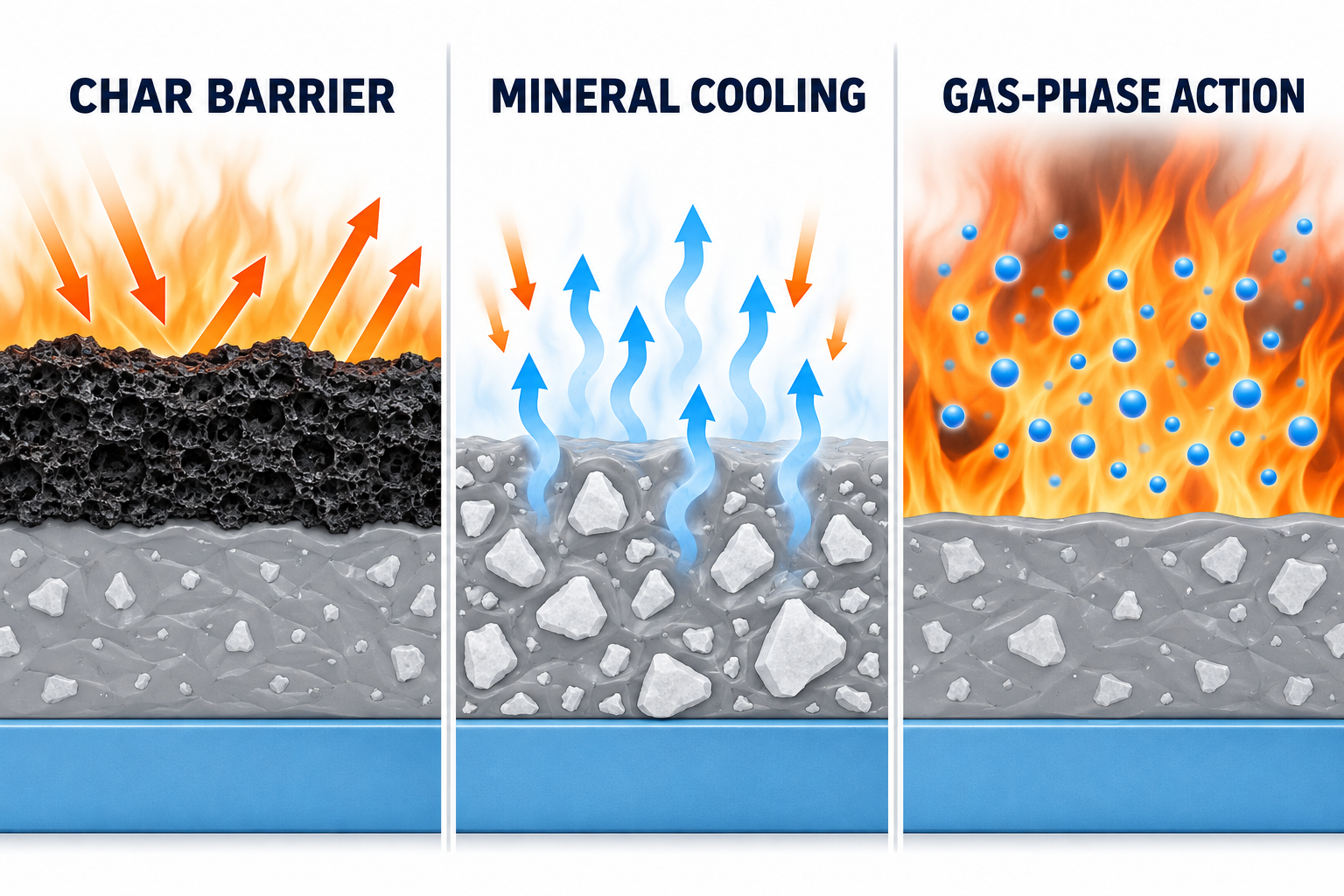
A char-forming package aims to protect the condensed material. A mineral system absorbs heat and contributes a residue. Gas-phase action interferes with combustion chemistry above the surface. Several commercial packages combine actions rather than belonging to only one category.
This explains why a chemical family cannot be ranked without an application. A mechanism depends on what the polymer does when heated and how the other ingredients influence it. A useful protective layer must form and remain effective in that formulation. A mechanism diagram cannot establish the required dose or predict a classification.
Compare the Compromise, Not Just the Flame Rating
Two materials can satisfy the same flammability target and still behave differently in production. The following comparison focuses on what can be lost while chasing the headline result. These are questions to investigate, not predictions that every product in a family will behave identically.
| Priority | Useful comparison | Evidence to request |
|---|---|---|
| Thin-wall performance | Rating at the required thickness and color | Relevant test report or recognition for the exact grade |
| Mechanical function | Impact, elongation and feature durability after modification | Property data under the required conditioning |
| Low smoke | Specified smoke and gas criteria, separately from burning | Results from the application’s applicable methods |
| Reliable processing | Feeding, dispersion, melt behavior and surface quality | A representative production trial and processing guidance |
| Acceptable cost | Finished material and usable-part cost | Complete formulation basis, yield and throughput assumptions |
| Documentation | Exact substance, grade and destination requirements | Current SDS, TDS and relevant declarations |
According to UL Solutions’ description of plastics combustion tests, vertical classifications evaluate burning, afterglow and dripping under defined conditions. A classification therefore answers a specific test question. It does not establish every aspect of a finished product’s fire safety, smoke behavior or service performance.
A Practical Example: Two Parts, Two Different Shortlists
Consider an illustrative comparison, not a reported customer case. One project is a halogen-free PP enclosure with snap-fit clips. Another is a glass-fiber-reinforced nylon connector. Both request a vertical flame classification, but the material functions are different.
For the enclosure, an intumescent PP package may be worth investigating. The meaningful trade-off is whether the modified material retains the clip function and molds the required features. For the connector, a reinforced-nylon package belongs on the shortlist, with electrical and conditioning requirements carried into the evaluation.
Sending the same “best additive” to both projects would skip the reason each shortlist exists. Even a favorable test plaque from the first project would provide little evidence for the second. Compare recommendations within the application before comparing suppliers across applications.
Our Recommendation: Buy the Form You Can Process Reliably
If you compound materials, flame retardant additives offer control over the formulation. That control also requires suitable feeding, dispersion and verification. A technically appropriate powder can disappoint when the incorporation process is inconsistent.
If your operation mainly molds or extrudes parts, flame retardant masterbatch may simplify additive handling. Confirm carrier compatibility and active content. A pellet concentrate is a supply form, not a separate flame-retardant chemistry, and its let-down ratio is not the same as the final active-additive concentration.
If you lack formulation resources, a qualified ready-to-process compound may be a more practical purchase. Ask for evidence covering the exact grade and intended conditions. Rectivas Materials works as a sourcing and technical partner, helping connect application requirements with candidate supply options and supporting documents. Any proposed material still needs validation for its intended use.
Frequently Asked Questions
What is the best flame retardant for plastics?
There is no single best flame retardant for every plastic. The useful answer depends on the polymer, application, fire test and properties that must be retained. Intumescent packages, mineral hydroxides, nitrogen-based products and brominated systems serve different needs. Compare candidates in the finished formulation under the required conditions rather than ranking chemical names alone.
What is the best flame retardant for polypropylene?
For halogen-free PP, phosphorus-nitrogen intumescent packages are a common direction to investigate. Other systems may be appropriate where requirements permit them. The choice changes with reinforcement, processing and the finished part’s mechanical demands. A PP-compatible package should be supported by relevant formulation evidence; APP alone does not describe a complete, validated solution for every application.
Are ATH and MDH interchangeable?
ATH and MDH share a mineral flame-retardant role, but they are not interchangeable without evaluation. Their thermal behavior differs, and commercial grades vary in particle characteristics and surface treatment. Replacing one with the other can change processing and compound properties. Compare the selected grades within the actual polymer formulation and its required fire, electrical and mechanical tests.
Is a halogen-free flame retardant always better?
Halogen-free chemistry can be necessary for a customer specification, but the label does not prove that a material is universally better. It does not automatically establish low smoke, acceptable toxicity or the required flame classification. Evaluate the exact substances and finished compound against the application requirements, with current documentation and appropriate testing rather than broad environmental claims.
Can one flame retardant work in PP, ABS and nylon?
Some products have multiple intended resin applications, but that does not make one formulation transferable across PP, ABS and nylon. Each polymer has different compatibility, processing and burning behavior. Ask for evidence specific to the resin grade and reinforcement. A supplier’s broad application list is a useful starting point, not proof of identical performance in every listed polymer.
Is the cheapest flame retardant the lowest-cost option?
Not necessarily. A lower additive price may require a different loading or produce more scrap, slower processing or unacceptable properties. Compare the cost of the complete material and usable part, using consistent assumptions. Include carrier resin and active content when comparing concentrates. Avoid treating supplier price per kilogram as the only measure of the economic result.
Should I buy powder, masterbatch or a finished compound?
Choose the form that matches your processing capability. Powder offers formulation flexibility where suitable compounding resources exist. Masterbatch can simplify handling, but needs compatible carrier resin and a verified addition level. A finished compound reduces formulation work for the processor. None of these forms guarantees a flame rating without evidence for the resulting material and its intended conditions.
What should I send when requesting a recommendation?
Send the resin grade, reinforcement, application, processing method, target fire test, required thickness and color. Include smoke requirements, mechanical limits and relevant customer restrictions. Say whether you want an additive, concentrate or ready-to-process compound. This information allows a supplier to propose a meaningful shortlist and supporting evidence rather than responding with a generic product name or unsupported dosage.
Final Thoughts
The best flame retardant is the system that fits the part and can be processed consistently, with evidence for the required performance. Use chemistry families to build an application-specific shortlist, then compare the compromises in the finished compound. Rectivas Materials can help source candidate additives or masterbatch and coordinate technical information. Keep the exact resin, reinforcement and test conditions attached to every recommendation.
— Rectivas Materials Team · Chen (老陈)