Quick answer: BDP, RDP and TPP are the three aryl phosphate ester flame retardants that dominate PC/ABS and PPO/PPE blends. TPP is the oldest and cheapest but volatile at processing temperature; RDP improved on it with oligomeric structure and lower volatility; BDP (bisphenol-A bis(diphenyl phosphate)) is today’s default because it adds the best hydrolytic and thermal stability of the three. For a new PC/ABS program in 2026, BDP at 8–14% is the standard starting point — RDP and TPP survive mainly in legacy formulations and cost-driven niches.
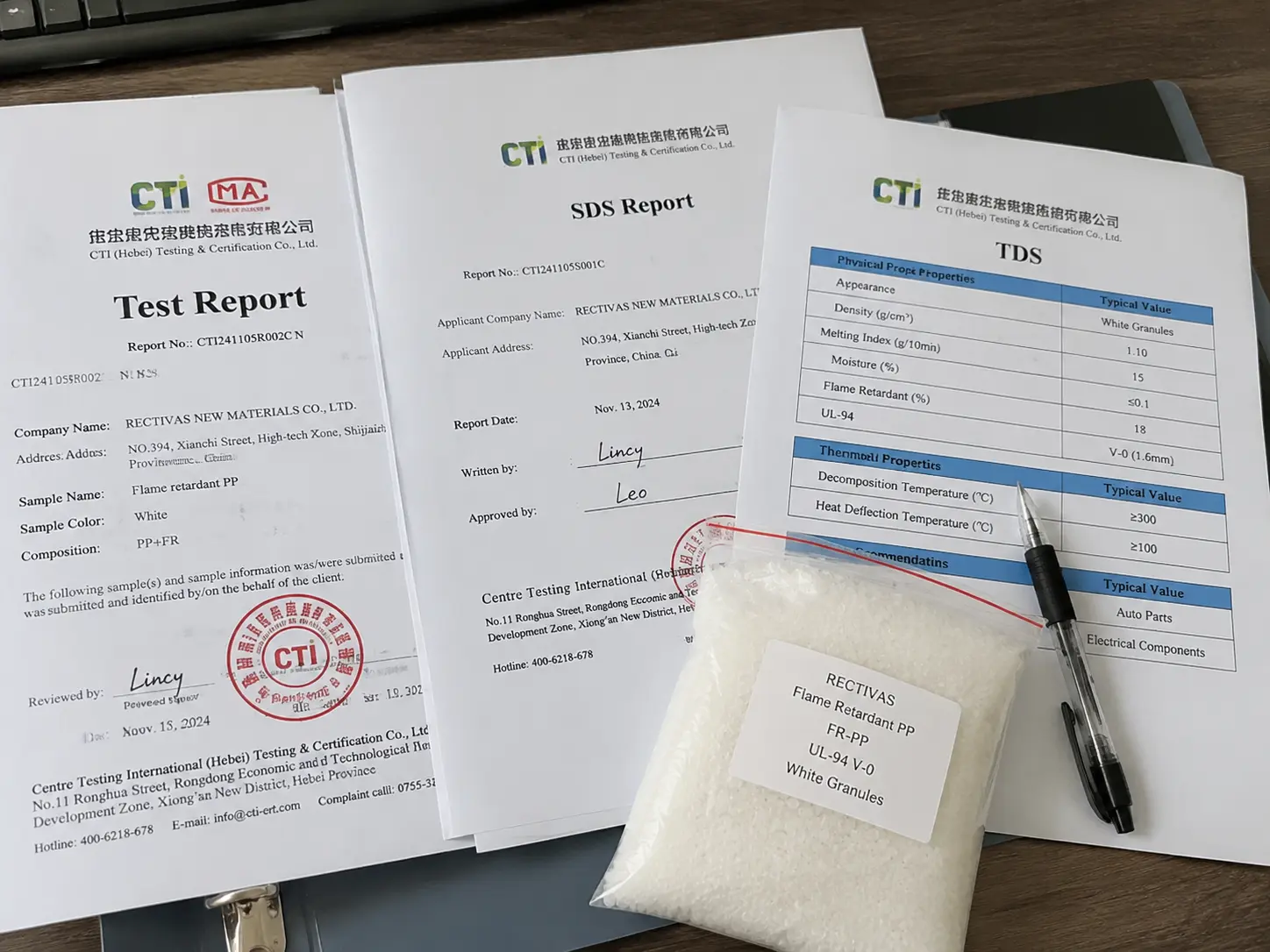
If you compound PC/ABS for laptop housings, chargers or appliance interiors, you have almost certainly run one of these three liquids through your line. They get discussed as if interchangeable — “an aryl phosphate at 10–12%” — and on a good day they are. The differences show up on the bad days: parts blooming white after a summer in a shipping container, juicing at the vent port, or a V-0 that quietly becomes V-1 after humid aging. Those failure modes are exactly where the three molecules part ways.
One Family, Three Generations
Q: What do BDP, RDP and TPP have in common? All three are aryl phosphate esters that work the same way: part gas-phase flame inhibition via PO• radicals, part condensed-phase char promotion in the PC or PPO fraction of the blend.
The family logic is a straightforward evolution against one enemy: volatility.
- TPP (triphenyl phosphate) — a single small molecule, melting around 49°C. Effective and cheap, but with meaningful vapour pressure at 240–260°C processing: it juices at the die, fogs vent ports, and migrates to part surfaces over time.
- RDP (resorcinol bis(diphenyl phosphate)) — the first oligomeric fix. Two phosphate groups bridged by resorcinol roughly double the molecular weight, cutting volatility sharply. Its weak point is the resorcinol linkage, which is comparatively vulnerable to hydrolysis.
- BDP (bisphenol-A bis(diphenyl phosphate)) — the same bridging idea using bisphenol-A. Slightly less phosphorus per kilogram than RDP, but the most hydrolytically stable and thermally robust of the three, which is why it took over the market.
The Three Side by Side
| Property | TPP | RDP | BDP |
|---|---|---|---|
| Form at RT | Solid flake (mp ~49°C) | Viscous liquid | Viscous liquid |
| Phosphorus content | ~9.5% | ~10.8% | ~8.9% |
| Volatility at processing | High — juicing/blooming risk | Low | Lowest |
| Hydrolytic stability | Moderate | Weakest of the three | Best of the three |
| Typical loading in PC/ABS for V-0 | 8–12% (rarely alone today) | 8–12% | 8–14% |
| 2026 market position | Legacy / cost niche / co-FR | Established, second choice | Industry default |
Note the phosphorus-content column: RDP actually carries the most phosphorus, which is why some formulators still reach for it when every percent of loading hurts stiffness. You buy that efficiency with hydrolysis risk — a trade we only recommend when the part sees a dry-environment life.
Why This Family Owns PC/ABS
Q: Why not just use a brominated system or a phosphinate in PC/ABS? Because aryl phosphates are unusually well matched to what a PC/ABS blend needs — they flame retard and plasticise at the same time.
Three reasons the fit is so good. First, polycarbonate is an excellent char former, and phosphoric acid species catalyse that charring; the FR leans on the polymer’s own chemistry. Second, the ester doubles as a flow promoter — PC/ABS is viscous, and 10% liquid phosphate cuts melt viscosity enough to fill thin laptop-housing walls, a side effect formulators actively exploit. Third, the loading window that achieves UL94 V-0 at 1.5–2 mm barely moves impact strength, which brominated routes at equivalent performance struggle to match in this blend. The same logic carries the family into PPO/PPE blends and, at lower stakes, into flexible PVC where phosphate esters serve as flame retardant plasticisers — the wider phosphorus toolbox, from these esters to red phosphorus and phosphinates, is mapped on our phosphorus flame retardant page.
The trade-offs are equally structural: the plasticising effect drops heat deflection temperature by 15–25°C versus unmodified blend, and every aryl phosphate needs an anti-drip agent (fibrillating PTFE at 0.3–0.5%) to hold V-0, since the ester makes the melt more willing to flow, not less. For neat PC where transparency and HDT can’t be sacrificed, the answer usually isn’t a phosphate at all but a sulfonate like KSS flame retardant at fractional loadings — different problem, different chemistry; our notes on flame retardant polycarbonate draw that line in detail.
Choosing Between Them: The Decision in Practice
- New PC/ABS or PPO program → start with BDP. It is the default for a reason: fewest field surprises, best humid-aging retention, priced within reach of RDP.
- Loading-critical, dry-environment part → consider RDP. The extra phosphorus buys you a point or two of loading. Confirm with humid aging (we suggest 85°C/85% RH, 500 h, then re-burn) before committing.
- Cost-driven, thick-wall, short-life part → TPP has a niche, usually blended with a higher-MW phosphate rather than alone, capping TPP at the level where blooming stays invisible.
- Whatever you pick, screen the pair, not the molecule. Phosphate + PTFE anti-drip + (sometimes) a drip of epoxy stabiliser is the real system. We had a Southeast Asian customer whose RDP-based charger housing passed V-0 fresh but failed after tropical warehouse storage — hydrolysis had eaten enough phosphate to matter. Switching the same formulation to BDP, same loading, recovered the rating through aging. The burn bar you test in week one is not the part your customer holds in year two.
Handling note for anyone moving from powder systems: BDP and RDP are viscous liquids that need heated storage and dosing via liquid injection into the extruder — or, the route many of our masterbatch customers prefer, pre-absorbed onto a carrier so the line keeps running on solids. That format question sits with your compounding setup, and it’s exactly the kind of thing worth one email before ordering: request a quote with your blend ratio, wall thickness and target rating, and our partner factory’s lab will recommend the ester, loading and format together.
FAQ
Is BDP the same as BAPP?
Yes — bisphenol-A bis(diphenyl phosphate) appears in literature as BDP, BAPP and occasionally BPADP. Same molecule, CAS 5945-33-5 for the main oligomer. Check CAS numbers, not abbreviations, when comparing quotes.
Are aryl phosphates halogen-free and RoHS compliant?
Yes. BDP, RDP and TPP contain no halogens and sit comfortably within RoHS and REACH requirements as of 2026. TPP carries more environmental scrutiny (aquatic toxicity) than the oligomers, one more reason its share keeps shrinking.
Can I use BDP or RDP in straight ABS without PC?
Poorly. The mechanism leans on PC’s char-forming backbone; neat ABS chars badly, so aryl phosphates alone underperform in it. Straight ABS is still mostly a brominated-plus-antimony territory — or a switch of blend to PC/ABS precisely to unlock the phosphate route.
Why did my phosphate-ester compound lose its V-0 after aging?
The two usual suspects are hydrolysis (RDP-based systems in humid climates — re-test after 85/85 aging) and migration (TPP blooming to the surface and evaporating). Both show up as a slow drift from V-0 to V-1/V-2 with no change in your process. An ester with higher molecular weight and better hydrolytic stability — in practice, BDP — is the standard fix.
Final Thoughts
Phosphate esters are liquids, which changes handling and dosing more than most buyers expect. BDP resists hydrolysis best and TPP is the most volatile – that difference decides service life more than initial rating does. We supply these into PC and PC/ABS work; see the polycarbonate systems page for how they sit alongside anti-drip and impact modifiers, and ask about processing temperature limits before you commit. Whether an aryl phosphate is even the right route depends on whether you are protecting clarity or impact, which is the decision walked through in flame retardant polycarbonate and PC/ABS.
—— Rectivas Materials 团队 老陈