Quick answer: Expandable graphite (EG) doesn’t fight fire chemically — it fights it physically. Heat it past roughly 180–220 °C and the sulfuric acid trapped between its graphite layers decomposes and forces the material to expand up to 100–300 times its original volume, into a low-density insulating char. No radical scavenging, no charring reaction with the polymer — just a worm-like carbon barrier that blocks heat. It shows up most in rigid PU/PIR foam, intumescent steel coatings, and EPS building insulation, and it gets noticeably better when paired with ammonium polyphosphate rather than used alone.
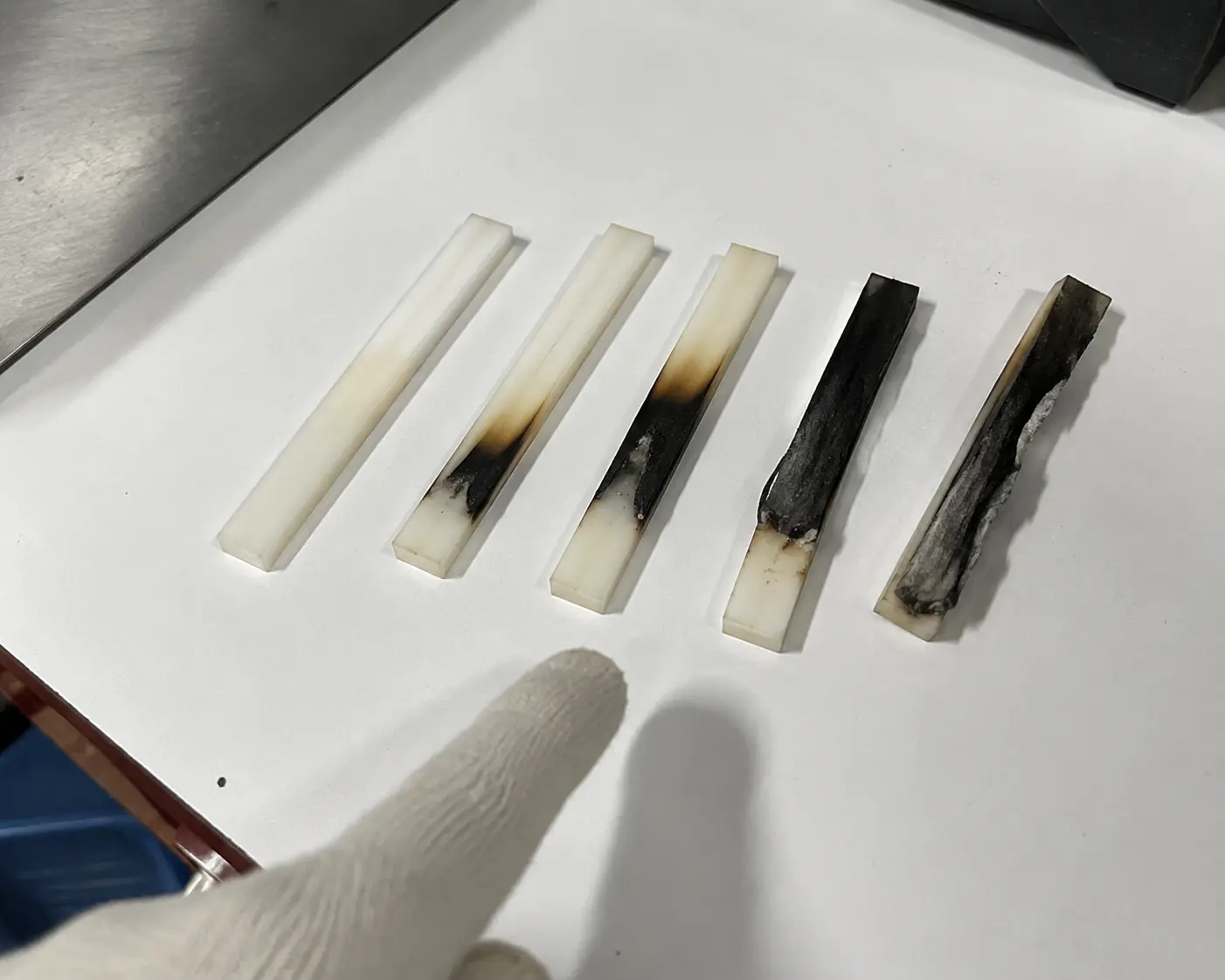
Most of the flame retardants on this site work by chemistry — releasing a radical scavenger, forcing an acid-catalyzed char, absorbing heat as they decompose. Expandable graphite is the odd one out: it’s essentially a physical trick, and it’s worth understanding on its own terms before you decide where it fits in a formulation.
What “expandable” actually means
Natural or synthetic graphite is treated with an intercalating agent — typically sulfuric acid — that wedges between the graphite’s carbon layers without destroying the sheet structure. At room temperature this sits inert. Heat it to the 180–220 °C range and the trapped acid decomposes, releasing gas that forces the graphite layers apart violently — the material grows into a low-density, worm-shaped char structure, sometimes 100 to 300 times its starting volume. That expanded char is the entire flame retardant mechanism: a thick, insulating carbon layer that blocks heat transfer to whatever is underneath and starves the fire of fresh fuel.
This is a physical intumescent process, not a chemical one — expandable graphite doesn’t meaningfully react with the polymer around it. That distinguishes it from the chemical intumescent system we cover on our ammonium polyphosphate (APP) page, where the acid source actively dehydrates the polymer into char. Different mechanism, same goal — which is exactly why the two work well paired.
Where it gets used
| Application | Why expandable graphite |
|---|---|
| Rigid PU / PIR foam | Cellular structure gives the expanding char somewhere to grow into; often combined with APP |
| Intumescent steel coatings | Classic use case — the coating swells into an insulating layer that buys structural steel time in a fire |
| EPS building insulation / facades | Under active research and use following high-profile facade fire incidents; performance is scale-dependent |
| Cable and rubber compounds | Secondary char-reinforcement role alongside a primary mineral or phosphorus system |
The APP synergy — and the honest limitation
Research on rigid PU foam bears this out directly: a triple-layer EG/APP/char-former coating cut peak heat release by roughly half compared to an untreated control, with meaningfully less smoke — better than either component alone. The physical barrier and the chemical char reinforce each other; EG gives the bulk and insulation, APP gives the chemical char strength and adhesion.
It isn’t a universal fix. In large-scale facade fire testing, expanded graphite char has shown a real weak point above roughly 540 °C — the char layer can detach or oxidize away under sustained, severe heat, which is worth knowing if your application faces a serious, prolonged fire scenario rather than a bench-scale ignition test. Formulate and test at the scale your real fire exposure demands, not just a small specimen.
Where Rectivas fits
To be direct: expandable graphite itself — the intercalated mineral compound — is a specialty graphite product, not something we manufacture. What we do supply is its most common synergist: ammonium polyphosphate (APP), in Phase II and coated grades, built for exactly this kind of intumescent pairing in rigid foam and coating systems. If your formulation is EG-based and needs the APP half of the system — or if you’re building an intumescent PP/PE package from APP alone — request a quote and we’ll match the grade to your process.
FAQ
How does expandable graphite work as a flame retardant?
Physically, not chemically. Sulfuric acid trapped between graphite layers decomposes on heating (around 180–220 °C), forcing the layers apart into a low-density expanded char up to 100–300 times the original volume. That char insulates against heat and blocks fuel supply to the flame.
Is expandable graphite better than ammonium polyphosphate (APP)?
Neither — they’re different mechanisms that work best combined. EG provides a purely physical, bulky insulating char; APP chemically catalyzes char formation and adds structural strength to it. Studies on rigid PU foam show EG+APP systems outperforming either used alone.
Where is expandable graphite most commonly used?
Rigid polyurethane/polyisocyanurate foam, intumescent steel fireproofing coatings, and increasingly EPS building insulation and facade systems following high-profile fire incidents. It also appears as a secondary char-reinforcing additive in some cable and rubber compounds.
Does expandable graphite fail in a severe fire?
It has a known weak point: large-scale testing shows the expanded char layer can detach or oxidize away above roughly 540 °C under sustained exposure. For applications facing serious, prolonged fire scenarios, test at realistic scale rather than relying on small bench specimens alone.
Final Thoughts
Expandable graphite works mechanically rather than chemically, so particle size and your process are the whole story. Too fine and it will not expand usefully; too coarse and it will not survive extrusion or show an acceptable surface. That is a specification conversation before it is a price one. Tell us your process and surface requirement, and see the chemicals overview for where EG sits against other char-forming routes.
—— Rectivas Materials 团队 技术工程师老陈