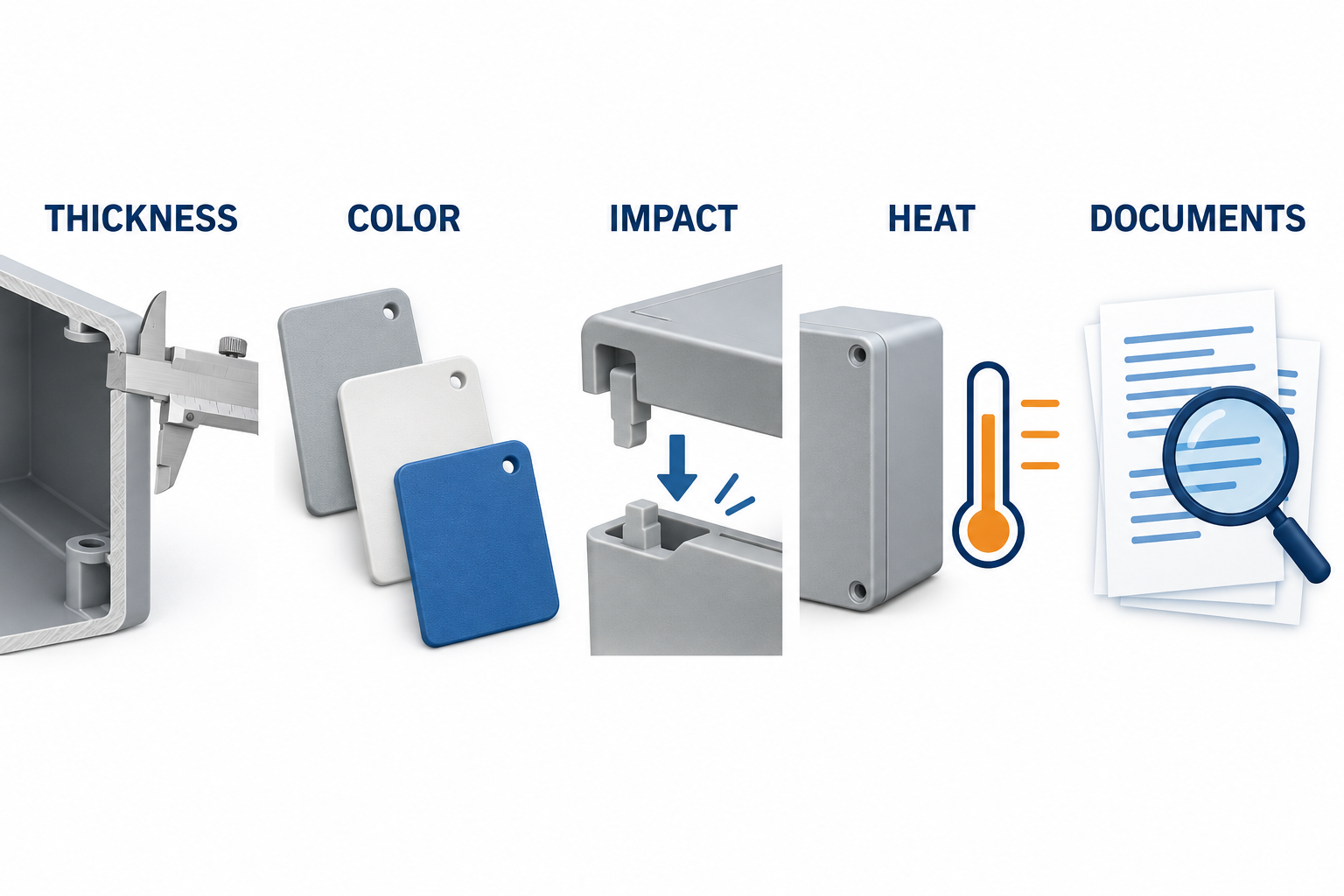
Quick answer: Before choosing a grade for a flame retardant ABS housing, check five things: the required flame rating at the relevant thickness, color coverage, mechanical performance, thermal requirements and exact material documentation. A V-0 label alone does not confirm that a thin enclosure, snap-fit lid or heated screw boss will meet its design requirements. Compare candidate grades under consistent conditions, then validate the molded part and applicable product requirements.
Choose for the Housing, Not Just the Resin Label
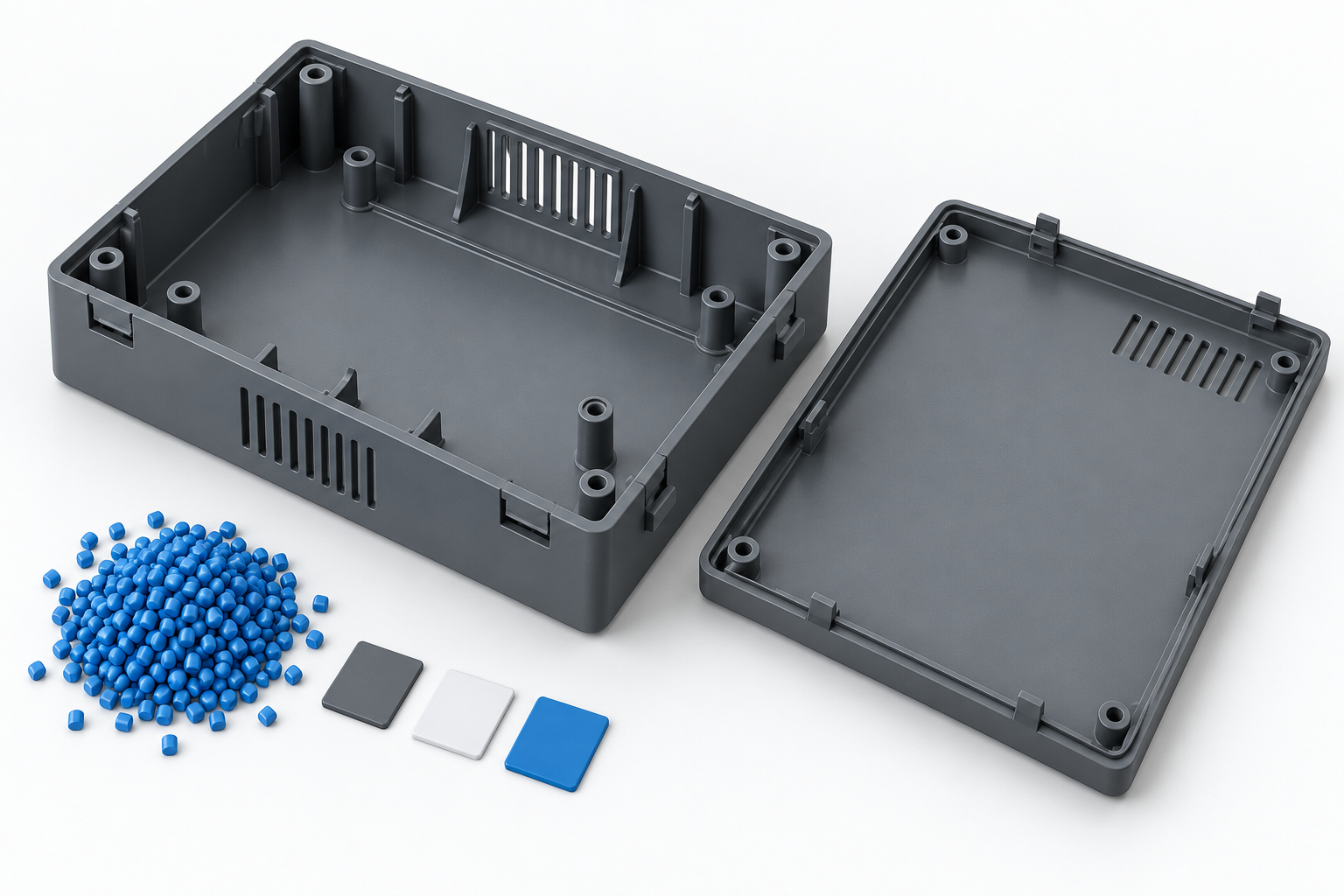
A housing protects components, holds fasteners and survives assembly before its fire performance is ever tested. The material has to work at the thin wall, around a screw boss and through the lid’s fastening features. A catalog description that says “flame-retardant ABS” leaves much of that work unspecified.
This guide focuses on injection-molded housings. It does not treat an ABS filament claim as evidence for an injection-molded part, or a PC/ABS blend as identical to ABS. Keep the resin family, grade and production route explicit throughout the comparison.
The Five Checks at a Glance
| Check | Question to resolve | Evidence to compare |
|---|---|---|
| Thickness and flame rating | Does the evidence cover the intended material thickness? | Exact-grade report or recognition information |
| Color | Is the supplied color within the documented scope? | Color designation and complete material identification |
| Mechanical performance | Will clips, bosses and the assembled enclosure function? | Comparable property data and representative part evaluation |
| Thermal requirements | Which temperature-related properties does the application require? | Relevant heat data, conditions and service evaluation |
| Documentation | Do the purchase and delivered material match the evidence? | Grade, manufacturer, current documents and batch traceability |
Use the table to organize a shortlist. It is not a requirement that every enclosure needs the same classification or test program. The product designer should identify the applicable requirements before procurement compares materials.
1. Match the Flame Rating to the Relevant Thickness
Start with the drawing and the product requirement. Identify the material thickness relevant to the required evaluation, including the areas that could become thinner after molding. Do not quote only the enclosure’s nominal wall if it hides an important local feature or tolerance.
UL’s plastics recognition program material identifies minimum thickness or thickness range and colors to be tested as relevant recognition topics. Keep those conditions attached to the material evidence rather than reporting the flame class by itself.
A supplier data sheet can make the relationship visible. The IRPC AN620 technical sheet, revision May 2021, reports flammability entries at different specimen thicknesses alongside impact and heat data. It is an example of how properties are specified, not confirmation of a current recognition entry or a recommendation for your housing.
Ask for current documentation before approving a grade. If the evidence does not clearly cover the intended condition, refer the gap to the supplier and responsible engineer. Increasing the amount of a flame-retardant additive is not a substitute for resolving what the material documentation actually supports.
For a deeper discussion of the wall-thickness problem, use the separate thin-wall flame retardant guide. This housing checklist keeps that issue connected to color, mechanical function and procurement.
2. Treat Color as Part of Material Identity
“Same grade, different color” should trigger a documentation check. Confirm whether the proposed color designation is covered by the relevant material evidence. Do not assume that a favorable result for a natural or black version automatically settles another supplied color.
Also distinguish a factory-colored compound from a processor adding a separate color concentrate. The latter introduces a material combination that should be reviewed with the supplier. Record the concentrate grade, carrier and proposed addition basis rather than describing the change only by its visual shade.
Appearance has its own acceptance criteria. A housing can meet its required flame performance while still showing unacceptable gloss, visible weld lines or color variation. Agree on the cosmetic surfaces and the reference sample before the trial, particularly where the lid and body must match.
Our practical recommendation is to approve the actual supplied material configuration. If the project will use several colors, list them in the inquiry. That gives the supplier an opportunity to identify documentation differences early instead of discovering them after tooling or purchasing decisions.
3. Check Impact, Clips and Screw Bosses
Impact data helps screen candidates, but a molded enclosure has geometry that a standard specimen does not reproduce. A thin corner, assembly clip and screw boss can each need separate attention. Define what the housing must survive during assembly, transport and normal use.
Compare technical data on a consistent basis. Note the test method, specimen condition, temperature and whether the value describes a notched or unnotched specimen. Do not rank grades by numbers with different units or test conditions as though they were one scale.
For a snap-fit lid, evaluate the actual engagement and removal sequence where the design requires it. For a screw-fastened assembly, review the fastening process and any visible cracking or stress whitening. These are application checks to agree with the designer, not universal pass limits for every ABS housing.
If a trial part breaks at a weld line, preserve the sample and review both material and molding conditions. One failed feature does not independently prove that the resin is defective. Conversely, a successful flat test plaque does not establish that the actual assembly works.
A higher-flow grade may help a particular mold fill, but the selection should remain a comparison of the complete property package. Ask which mechanical trade-offs accompany the candidate grade and confirm them in representative parts rather than selecting on flow alone.
4. Separate Heat Deflection, Thermal Aging and Service Conditions
A housing near a power component needs a clear thermal requirement. Identify the expected exposure, duration, loads and relevant locations. The surface temperature of the enclosure and the conditions at a loaded internal feature may not be the same design question.
ASTM D648 concerns deflection temperature under flexural load. A heat-deflection result describes behavior in its specified test. It should not be turned directly into a guaranteed long-term operating temperature for a loaded assembly.
UL’s thermal-aging service description addresses long-term changes and determination of RTI. This is a different evaluation from a heat-deflection test. Where RTI or other thermal credentials are required, review the relevant material evidence and property category.
Do not treat a flame classification as a thermal-service rating either. UL’s combustion test guidance describes controlled flame tests; it does not establish whether a fastened housing keeps its dimensions through the intended operating life.
If ABS candidates cannot satisfy the full requirement, discuss an alternative material with the responsible engineer. A flame-retardant PC/ABS blend may be worth investigating, but it is a material change.
5. Connect the Grade Documents to the Delivered Material
Build a small evidence package for each shortlisted grade. Include the manufacturer and full grade name, the current technical and safety data sheets, relevant recognition information and the supplied color identification. Keep the source and date with each document.
UL’s material substitution guidance describes the Yellow Card as a record of safety and performance-related properties for a polymeric material. Use the exact record and its defined scope. Do not replace that review with a generic statement that the supplier sells “UL material.”
At receipt, compare labels and delivery documents with the approved purchase description. If a distributor uses a stock code, request a traceable connection to the manufacturer’s grade. Keep material batches linked to trial results so the approved sample can be connected to production.
A certificate of analysis may help verify agreed batch characteristics, but it answers a different question from a recognition record. Likewise, a safety data sheet is not a flame-rating report. Name each document by the evidence it provides rather than treating all documents as interchangeable proof of suitability.
Choose a Supply Form That Fits Your Capabilities
If your operation mainly injection molds parts, a suitable flame retardant compound may reduce formulation work. Confirm the exact supplied grade and what its evidence covers. A general compound description does not certify every enclosure made from it.
If you develop the formulation, the flame retardant additives for ABS page provides a starting point for discussing chemistry and application requirements. Keep the full recipe, pigment system and processing route attached to the development plan. There is no universal additive dosage that turns any ABS into a qualified housing material.
A flame retardant masterbatch is another supply form, not automatic evidence for the final mixture. Confirm ABS compatibility, active content and the supplier’s intended application. Evaluate the final blend rather than transferring a claim from the concentrate into an untested formulation.
A Practical Scenario: The New Color and Thinner Lid
Consider a hypothetical enclosure project. A supplier’s original sample was accepted for an early prototype. The revised drawing then reduces the lid thickness, and purchasing requests a new color using a separate concentrate. The team describes the resin as unchanged.
That description hides two relevant changes. Before ordering production material, compare the revised thickness with the material evidence and review the colored formulation with the supplier. Repeat the necessary part checks for the actual lid, including its fastening features.
The lesson is not that the changes must fail. It is that the original approval basis may no longer describe the proposed purchase. Resolve the evidence and validation plan while the changes are still easy to review, instead of relying on the familiar grade name to carry the decision.
Our Recommendation: Send One Clear Housing Brief
Send the supplier the drawing requirements and a concise material brief. State whether you are buying ready-to-mold resin, a concentrate or an additive package. Separate mandatory acceptance requirements from preferences such as appearance or price.
| Brief item | What to include | What to ask back |
|---|---|---|
| Fire requirement | Applicable classification and relevant thickness | Exact-grade evidence and any limitations |
| Color and finish | Supplied color, cosmetic surfaces and reference | Documented color scope and trial material identity |
| Mechanical function | Clips, bosses, fastening and application loads | Comparable property data and proposed part checks |
| Temperature exposure | Location, duration, loads and specified thermal criteria | Relevant thermal evidence for the exact grade |
| Supply and changes | Form, production route and material identification | Traceability and how substitutions are reviewed |
For electrical parts, add any specified electrical or ignition requirements separately. Do not impose a single CTI or glow-wire value on all housings without checking the actual product requirement. A structured brief helps suppliers identify missing information before they suggest a grade.
Rectivas Materials works as a sourcing and technical partner. We can help coordinate candidate material information and sampling discussions. The final selection should follow the project’s documented requirements, with material recognition and finished-product acceptance kept distinct.
Frequently Asked Questions
What should I check first for a flame retardant ABS housing?
Start with the written product requirement and the housing design. Identify the relevant thickness, supplied color, mechanical functions and temperature exposure before comparing grades. Then request documents for the exact candidate material. This avoids selecting on a flame-class label alone and gives the supplier a clear basis for proposing samples, supporting evidence and the necessary application checks.
Does a V-0 resin automatically certify the finished enclosure?
No. Keep the material’s documented evidence separate from acceptance of the completed product. The enclosure has its own geometry, assembly and intended use, and the applicable evaluation may require more than a material flame classification. Ask the responsible engineer which material credentials apply and which finished-product checks remain, rather than describing a resin document as certification of every molded part.
Can I change the housing color without reviewing the material?
Review the proposed color against the exact grade’s documented scope and the supplied formulation. A separate color concentrate can introduce a carrier and other ingredients as well as pigment. Ask the supplier what evidence covers the actual combination. Also agree on cosmetic acceptance, since a color that is technically suitable may still need molding trials to achieve the required appearance.
Does higher impact strength always make a better housing?
Impact data is useful only when the methods, conditions and units are comparable. The enclosure also needs to fill, fasten and retain its dimensions. A stronger specimen result does not by itself confirm a clip or boss design. Compare the complete property package and evaluate representative molded parts against the actual assembly and use requirements before choosing the grade.
Is heat deflection temperature the continuous-use temperature?
Do not use a heat-deflection value directly as a guaranteed operating temperature for a housing. It is associated with a defined load and test procedure. Long-term exposure and the assembled part’s loads require their own evaluation. Where thermal-aging credentials are specified, check the relevant material record and conditions instead of replacing them with a short-term heat data point.
Should I choose ABS or PC/ABS for an enclosure?
Compare exact grades against the same application requirements. PC/ABS is a different material family and may offer useful candidate options, but its name does not guarantee better performance in every housing. Review fire evidence, mechanical function, thermal requirements, appearance and processing together. A switch should be treated as a material substitution with an agreed validation plan rather than an automatic upgrade.
Should I buy a compound or add a masterbatch myself?
A ready-to-mold compound can simplify material preparation where formulation resources are limited. A concentrate offers another route but requires compatibility and final-blend evaluation. Choose according to your capabilities and the evidence needed for the project. Neither purchase form automatically settles the housing’s requirements; identify the final material configuration and confirm what the supplier’s documents actually cover before production.
What should be included in the sample request?
Provide the intended grade or resin family, drawing requirements, relevant thickness, color and finish, fastening features and temperature conditions. State the required fire and other product criteria, plus the intended supply form. Ask for current documents and clearly identified sample material. Keeping this information together makes the trial more meaningful and helps connect the eventual purchase to the evaluated sample.
Final Thoughts
A reliable flame retardant ABS housing starts with a grade that matches all five checks: thickness, color, mechanical function, thermal requirements and documentation. Keep the supplied material and evaluation conditions visible throughout selection and molding trials. Rectivas Materials can help coordinate compound, additive or masterbatch sourcing discussions. The final decision should connect exact-grade evidence with the actual housing design and the product’s acceptance requirements.
— Rectivas Materials Team · Chen (老陈)