Quick answer: Importing flame retardant additives needs two document sets that people often confuse. The shipping set clears customs: commercial invoice, packing list, bill of lading, certificate of origin, and an HS code you have verified yourself. The compliance set satisfies your customer and your regulators: SDS in the destination format and language, RoHS and REACH declarations, and batch COAs. Most flame retardant powders and masterbatch pellets ship as ordinary cargo, not dangerous goods — but confirm that per product rather than assuming it, because a few chemistries do carry transport classifications.
Nearly every problem I see on the compliance side of an import comes from the same root cause: the buyer assumed the supplier knows what the destination country requires, and the supplier assumed the buyer would ask for anything unusual. Neither assumption is safe. Chinese suppliers know Chinese export requirements well; they do not automatically know that your customer’s EU importer needs a specific REACH statement, or that your customs broker will want the HS code justified. This is the checklist that closes that gap.
Set 1: Shipping Documents
| Document | Who issues it | What to check |
|---|---|---|
| Commercial invoice | Supplier | Product description matches the HS code; Incoterm stated explicitly |
| Packing list | Supplier | Net and gross weights, bag count, pallet count — must match the B/L |
| Bill of lading / air waybill | Carrier | Consignee details exactly as your customs registration reads |
| Certificate of origin | Chamber of commerce / CCPIT | Whether a preferential form (e.g. FTA certificate) applies — it can cut duty |
| Fumigation / ISPM 15 statement | Packer | Required if wooden pallets are used; plastic pallets avoid the issue |
On HS codes: verify the classification with your own broker rather than accepting the supplier’s number. Flame retardant products spread across several headings depending on chemistry and form — an inorganic mineral powder, an organic phosphorus compound and a polymer-based masterbatch pellet do not share a code. The supplier’s code reflects how they export it; your broker’s reflects how your customs authority will assess duty on it, and only the second one determines what you pay. Getting this wrong is expensive in both directions: overpaid duty you rarely recover, or an underpayment that surfaces as a penalty during a post-clearance audit.
Set 2: Compliance Documents
Q: What compliance paperwork should I require from a flame retardant supplier? SDS in your destination’s format, RoHS and REACH declarations that name the regulation version, and per-batch COAs.
- SDS in the right format and language. A 16-section GHS SDS is the baseline, but formats diverge: the EU expects REACH Annex II style, often with local-language requirements for the destination country; the US expects OSHA HazCom 2012 alignment; the UK has diverged post-Brexit. Ask specifically for the destination format — a Chinese-market SDS translated into English is not the same document.
- RoHS declaration. Should name the directive and amendment (2011/65/EU as amended by 2015/863 for the four added phthalates) and reference test evidence, ideally IEC 62321. A one-line “RoHS compliant” on letterhead is worth very little if your customer audits you.
- REACH statement. Two distinct things here that get conflated: registration status (relevant if you import a substance into the EU above threshold — note that the importer carries this obligation, not the Chinese supplier) and SVHC screening against the current candidate list. That list updates roughly twice a year, so a declaration dated three years ago is stale by definition.
- Batch COA. Covered in detail in our guide to flame retardant sample evaluation — the short version is that it must carry the actual batch number and measured values.
- Halogen content report, if your customer’s specification includes a halogen-free clause. This is a specific test with specific ppm limits, not something an SDS covers; the thresholds are explained in our article on halogen-free material specifications.
Dangerous Goods: Usually Not, But Verify
Most of what moves in this industry — mineral hydroxides, phosphinate powders, masterbatch pellets, polymeric brominated products — ships as general cargo with no dangerous goods declaration. That is the normal case and it keeps freight simple.
The exceptions matter enough to check per product rather than per supplier. Some chemistries carry transport or handling classifications — red phosphorus is the obvious one in our own range, and certain liquid phosphate esters have their own handling requirements. The authoritative answer is section 14 of the SDS, which states UN number and transport class or explicitly confirms the material is not regulated. Read that section before booking freight, particularly for air shipments where the rules are stricter and a surprise reclassification at the airport is both expensive and slow.
Packaging and Labelling
Practical details that cause real problems when they are wrong:
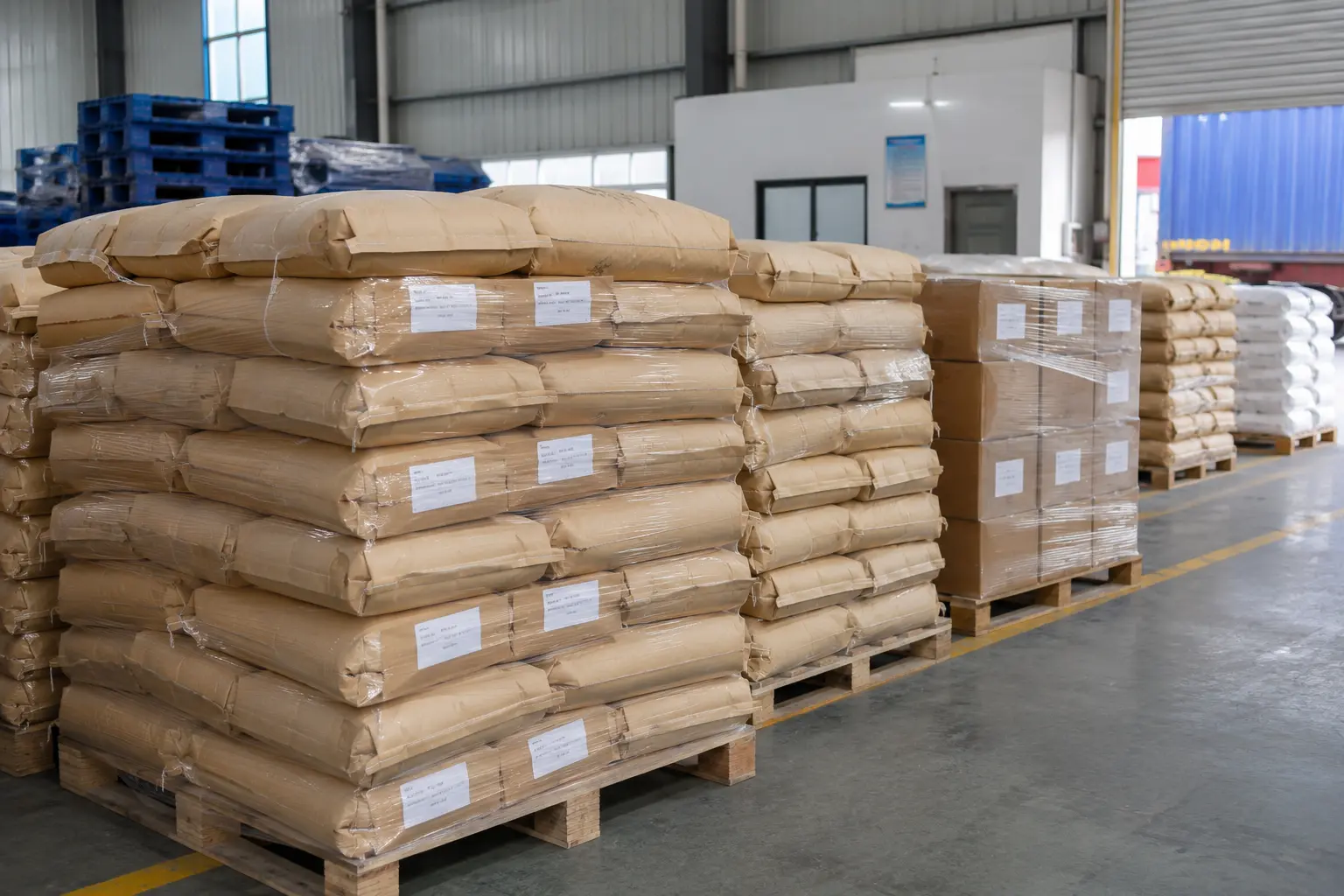
- Bag labels must match the documents. Product name, batch number, net weight and manufacturer name on the bag should correspond exactly to the invoice, packing list and COA. Customs inspectors compare these, and a mismatch turns a routine clearance into an inspection.
- Standard formats: 25 kg paper or PE-lined bags for powders, 500–1000 kg big bags for volume, 25 kg bags for masterbatch pellets. Palletized and stretch-wrapped for container shipment. Confirm pallet dimensions suit your warehouse handling equipment before shipping — a pallet that does not fit your racking is a small problem that recurs on every delivery.
- Moisture protection in transit. Sea freight through the tropics puts material through humidity and temperature cycling for weeks. For hygroscopic products, ask about moisture barrier liners and desiccant. This connects directly to processing: material that absorbs moisture in a container arrives ready to cause voids and brittleness on your line.
- GHS pictograms and hazard statements where the classification requires them, in the destination language. If a product is not classified as hazardous, the labelling burden is minimal — another reason to confirm classification early.
A Sequence That Avoids Most Problems
The ordering that works, from buyers who import this material routinely:
- Before sampling: ask for SDS and TDS. Read section 14 for transport classification and check whether the SDS format suits your destination.
- Before ordering: confirm the HS code with your broker using the actual product description; request the compliance declaration set; agree the Incoterm explicitly (FOB and CIF divide responsibility very differently when something goes wrong at the port).
- Before shipment: review a draft of the invoice and packing list against your customs registration details; confirm pallet type and whether ISPM 15 treatment applies.
- On arrival: run incoming inspection against your qualified reference values before the material enters production.
What we prepare as standard — TDS, SDS, batch COA, third-party test reports through an accredited laboratory, and export packaging — is set out on our flame retardant manufacturer page, with the document library on our downloads page. If your destination needs something beyond the standard set, tell us at RFQ stage rather than after production — send your destination country and customer requirements and we will confirm what we can issue before you commit to an order.
FAQ
Are flame retardant additives classified as dangerous goods for shipping?
Most are not. Mineral hydroxides, common phosphinate and nitrogen-based powders and masterbatch pellets typically ship as general cargo. Some chemistries do carry classifications, so check section 14 of the SDS for each specific product rather than generalising from one.
Who is responsible for REACH registration when importing into the EU?
The EU importer, not the non-EU supplier — this catches buyers out regularly. A Chinese manufacturer cannot register under REACH directly; they can appoint an Only Representative, or the importer carries the obligation themselves above the tonnage threshold. Clarify which arrangement applies before your first bulk shipment.
What is the correct HS code for flame retardant masterbatch?
It depends on the polymer carrier and composition, and it differs from the code used for raw flame retardant chemicals. Have your broker classify it from the actual product description and composition rather than reusing a code from a different product — the duty consequences are yours, not the supplier’s.
How long does a REACH SVHC declaration stay valid?
Until the candidate list next updates, which happens roughly twice a year. For ongoing supply, ask for a refreshed declaration annually or after each list update rather than filing one indefinitely — an out-of-date declaration is a common audit finding.
Final Thoughts
The single most useful thing to know here: REACH registration duty sits with the EU importer, not with your Chinese supplier. Budget for it rather than assuming it comes with the goods. We provide TDS, SDS, COA and third-party reports arranged through an accredited laboratory as standard – see the document pack – and we will tell you which documents we can issue and which you must obtain yourself. For cable compounds specifically, which reports the material can carry and which only the cable maker can issue is covered in LSZH cable compound certification requirements.
—— Rectivas Materials 团队 阿丽