Quick answer: Flame retardant masterbatch compounds are polymer-based materials used to improve the fire behaviour of plastics. The phrase often combines two different supply forms: a concentrated masterbatch that you blend with base resin, and a finished compound that you process as supplied. Their performance comes from the additive chemistry, its concentration in the final material, and the application—not from the pellet format alone.
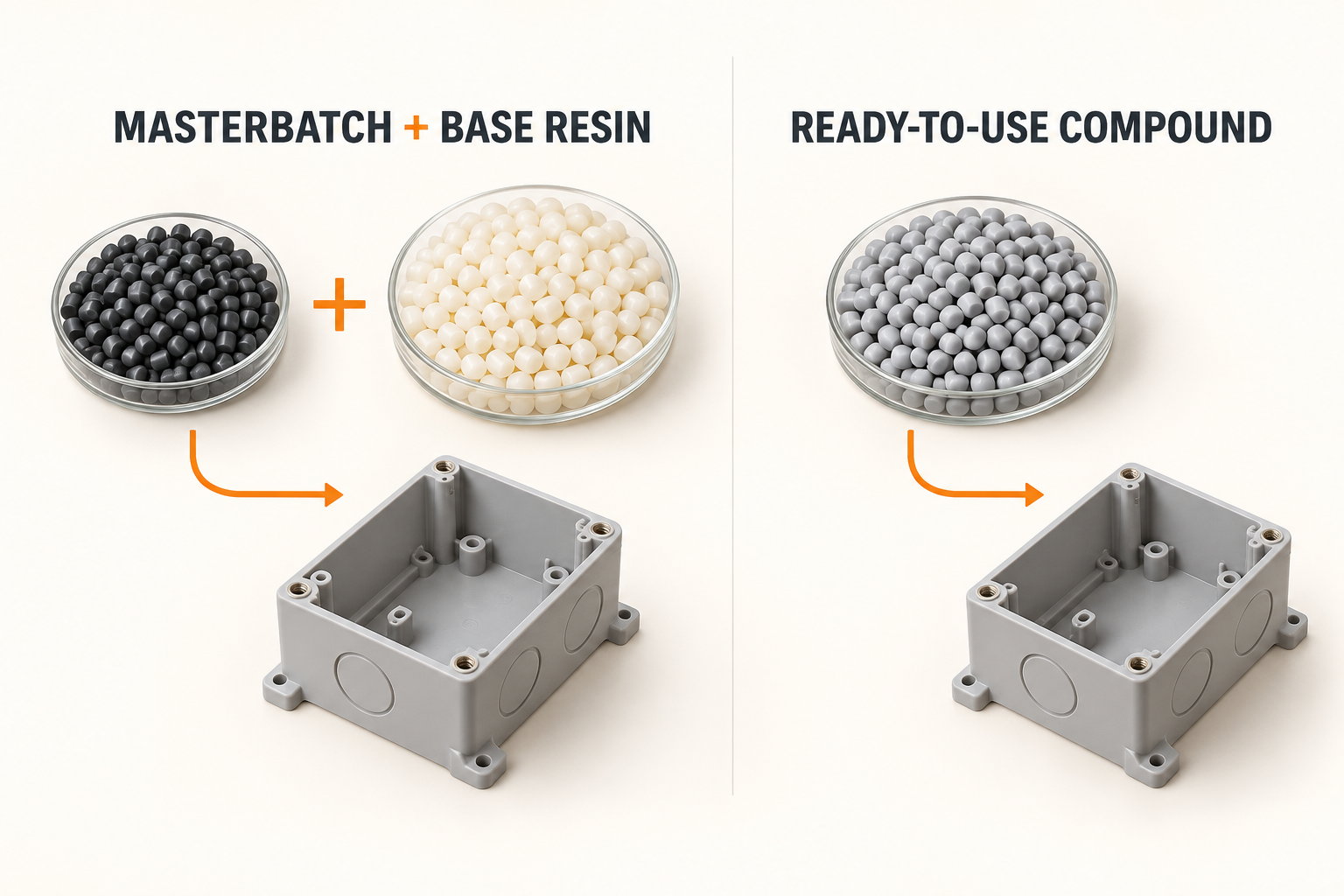
Two bags of plastic pellets can look almost identical and require completely different instructions at the hopper. One contains a flame retardant concentrate. The other contains the complete polymer formulation. If that distinction is missing from the quotation, “add flame retardant pellets” is not a usable production instruction.
This guide explains what these materials contain, how the main flame retardant systems work, and where they are used. It also separates useful material properties from claims that need evidence on the final formulation.
What Are Flame Retardant Masterbatch Compounds?
The term is used loosely in product listings and introductory articles. It does not define one chemical substance or one standard formulation. In practice, it may refer to a flame retardant concentrate, a ready-to-use flame retardant plastic, or the family of pelletised materials used to introduce flame retardancy.
A masterbatch contains additives dispersed in a carrier polymer. It is normally designed for addition to another resin at a specified let-down ratio. A finished compound already contains the base polymer and its formulated additive package, and is normally processed without further dilution. Confirm which meaning the supplier intends before comparing products.
The distinction is also visible in the LEHVOSS flame retardant product brochure, which presents masterbatch solutions and directly usable PP compounds separately. It is a distinction in how the material is supplied and used, rather than a judgement about which format is inherently more effective.
| Point to clarify | Flame retardant masterbatch | Finished flame retardant compound |
|---|---|---|
| Purpose | Delivers a concentrated additive package into a compatible base resin | Delivers a complete material formulation for processing |
| Before moulding or extrusion | Blend and meter at the supplier’s specified ratio | Follow grade-specific drying and processing instructions |
| Important specification | Carrier, compatible resin, active package and let-down ratio | Polymer grade, reinforcement, colour and final property profile |
| Evidence to request | Results for the specified masterbatch/base-resin combination | Results for the exact supplied compound grade |
For available concentrate formats, start with the flame retardant masterbatch range. If you need a complete formulation rather than a dosing ingredient, the relevant supply route is finished flame retardant compound.
What Is Inside the Pellets?
In a masterbatch, the carrier gives the additive package a pellet form and helps introduce it into the melt. The flame retardant package does the main work during fire exposure. Depending on the grade, the formulation may also contain dispersing aids, stabilisers or synergists that support processing and performance.
The carrier remains in the finished plastic. It is not packaging that disappears during melting. Its compatibility and proportion can therefore affect flow, stiffness, impact resistance and appearance. A PP carrier and a PE carrier are not interchangeable descriptions just because both arrive as small pellets.
The additive package may be one active ingredient or several ingredients designed to work together. “Active content” should identify what is being measured: a single flame retardant, a complete synergistic package, or another specified fraction. Those quantities are not automatically comparable across suppliers.
A finished compound has a broader formulation. Alongside the flame retardant system, it can contain reinforcement, impact modifiers, pigments and other ingredients required for the intended part. This is why the resin name alone—such as FR-PP or FR-ABS—does not fully describe the material you will receive.
How Do They Slow Burning?
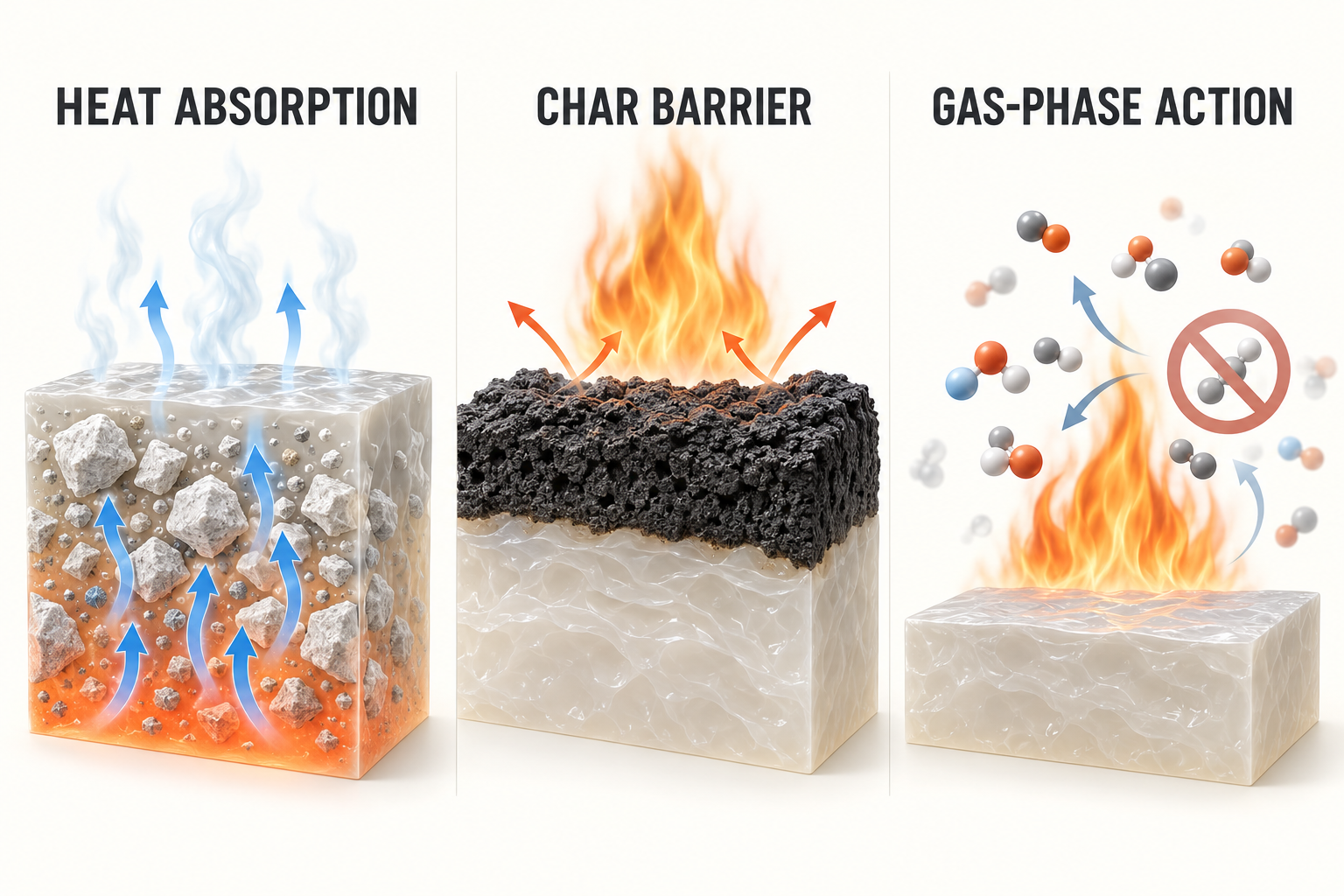
Flame retardants intervene in the processes that sustain combustion. Different chemistries act in the solid material, in the flame above it, or in both places. The pellet shape is a delivery format; it does not determine the mechanism.
Heat absorption and water release
Mineral flame retardants such as aluminium hydroxide and magnesium hydroxide undergo endothermic decomposition. The reaction absorbs heat and releases water vapour; the mineral residue can also contribute to protection. Pinfa’s transportation materials brochure describes this mechanism and notes that mineral systems can require comparatively high loadings.
The practical constraint is temperature. An additive must tolerate manufacture of the plastic and become useful during fire exposure. A mineral system that suits one processing window may not suit another. “Mineral” is a chemistry family, not a universal processing recommendation.
Protective char formation
Some systems encourage a protective surface residue. Intumescent formulations expand to create a char barrier that reduces heat transfer and limits the supply of combustible decomposition products to the flame. The ingredients must form a functioning package within the chosen polymer.
For example, Clariant describes Exolit AP 766 as a phosphorus–nitrogen intumescent system for polyolefins. Its protective effect comes from the char formed during exposure. That example explains a mechanism; it is not a formula that can be copied into every PP grade.
Interruption of flame chemistry
Gas-phase systems interfere with the chemical reactions that sustain a flame. Brominated systems commonly use this route, while some phosphorus-based systems also contribute gas-phase action. The balance between gas-phase and solid-phase activity depends on the chemistry and polymer combination, as outlined in Clariant’s engineering-plastics flame retardant overview.
Do not infer smoke performance from this mechanism alone. Suppressing visible flaming, limiting smoke, and reducing corrosive combustion products are different objectives and require the relevant evidence.
Main Types of Flame Retardant Systems
There are two useful ways to describe these materials: by the additive chemistry and by the polymer they are intended to modify. Keep both descriptions. “Halogen-free” tells you something about composition, but it does not tell you whether the material will run in your resin or meet your part specification.
| System family | Examples or description | What needs checking |
|---|---|---|
| Mineral | Aluminium hydroxide, magnesium hydroxide | Thermal window, final loading, flow and mechanical properties |
| Phosphorus–nitrogen intumescent | Packages designed to build an expanded protective char | Polymer compatibility, moisture sensitivity and char effectiveness |
| Other phosphorus or nitrogen systems | Phosphinates, selected melamine derivatives and combined packages | Exact chemistry, reinforcement effects and processing stability |
| Halogenated packages | Brominated flame retardants, sometimes with synergists | Substance identity, application restrictions and required declarations |
This is an orientation table, not a substitution chart. Ingredients within one family may have very different thermal stability, particle size and behaviour in a polymer. A nitrogen-containing additive for unreinforced nylon, for instance, cannot be assumed to give the same result in a glass-filled formulation.
For the concentrate supply route, halogen-free flame retardant masterbatch is a relevant starting point when the specification calls for that chemistry direction. Ask for the exact composition definition and supporting documentation rather than treating the label as a complete specification.
Where Are These Materials Used?
Electrical and electronic components
Housings, connectors, clips and other components may require a defined flammability classification alongside electrical, thermal and mechanical properties. A material that extinguishes well but becomes too brittle for a snap-fit is not a successful replacement. Thin sections, pigmentation and reinforcement need to be included in the material assessment.
Wire and cable materials
Flame retardant systems are used in insulation and sheathing formulations. Low-smoke zero-halogen applications add requirements beyond resistance to flame spread. Cable construction matters as well as the polymer: a compound report does not replace testing of the required cable assembly. Mineral systems are one established route, but the full formulation must retain the specified flexibility and processing behaviour.
Profiles, sheets and construction products
Extruded profiles, protective sheets and other plastic construction products can use flame retardant formulations. Their fire requirements come from the application and installation. A small-scale plastics rating does not automatically qualify a wall covering, panel or installed building product.
Transport and industrial parts
Interior components, equipment covers and related parts can have combined demands for flame behaviour, smoke, durability and mechanical performance. The polymer and required test programme should be identified before deciding on a concentrate or finished compound. An application category is a reason to investigate a material, not evidence that it is approved.
Benefits and Performance Limits
Masterbatch makes a powder-based additive package easier to handle and meter as pellets, while retaining the ability to use a chosen base resin. It can reduce direct powder handling. That benefit does not remove the need to follow the SDS or manage dust from pellet attrition.
A finished compound simplifies formulation control at the converter because the ingredients arrive together. It can be useful when reinforcement, colour and mechanical targets must be maintained as one material specification. Its advantage depends on the supplied grade and process, rather than on a universal loading threshold.
Both routes involve trade-offs. Added ingredients can change melt flow, density, impact strength, elongation, surface finish or colour. Some formulations have a narrower processing window or need controlled drying. These effects should be measured on representative parts, including the features that matter in service.
The cheapest bag is therefore not always the lowest-cost acceptable part. For masterbatch, include base resin, concentrate, drying, dosing and reject costs. For finished compound, compare the complete material cost against its processing and qualification requirements. Use equivalent performance targets on both sides.
Why Dosage and Test Conditions Matter
Adding a flame retardant masterbatch is a formulation change. The final additive fraction depends on its active content and the amount added; it is not equal to the masterbatch addition percentage.
Illustrative calculation, not a dosing recommendation: suppose a masterbatch contains 50% of a defined active package and makes up 20% of the final blend by mass. The final blend contains 10% of that package: 0.50 × 0.20 = 0.10. Its remaining composition includes the carrier and base resin. This calculation cannot predict a fire rating.
If “20% addition” instead means 20 kg added to 100 kg of base resin, the denominator changes. The blend weighs 120 kg and contains 10 kg of the package, giving about 8.3% active package in the final blend. Clarify whether instructions refer to the final blend or to the base-resin weight.
Fire test results also have boundaries. UL’s plastics combustion testing overview describes different small-scale test classifications. A quoted UL 94 result needs its material identity, specimen thickness and other applicable conditions. A rating on a supplier’s formulation does not automatically transfer to your blend after dilution, recolouring or a resin change.
The oxygen index method described in ISO 4589-2 determines the minimum oxygen fraction that supports combustion under specified conditions. LOI cannot be converted directly into a UL 94 classification. Similarly, “halogen-free” is not proof of low smoke or unrestricted use. Request the appropriate reports for each requirement rather than asking one result to stand in for all of them.
A Practical Way to Use This Information
If you are learning the category, first identify the supply form, polymer family and intended application. Those three details make a product description meaningful. Avoid starting with a generic promise such as “V-0 pellets” without knowing how the pellets were evaluated.
If you already have an approved base resin and suitable blending equipment, a concentrate may be worth evaluating. If you need one material feed with a complete mechanical and fire-performance specification, examine the finished compound route. Neither decision should be made from pellet appearance.
For example, in a hypothetical enclosure trial, changing to a different base resin after the first successful burn test means changing the formulation under assessment. Record that change and repeat the relevant checks. Keeping the same masterbatch dosage does not establish that the replacement blend behaves identically.
Before requesting a sample, send the resin grade, process, minimum section thickness, target test, colour and essential mechanical properties. Specify any limits on halogens, smoke or restricted substances. Rectivas can use those details to coordinate sourcing and sample discussions with the relevant factory.
When you move from understanding the category to comparing concentrate grades, the existing flame retardant masterbatch selection guide covers carrier, active content, process matching and verification in more detail.
FAQ
Are flame retardant masterbatch and compound the same?
Usually they describe different supply forms. Masterbatch is a concentrated additive package intended for blending with a compatible base resin. A finished compound contains the complete formulation and is normally processed as supplied. Product listings sometimes use the terms loosely, so ask for written dilution and processing instructions. The product name alone is not enough to identify the material.
Are all flame retardant masterbatch compounds halogen-free?
No. The category includes halogenated and non-halogenated systems, and a pellet format does not reveal which chemistry is present. If halogen content is a purchasing requirement, state the applicable definition and request supporting information for the exact grade. Also check the carrier, pigments and other ingredients. A halogen-free claim does not automatically establish low smoke or suitability for every application.
Will adding more masterbatch guarantee a better fire rating?
No. Increasing addition changes both the additive fraction and the carrier fraction in the finished material. It may affect melt behaviour, mechanical properties and how the formulation burns. Follow the recommended trial range for the specific resin and application, then evaluate the resulting material. Dosage arithmetic tells you composition; it cannot determine a classification or replace a test.
Can the same grade be used in PP, PE and ABS?
Only when the supplier has specified and supported those combinations. Polymer compatibility, processing temperature and the required additive chemistry differ. Even a broadly compatible carrier does not make the whole flame retardant package universal. Request evidence for your resin grade, process and thickness rather than assuming that success in one polymer transfers to another. Colour and reinforcement changes also deserve review.
What information should be included in a sample request?
Include the base resin or required compound polymer, production process, minimum part thickness, colour and target fire test. Add the mechanical properties that cannot change and any smoke, halogen or substance restrictions. Ask whether the sample is a concentrate or a finished formulation, and request its processing instructions. This gives the supplier a useful technical brief instead of an ambiguous request for flame retardant pellets.
Can I compare masterbatch and compound prices per kilogram?
You can record those prices, but they represent different quantities of usable formulation. Masterbatch must be combined with base resin at the specified ratio; compound is normally bought as the complete material. Compare the cost of an acceptable finished part, including dosing, drying, scrap and qualification. Keep the required properties and test conditions equivalent so the price comparison answers the production question.
Which documents should I request before a production order?
Start with a TDS, SDS and clear processing instructions for the exact grade. Request relevant test reports, lot identification and the agreed certificate-of-analysis items. For concentrate, the evidence should identify the tested base resin and addition ratio. Where formal recognition is required, verify its scope separately. A general brochure, sample photograph or supplier declaration does not replace grade-specific supporting evidence.
Can Rectivas help source a suitable material?
Yes. Rectivas works as a sourcing and technical coordination partner and can discuss concentrate or finished-compound options with the factories involved. Send the application brief and required documentation with your enquiry. Sample availability, trial quantity, minimum order and lead time need confirmation for the proposed grade. Qualification remains tied to your specified formulation, processing conditions and relevant test requirements.
Final Thoughts
Flame retardant masterbatch compounds are useful only when the description connects chemistry, supply form and application. Establish whether you need a concentrate or a complete formulation, then assess the final material against its fire and mechanical requirements. Send your resin, process, thickness and target test when asking Rectivas about a sample. Those details help turn a broad material category into a practical sourcing discussion.
— Rectivas Materials technical content team