Quick answer: Flame retardants can reduce a plastic’s toughness when particles, poor interfaces, excessive loading or processing damage make cracks easier to start and spread. The effect is formulation dependent: stiffness may rise while impact resistance falls, and some systems retain useful strength. To improve flame retardant mechanical properties, compare matched specimens, identify the failure mechanism and retest both fire performance and the properties your part needs.
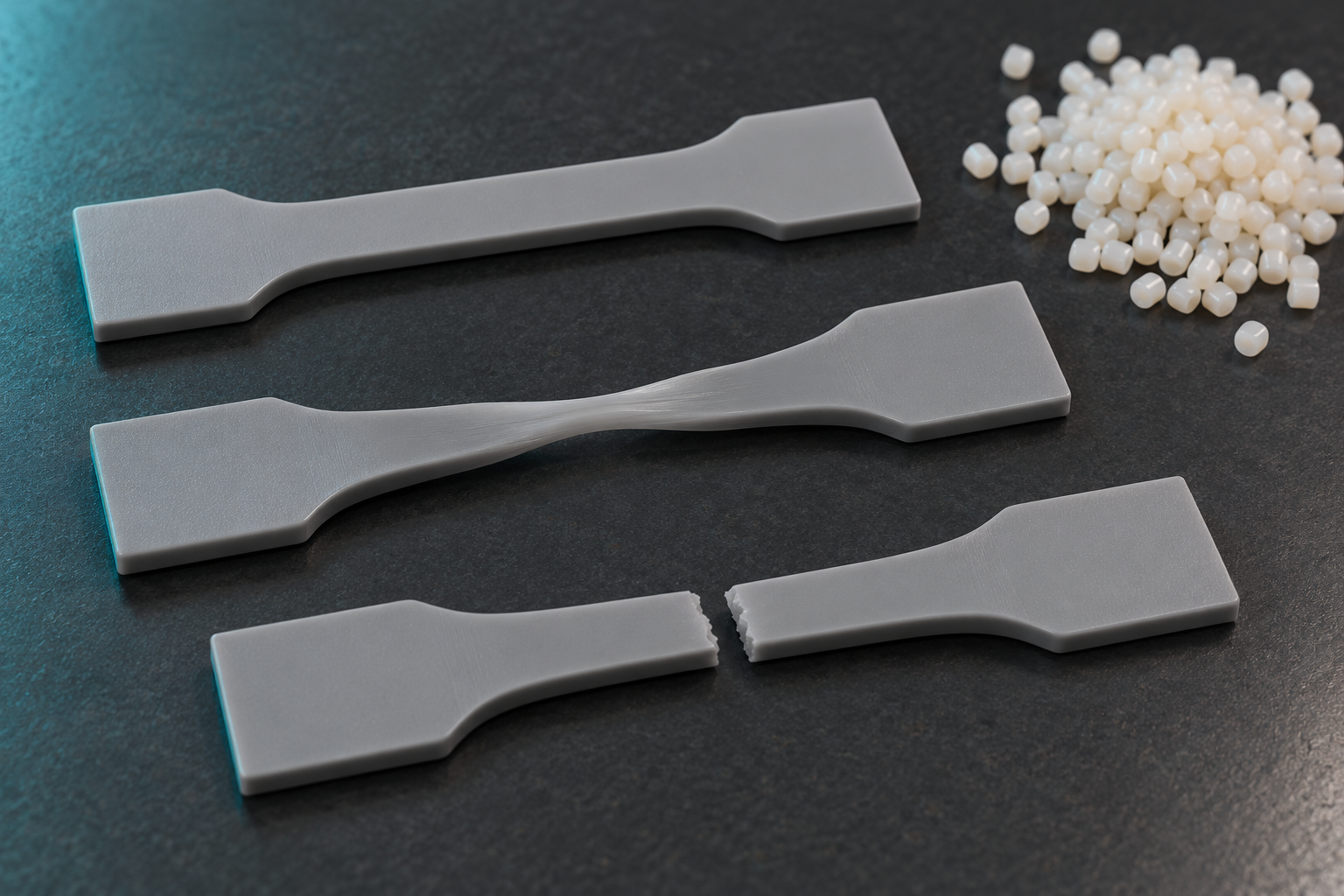
A plastic enclosure passes a flame test, but its clips break during assembly. A cable compound looks stiffer on the data sheet, yet its elongation has fallen. Both situations deserve attention before the next material order.
The useful question is which property changed, under what conditions, and why. “Make it stronger” is too vague for a supplier to act on. This guide focuses on mechanical performance after formulation and processing, rather than treating a fire rating as a complete material specification.
Strength, Stiffness and Toughness Are Different
Tensile strength describes resistance to tensile stress. Modulus describes stiffness in the measured strain range. Elongation at break describes how far a specimen stretches before rupture. Impact resistance concerns the energy absorbed in a particular impact test. These measurements answer different questions.
A rigid, filled plastic can resist small deflections well and still fracture at a notch. A flexible material can stretch extensively without having high tensile strength. Neither observation is contradictory. For a snap fit, impact and strain capacity may matter more than a modest gain in modulus.
| Property | What it helps assess | What it cannot establish alone |
|---|---|---|
| Tensile strength | Stress capacity in the specified tensile test | Drop resistance or repeated clip assembly |
| Tensile or flexural modulus | Resistance to elastic deformation | Resistance to brittle fracture |
| Elongation at break | Strain capacity under the stated conditions | Long-term creep or an assembled part’s durability |
| Notched impact resistance | Response to rapid loading with a defined notch | All impact geometries and service temperatures |
| UL 94 classification | Small-scale burning behavior in the relevant test | Any of the mechanical properties above |
ASTM distinguishes these tests explicitly: D638 addresses tensile properties, while D256 addresses Izod pendulum impact resistance. UL’s UL 94 test overview describes burning, afterglow and dripping evaluations. A V-0 result provides no substitute for a mechanical test.
Why Flame Retardants Can Make Plastics Brittle
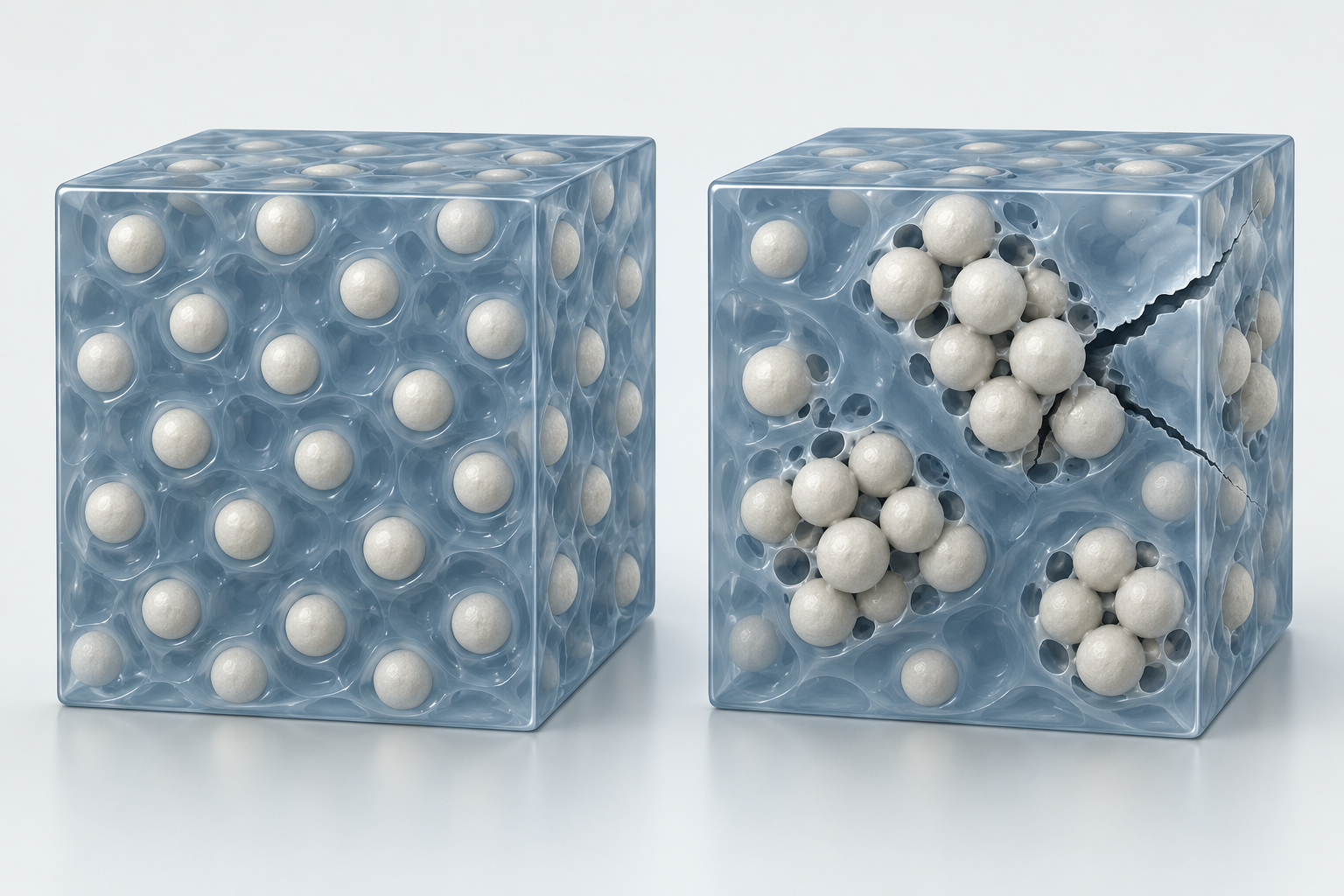
Particle loading changes the material carrying the load. Many flame retardants introduce a separate solid phase into the polymer. As loading increases, the matrix and its interfaces must accommodate more particles. Depending on particle shape, concentration and adhesion, stiffness can increase while ductility or impact resistance decreases. There is no universal loading threshold that applies across polymers and flame-retardant families.
Agglomerates can become local defects. A cluster is mechanically different from the same quantity of well-distributed particles. Large clusters, voids and poorly wetted regions can concentrate stress. A fracture surface may suggest these problems, but visual inspection alone cannot prove the complete cause. Compare formulation records and microscopy with mechanical results.
The interface controls stress transfer. A particle that separates from the matrix under load can leave a cavity and help a crack develop. Appropriate surface treatment or a compatible coupling strategy may help. The choice depends on the filler and polymer. A coating that works in one resin does not automatically work in another.
The additive can change the polymer phase. Some additives affect crystallization, mobility or plasticization. Others are unsuitable for the processing temperature or can interact with the formulation. A property change therefore needs a material-specific explanation rather than an assumption that every flame retardant behaves like a rigid mineral filler.
The Chemistry Label Does Not Predict the Result
“Halogen-free” identifies a compositional requirement, not a guaranteed mechanical outcome. Mineral hydroxides, phosphorus–nitrogen blends and other systems differ in chemistry and required formulation. Brominated systems also vary. Comparing two labels without matching the resin, reinforcement and fire target hides the variables that determine performance.
For example, a 2024 study of polypropylene composites examined intumescent flame retardants with additional formulation components and reported changes in both fire and mechanical behavior. Its value here is the demonstrated interaction between ingredients, not a universal recipe for PP.
Similarly, Clariant’s Exolit OP 1260 guidance makes dosage dependent on polymer grade, processing and glass reinforcement, and emphasizes homogeneous dispersion. That is guidance for a particular commercial system, not evidence that another supplier’s powder has identical performance.
When evaluating flame retardant additives, ask for a recommendation tied to your exact base polymer and test target. A familiar chemical name is only the start of the selection.
Check Processing Before Replacing the Formulation
A brittle part does not establish that the flame-retardant chemistry is wrong. Excessive thermal history, contamination, inappropriate drying or poor molding conditions may produce a similar symptom. Hydrolysis is particularly relevant to moisture-sensitive polymers processed under unsuitable conditions. Do not apply that explanation automatically to every resin.
Record actual melt temperature where practical, residence time, drying conditions and regrind history. Barrel setpoints alone do not describe the material’s thermal history. Check whether the first acceptable parts and later brittle parts came from the same batch and comparable operating conditions.
Then examine the fracture location. Repeated failure at a weld line, sharp corner or screw boss points to a local issue that standard test bars may not reproduce. Failures spread across several geometries justify broader investigation into the compound, processing or contamination.
For concentrates, verify both dosing and carrier compatibility. A flame retardant masterbatch introduces carrier polymer as well as active ingredients. A low addition rate does not make a carrier mismatch irrelevant. Conversely, changing to a concentrate does not automatically improve the final part’s toughness.
A Practical Investigation of a Broken Clip
Consider this hypothetical troubleshooting exercise, not a Rectivas customer case. An injection molder trials a flame-retardant PP enclosure on Monday. During the first assembly check, two of ten clips crack at their roots. An older non-FR version assembled successfully. The first proposal is to cut the flame-retardant dose.
That comparison has too many open variables. The engineer first records the PP grade, total formulation, actual dosing and molding settings. Next, the team compares the same base resin with and without the FR package using matched preparation. It also checks whether the clip geometry or gate location changed.
If test bars retain acceptable impact performance but clips still fail at one weld line, investigate the molding and geometry. If matched bars also lose substantial ductility, investigate the formulation and processing history. Either finding is useful. Neither justifies shipping a lower-dose formulation before its fire performance has been checked.
The ten-part observation identifies a problem; it is not a statistically established failure rate. A production acceptance plan needs appropriate sampling and defined pass criteria.
How to Compare Mechanical Test Data Fairly
Start with the same base resin grade, then account for every ingredient in the final compound. Compare conditioned specimens made by the same process, with matching dimensions, test methods, speeds and temperature. ASTM D638 specifically identifies preparation, test speed and environment as factors affecting tensile results.
Keep notched and unnotched impact results separate. Confirm whether the method is Izod or Charpy and check the units before comparing numbers. ASTM D256 and ISO 180 should not be assumed interchangeable. A supplier’s room-temperature value also does not establish cold-service performance.
A useful calculation is property retention (%) = candidate value ÷ reference value × 100. As an arithmetic example only, 12 kJ/m² divided by 20 kJ/m² gives 60% retention. Those figures are invented to explain the calculation, not typical performance or a product specification. Use the formula only for results with matching methods and units and a nonzero reference.
Retention also needs an absolute requirement. A large percentage loss may still leave adequate performance, while a small loss can push a marginal design below its minimum. Include variation between specimens and batches rather than qualifying the material from one favorable result.
Which Change Should You Trial First?
Use the observed failure to select a controlled trial. Keep the rest of the formulation and processing as stable as possible. Otherwise, an improved result cannot tell you which change helped or whether it will survive production variation.
| Observed problem | First comparison | What to verify after a change |
|---|---|---|
| Higher modulus, lower elongation | Matched resin and loading series | Required strain capacity and fire target together |
| Scattered brittle failures | Dispersion, dosing consistency and contamination | Repeatability across specimens and batches |
| Failure at one weld line | Gate, flow path and molding conditions | Actual part performance at the critical location |
| Properties drift during a run | Residence time, moisture and material feed history | Start, steady-state and restart samples |
| Toughener improves impact | A controlled modifier series | Flammability, stiffness, flow and heat requirements |
Surface treatment, coupling agents or impact modifiers may help a suitable system, but they are formulation changes with tradeoffs. More mixing can improve dispersion yet also increase thermal exposure or damage reinforcement. The answer is a controlled process window, not maximum shear.
If you are considering an FR-PP, FR-ABS or another flame retardant compound, request grade-specific mechanical data and its test conditions. A grade name alone does not establish clip durability, a certified fire classification or suitability for your application.
Our Recommendation Before You Order
For compounders, define the fire target and the mechanical minimums before screening additive packages. For molders, request a sample of the complete proposed material and test the critical part feature. For procurement, compare the cost of accepted parts, including breakage and requalification, rather than powder price alone.
Send the resin grade, complete dosing basis, minimum wall thickness, color, processing conditions and failure photographs with the inquiry. Include test reports where available. The existing guide to choosing flame retardants for plastics covers broader selection; this investigation focuses on the mechanical limits that a fire rating cannot answer.
Frequently Asked Questions
Do flame retardants always reduce plastic strength?
No. The outcome depends on the resin, additive chemistry, loading, interfaces and processing. A formulation may retain tensile strength while losing elongation, or gain stiffness while losing impact resistance. Some combinations can improve selected properties. Ask which property was measured and compare matched test conditions before concluding that the material has become stronger or weaker overall.
Why can stiffness increase while impact resistance falls?
Rigid particles can restrict deformation at small strains, increasing modulus. Under rapid loading, poorly bonded interfaces or clusters can instead help cracks initiate and propagate. These effects concern different stages of deformation, so they can occur together. Check the specific impact method, notch condition and temperature. A higher modulus by itself does not establish a tougher or more durable part.
Does UL 94 V-0 guarantee good mechanical properties?
No. V-0 describes performance in the applicable vertical burning test, including burning behavior and dripping criteria. It does not specify tensile strength, impact resistance or snap-fit durability. Specify those requirements separately. Verify the fire evidence for the relevant material conditions, then evaluate mechanical performance using appropriate specimens and the actual part geometry where the application requires it.
Can lowering the flame retardant dose restore toughness?
It may help when loading contributes to the problem, but it can also compromise the required fire performance. First check actual dosing, dispersion, resin compatibility and processing history. Trial any reduced loading as a new formulation, then repeat the relevant mechanical and fire evaluations. A satisfactory hand-bend test does not qualify a lower-dose material for its intended application.
What should a supplier provide for a material comparison?
Request the exact grade designation, current technical data sheet, mechanical test methods, specimen details and conditioning information. Ask what fire evidence applies to the proposed grade and thickness, and whether the supplied color is covered. Separate typical published values from contractual acceptance limits. Missing information should be clarified before sample approval rather than filled with assumptions from a similar grade.
Is masterbatch or ready-made compound better for toughness?
Neither supply form guarantees better toughness. A masterbatch needs a suitable carrier, controlled dilution and adequate distribution in the final resin. A ready-made compound simplifies the material feed but still needs application validation. Compare the final molded or extruded material, including its mechanical variability, fire evidence and processing behavior. Choose the supply form that fits your equipment and control capability.
What affects the price of a tougher flame-retardant material?
Base resin selection, additive efficiency, surface treatment, compatibilization, impact modification and required documentation can all affect the quotation. Lower breakage may justify a higher material price, but that benefit needs production evidence. Give suppliers the same mechanical minimums and fire target when comparing offers. There is no meaningful universal price premium for a material described only as tougher.
Can Rectivas arrange samples and mechanical evaluation?
Rectivas acts as a sourcing and technical partner. Share the resin, application, fire target and mechanical acceptance criteria so suitable factory options can be discussed. Sample availability, minimum order quantity, lead time and testing scope need confirmation for the specific material. Where testing is required, agree on the laboratory, methods and reporting scope before treating the evaluation as qualification evidence.
Final Thoughts
Good flame retardant mechanical properties come from a balanced formulation and controlled processing, verified against the part’s real requirements. Identify whether the problem is stiffness, strength, strain capacity or impact resistance before changing the material. Rectivas can help discuss additive, masterbatch and compound options with partner factories. Bring the fire target and mechanical limits together so the next sample answers a clear question.
— Rectivas Materials Team, Chen