Quick answer: Flame retardants can change melt flow through particle loading, polymer compatibility and interactions within the formulation. Some compounds become harder to fill, while others flow more readily. A melt flow index alone cannot predict mold filling or UL 94 performance. Check the complete material, test conditions and machine behavior before changing the dose, raising temperatures or buying a higher-flow grade.
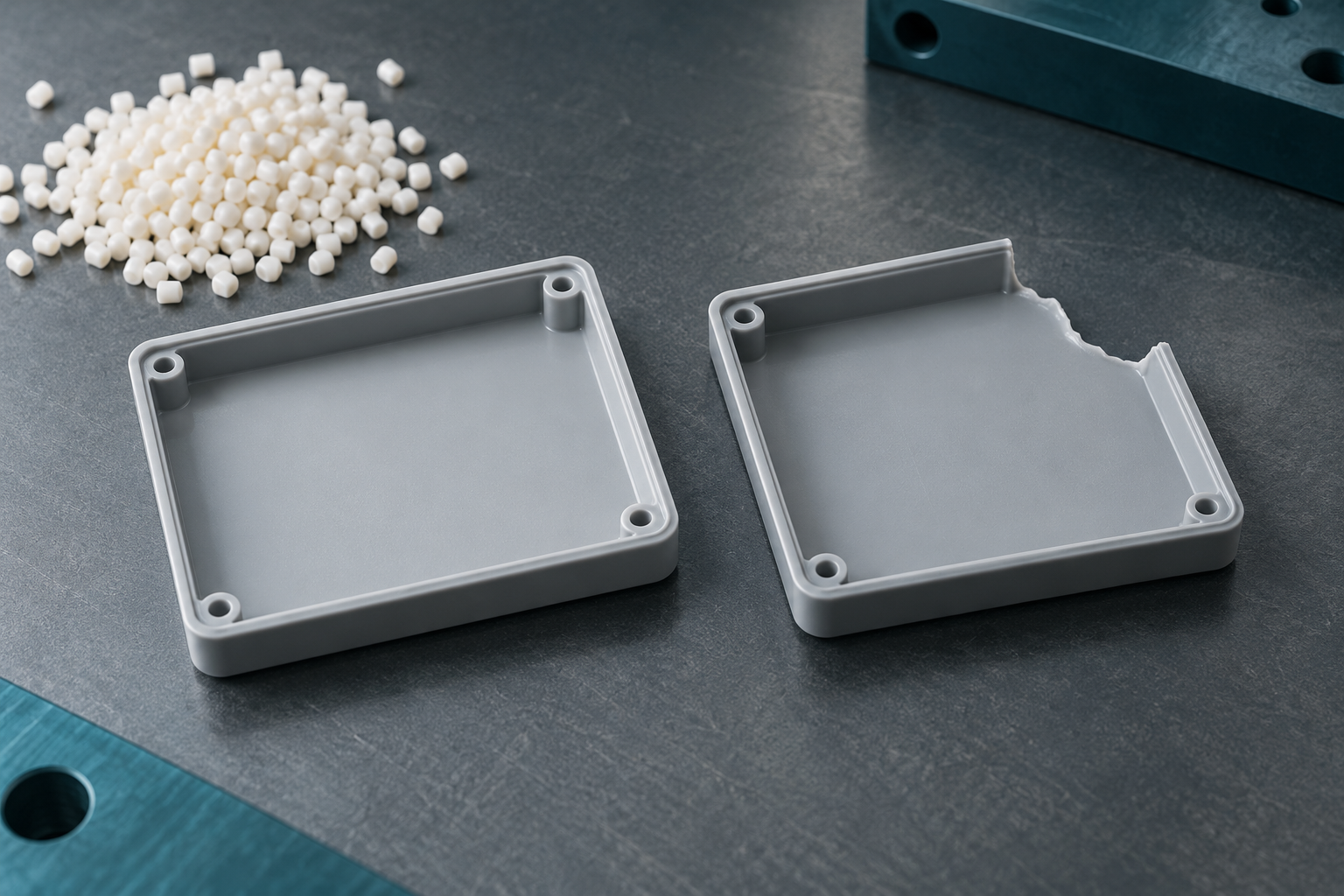
The mold ran acceptably with the original resin. After an FR material change, the far corner stops filling and injection pressure rises. It is tempting to ask for a powder that “does not affect flow.” That request skips the information needed to solve the problem.
Start by identifying what changed: the final formulation, the measured flow result, the thermal history or the filling process. This article explains flame retardant melt flow as a practical material-selection and troubleshooting issue. The aim is a repeatable production window, with fire and mechanical requirements still satisfied.
What MFI, MFR and MVR Actually Tell You
Melt flow index, or MFI, is a common commercial term. Melt mass-flow rate, MFR, reports extruded mass in grams per ten minutes under specified conditions. Melt volume-flow rate, MVR, reports volume in cubic centimeters per ten minutes. The temperature and applied load belong with the result.
ISO 1133-1:2022 describes mass and displacement procedures under defined temperature and load. These are primarily quality-control measurements. When a supplier sends “MFI 15” without units, conditions or method, the number is incomplete.
Within a suitable, comparable material family, a higher MFR can indicate easier flow under that test condition. It does not establish lower viscosity at every shear rate, better filling of every mold or equivalent mechanical properties. Comparing different resin families or filled and unfilled grades requires more care.
| Information | Record with the result | Why it matters |
|---|---|---|
| MFR or MVR | Mass or volume, with units | The values describe different quantities |
| Temperature and load | Both specified test conditions | Different conditions invalidate a direct ranking |
| Method and preparation | Standard, procedure, drying and preheating | Handling and test history can change the result |
| Material identity | Final compound, color and reinforcement | Base resin data do not describe every finished formulation |
| Application evidence | Pressure, fill time and part quality in a defined trial | A flow number cannot qualify the production process alone |
Why a Flow Number Cannot Predict Mold Filling
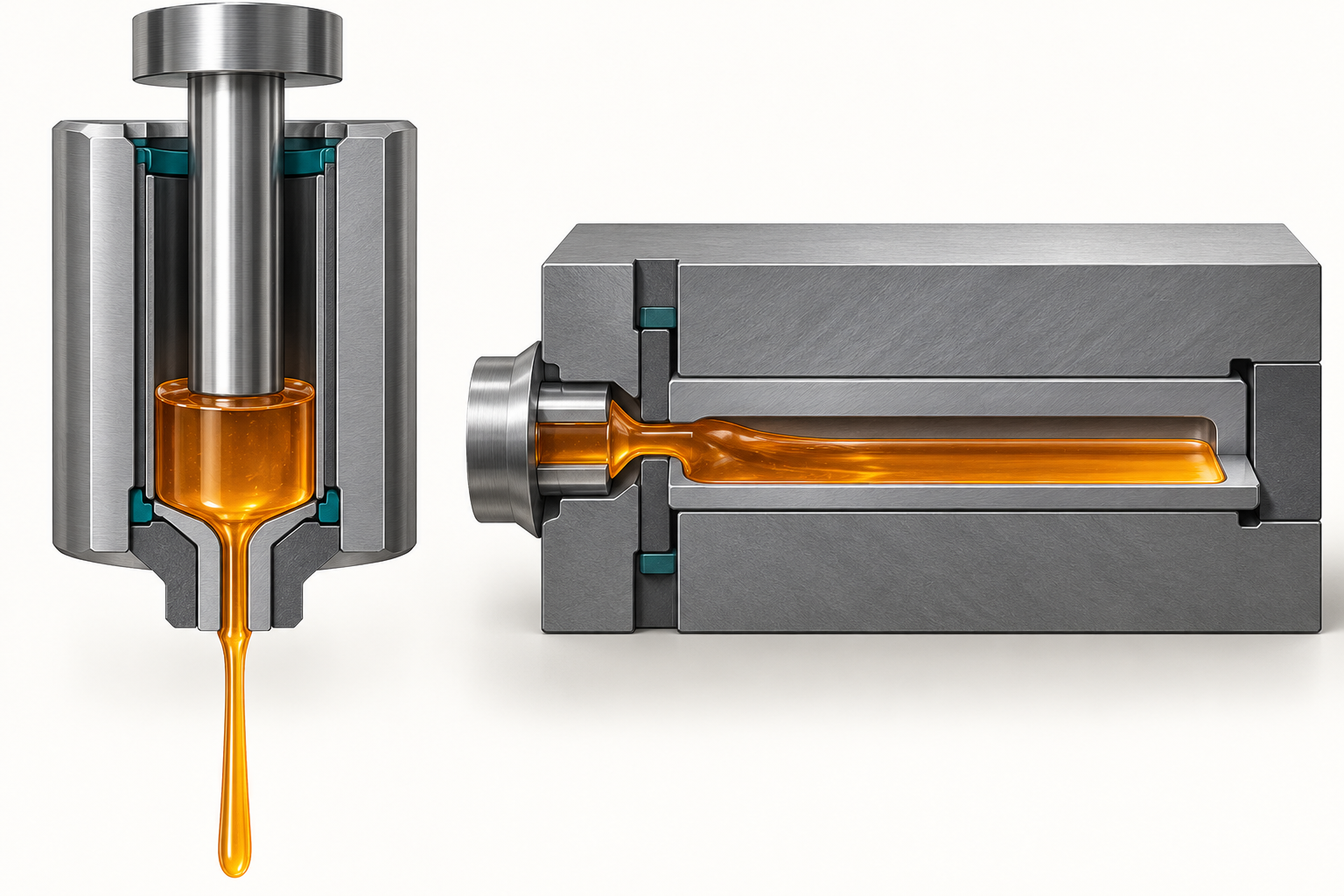
An extrusion plastometer uses a defined die and loading arrangement. Injection molding adds a nozzle, runner, gate and cavity, with changing temperature and shear conditions. The melt must travel and fill before cooling prevents further movement. A material that looks acceptable in a laboratory flow test may still struggle in a long, thin flow path.
ASTM D1238-26 cautions that the measured flow rate is an empirical parameter and may not correlate directly with large-scale processing. It also requires supporting correlations before using flow uniformity to infer uniformity of other properties. ASTM and ISO methods address the same subject but differ technically.
Where filling is critical, request viscosity data across relevant conditions or a suitable mold-filling evaluation. A spiral-flow comparison can also support screening when its geometry and processing conditions are defined. Treat it as comparative evidence for that setup, not a universal flow length for a production part.
How Flame Retardants Can Change Flow
Solid loading can increase resistance. A particulate FR package adds a dispersed phase to the polymer. Its effect depends on concentration, particle shape, particle interactions and the matrix. High loading or poorly dispersed material may make processing more demanding. There is no single loading percentage at which every resin becomes difficult to mold.
Carrier resin and compatibility change the blend. A concentrate adds carrier polymer as well as active ingredients. The final blend may differ from the neat resin in viscosity and morphology. When buying a flame retardant masterbatch, evaluate its recommended dilution in the exact base grade rather than comparing the concentrate’s flow value with the resin’s value.
Some additives increase flow. Plasticizing effects or a specifically engineered formulation can reduce flow resistance. The direction is chemistry dependent. Do not infer flow behavior from a broad label such as halogen-free or phosphorus-based. Request measurements on the proposed complete formulation and compare them under the same test conditions before making a material decision.
Degradation can create misleading improvement. Chain scission may reduce molecular weight and raise flow in susceptible polymers. Other reactions may increase viscosity. If a batch flows differently after prolonged heating, investigate its condition before calling the change an advantage. Flow, appearance and mechanical results need to be considered together.
Diagnose Short Shots Before Changing the Recipe
A short shot is an incompletely filled part. Material viscosity is one possible cause, alongside insufficient delivered material, cooling, flow restrictions and trapped gas. The same visible defect can therefore require very different corrections. First confirm that the intended material and process are actually reaching the mold.
Record shot size, cushion, fill time, pressure behavior and transfer settings. Confirm whether the machine reaches a pressure limit and fails to maintain the intended injection speed. Check recovery consistency and material feeding. A setpoint is not proof that the machine followed the intended profile.
Then inspect where the fill stops. One cavity failing repeatedly suggests a local imbalance, restriction or venting problem worth checking. Similar changes across all cavities may point toward a shared material or process variable. These are investigation clues, not diagnoses by appearance alone.
Autodesk’s short-shot guidance treats venting, flow restrictions and process conditions as relevant causes. Raising pressure without checking the cause can leave a narrow process window or introduce another defect.
Run a Controlled Troubleshooting Trial
Consider a hypothetical trial, not a Rectivas customer case. On Tuesday, a molder changes a two-cavity PP cover to an FR formulation. During twenty consecutive shots, the same far corner in one cavity remains incomplete. The immediate request is a higher-MFI compound.
Before replacing the material, the team retains labeled samples, checks the supplied grade and reviews the fill profile. Both cavities use the same material, so the persistent difference justifies checking the local flow path and venting. The engineer compares observations with the last acceptable setup before proposing a controlled correction.
If the cavity issue is corrected and filling stabilizes, that supports a process or tool explanation for this trial. If both cavities remain pressure limited under a verified setup, a material-flow comparison becomes more useful. Neither outcome can be assumed in advance. The twenty shots illustrate a diagnostic sequence, not an established production acceptance sample size.
A trial log should record each change, its reason and the measured result. Without that record, three simultaneous adjustments may produce a good part without revealing what restored filling.
| Observation | Check first | Useful evidence |
|---|---|---|
| One cavity stays short | Local flow path, gate and vent condition | Cavity-by-cavity fill pattern under the same setup |
| All cavities become pressure limited | Material identity, actual temperature and restrictions | Fill-time and pressure records against an acceptable run |
| Flow result rises after long heating | Test history, moisture and possible degradation | Matched fresh samples and retained property data |
| Intermittent shorts and variable cushion | Dosing, feeding and delivery consistency | Shot-to-shot records and material feed checks |
| Concentrate trial differs from expectation | Actual dilution and base-resin compatibility | Data on the final blend, not the concentrate alone |
Improve Filling Without Losing Other Requirements
Choose an adjustment that matches the evidence. A material issue may justify another base grade, a more suitable FR package, improved dispersion or a compatible carrier. Each proposal needs evaluation in the complete formulation. Adding a lubricant or processing aid is not automatically neutral to fire performance, surface quality or long-term behavior.
Temperature and injection-speed changes also need boundaries. Follow the material supplier’s permitted processing window and the machine and mold limits. More heat may help filling but can increase thermal exposure. A change that fixes one short shot while producing gas, discoloration or property loss is incomplete.
For a proposed FR-PP or FR-ABS flame retardant compound, ask for data on the complete grade and conditions. Confirm the intended thickness and color, then evaluate filling, critical mechanical features and relevant fire evidence together. The designation alone does not qualify the part.
Why Better Processing Flow Does Not Guarantee V-0
Flow during molding and melt behavior during burning occur under different thermal and chemical conditions. The polymer may decompose, form char or change its melt strength during a flame test. A room-temperature data sheet’s MFR entry cannot capture that complete sequence.
A 2015 experimental study of melt dripping found behavior dependent on the polymer and FR system. Its relevance is that dripping cannot be predicted from one general rule. It does not provide an MFI target that guarantees V-0.
UL’s vertical burning overview includes burning, afterglow and dripping criteria. V-0 does not mean that no physical droplet can ever form; cotton ignition by burning drops is part of the assessment. Recheck the applicable fire performance when changing a formulation to improve filling.
What to Send Before Requesting a New Material
If you compound your own material, share the base resin, full formulation and dosing basis when discussing flame retardant additives. If you mold purchased compounds, provide the exact grade, flow test conditions, trial settings and failure location. Include minimum wall thickness, color, reinforcement and the required fire classification.
For procurement, the useful comparison is the cost of repeatably acceptable parts. A higher-flow grade that fills the mold but fails a clip test is not a completed substitution. For concentrate selection, the separate masterbatch carrier resin guide covers carrier compatibility; this article focuses on final-material flow and process evidence.
Frequently Asked Questions
Do flame retardants always reduce melt flow?
No. Solid loading can increase flow resistance, while some additives or engineered formulations can increase flow. The result depends on the polymer, FR chemistry, concentration, compatibility and processing history. Compare the final compound under matched test conditions. A result from one resin or commercial formulation should not be treated as the expected behavior of every flame retardant.
Is a higher MFI always better for injection molding?
No. Higher MFI may help screening within a comparable material family, but it does not guarantee the best molding window or part properties. The measurement applies to a particular temperature and load. Consider viscosity under relevant processing conditions, thermal stability, flash, mechanical requirements and fire performance. Qualify the material in a representative trial rather than selecting the largest number.
Can I compare MFR and MVR directly?
No. MFR measures mass flow, whereas MVR measures volume flow. Converting between them requires the appropriate melt density under the relevant conditions. Room-temperature pellet density is not a reliable substitute. When filled or reinforced compounds differ in density, comparisons need particular care. Request matched methods, temperature, load and material preparation before using either value to rank candidate grades.
Will increasing temperature solve an FR short shot?
It may improve filling when the thermal conditions are the cause and the adjustment stays within the permitted material window. It will not correct every feeding, venting or tooling problem. Excessive temperature or residence time can damage a susceptible formulation. Record the actual process response and part quality, and check the cause before repeatedly increasing barrel or hot-runner settings.
What flow data should I request from a supplier?
Request the exact grade, MFR or MVR units, temperature, load, test method and preparation conditions. Clarify whether the value is typical or an agreed acceptance limit. For a difficult thin section, ask whether relevant viscosity or filling data are available. Match those records to the final compound, reinforcement and color rather than accepting a neat-resin number as equivalent.
Should I buy additives, masterbatch or a compound?
Choose according to your equipment and process control. Additives require suitable compounding capability. Masterbatch requires compatible dilution and consistent dosing. A compound reduces blending variables at the molding machine but still needs a production trial. Compare the final material’s filling, mechanical performance and fire evidence. None of these supply forms guarantees trouble-free processing solely because of its physical form.
What affects the cost of a higher-flow FR material?
Base grade, reinforcement, additive package, compatibility requirements and qualification work can affect the quotation. A higher material price may be justified if it reduces rejects or enables a required geometry, but that benefit needs trial evidence. Compare suppliers against the same application and acceptance criteria. There is no universal surcharge for a material described only as high flow.
Can Rectivas help arrange a material trial?
Rectivas is a sourcing and technical partner and can discuss suitable additive, masterbatch or compound options with partner factories. Share the application, resin grade, fire target and processing problem first. Sample availability, minimum order quantity, lead time and test scope need confirmation for the specific proposal. Agree on evaluation criteria before treating a successful sample as production qualification.
Final Thoughts
Flame retardant melt flow needs to be judged in the final formulation and the actual filling process. Keep the test method, temperature and load beside every flow value, then investigate material, machine and mold evidence together. Rectivas can help discuss supply options with partner factories. Define the required processing window, fire performance and mechanical limits before approving the next sample.
— Rectivas Materials Team, Chen