Quick answer: Flame retardant processing temperature must match the actual melt conditions and exposure time of the complete formulation. A decomposition temperature from a technical sheet is not a machine setpoint or a guaranteed operating limit. Compare the selected grade’s processing guidance with the resin’s requirements, then verify melt temperature, dispersion and finished properties in a representative trial. Lowering barrel settings alone may not remove excessive thermal exposure.
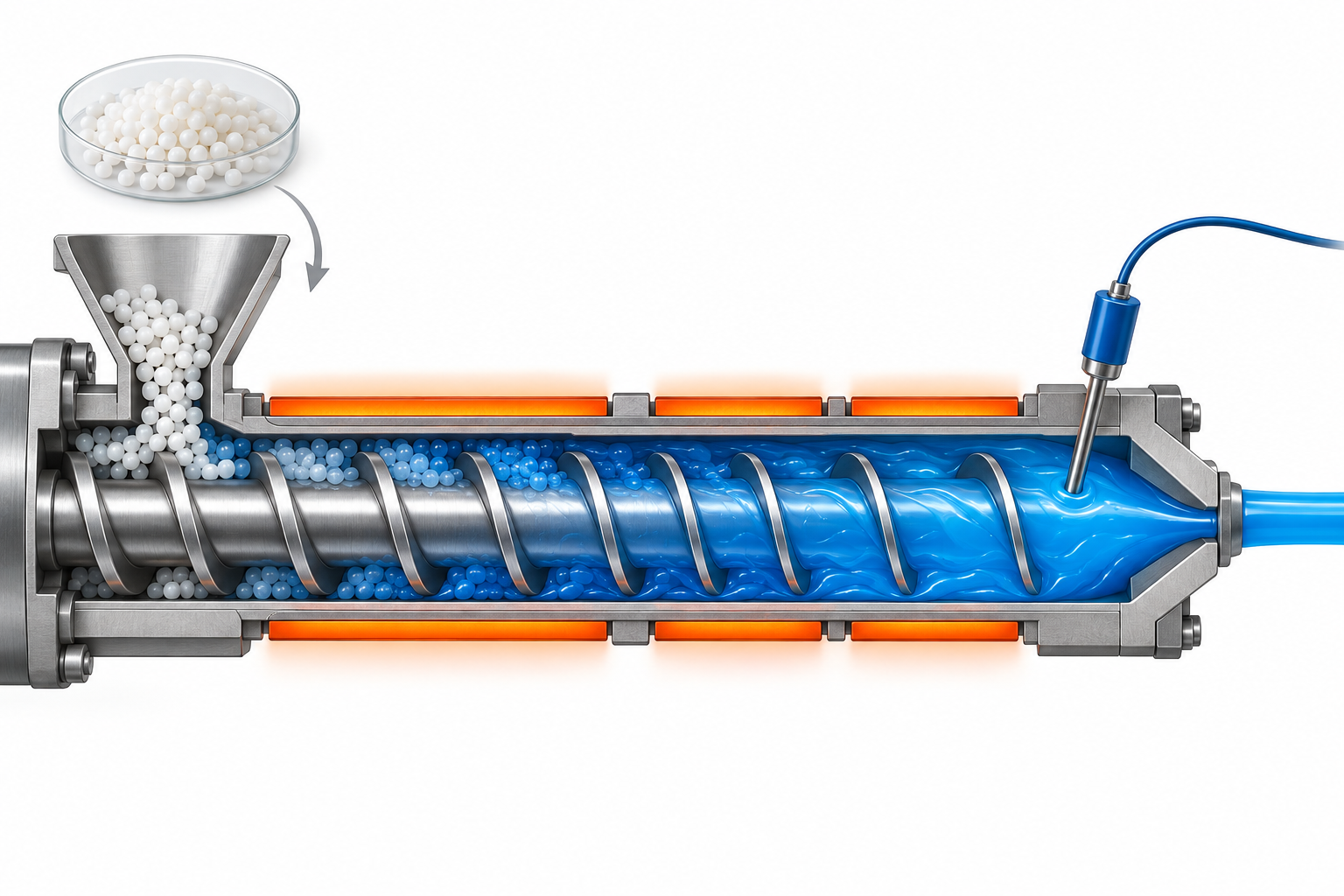
Which Temperature Are You Comparing?
A supplier says a powder is thermally stable. An operator gives the barrel temperature. A test report lists a mass-loss temperature. All three statements may be accurate, yet they describe different things. Mixing them together is how an apparently compatible additive ends up producing gas, discoloration or inconsistent properties.
The useful question is whether the complete recipe has a workable processing window: enough heat and mixing to incorporate the ingredients, without unacceptable damage during the time spent in the equipment. That window belongs to a specific formulation and process, not simply a chemical family.
| Temperature term | What it describes | What it does not establish |
|---|---|---|
| Barrel setpoint | The controller target for an equipment zone | The temperature throughout the polymer melt |
| Measured melt temperature | Material temperature at the measurement location | Every local peak or the entire exposure history |
| TGA onset or mass-loss temperature | A defined event under specified analytical conditions | A permitted production temperature for all processes |
| Supplier processing limit | Guidance for the selected product and intended use | Approval of any resin blend, screw design or holding time |
| Drying temperature | A preparation condition before melt processing | A substitute for the melt-processing window |
Why Decomposition Temperature Is Not a Processing Limit
Thermogravimetric analysis, or TGA, measures changes in sample mass during a controlled temperature program. A reported onset, a specified percentage of mass loss and a peak rate of mass loss are different endpoints. Ask which endpoint the quoted number represents before comparing two data sheets.
The conditions also matter. NETZSCH describes TGA in terms of controlled heating rate, atmosphere and other measurement conditions. Its application discussion of heating rates demonstrates that measured decomposition temperatures can shift with the heating program.
A useful comparison therefore requires matching test conditions and definitions. A brief ramp through a temperature in a small analytical sample does not establish acceptable behavior during a longer hold in a polymer melt. Nor does a small mass loss necessarily identify which ingredient changed in a multicomponent compound.
Use thermal analysis as screening evidence. The operating recommendation should also consider the manufacturer’s processing instructions and the complete recipe. Where the available margin is narrow, ask for grade-specific advice or additional testing rather than choosing an arbitrary temperature subtraction.
Temperature References for Common Flame Retardant Systems
The examples below illustrate how to read different kinds of evidence. They are deliberately labeled by source and product. They are not universal upper limits for all ATH, MDH, APP or phosphinate products.
| System or example | Published reference | How to use it |
|---|---|---|
| ATH in Huber cable guidance | Decomposition around 220°C | Screen thermal compatibility; obtain the selected grade’s processing guidance |
| MDH in the same Huber guidance | Decomposition around 330°C | A higher thermal reference, not permission to process every formulation at that temperature |
| Clariant Exolit AP 766 | DTA/TG decomposition >240°C; stated melt limit 250°C | Follow this grade’s separate processing instruction; do not derive a limit from the analytical entry |
| Clariant Exolit OP 1312 | DTA/TG decomposition >320°C; stated melt limit 320°C | A product-specific example for intended applications, not a limit for every phosphinate |
Sources: Huber’s wire and cable brochure, Clariant AP 766 and Clariant OP 1312. The Huber brochure is dated 2022; the Clariant pages show a February 2026 edition. Obtain current documentation for procurement. The “greater than” entries are not exact decomposition onsets.
ATH Versus MDH: Thermal Compatibility Comes First
ATH and MDH release water during thermal decomposition. That behavior supports their flame-retardant function but is undesirable if it occurs prematurely during processing. Their different thermal behavior helps explain why a mineral package suited to one process may be unsuitable for another.
Huber’s cable guidance identifies MDH as an option where processing temperatures approach or exceed the range suitable for ATH. It also emphasizes particle characteristics and surface treatment. Thermal compatibility is therefore an initial filter, not a complete product specification.
Do not assume that changing ATH to MDH preserves extrusion behavior or mechanical performance. A new mineral grade may require a different formulation balance. Review the carrier polymer, filler level and surface treatment alongside the thermal information. The mineral flame retardant product page is a starting point for discussing candidate grades.
APP Packages and Engineering-Plastic Systems Need Their Own Data
“Phosphorus-based” is too broad to specify a processing window. An APP-based intumescent package and a phosphinate package intended for reinforced nylon are different products. Their components, intended resins and processing instructions should not be pooled into one family temperature.
The AP 766 and OP 1312 examples above show why product identity matters. The published analytical entries and melt instructions must be read together. A value beginning with “greater than” gives incomplete information about the later decomposition behavior; it is not a point from which a precise operating margin can be calculated.
For higher-temperature resin applications, request documentation for the entire package, including synergists. A suitable main active ingredient does not establish that every companion ingredient survives the proposed process. Review the resin supplier’s instructions as well. The relevant sourcing discussion can start with aluminum diethylphosphinate flame retardants, while keeping any commercial blend distinct from the individual chemical.
Barrel Temperature, Melt Temperature and Time Work Together
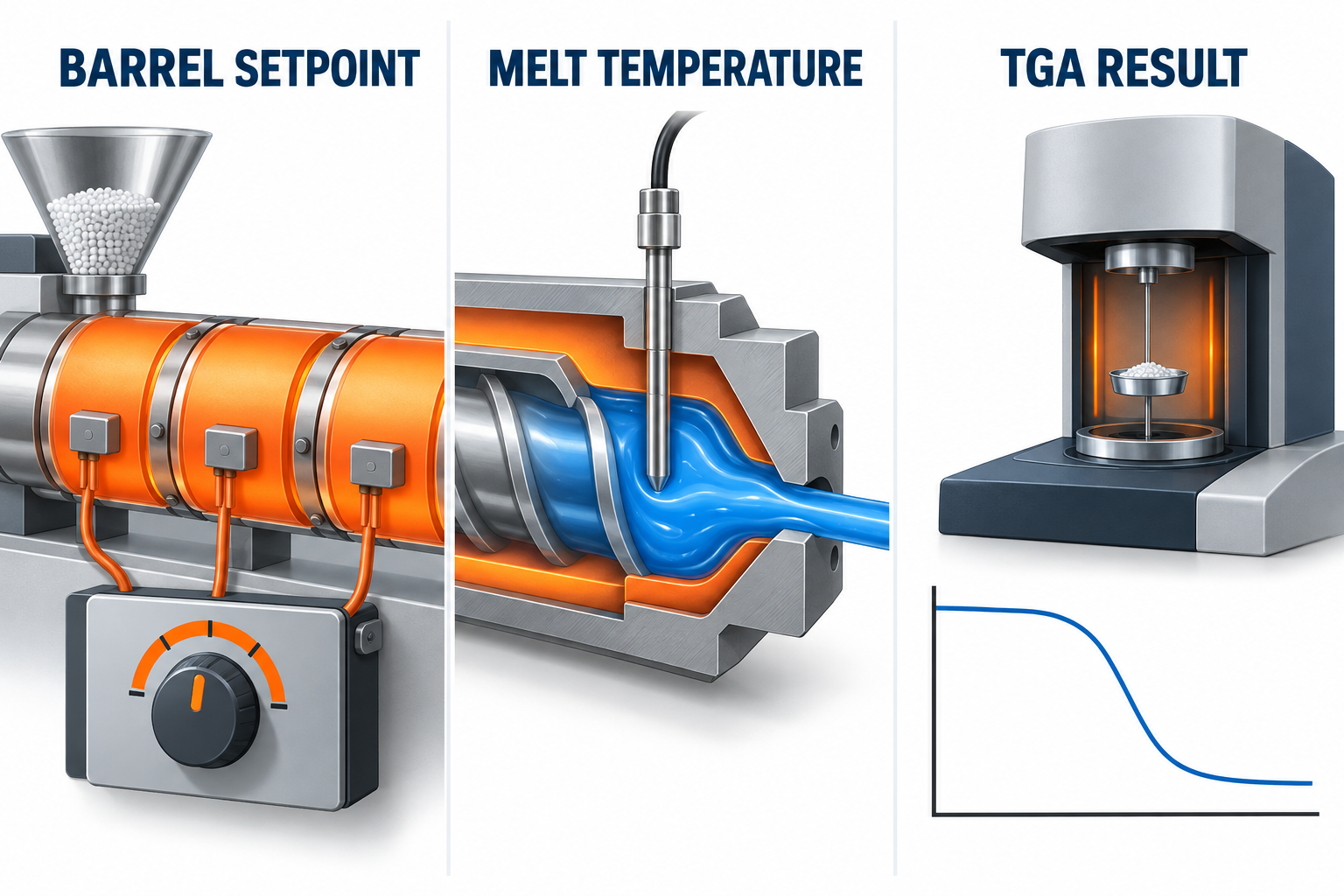
External heaters are only part of the thermal history. Mechanical work during mixing can contribute heat, while residence time controls how long material remains exposed. A cooler zone setting does not by itself establish that the melt has cooled enough or that a long hold is acceptable.
Coperion’s technical presentation discusses temperature peaks, kneading time and residence time together. That relationship is a better starting point than evaluating a barrel profile in isolation.
Keep records of the temperature measurement location and method. A reading near discharge is useful, but it cannot reconstruct every local peak upstream. Compare stable production with startup, interruptions and low-throughput operation. Those conditions can expose weaknesses that a short, steady trial misses.
A useful process record includes material identities, feed rates, screw speed, temperature settings, measured melt temperature and relevant holding conditions. Change one planned variable at a time where practical. Otherwise, a good-looking result may leave you unable to explain which adjustment helped.
Gas, Discoloration and Deposits: Investigate Before Blaming Heat
Visible defects can be consistent with thermal damage, but none is a diagnosis on its own. Moisture, trapped air, contamination, feeding variation and poor dispersion can produce overlapping symptoms. Start by preserving the sample and recording when the symptom occurred.
If bubbles appear after a production interruption, compare restart material with stable-running material and review holding conditions. If discoloration develops during continuous production, check actual melt conditions, residence behavior and the raw-material combination. These are investigation paths, not claims that one symptom identifies one mechanism.
Drying also needs its own review. Follow the resin and additive instructions rather than applying the highest temperature tolerated by one ingredient to the whole blend. An apparent moisture problem should not be addressed with an unverified drying cycle that introduces a different problem.
Once processing is stable, verify the required finished properties, including the relevant fire test. Appearance alone cannot demonstrate retained flame-retardant performance. For the broader sample evaluation sequence, see the published flame retardant sample evaluation guide.
A Practical Scenario: A Recipe That Changes After a Stop
Consider a hypothetical extrusion trial. The compound appears satisfactory during continuous running, but bubbles develop in the first material discharged after a stoppage. The operator has not changed the barrel settings. The purchasing team concludes that the additive is inconsistent.
That conclusion is premature. Compare the raw-material batch, moisture preparation, actual melt readings and the time material remained in the equipment. Retain separate samples from before the stop, restart and stable production. If the defect follows holding conditions rather than a material batch, the investigation should follow that evidence.
The lesson is not that thermal decomposition is always responsible. It is that the same setpoint can accompany a different exposure history. Ask the material and equipment suppliers to review the actual conditions before increasing the additive level, replacing the chemistry or declaring a batch defective.
Our Recommendation: Request a Grade-Specific Processing Window
For a new formulation, share the resin grade, reinforcement, full additive package and intended process. Ask the supplier to distinguish analytical thermal data from recommended melt and drying conditions. If a number has no test method or definition attached, clarify it before using it to approve a trial.
For an existing recipe, make the request concrete: state what changed and provide the thermal and production history available. “The machine is set below the decomposition temperature” is not enough to explain a failure or demonstrate compatibility.
When sourcing flame retardant additives, compare the supporting documents as carefully as the chemical name. Rectivas Materials acts as a sourcing and technical partner and can help coordinate candidate information and sample discussions. The processing window and final performance still need verification for your formulation and equipment.
Frequently Asked Questions
What is flame retardant processing temperature?
It is the temperature range in which a particular flame-retardant formulation can be incorporated and processed without unacceptable changes. The useful range depends on the additive grade, resin, other ingredients, mixing conditions and exposure time. Distinguish the machine settings from measured melt temperature, and use product-specific guidance rather than a generic chemical-family number for approval.
Is decomposition temperature the maximum processing temperature?
No. A decomposition temperature describes a thermal event under particular measurement conditions. It may refer to an onset, a mass-loss percentage or another endpoint. A processing recommendation also accounts for the intended application and material behavior. Read the selected grade’s processing instructions separately, and do not calculate a universal operating limit from a single TGA value.
Can ATH and MDH use the same processing conditions?
Not automatically. Their thermal behavior differs, and selected grades also differ in particle properties and surface treatment. MDH can suit processes that exceed the range appropriate for ATH, but substituting it changes the formulation. Confirm the actual grade’s thermal guidance, processing behavior and finished properties rather than transferring the previous temperature profile without an evaluation.
Why can the melt be hotter than the barrel setpoint?
Mixing introduces mechanical energy as well as heat supplied by the barrel heaters. The material temperature can therefore differ from the controller target. The difference depends on equipment and operating conditions. Measure melt temperature using an appropriate method and location, and review shear and residence behavior rather than assuming that the displayed zone settings describe the whole melt.
Does a masterbatch protect an additive from overheating?
A masterbatch can improve handling and incorporation, but pellet form does not remove the thermal limits of its active ingredients or carrier. Consider the concentrate’s manufacture and its later processing into the final material. Obtain guidance for the actual masterbatch and let-down conditions. Do not assume that an additive’s powder data alone approves the complete concentrate.
How much temperature margin should I leave?
There is no universal margin that can be subtracted from every decomposition temperature. The appropriate allowance depends on the measurement definition, product guidance, exposure time and process variation. Where the available window is narrow, discuss the specific conditions with the supplier and validate them. An arbitrary margin can conceal incompatible ingredients or unnecessarily restrict a workable process.
What documents should I request before a trial?
Request the current technical data sheet, safety data sheet and available processing guidance for the exact commercial grade. Clarify the thermal test method, reported endpoint, drying instructions and recommended melt conditions. Provide the intended resin and process in return. A generic brochure or another grade’s successful application is insufficient to define your complete trial window.
Can a good-looking part still have a processing problem?
Yes. Appearance is only one observation and cannot establish all mechanical, electrical or flame properties. A process change may produce acceptable-looking parts while altering other required performance. Compare representative samples under the specified conditioning and test requirements. Keep the formulation and production records attached to the results so that a visual improvement is not mistaken for full validation.
Final Thoughts
A reliable flame retardant processing temperature comes from matching grade-specific guidance to the complete formulation and its real thermal history. Keep barrel settings, measured melt temperature and analytical decomposition data separate. Then verify the proposed window under representative operating conditions, including relevant interruptions. Rectivas Materials can help coordinate additive sourcing and technical information; the final decision should rest on documented compatibility and the finished material’s required performance.
— Rectivas Materials Team · Chen (老陈)