Quick answer: Ordinary calcium carbonate should not be treated as a drop-in flame retardant for polypropylene. It is commonly used as a mineral filler, and its effect on fire behavior depends on the complete formulation. Some studied combinations improve selected fire properties; others interfere with a protective system. For PP purchasing, distinguish ordinary filler masterbatch from a formulated flame-retardant package, then verify the actual blend and required test.
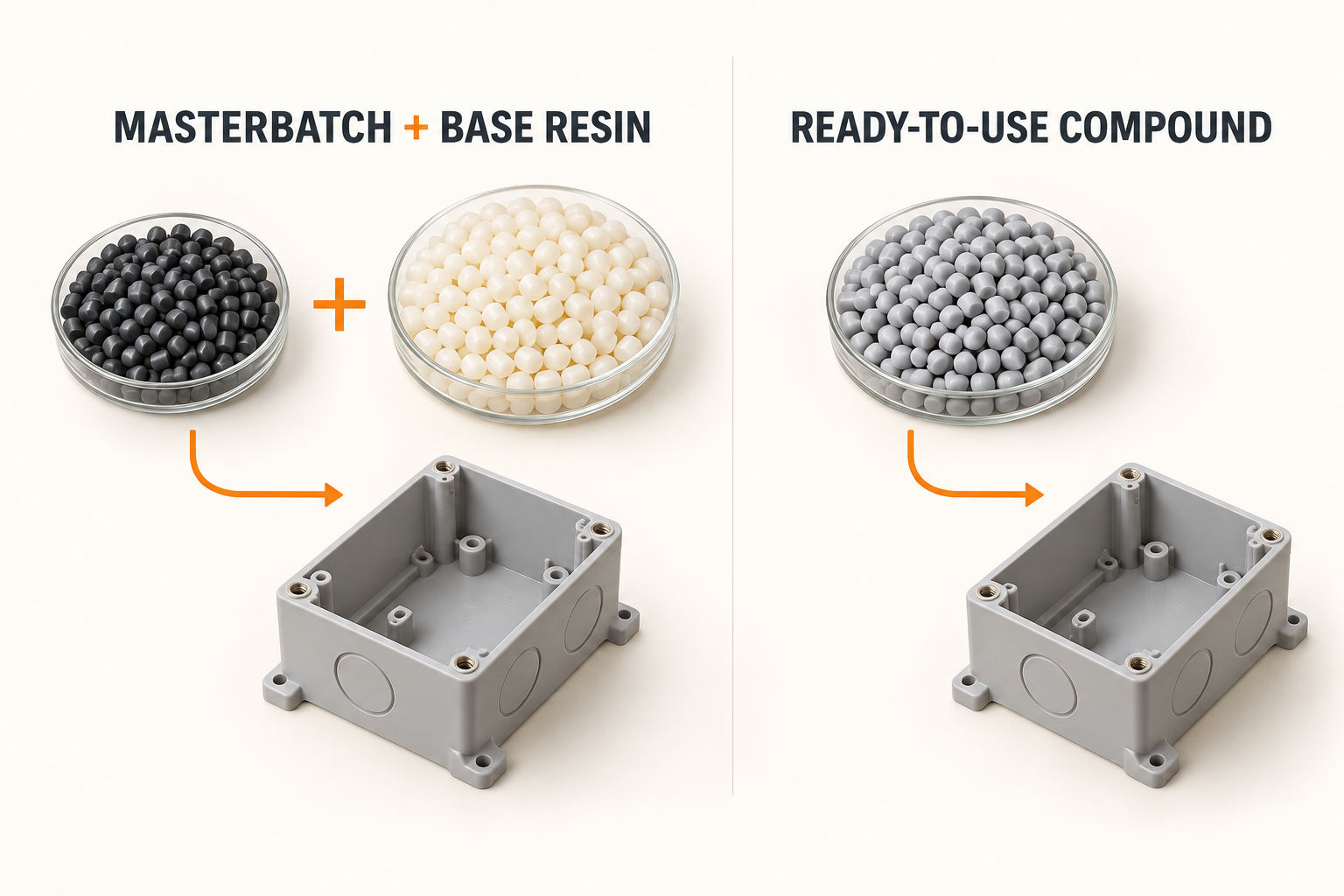
Two quotations can both mention calcium carbonate and describe very different materials. One may be an ordinary filler concentrate intended to change the composition of PP. Another may contain a separate flame retardant package alongside the filler. Calling both products “filled masterbatch” removes the distinction that matters for qualification.
This guide answers the material question first, then explains what it means for PP formulation and purchasing. It does not provide a universal recipe or dosage. The useful outcome is a clear description of what the proposed product contains, what it is intended to do and which evidence applies to the resulting plastic.
Calcium Carbonate Filler Is Not the Same as an FR Package
Calcium carbonate, CaCO3, is an inorganic mineral used in polymer formulations. A calcium carbonate filler masterbatch introduces that material through a carrier. The product name alone does not establish that the concentrate contains a dedicated flame retardant system or has been evaluated against a fire requirement.
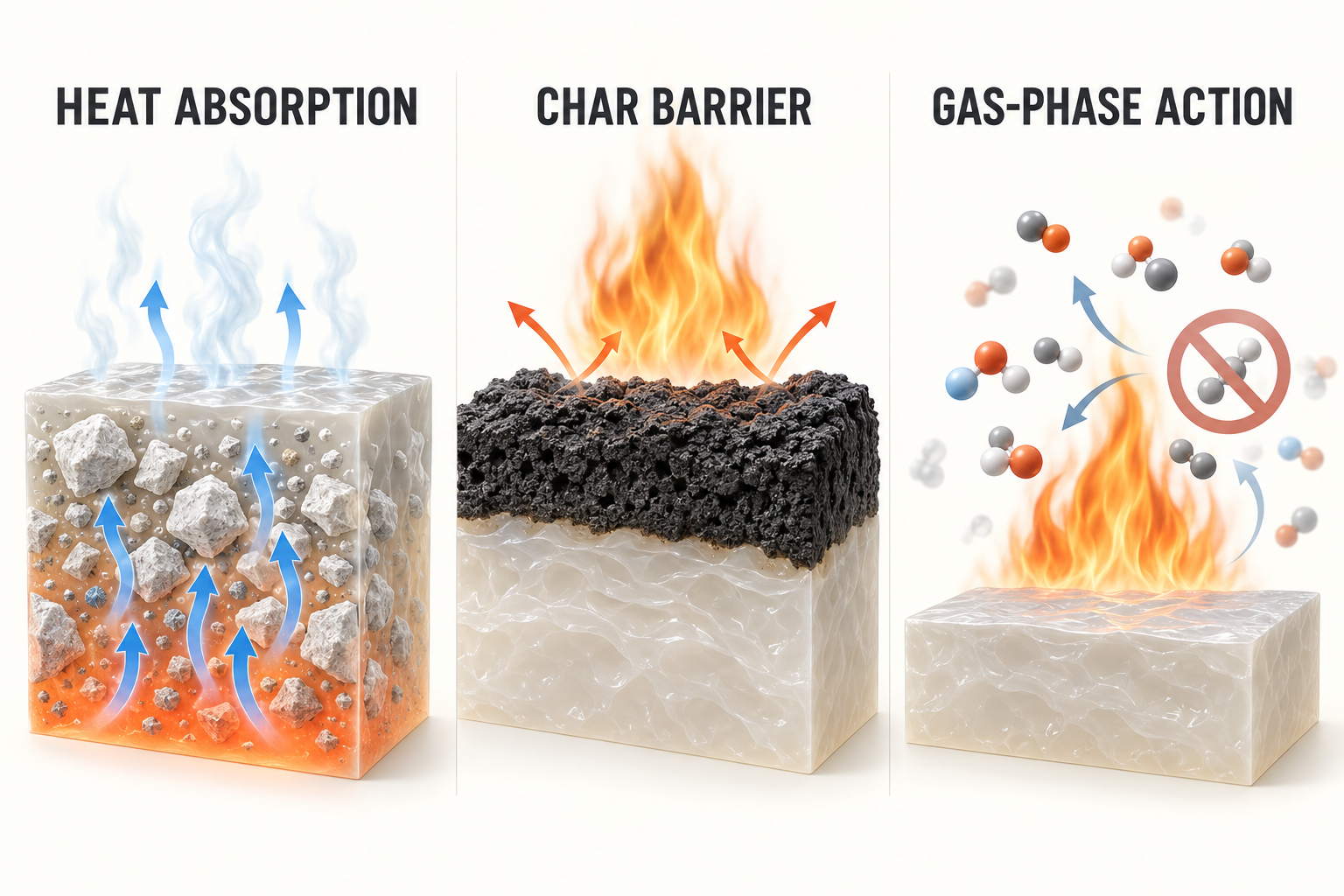
A flame retardant package is selected to change the burning behavior of the specified polymer under relevant conditions. It may contain one ingredient or a combination. A package can also interact with other formulation components, so identifying a noncombustible mineral does not answer whether the final PP article will meet its required test.
Alexander Morgan’s polymer flame-retardant chemistry presentation hosted by NIST emphasizes matching the chemical approach to the polymer and test. The distinction is useful here: the name of a mineral is less informative than its function in a defined formulation. A filler and an FR package are not interchangeable purchasing descriptions.
| Proposed material | What to establish | What the name does not prove |
|---|---|---|
| Ordinary CaCO3 filler masterbatch | Mineral grade, carrier, composition and incorporation guidance | A fire rating for the final PP blend |
| FR concentrate for filled PP | Compatibility with the existing filled formulation | Suitability for every mineral loading or PP grade |
| Integrated filler/FR masterbatch | Declared filler and FR functions, carrier and final-blend recipe | A universal addition ratio or end-product approval |
| Finished FR compound | Exact supplied grade and relevant processing/test evidence | Unrestricted performance after dilution or substitution |
Can Calcium Carbonate Affect PP Fire Performance?
Yes. Changing the filler package changes the material being evaluated. The result can depend on interactions with the FR system, the mineral characteristics, dispersion and the specimen construction. The direction of the change should be established for the formulation instead of assumed from the filler name.
A 2003 study of filled intumescent PP blends reported reduced fire-protective performance when calcium carbonate reacted with APP in its investigated system. That is evidence for a particular combination, not proof that all CaCO3-containing plastics inevitably fail or that every APP formulation behaves identically.
Conversely, Deodhar and colleagues studied a nanoparticle CaCO3/APP combination in PP and reported reduced burning rates in their samples. Their interpretation involved reactions between the additives and released gases. This does not contradict the need for validation; it shows why particle form, package design and experimental conditions cannot be discarded when interpreting a result.
Neither paper should be converted into a simple sales rule. “CaCO3 always destroys intumescence” and “CaCO3 makes PP flame retardant” are both broader than those findings support. State which formulation was evaluated, which property changed and which conditions were used.
What About Combinations with Mineral Flame Retardants?
A 2024 study by Mapossa and colleagues investigated PP/calcium carbonate composites containing magnesium hydroxide and zinc borate. It evaluated processing, mechanical, thermal and fire-related properties for the studied combinations. The findings concern the complete composite, not calcium carbonate acting as an independently qualified substitute for its other ingredients.
For a buyer, that distinction prevents a common reading error: a paper about an FR composite is not a datasheet for every filler used inside it. Check the composition and specimen before comparing the result with your PP recipe. Do not lift an experimental percentage into a supplier inquiry as though it were a universal production setting.
The same caution applies to specially modified particles. A description such as coated, treated or functionalized needs a specific meaning. Ask what treatment is present and why it is proposed for the formulation. Evidence for a modified material cannot automatically be assigned to an untreated powder carrying the same mineral name.
Particle Grade and Surface Treatment Still Matter
Record the supplier’s mineral designation, relevant particle information and any surface treatment. If the commercial product is a masterbatch, identify the carrier and other declared components as well. A powder designation and a concentrate designation describe different points in the supply chain.
Two fillers with a similar nominal particle-size value are not necessarily equivalent. The rest of the specification and the resulting behavior in the blend still need review. For a substitution trial, keep the reference material and its documents available rather than relying on memory of how the previous powder looked.
Do not promise a fixed outcome from surface treatment alone. A treatment intended to assist incorporation must be assessed alongside the flame retardant chemistry, carrier, pigments and other ingredients. The appropriate decision is based on the final composition and relevant trial observations.
It is also useful to state what must remain unchanged. Flow, impact, elongation, appearance and processing stability may all matter to the application. A material change should be judged against those requirements as well as the requested fire result.
Two Masterbatch Routes for Calcium-Carbonate-Filled PP
Route one adds an FR concentrate to an existing filled recipe. The starting information includes the PP resin, current calcium carbonate grade and loading, color package and process. The proposed concentrate must be reviewed against that whole formulation. A recommendation for unfilled PP does not establish the correct approach for the filled version.
Route two combines filler and FR functions in one masterbatch. Here the supplier needs to define the intended contributions and carrier. The converter still needs an agreed final-blend recipe and trial plan. Putting ingredients in one pellet can simplify some handling decisions, but it does not remove the need to establish the properties of the finished material.
Rectivas can review both supply routes through partner factories. The calcium-carbonate-filled PP masterbatch section is the relevant product starting point. The proposal and available documents are confirmed for the application; this article does not assign a common grade, loading or fire classification to every inquiry.
Keep Filler Content, FR Content and Addition Ratio Separate
First identify the basis of each percentage. A concentrate’s composition is different from its percentage in the finished blend. A combined masterbatch can introduce mineral, carrier and FR ingredients together; the addition level does not tell you each resulting fraction without the composition.
Hypothetical arithmetic, not a recipe: suppose a masterbatch contains 50% calcium carbonate and 20% of a defined FR package, with the balance as other declared ingredients. At 10% of final-blend mass, it contributes 5% calcium carbonate and 2% FR package. These invented figures explain multiplication only; they are not a suggested commercial formulation or prediction of fire performance.
Also check whether “10% addition” means a share of the final blend or material added to a stated amount of base resin. The denominator changes. Have the proposed recipe written in one consistent mass basis before calculating cost or interpreting a supplier’s recommendation.
For broader recipe development, the flame retardant formulations guide explains how to keep ingredient roles and the target test connected. This article stays focused on the calcium carbonate question rather than treating one filler as the complete formulation strategy.
Compare Evidence on the Actual PP Formulation
Agree the test requirement, specimen and essential mechanical properties before starting. Keep a documented baseline, change the intended variable and retain labeled samples. If multiple ingredients must change together, describe the trial as a package comparison rather than claiming to have isolated the mineral’s effect.
A useful hypothetical example is a sheet producer comparing two filled formulations at the same nominal thickness. If resin, pigment and FR package also change, any difference in burning cannot be attributed to calcium carbonate content alone. The test can still inform a material decision, but its interpretation must match the design of the comparison.
Review processing and performance together. A candidate that meets a fire criterion but cannot produce the required geometry or retained mechanical properties has not answered the full purchasing brief. Similarly, an attractive extrudate does not establish the required fire behavior.
| Before a trial | Information to record | Reason |
|---|---|---|
| Material identity | Resin, filler, treatment, concentrate and color package | Defines the formulation being compared |
| Addition basis | Ingredient fractions on a consistent mass basis | Prevents carrier, filler and FR content being confused |
| Acceptance criteria | Named test, specimen and required non-fire properties | Connects results to a usable product |
| Repeat supply | Grade identity, document revision and change-review conditions | Preserves the basis of material approval |
For ingredient-led development, compare flame retardant additive options. If a non-halogenated concentrate is specified, review halogen-free masterbatch options with the full filled-PP recipe. Neither category name replaces grade-specific confirmation.
Frequently Asked Questions
Is calcium carbonate a flame retardant?
Ordinary calcium carbonate is commonly used as a filler and should not be assumed to replace a dedicated FR package in PP. It can affect fire behavior within particular combinations, but the direction and usefulness of the effect are formulation-dependent. Request evidence for the actual blend and test instead of assigning a fire classification from the mineral name.
Can ordinary filler masterbatch make PP pass UL 94?
The name “filler masterbatch” does not establish that result. Confirm whether the product contains an FR package and obtain the relevant evidence for the proposed blend, grade and thickness. A result for another recipe does not automatically transfer after substitution. The final material must be evaluated against the applicable requirements; adding a mineral is not a classification procedure.
Does calcium carbonate always interfere with APP?
No universal conclusion should be drawn from one formulation. Published work includes both reduced protective performance in an investigated intumescent system and beneficial results in other designed combinations. Particle form, composition and test conditions need to remain attached to the findings. Review the complete system and run the relevant comparison rather than treating all APP/CaCO3 combinations as identical.
Are ATH, MDH and calcium carbonate interchangeable fillers?
No. A shared mineral or powder description does not make their chemical behavior or intended formulation role interchangeable. Substitution requires a review of the system, processing and final requirements. Obtain the proposed material identity and supporting guidance, then compare representative samples. Do not transfer a dosage or fire result from one ingredient to another solely because both are inorganic.
Can filling and flame retardancy be combined in one masterbatch?
That supply route can be reviewed, but the intended filler and FR functions must be defined together with the carrier and final-blend recipe. Confirm which application the candidate is designed for and which documents are available. One pellet does not imply one universal specification. Processing, mechanical properties and fire performance still need validation in the relevant finished material.
What should I send when requesting a sample?
Provide the PP grade, existing filler identity and amount, surface treatment where known, color package, process and product geometry. State the required fire method and essential mechanical properties. Clarify whether you need an FR concentrate for an existing filled recipe or an integrated filler/FR masterbatch. Rectivas can use that brief to coordinate candidate sourcing and sample discussions with partner factories.
Final Thoughts
The useful question is not whether the words calcium carbonate appear in an FR composite. It is what the mineral does in the proposed PP formulation and which evidence supports that result. Separate filler, carrier and FR contributions, choose the supply route that fits the process, and qualify representative material. A clear recipe and test requirement make a sourcing discussion more useful than a generic promise of flame retardancy.
— Rectivas Materials technical content team