Quick answer: LSZH compound density determines how much jacket volume you obtain from each kilogram, but cable dimensions and production losses determine the final saleable length. For a simple circular sheath, calculate its cross-sectional area, multiply by density to find mass per metre, then divide usable material mass by that result. Compare grades against the same cable design and performance requirements; a cheaper kilogram does not necessarily produce a cheaper metre.
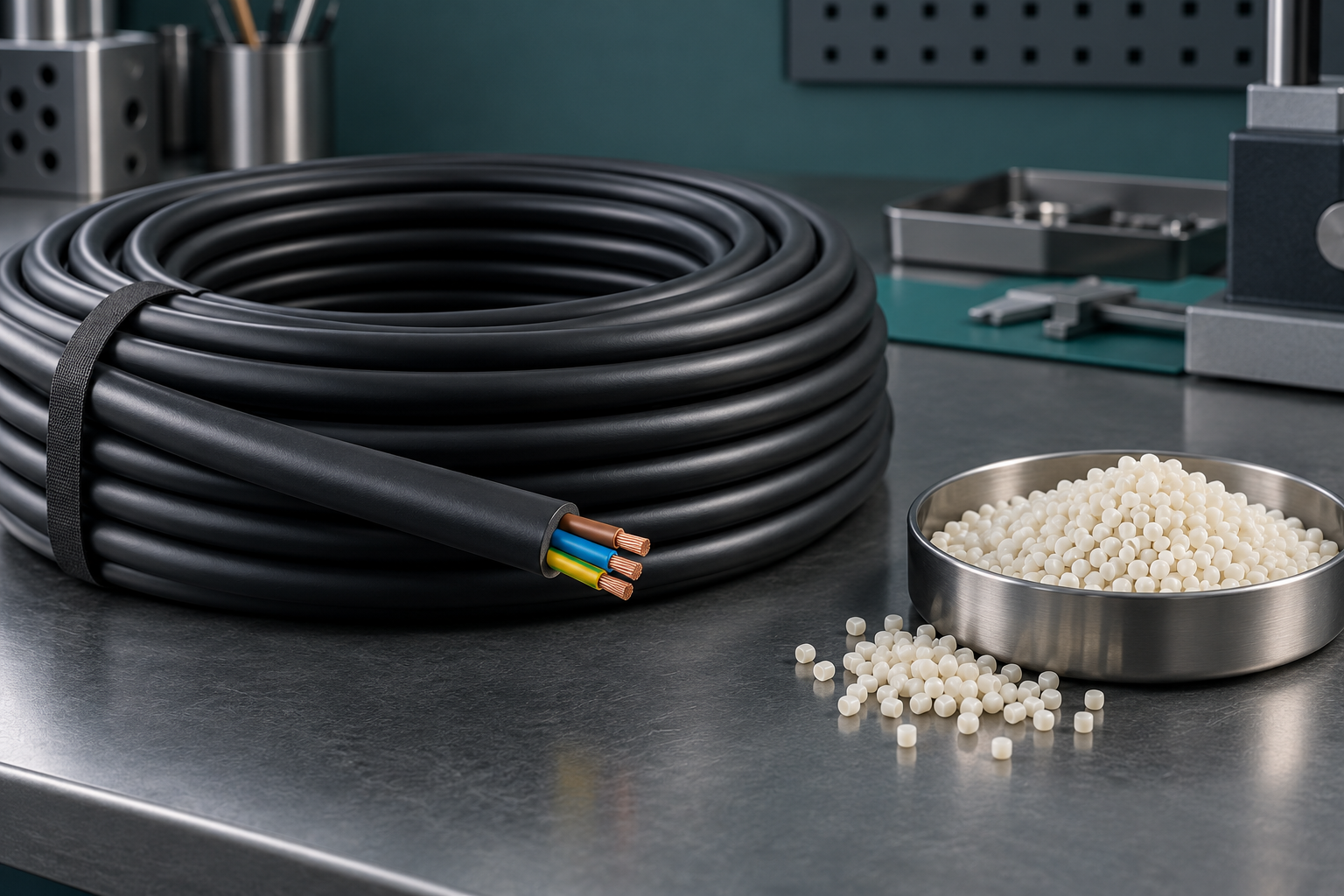
Two suppliers quote one tonne of cable compound. One price looks better, but the production team wants to know how many metres that tonne will cover. The quotation cannot answer this without a density value and a defined cable construction.
This guide calculates jacket consumption rather than total cable weight. Copper, insulation, fillers, tape and armor have their own mass. Keeping the sheath calculation separate makes the comparison useful for material purchasing and extrusion planning.
What LSZH Compound Density Means
Density is mass per unit volume of the material. For solid cable compounds, it may be reported in g/cm³ or kg/m³. A density of 1.50 g/cm³ equals 1,500 kg/m³. Those are equivalent units, not different material properties.
Specific gravity is a relative density and has no unit. Its reference conditions matter. Although a plastics data sheet may show a specific-gravity number close to a density expressed in g/cm³, confirm which quantity is being reported before using it in a purchasing calculation.
Bulk density is different. It includes the spaces between pellets in a container. It helps with storage and handling but cannot replace the solid compound density when calculating an extruded jacket. A loosely filled pellet bag does not describe the volume of finished polymer in a cable.
| Reported property | What it describes | Use in jacket yield calculations |
|---|---|---|
| Solid material density | Mass divided by specimen volume | Use with consistent units and representative material |
| Specific gravity | Density relative to a reference | Confirm reference conditions and interpretation first |
| Pellet bulk density | Pellets plus spaces in a measured container | Do not use as solid jacket density |
| Finished cable linear mass | Mass per length of the whole construction | Separate the sheath from other cable components |
There Is No Universal LSZH Density
LSZH describes low-smoke, zero-halogen characteristics under relevant assessment conditions. It does not prescribe a single recipe or density. Polymer blends, mineral flame retardants and other ingredients change the resulting value. Different grades may also target different mechanical, processing and cable-test requirements.
Manufacturer examples show why a universal range can mislead. The Borealis Casico FR4802 data sheet, dated February 2023, lists a typical density of 1,155 kg/m³, equivalent to 1.155 g/cm³. It expressly says its typical data should not be used for specification work.
A 2016 Teknor Apex announcement for Halguard 58625 lists specific gravity of 1.66. This historical example illustrates variation; it is not a current purchase specification or evidence that these two grades are interchangeable. Obtain current documents for the actual material offered.
Consequently, “LSZH is always heavier than PVC” is too broad. Compare specific grades. A density advantage has value only if the replacement also meets the application requirements. Do not substitute one of these published examples simply because its number is lower.
Calculate Sheath Mass per Metre
For a circular, concentric, solid sheath, define D as the outside diameter after sheathing and d as the diameter immediately underneath the sheath. Both dimensions below are in millimetres. This model assumes a uniform annulus and does not include penetration into gaps in the underlying construction.
Sheath area A (mm²) = π × (D² − d²) ÷ 4. If wall thickness is t, then D = d + 2t. Use the diameter under this layer, not the conductor diameter when insulation or other layers sit between them.
Sheath mass per metre (kg/m) = A × density (g/cm³) ÷ 1,000. A square millimetre extended over one metre has a volume of one cubic centimetre, which explains the unit conversion. Multiply kg/m by 1,000 for kg/km.
Theoretical length (m) = available compound mass (kg) ÷ sheath mass per metre (kg/m). Here, one metric tonne means 1,000 kg of net compound, excluding packaging. This is the length for the specified sheath layer, not an assurance of finished cable output.
Worked Example: One Tonne, Two Densities
The following figures are hypothetical calculation inputs, not Rectivas specifications, market prices or a comparison of the manufacturer grades above. Assume an 8.0 mm diameter under the jacket and a 10.0 mm finished diameter, giving a 1.0 mm nominal wall and an area of approximately 28.274 mm².
Candidate A has a density of 1.50 g/cm³. Its calculated jacket consumption is 0.0424115 kg/m, or about 42.41 kg/km. Dividing 1,000 kg by this consumption gives approximately 23,579 m before losses. Candidate B, at 1.60 g/cm³, consumes about 45.24 kg/km and gives approximately 22,105 m.
| Hypothetical input or result | Candidate A | Candidate B |
|---|---|---|
| Density (g/cm³) | 1.50 | 1.60 |
| Sheath consumption (kg/km) | 42.41 | 45.24 |
| Theoretical metres per 1,000 kg | 23,579 | 22,105 |
| Metres at assumed 97% mass utilization | 22,871 | 21,442 |
| Assumed price (USD/kg) | 2.00 | 1.90 |
| Theoretical sheath material cost (USD/m), before losses | 0.08482 | 0.08595 |
Candidate B costs 5% less per kilogram but approximately 1.33% more per theoretical metre in this example. That conclusion assumes identical geometry and excludes processing differences. It is arithmetic, not a prediction of which commercial material is better.
Wall Thickness and Losses Can Erase the Saving
At a fixed 8.0 mm underlying diameter, increasing the example wall from 1.0 to 1.1 mm raises the outside diameter from 10.0 to 10.2 mm. The annular area increases by approximately 11.22%. At unchanged density, material consumption rises by the same proportion.
This is why a density comparison based only on nominal drawings can disappoint. Measure actual dimensions, wall variation and eccentricity. Extra thickness used to protect a minimum-wall requirement can consume more material than the density change saves. Do not reduce wall thickness below the applicable cable design requirements to recover yield.
For losses, define mass utilization = compound mass incorporated in accepted cable ÷ net compound issued. If this is 97%, the simplified usable mass from one tonne is 970 kg. Divide that mass by consumption per metre to obtain the table’s adjusted lengths.
The assumed 3% difference is not an industry benchmark. Startup purge, color changes, rejects, retained material and inventory movements need consistent accounting. Recoverable scrap should be recorded separately, with any reuse subject to the material and cable qualification requirements.
Check the Calculation Against Your Line
Consider a hypothetical planning exercise, not a customer case. A cable plant receives a one-tonne quotation and calculates 23.6 km for the example design. During a trial, output is lower. Purchasing suspects that the density on the technical sheet is wrong.
The engineer first reconciles net material issued and returned stock, then checks accepted length and actual sheath dimensions. If the wall is thicker than the calculation assumed, that explains part of the difference without proving a material discrepancy. If purge was omitted, the theoretical denominator was also incomplete.
A representative stripped-jacket sample can help check linear mass, provided the stripping and weighing method isolates the intended layer. Do not divide the entire finished cable weight by its length and label the result sheath consumption. For irregular cores or material entering gaps, measured layer consumption may be more useful than the ideal annulus.
Keep theoretical geometry, measured layer mass and inventory yield as separate records. They test different assumptions. A disagreement becomes easier to investigate when each quantity has a defined boundary.
Which Density Value Should You Trust?
Request the method, units, specimen preparation and test conditions. ASTM D792 addresses density and specific gravity by displacement. ISO 1183-1:2025 describes methods for non-cellular plastics, including immersion and liquid pycnometer methods. Follow the relevant material specification and agreed method rather than treating all measurements as identical.
Separate a typical technical-data-sheet value from a contractual acceptance limit. Ask whether the proposed color and formulation are represented. An incoming result outside expectation needs investigation of sampling, measurement and material identity; density alone cannot identify the precise formulation or establish contamination.
For LSZH cable compounds, density is one selection parameter alongside extrusion behavior, mechanical properties and required cable-test evidence. Low smoke and halogen performance need their own assessment. A lighter sample does not demonstrate compliance.
Our Recommendation Before Comparing Quotations
Give each supplier the same cable construction, performance requirements and intended processing route. Compare the offered grade’s density and price, calculate sheath cost per metre, then replace assumptions with trial measurements. The broader flame retardant cost-per-part guide explains total-cost principles; this article supplies the cable-layer calculation.
If you buy a finished flame retardant compound, request grade-specific data and samples. If you formulate with mineral flame retardants, calculate and measure the complete blend. Filler density alone cannot determine finished compound yield without the rest of the formulation.
Frequently Asked Questions
What is the typical LSZH compound density?
There is no single density that defines LSZH. Published grades use different polymers and flame-retardant systems, and their values can vary substantially. Request the current technical data sheet for the exact proposed material, including its method and units. Treat a published typical value as planning information unless a separate acceptance specification has been agreed for the supplied grade.
Is LSZH always heavier than PVC?
No. The answer depends on the specific LSZH and PVC formulations and the cable construction. Mineral-filled LSZH can have substantial density, but other LSZH systems can be lighter. Compare actual grade data under compatible conditions. For finished cable weight, include every component and layer. A statement about jacket material density cannot automatically describe the mass of the entire cable.
Can pellet bulk density predict metres per tonne?
No. Pellet bulk density includes the spaces between pellets in the container. Those spaces are not part of a solid extruded sheath. Use representative solid material density with the sheath volume, or measure the accepted layer’s mass per metre directly. Bulk density remains useful for handling and storage decisions, but substituting it into the jacket calculation gives a misleading yield.
Does lower density guarantee better cable performance?
No. Lower density reduces mass at a fixed material volume, but says little by itself about flame propagation, smoke, halogen emissions or mechanical durability. A lower-density proposal must meet the same application requirements before its yield advantage is useful. Confirm processing suitability and cable-test evidence, and evaluate actual wall control. A material that needs a different construction changes the comparison.
What documents should I request with a quotation?
Ask for the precise grade, current technical data sheet, density method and units, and clarification of typical values versus acceptance limits. Include the required mechanical and fire-related evidence in the request. Confirm the offered color, supply form and batch documentation. A generic LSZH label does not establish that the quoted material matches your existing cable design or qualification requirements.
How should I compare prices from two suppliers?
Start with the same approved construction and performance targets. Calculate each proposed grade’s sheath mass per metre from geometry and density, then multiply by price per kilogram. Add production loss and other conversion costs using a consistent basis. Replace assumptions with representative trial data before selecting the supplier. A lower kilogram price can disappear when consumption or rejection rates increase.
Can a supplier guarantee cable length from one tonne?
A meaningful guarantee would need defined dimensions, material density, net mass, production-loss treatment and acceptance criteria. Without those boundaries, metres per tonne is only an estimate. Agree whether the comparison concerns theoretical sheath length, extruded length or accepted finished cable. The supplier does not control every process or tooling variable, so record responsibilities and measurement methods before treating yield as contractual.
Can Rectivas help compare grades and arrange samples?
Rectivas works as a sourcing and technical partner. Share the cable construction, required performance, current material data and processing conditions so suitable options can be discussed with partner factories. Sample availability, minimum order quantity, lead time and test scope require confirmation for the specific proposal. Density and cost calculations support evaluation; they do not replace qualification of the finished cable.
Final Thoughts
LSZH compound density is useful when it is connected to a defined sheath geometry and a measured production yield. Compare the same construction, distinguish solid density from bulk density, and keep theoretical length separate from accepted output. Rectivas can help discuss material options with partner factories. Bring the density, performance requirements and trial results together before deciding which quotation delivers the better metre of cable.
— Rectivas Materials Team, Leon