Quick answer: RoHS compliance does not establish that a plastic is halogen-free. RoHS restricts specified substances, while a halogen-free claim needs its own definition, limits and evidence. A material can satisfy one requirement without satisfying the other. Before approving a flame-retardant additive, masterbatch or compound, identify the exact grade, separate the two requirements and check that the supporting documents address the material actually being supplied.

A supplier sends a RoHS report in response to a request for halogen-free plastic. The document looks professional and the grade name matches the quotation. That is a useful start, but it does not resolve the missing requirement.
The RoHS vs halogen-free distinction matters because procurement teams can approve the wrong material when they treat those descriptions as interchangeable. This guide explains the separate questions and shows how to make an enquiry specific enough for meaningful supplier comparison.
RoHS and Halogen-Free Answer Different Questions
The European Commission’s RoHS overview identifies ten restricted substances in electrical and electronic equipment: lead, cadmium, mercury, hexavalent chromium, PBB, PBDE and four specified phthalates. The requirements apply within the relevant legal scope, including applicable exclusions and exemptions. They do not amount to a general ban on every halogen-containing material.
A halogen-free requirement instead needs a stated definition. Depending on the industry or customer specification, it may concern particular elements, particular substances, intentional additions or results from a specified assessment. The phrase alone does not identify all of those boundaries.
Therefore, RoHS-compliant does not automatically mean halogen-free, and halogen-free does not automatically mean RoHS-compliant. A low-halogen result would not, by itself, resolve a separate concern about a restricted metal or plasticizer. Keep the requirements in separate fields when comparing materials.
| Requirement | Question it addresses | What it does not prove alone |
|---|---|---|
| RoHS | Specified restricted-substance requirements for the relevant product scope | Compliance with a separate halogen-free specification |
| Halogen-free / low-halogen | A defined composition or test requirement | Every RoHS requirement or every other chemical restriction |
| Flame-retardant classification | Burning behavior under a named method and specimen scope | RoHS or halogen-free status |
| Material identity and traceability | Which supplied grade, color and revision the evidence concerns | A passing result for an untested or unrelated formulation |
Can a Brominated Material Still Meet RoHS Requirements?
A brominated formulation is not automatically disqualified simply because it contains bromine. The named PBB and PBDE restrictions concern specified substance groups, rather than total bromine as an element. The proposed material still needs assessment against all applicable requirements.
Equally, do not approve a specific brominated additive by reasoning that its trade name is absent from a short list. Impurities, formulation ingredients, product scope and other applicable requirements still need review. A statement about the distinction between total bromine and restricted substances is not a blanket approval of every brominated product.
This is important when comparing brominated flame retardant additives with alternatives. Ask which requirement is driving the change. If the customer explicitly requires a halogen-free formulation, a RoHS declaration on a brominated system does not answer that request.
If the enquiry is only about a particular restricted substance, clarify it before proposing a complete formulation change. A technically unnecessary substitution can introduce processing, mechanical and qualification work without solving a properly defined problem.
Define Halogen-Free Before Comparing Test Numbers
For a concrete example, Molex publishes its low-halogen definition as bromine below 900 ppm, chlorine below 900 ppm and their sum below 1,500 ppm per homogeneous material. This is a published supplier definition. It is not permission to apply those numbers indiscriminately to every cable, polymer or customer.
Notice the scope: the example addresses bromine and chlorine, with a defined reporting basis. It does not establish that every halogen is literally absent. “Zero” in a commercial phrase should not be translated into an analytical assertion without checking the actual specification and measurement capability.
Similarly, requirements developed for laminate materials should not automatically be presented as a universal plastics rule. Read the scope of any standard cited in a purchase specification. A connector, cable jacket and printed-circuit laminate can require different evidence even when each enquiry uses the word halogen-free.
Write down the elements or substances covered, individual and combined limits where applicable, measurement method, reporting units and sample basis. If the customer instead prohibits intentional addition, record that requirement as well. A test result and an intentional-addition declaration address related but different evidence.
A RoHS Report and a Halogen Report Are Not Interchangeable
Read the result columns, not just the report title. Which substances or elements were actually examined? What method was used? What was the reporting limit? Does the conclusion concern the stated requirement, or only the listed analytical results?
Elemental screening of total bromine does not identify which brominated molecules are present. A bromine result alone therefore cannot establish PBB or PBDE content. Conversely, results for selected restricted substances do not automatically quantify all bromine and chlorine in a polymer. Where screening leaves a question unresolved, agree on appropriate follow-up assessment with the laboratory.
Also distinguish a safety data sheet, a supplier declaration and a laboratory report. An SDS communicates hazard information; it is not necessarily a complete formulation disclosure. A declaration states the supplier’s position and scope. A report describes the submitted specimen and the tests performed. Useful purchasing evidence may involve several documents rather than one page marked “pass.”
| Document or result | Useful check | Common mistake |
|---|---|---|
| RoHS supplier statement | Product, revision, scope and any exemption basis | Reading it as a halogen-free declaration |
| Halogen test report | Analytes, limits, methods and sample identity | Assuming all halogens and all restricted substances were assessed |
| Elemental screening | What the method can resolve and what needs follow-up | Treating total bromine as identified PBB/PBDE |
| SDS or technical data sheet | Grade identity, intended use and supporting information | Treating a generic sheet as a complete compliance assessment |
Match the Evidence to the Final Formulation
A halogen-free FR package does not make a halogen-containing base polymer halogen-free. Nor does a report on a neat resin automatically cover a blend containing pigments, modifiers or recycled content. Identify the complete material whose performance is being claimed.
When sourcing halogen-free flame retardant additives, establish which evidence belongs to the additive and what must be checked on the final formulation. For a concentrate, include the carrier and dilution in the evaluation. For a ready-made grade, confirm color, formulation revision and any subsequent additions.
The reporting basis also matters. A weighted average across an entire assembly should not be assumed to satisfy a requirement applied at a smaller material level. Agree the relevant sample boundaries with the responsible compliance reviewer before collecting or mixing specimens.
For a proposed flame retardant compound, request grade-specific information rather than a report covering an undefined family. Maintain a link between the approved sample, the order description and the material delivered. That link becomes especially important after a supplier or formulation change.
How a Purchasing Misunderstanding Happens
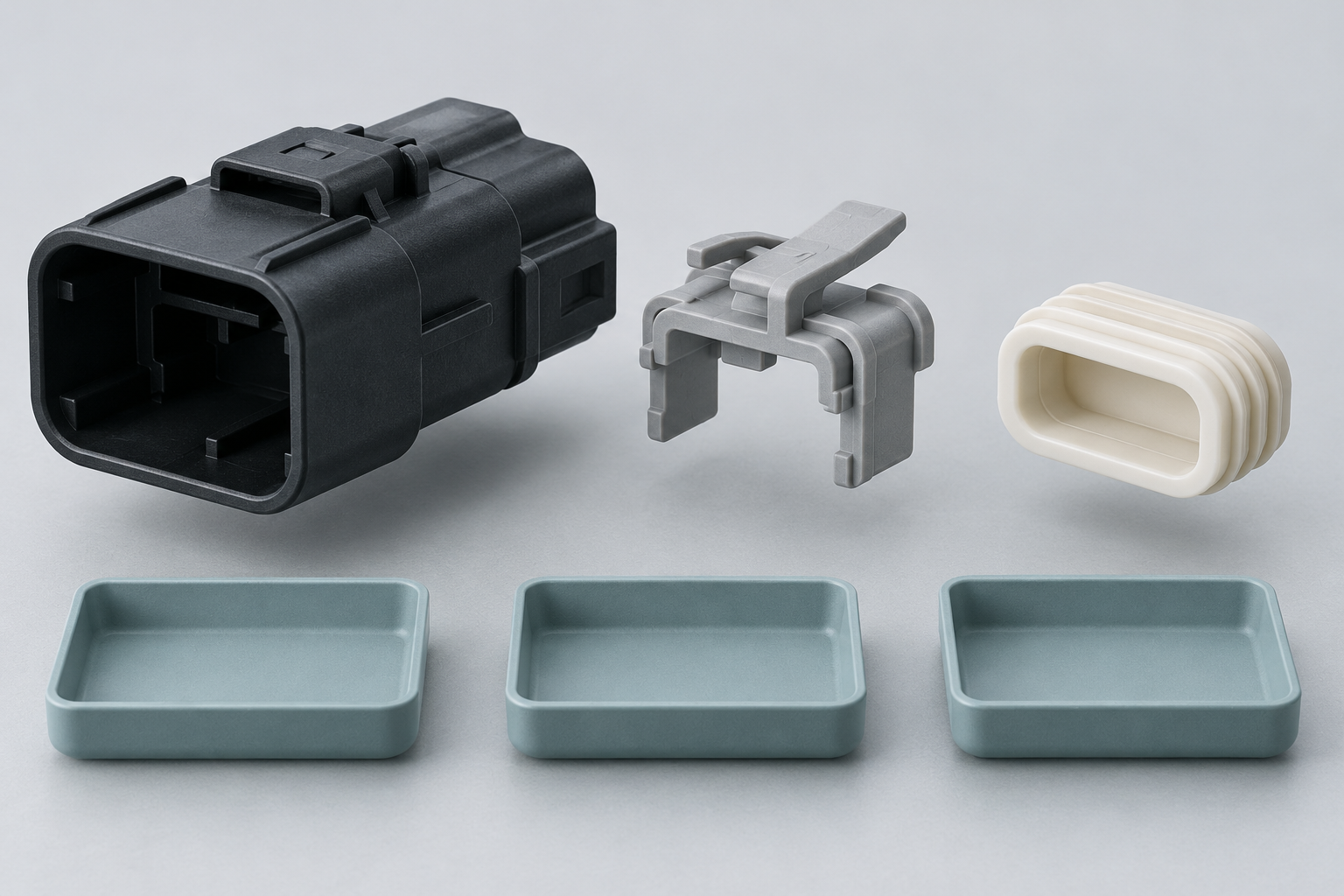
Consider this hypothetical procurement exercise, not a Rectivas customer case. A molder requests “RoHS halogen-free V-0 material” for a connector. A supplier replies with a RoHS statement and a flame-test report. The buyer marks both requirements complete because the documents look relevant.
The missing step is separating the request. The buyer needs a defined halogen requirement, relevant supporting evidence and a matching fire-performance scope. The RoHS statement does not resolve the unaddressed halogen question; the flame report does not resolve it either.
The purchasing team returns a short list of missing information: exact material and color, customer halogen specification, test methods and results, plus confirmation that the proposed formulation matches the documents. The supplier can then answer a concrete request instead of repeating a generic compliance claim.
If a supplier reports compliance with an exemption, record that basis and have its applicability checked for the intended product. Do not silently convert it into “no restricted substance present.” TE Connectivity’s compliance definitions illustrate why different status descriptions need to remain distinct.
Our Recommendation Before Approving a Grade
Give suppliers separate requirements for RoHS, halogen content and fire performance. Include the application, base resin, color, wall thickness and intended market. Ask for documents that identify the proposed grade and explain how each requirement is supported.
For procurement, compare the same scope across quotations. For formulators, check the full blend and proposed changes. For OEM material teams, align the supplier’s evidence with the product’s applicable obligations and customer specifications before approving a substitution.
Use the broader halogen-free vs halogenated flame retardants guide for formulation tradeoffs. This article addresses a narrower question: whether the documents prove the particular compliance and composition claims in your enquiry. Neither a green symbol nor a familiar acronym completes that assessment.
Frequently Asked Questions
Does RoHS compliant mean halogen-free?
No. RoHS concerns specified restricted substances within its applicable scope, while halogen-free requires a separate definition and evidence. A report addressing the named RoHS substances does not automatically determine every halogen in a plastic. Ask the supplier for the precise halogen requirement, test method and grade-specific supporting documents rather than treating the two descriptions as the same approval.
Can a halogen-free plastic fail a RoHS requirement?
Yes. A halogen-free claim does not establish compliance with every separate restriction concerning metals, plasticizers or other named substances. The final material and relevant product scope need their own review. Keep the requirements separate in the purchasing specification and document list. A satisfactory result for one chemical property cannot substitute for an assessment of a different restricted-substance requirement.
Are all brominated flame retardants prohibited by RoHS?
No. The presence of bromine is not itself the same as the presence of a specifically restricted substance group. However, that distinction does not approve any particular additive automatically. The exact formulation, impurities, applicable restrictions and supporting evidence still matter. If your customer requires halogen-free material, a RoHS declaration on a brominated system does not satisfy that separate requirement.
Does halogen-free literally mean no halogen can be detected?
Not necessarily. Commercial definitions may specify particular elements and concentration limits, or address intentional addition. They should not be interpreted without reading their scope. Ask which definition applies and whether the method can evaluate the required limits. A statement about bromine and chlorine should not be expanded into a claim that every halogen is absent under every analytical method.
What should I request from a material supplier?
Request the exact grade and color, a scoped RoHS statement, and the definition and evidence supporting the halogen-free claim. Ask for test methods, results, reporting limits, sample descriptions and relevant revision information. Record any exemption basis separately. Add the fire and mechanical requirements needed for the application so the quotation concerns the complete material decision rather than one isolated document.
Can one laboratory report cover both requirements?
A report may contain several relevant assessments, but its title alone does not show that both requirements were addressed. Review the analytes, methods, specimen and conclusions for each requirement. A combined report must still provide suitable evidence for its separate claims. Confirm that the submitted sample represents the offered grade, including color and formulation, and clarify any gaps before approval.
Will changing to halogen-free increase the purchase price?
There is no universal price change. Base resin, FR package, loading, processing and qualification requirements affect the comparison. First confirm whether the customer actually requires halogen-free material or a specific restricted-substance condition. Compare quotations against the same requirements, then include trial, rejection and qualification costs where relevant. A cheaper document package is not necessarily an equivalent material offer.
Can Rectivas help source material and supporting documents?
Rectivas works as a sourcing and technical partner with partner factories. Share the application and separate requirements for RoHS, halogen content and fire performance so suitable options and available documentation can be discussed. Sample availability, minimum order quantity, lead time and testing scope require confirmation for each proposal. Material documentation supports your assessment; it does not automatically establish finished-product compliance.
Final Thoughts
RoHS vs halogen-free is a distinction between different requirements and evidence. Define each claim, identify the complete formulation and check that the documents match the supplied grade. Keep fire performance separate as well. Rectivas can help discuss additive and compound options with partner factories once those requirements are clear, so the next quotation answers the actual material need rather than a collection of ambiguous labels.
— Rectivas Materials Team, Ally