Quick answer: Flame retardants work in one of two places — in the flame itself, or in the solid material. That distinction is not academic: gas-phase systems clear UL94 easily and struggle on glow wire, while char-forming systems behave the other way round. If your part has to pass both, the mechanism decides your chemistry before cost does.
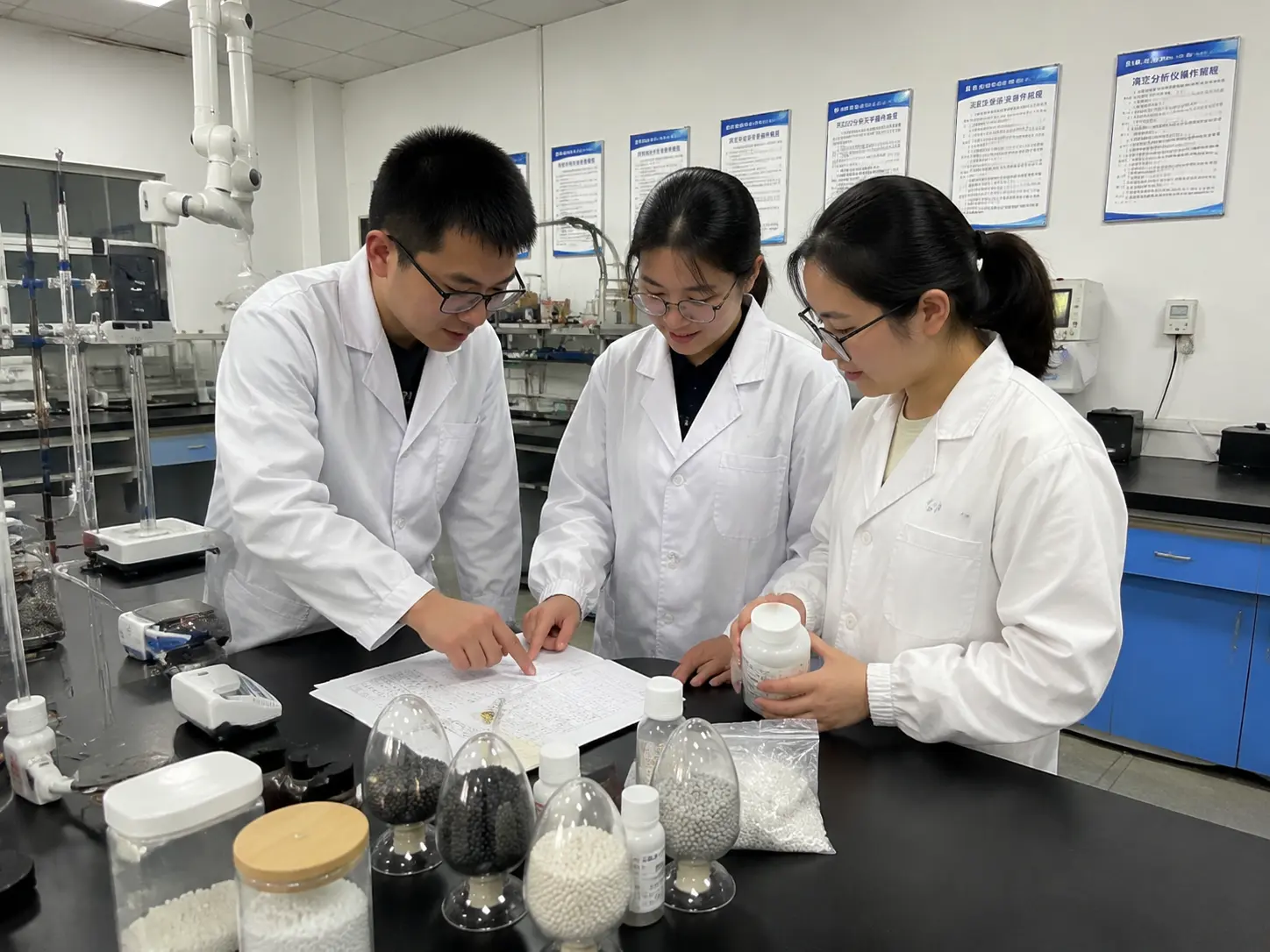
When a customer asks me why their V-2 compound keeps dripping flaming polymer, or why a competitor hits V-0 at 18% loading while they need 25%, the answer is almost never “use more additive.” It is almost always a mechanism mismatch. So here is the working model we use on the formulation floor — no chemistry degree required, but enough depth that you can read a TDS critically.
Start With How Polymers Burn
Q: Why do plastics burn at all? Because heat breaks polymer chains into small volatile fragments, and those fragments — not the solid — are what actually burns.
Polymer combustion is a loop with four stations:
- Heating — an external source raises the polymer surface temperature.
- Pyrolysis — chains crack into flammable gases (the “fuel”).
- Ignition — fuel gases mix with oxygen and ignite above the surface.
- Feedback — the flame radiates heat back down, accelerating pyrolysis.
Inside the flame itself, combustion is propagated by highly reactive H• and OH• radicals. Every flame retardant mechanism attacks one or more stations of this loop. Once you see the loop, every product category on our site slots into place.
Mechanism 1: Gas-Phase Radical Quenching
Q: How do brominated flame retardants work? They release halogen radicals into the flame that neutralise the H• and OH• radicals driving combustion — chemically starving the flame from inside.
Brominated (and chlorinated) flame retardants decompose slightly below the polymer’s pyrolysis temperature, releasing HBr into the gas phase. HBr swaps the hyperactive flame radicals for lazy Br• radicals, and the chain reaction stalls. This is why halogen systems are so efficient per kilogram: they poison the flame directly rather than fighting the whole heat balance.
Two practical notes. First, the mechanism is why antimony trioxide flame retardant exists as a product category: Sb₂O₃ has almost no effect alone, but with a bromine source it forms SbBr₃/SbOBr species that shuttle halogen radicals into the flame far more effectively — a 3:1 Br:Sb ratio can cut total loading by a third. Second, gas-phase action means more smoke: unburned fuel fragments leave the flame as soot, which is exactly the trade-off buyers weigh in our halogen-free vs halogenated comparison.
Mechanism 2: Condensed-Phase Char Formation
Q: What does “intumescent” mean? The additive system swells into a foamed carbon char that physically walls the polymer off from heat and oxygen.
Char formers work at the surface, not in the flame. A classic intumescent package built on ammonium polyphosphate has three actors: an acid source (APP releases phosphoric acid on heating), a carbon source (a polyol, or the polymer itself), and a blowing agent (typically melamine, releasing inert gas). Heat triggers the sequence — acid catalyses charring, gas foams the char — and within seconds the surface is covered by an insulating barrier that can expand to many times its original thickness.
The elegance of the condensed-phase route: it cuts heat feedback, blocks fuel release and produces little smoke, because the carbon stays on the part instead of leaving as soot. The catch is that char quality is polymer-dependent — PP chars beautifully with an intumescent package at 18–25%, while polymers that depolymerise cleanly (POM is the notorious case) leave nothing to char. Phosphinate salts like DEPAL extend the same condensed-phase logic to engineering polymers — the chemistry family is mapped on our phosphorus flame retardant page. Phosphorus is also the versatile one: depending on structure, it can act in the gas phase too (PO• radicals are decent quenchers), which is why some phosphorus systems punch above their loading.
Mechanism 3: Endothermic Cooling
Q: How can a simple mineral like aluminium hydroxide stop fire? By drinking the heat. ATH decomposes at ~180–200°C and MDH at ~300–340°C, and both reactions absorb large amounts of energy while releasing water vapour.
Mineral hydroxides attack station 1 of the loop: they hold the polymer below its pyrolysis temperature by soaking up incoming heat. Three effects stack up — the endothermic decomposition cools the substrate, the released steam dilutes fuel gases at the surface, and the remaining metal-oxide skeleton forms a heat-reflecting ceramic layer. Water vapour is also why magnesium hydroxide flame retardant and ATH dominate low-smoke applications: steam is the cleanest “flame retardant exhaust” there is, which is the entire premise of LSZH cable compounds.
The trade-off is brute-force loading. Because the mechanism is thermal rather than catalytic, you need 50–65% mineral in the compound to reach cable-grade performance — and that much filler reshapes mechanicals, viscosity and line speed. Mechanism choice is never free.
Mechanism 4: Dilution and Anti-Dripping
Two supporting mechanisms round out the toolbox. Fuel dilution: nitrogen compounds like melamine cyanurate release inert gases that thin the fuel/oxygen mixture below its flammability limit — melamine cyanurate in unfilled PA6 is the textbook case, passing V-0 partly by gas dilution and partly by dripping the flame away. Anti-dripping: a fraction of a percent of PTFE fibrillates into a network that holds the melt together — essential when a specification (UL94 V-0) treats flaming drips as failure, and a good example of how a “flame retardant package” contains actors that never touch the flame chemistry at all.
The Four Mechanisms Side by Side
| Mechanism | Where it acts | Typical chemistry | Typical loading | Strength / trade-off |
|---|---|---|---|---|
| Radical quenching | Gas phase (in the flame) | Brominated FR + Sb₂O₃ synergist | 10–20% | Most efficient per kg / more smoke, regulatory pressure |
| Char formation | Condensed phase (surface) | APP intumescent, phosphinates, red phosphorus | 8–25% | Low smoke, halogen-free / char depends on polymer |
| Endothermic cooling | Condensed phase (bulk) | ATH (~200°C), MDH (~330°C) | 50–65% | Cleanest smoke profile, low cost / high loading hits mechanicals |
| Dilution / anti-drip | Gas phase + melt | Melamine cyanurate, PTFE anti-drip | MC 5–15%; PTFE 0.1–0.5% | Gentle on mechanicals / rarely sufficient alone |
Matching Mechanism to Polymer: How We Actually Decide
On a real project the decision runs through three questions, in order:
- What does the polymer want to do when it burns? Char-friendly backbones (PP with an acid catalyst, epoxy, PC) reward condensed-phase systems. Clean-depolymerising or heavily plasticised systems push you toward gas-phase or mineral routes.
- What does the specification punish? A smoke-limited spec (LSZH, plenum, ASTM E84’s SDI limit) effectively bans heavy gas-phase halogen use. A drip-sensitive UL94 V-0 spec demands anti-drip in the package.
- What can the process tolerate? ATH’s ~200°C decomposition rules it out of PA66 or PBT processing at 260–280°C — you switch to MDH or phosphinates. Mechanism selection is also a processing-window decision.
One field example: an Indian customer making PP junction boxes was running a brominated package at 16% and failing glow wire, with smoke complaints from their end user. Same resin, swapped to an APP-based intumescent at 22%: V-0 at 1.6 mm held on our FR-PP base, glow wire passed, smoke visibly cleaner in the side-by-side burn video we shot for them. Nothing magical — the condensed-phase mechanism simply fit the failure mode better. That kind of substitution logic, spec by spec, is what our selection guide on how to choose flame retardants for plastics walks through resin by resin.
And whichever mechanism wins, the delivery format question — powder blend into a twin-screw line, or pellet concentrate into an injection press — is a separate decision with its own logistics; the full portfolio by chemistry and form sits under flame retardant additives. If you want a mechanism recommendation for a specific part, send us the resin, wall thickness and the exact specification line — request a quote and our partner factory’s lab will come back with a starting package and screening data. Mechanism aside, there is a second split worth understanding — whether the flame retardant is bonded into the polymer or merely mixed in: reactive vs additive flame retardants.
FAQ
Do flame retardants make plastic fireproof?
No. Every organic polymer burns if you put enough energy into it. Flame retardants delay ignition, slow flame spread and buy escape time — the difference between a part that self-extinguishes when the ignition source is removed and one that propagates the fire.
Which mechanism is “best”?
None of them universally. Gas-phase halogen is the most efficient per kilogram; condensed-phase char gives the best smoke profile at moderate loading; mineral cooling is cheapest per kilogram and cleanest but demands the highest loading. The best mechanism is the one that matches your polymer’s burning behaviour and your specification’s pass criteria.
Why do flame retardant plastics sometimes still drip when burning?
Because most flame retardants do not change melt behaviour. Thermoplastics soften and flow regardless of flame chemistry. If your spec fails parts on flaming drips, the package needs a dedicated anti-dripping agent (typically fibrillating PTFE) — it is a mechanical fix, not a chemical one.
Can I combine mechanisms from different suppliers?
Chemically yes, and commercial packages do it constantly (bromine + antimony, APP + melamine, MDH + phosphinate). But antagonism is real too — some combinations interfere with each other’s chemistry or wreck processing. Screen combined systems with LOI and UL94 before committing to a production trial; we arrange exactly this screening for customer-supplied combinations.
Final Thoughts
Mechanism matters commercially because it decides which test you can pass. Gas-phase systems clear UL94 easily and struggle on glow wire; condensed-phase char systems behave the opposite way. If your specification stacks both, the chemistry has to be chosen for the harder one. Our chemical families overview sorts the additive range by which mechanism they use – tell us the tests you must pass and we will start from there.
—— Rectivas Materials 团队 老陈