Quick answer: Work in this order and most of the guesswork disappears: identify the base resin, define the standard you must actually pass, then choose chemistry and product form last. Reversing it — picking a product first and hoping it suits the resin — is how trial batches get wasted. The resin rules out more options than any other single input.
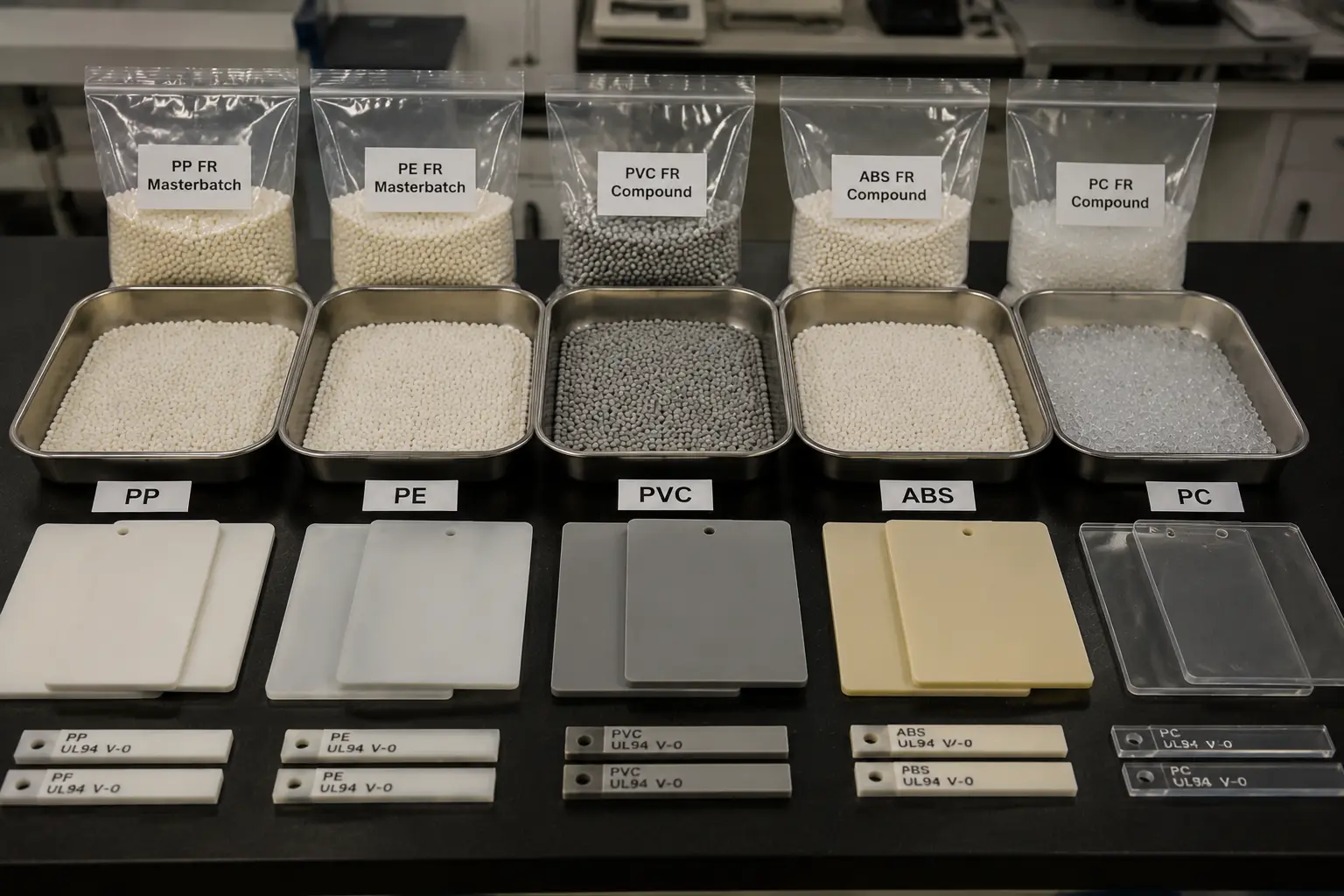
Do not start by asking for a product name. A useful flame retardant selection starts with the base resin, processing method, target flame rating, smoke or compliance requirement, mechanical property limits, and whether the production line needs additives or masterbatch.
Three Inputs That Decide 80% of It
Before anyone can give you a useful recommendation, these three have to be settled. Missing any one of them is why quotes come back vague.
| Input | What It Rules Out |
|---|---|
| 1. Base resin (and glass content) | Most of the options. Glass fibre kills dripping-based chemistry outright; POM rules out nearly everything; PVC needs almost none |
| 2. The standard, with thickness | A rating without a thickness is not a target. And if a glow wire or CTI clause is attached, that usually decides the chemistry before the burn rating does |
| 3. Your equipment | The product form. No twin-screw line means powder is not an option, whatever the price list says |
One thing worth checking before any of this: whether the clause on your drawing is as demanding as you think. HB requires only that a horizontal specimen burns slower than 40 mm/min, and many filled resins already pass untreated. We have quoted V-0 packages for parts whose drawings turned out to say HB — the correct answer there was that they did not need us for that component.
The Short Answer: Start with Resin, Standard and End Use
- Identify the polymer. PP, PE, PVC, PC, PC/ABS, PA, ABS, PU and LSZH compounds need different flame retardant systems because processing temperature and polarity differ.
- Define the target standard. UL94 V-0, V-1, V-2, LOI, low-smoke or LSZH targets lead to different loading levels, synergists, product forms and test plans.
- Select system and form. Decide whether the project needs halogen-free or halogenated chemistry, then decide whether direct additives or flame retardant masterbatch fits the plant workflow.
Flame Retardant Selection Flow for Plastics
Use this matrix before requesting samples. It turns a vague question into a technical RFQ by linking resin, target standard, system chemistry, product form and validation requirements.
| Selection Step | What to Confirm | Why It Matters |
|---|---|---|
| 1. Base resin | PP, PE, PVC, PC, PC/ABS, PA, ABS, PU or LSZH compound | Each polymer has different processing temperature, polarity and mechanical sensitivity |
| 2. Target standard | UL94 V-0 / V-1 / V-2, LOI, low smoke, LSZH, IEC cable requirements | Target rating affects loading level, synergist, smoke behavior and test thickness |
| 3. Chemistry direction | Halogen-free, halogenated, brominated, phosphorus, nitrogen-phosphorus or mineral system | Compliance, smoke, efficiency and cost often depend on chemistry direction |
| 4. Product form | Powder additive, liquid additive, compounded blend or flame retardant masterbatch | Form determines dosing, dispersion, handling and production workflow |
| 5. Processing method | Compounding, extrusion, injection molding, coating or cable compounding | Feeding equipment and processing temperature affect product form and stability |
| 6. Compliance needs | RoHS, REACH, halogen-free, customer restricted substances, smoke density | Compliance can eliminate technically strong but market-unacceptable systems |
| 7. Trial validation | Sample quantity, target thickness, color, mechanical property limits and annual demand | Final selection must be proven through processing and flame testing |
Match the Flame Retardant to the Plastic Resin
The same flame retardant system may not work across different plastics. PP, PVC, PC, PC/ABS, PA, ABS and LSZH compounds have different processing temperature, polarity, smoke behavior, mechanical property and color requirements.
- PP / Polypropylene — often needs phosphorus-nitrogen, intumescent or compounded systems with careful drip, smoke and mechanical balance. See flame retardant additives for polypropylene.
- PVC — selection depends on flexible or rigid PVC, plasticizer, smoke target and whether low-smoke or legacy systems are acceptable. See PVC flame retardant additives.
- PC / PC-ABS — often needs engineering plastic flame retardants with attention to UL94 thickness, heat resistance, color and impact strength. See flame retardant polycarbonate additives.
- ABS — housings and E&E parts commonly use brominated or halogen-free routes. See flame retardant ABS additives.
- PA / Nylon and LSZH cable — PA may need reinforced high-temperature systems; LSZH cable compounds need low-smoke and mechanical balance. See flame retardant cable compounds.
Choose Chemistry Direction and Product Form Separately
Two decisions are often mixed together: chemistry direction and supply form. First decide whether the project needs halogen-free, halogenated or low-smoke chemistry. Then decide whether the plant needs powder additives, compounded blends or flame retardant masterbatch.
- Halogen-free systems — useful for low-smoke, RoHS, REACH, LSZH, non-halogenated and customer restricted-substance requirements. Compare in Halogen-Free vs Halogenated Flame Retardants.
- Halogenated / brominated systems — may be considered when the market allows them and the project needs high efficiency, lower loading or cost control.
- Flame retardant additives — best for compounders needing formulation control, active loading adjustment and custom recipe development.
- Flame retardant masterbatch — best for processors needing cleaner dosing, pre-dispersion and easier let-down in extrusion or injection molding. Compare in Flame Retardant Additives vs Masterbatch.
Validate Flame Rating, Processing and Mechanical Properties Together
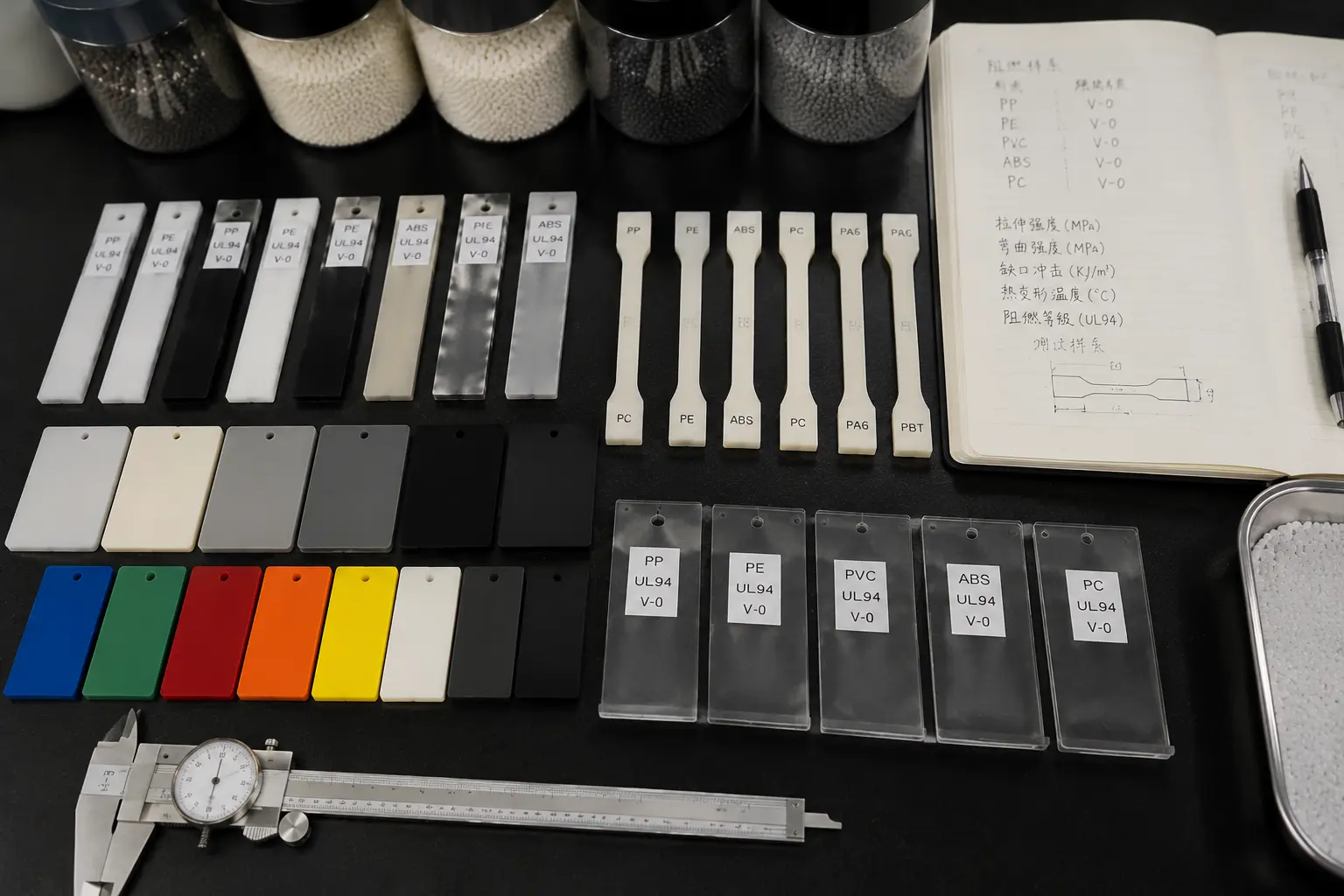
A flame retardant system should not be selected only by a catalog claim. Final selection must confirm flame rating, part thickness, smoke, color, processing stability, dispersion, mechanical property retention and compliance documentation:
- UL94 rating and thickness
- LOI or oxygen index
- Smoke density target
- Processing temperature
- Dispersion and feeding
- Color or transparency
- Impact and tensile retention
- RoHS / REACH documents
- Trial quantity and scale-up
Frequently Asked Questions
How do you choose flame retardants for plastics?
Start with the base resin, then define the target standard, smoke and compliance needs, processing method, color, mechanical property limits and whether the buyer needs additives or masterbatch.
Which resin information is needed for flame retardant selection?
Share the base polymer such as PP, PE, PVC, PC, PC/ABS, PA, ABS or LSZH compound, including resin grade, filler, glass fiber, processing temperature and final application.
Should buyers choose flame retardant additives or masterbatch?
Choose additives for formulation control and masterbatch for cleaner dosing, easier handling and pre-dispersion. The best form depends on equipment, feeding method and production workflow.
What should be included in a flame retardant RFQ?
Include base resin, processing method, target standard, part thickness, halogen-free or halogenated requirement, smoke target, color, mechanical property needs, sample quantity and annual demand.
Final Thoughts
Work in that order and most of the guesswork disappears: resin first, standard second, chemistry and form last. Reversing it – picking a product then hoping it suits the resin – is how trials get wasted. Once you know the first two, our additive range and masterbatch line are both organised by resin, and we will pre-screen a proposed system at your wall thickness before you commit to a trial.