Quick answer: Compare flame retardant additives vs masterbatch by the formulation work your process can control. Additives offer direct control of ingredients when suitable feeding, mixing and validation are available, either internally or through a compounder. Masterbatch supplies a pre-dispersed concentrate but still needs compatible resin, accurate dosing and adequate mixing. A finished compound is a third route when you need one formulated material feed.
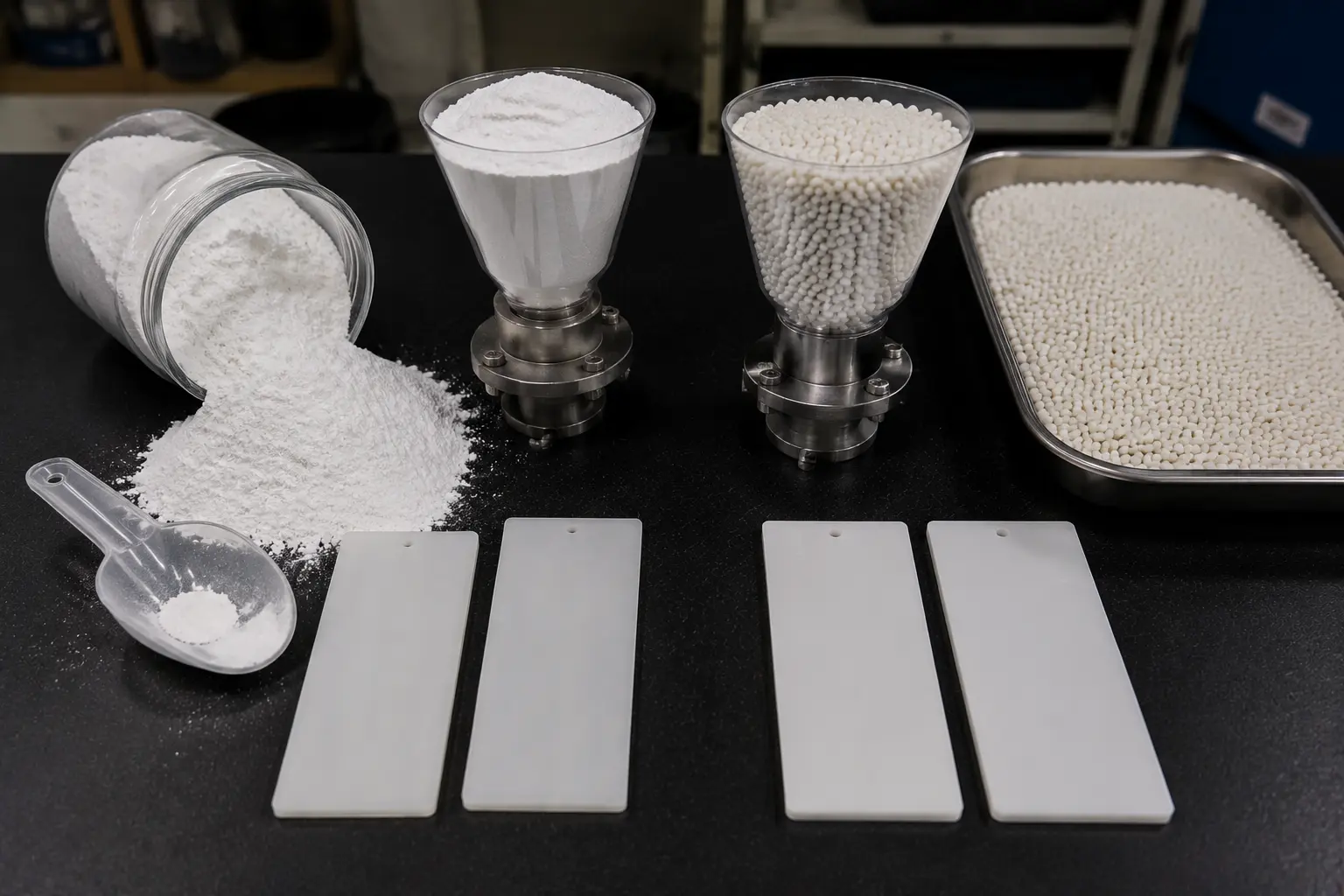
Flame retardant additives give more formulation control. Flame retardant masterbatch gives cleaner dosing and easier processing. The right choice depends on whether your team can handle powder feeding, dispersion, recipe control and testing in-house.
Three Checks Before You Compare Quotes
- Who controls incorporation? Identify the equipment and responsibility for feeding, mixing and dispersion. Owning a twin-screw line is not the only route: a qualified contract compounder may perform the formulation step. Confirm that the chosen route can process the proposed additive package.
- What can the final processing line handle? For masterbatch, confirm the supplier’s let-down instructions, feeder accuracy, carrier compatibility and mixing capability at the required output. A pellet form does not guarantee adequate distribution in every molding or extrusion process.
- What must the finished part retain? Agree the fire method, thickness, mechanical properties, color and other requirements. Compare candidate formulations against the same acceptance criteria rather than selecting by supply form or price alone.
For a formulation-led inquiry, review the flame retardant additives range. For a concentrate matched to your resin and dosing process, review the masterbatch range. Both routes need a representative trial.
The Short Answer: Control vs Convenience
- Choose additives for recipe control. Better when compounders need to adjust active loading, combine synergists and optimize cost or mechanical properties directly. Requires powder handling.
- Choose masterbatch for processing ease. Better when processors need cleaner feeding, pre-dispersed active ingredients and simpler let-down during extrusion or injection molding.
- Test both when the target is tight. For UL94 V-0, low-smoke, thin-wall, color-sensitive or mechanical-critical projects (PC, PA, LSZH), compare both forms through sample testing before locking the supply form.
Flame Retardant Additives vs Masterbatch: Decision Matrix
Use this matrix before requesting samples. It helps procurement and technical teams decide whether a flame retardant additive or flame retardant masterbatch is the better starting point.
| Decision Factor | Additives | Masterbatch |
|---|---|---|
| Formulation control | High — adjust active loading and synergists directly | Medium — depends on pre-made concentrate design |
| Dosing and handling | Requires powder or liquid feeding control | Cleaner — pellet form is easier to dose |
| Dispersion | Depends on mixer, screw design and feeding accuracy | Pre-dispersed in a compatible carrier resin |
| Carrier resin compatibility | No carrier resin, but compatibility must be proven in the formula | Must match PP, PE, PVC, PC/ABS, PA or other base resin |
| Cost control | More direct active cost control for high-volume compounding | May cost more per active ingredient, but saves handling complexity |
| Best buyer type | Compounders, formulation labs, resin modifiers | Molders, extruders, converters, production plants |
When to Choose Flame Retardant Additives
Choose flame retardant additives when you need maximum control over the complete formulation. This is common for compounders and manufacturers that already manage mixing, feeding, extrusion and quality testing:
- Custom recipes — precise balance of flame retardant, synergist, filler, pigment and processing additive
- Active loading control — iterative loading adjustment for cost, UL94 rating, LOI, smoke and mechanical properties
- High-volume compounding — powder handling already available, total active ingredient cost matters
- Technical development — R&D teams testing halogen-free, halogenated, phosphorus, nitrogen-phosphorus or mineral systems
When to Choose Flame Retardant Masterbatch
Choose flame retardant masterbatch when the production team needs a cleaner pellet form, easier dosing and more consistent dispersion — especially for processors that do not want to handle powder flame retardants on the production floor:
- Cleaner dosing — pellet form reduces dust, improves handling, simplifies the operator’s workflow
- Pre-dispersion — active ingredients pre-dispersed in a carrier resin, reducing burden on the final processing line
- Let-down convenience — useful for extrusion and injection molding with a defined addition ratio
- Plant compatibility — best when carrier resin matches the base polymer for a stable, repeatable route
The Third Option: Ready-Made Compound
Additives and masterbatch are not the only two routes, and framing the decision as a pair is where some buyers get stuck. The third format is a flame retardant compound — a finished pellet with the flame retardant already dispersed at the correct loading, which you feed straight into the moulding machine as a single material stream.
Consider finished compound when a single material feed, reduced formulation responsibility or a complete property specification suits your process. Evaluate it when concentrate dosing or mixing is difficult, or when trial results show that the current route is unreliable. There is no universal masterbatch percentage at which the decision changes: composition, equipment, output, reject costs and qualification requirements all matter.
A finished grade fixes more of the formulation at purchase. Confirm the resin, color, properties and processing instructions for each proposed grade, and request supporting evidence at the required thickness before approving a flame classification. Available supply routes are described on the flame retardant compound page.
If a quotation uses the terms interchangeably, our guide to flame retardant masterbatch compounds explains the material forms and their limits.
Do Not Compare Only the Price per Kilogram
A flame retardant additive may look cheaper per kilogram, while masterbatch may reduce production handling, dust, feeding loss and dispersion problems. The real comparison is total formulation and processing cost — active ingredient cost, let-down ratio, feeding equipment, dispersion stability, dust and handling loss, carrier resin compatibility, mechanical property retention, UL94/LOI pass rate and production repeatability.
Where Buyers Get This Wrong
Check these three points when preparing a trial and comparing quotations.
Compare equivalent formulations. A concentrate price includes its carrier and additive package. Divide its price by the declared active mass fraction only when comparing the same defined active package. That result is a price per kilogram of active, not the price of a usable final material. Include base resin and all other ingredients in the blend cost, then evaluate relevant handling, conversion and reject costs.
Keep carrier and let-down calculations separate. If a concentrate contains 50% carrier and is used at 20% of the final blend, it contributes 10% carrier by blend mass: 0.50 × 0.20 = 0.10. This is hypothetical composition arithmetic, not a grade specification or dosage recommendation. A 30% masterbatch addition does not by itself tell you the carrier fraction. Also clarify whether the addition is defined on final-blend or base-resin mass.
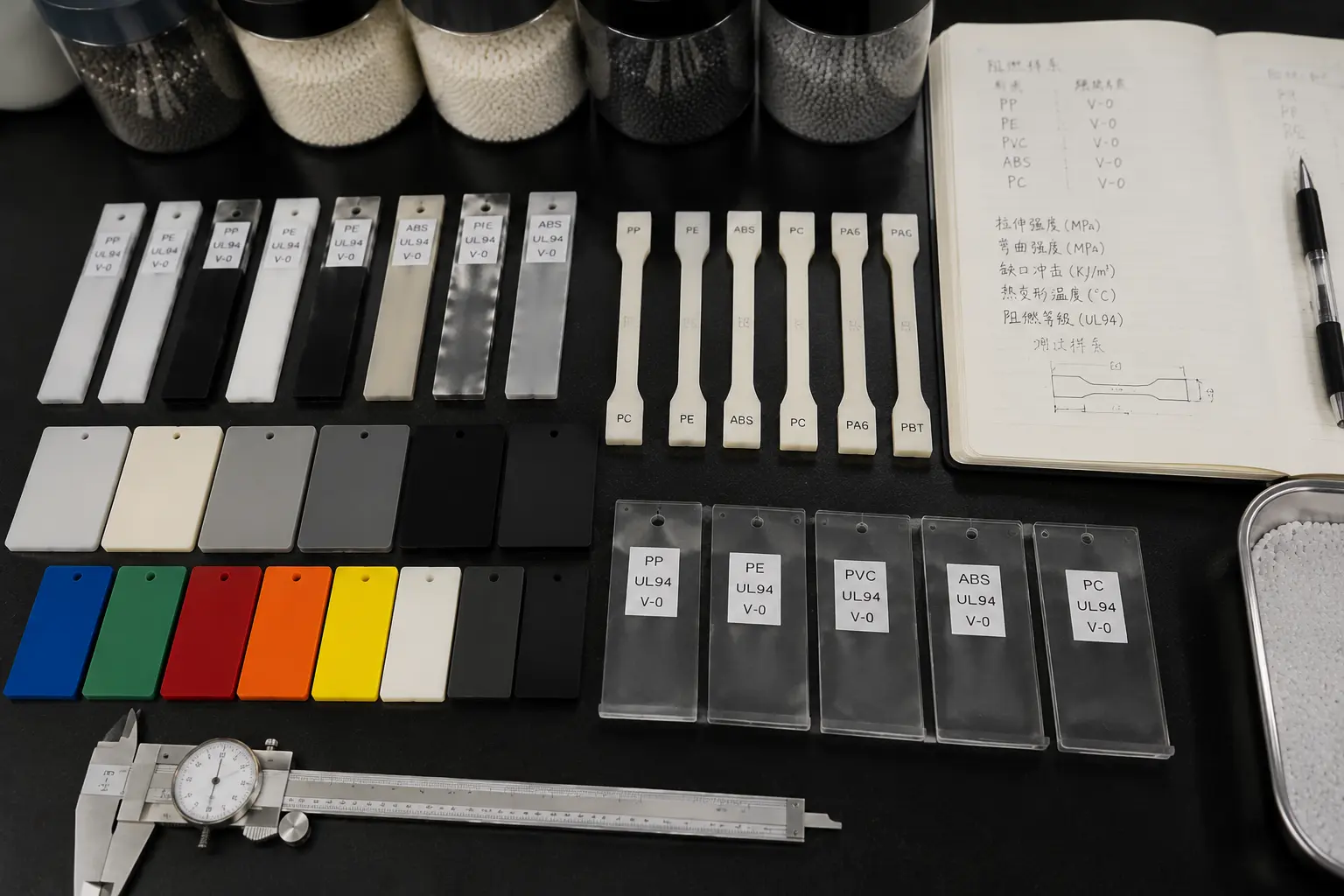
Qualify the intended production process. A bench trial and a production line may differ in feeding, screw configuration, output and residence time. Record the formulation and relevant settings, retain representative samples, and verify the required fire and mechanical properties. Pre-dispersion reduces some incorporation work; it does not remove all processing or qualification risks.
For a supplier example of the distinction between concentrate and directly usable compound, see the LEHVOSS flame retardant brochure. Its grade results are supplier-specific and are not specifications for material supplied by Rectivas.
Frequently Asked Questions
What is the difference between flame retardant additives and flame retardant masterbatch?
Flame retardant additives are active ingredients or blends added during formulation. Flame retardant masterbatch is a pre-dispersed concentrate with a carrier resin for easier dosing and cleaner processing.
When should a compounder choose flame retardant additives?
A compounder should choose flame retardant additives when it needs direct recipe control, adjustable active loading, flexible cost control and in-house dispersion management.
When should a processor choose flame retardant masterbatch?
A processor should choose flame retardant masterbatch when it needs cleaner dosing, pre-dispersion, easier feeding, reduced powder handling and compatibility with extrusion or injection molding lines.
Is there an option other than additives and masterbatch?
Yes — a ready-made flame retardant compound, supplied as finished pellets with the flame retardant already dispersed. It can simplify formulation and feeding at the converter, but still needs grade-specific processing and finished-part validation. Compare its complete material cost and flexibility against your actual concentrate or additive route; there is no universal loading threshold or price ranking.
What information is needed to compare additives and masterbatch?
Share the base resin, processing method, powder feeding capability, target flame rating, part thickness, halogen-free or halogenated requirement, color, mechanical property needs and trial volume.
Final Thoughts
Choose the supply form after checking who controls formulation, what the production line can mix and dose, and which finished-part requirements must be met. Compare the additive route, masterbatch concentrate and finished compound against the same criteria. Rectivas can coordinate sourcing and sample discussions with partner factories using your resin, process, test specification and expected order volume.
If you land on the powder side of this decision, the next question is not which chemistry but which grade your extruder can actually process. Particle size, surface treatment and active content decide that — the specification side of compounding flame retardants covers what to put on the enquiry.
If the decision lands on masterbatch, the next question is which one — and that comes down to carrier, active content and your process rather than chemistry. The four-step sequence is in how to choose a flame retardant masterbatch. For halogen-free projects, also consider carrier contribution, incorporation and the required properties. Further purchasing questions are covered in halogen free compound buying guide.