Quick answer: If you do not run a twin-screw line, this question is already decided — powder additives are not for you, however much cheaper they look per kilo. If you do run one, the honest comparison is not powder against pellets but cost per rated part: active content, the resin your masterbatch carrier displaces, and what a failed dispersion batch costs you in scrap.
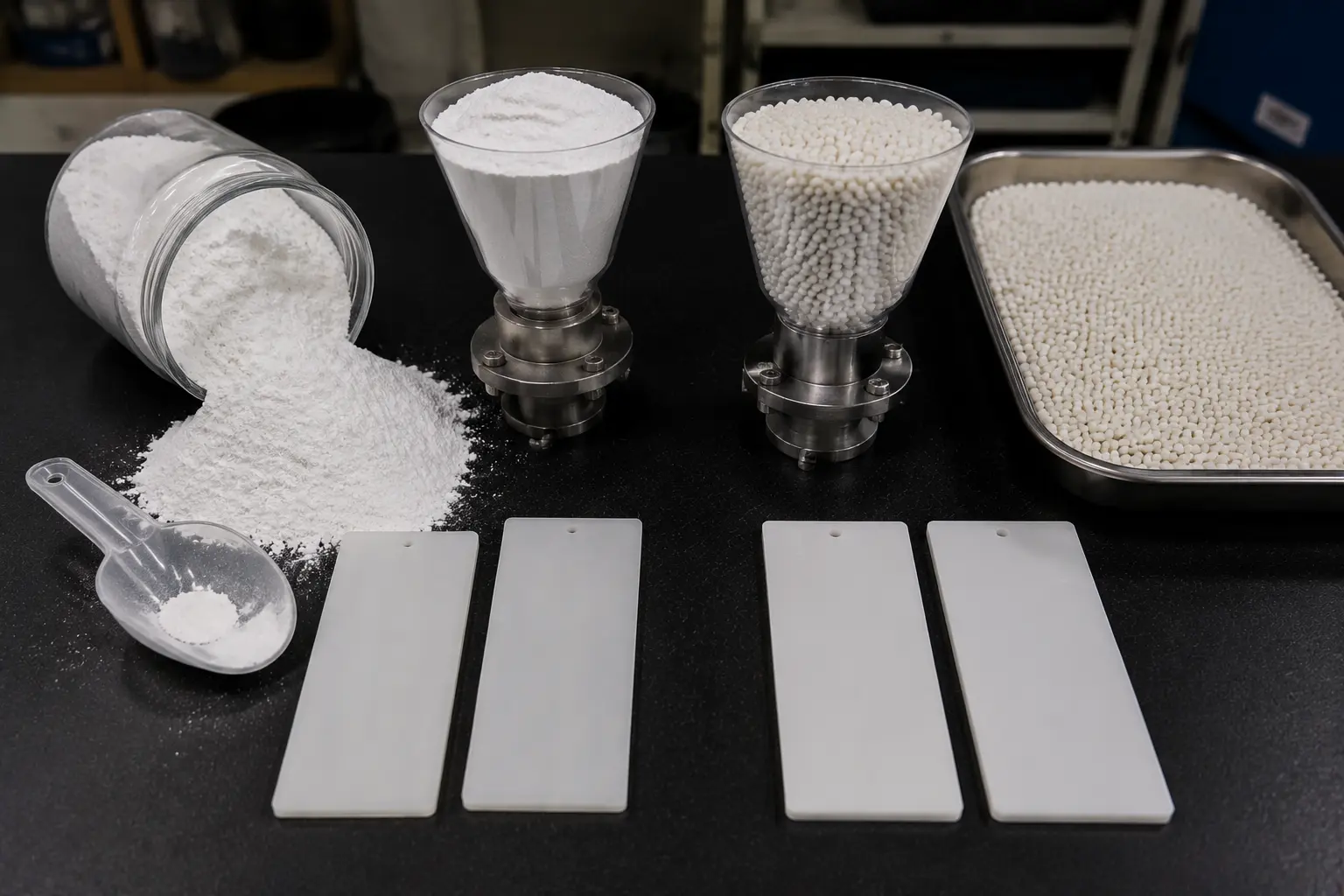
Flame retardant additives give more formulation control. Flame retardant masterbatch gives cleaner dosing and easier processing. The right choice depends on whether your team can handle powder feeding, dispersion, recipe control and testing in-house.
Three Questions That Settle It
Before comparing any quote, answer these. In most cases the first one alone decides the outcome, and buyers who skip it end up paying for equipment they do not have.
| Question | If yes | If no |
|---|---|---|
| 1. Do you own twin-screw compounding? | Powder is open to you and usually cheapest per kilo of active | Stop here. Masterbatch or compound. Dosing powder on a moulding machine does not work at flame retardant loadings |
| 2. Is your loading above roughly 40–50%? | Neither form is sensible — go to finished compound | Both remain viable; decide on question 3 |
| 3. Are your mechanical or colour targets tight? | Powder gives you formulation control the carrier would otherwise take away | Masterbatch buys you consistency and less dust for a modest premium |
The awkward part nobody quotes on: if you answered no to the first question and a supplier is still quoting you powder because it looks cheaper on the price list, they are selling you a problem you will discover on the production floor rather than in the quotation. We would rather lose that order than have it come back as scrap.
The Short Answer: Control vs Convenience
- Choose additives for recipe control. Better when compounders need to adjust active loading, combine synergists and optimize cost or mechanical properties directly. Requires powder handling.
- Choose masterbatch for processing ease. Better when processors need cleaner feeding, pre-dispersed active ingredients and simpler let-down during extrusion or injection molding.
- Test both when the target is tight. For UL94 V-0, low-smoke, thin-wall, color-sensitive or mechanical-critical projects (PC, PA, LSZH), compare both forms through sample testing before locking the supply form.
Flame Retardant Additives vs Masterbatch: Decision Matrix
Use this matrix before requesting samples. It helps procurement and technical teams decide whether a flame retardant additive or flame retardant masterbatch is the better starting point.
| Decision Factor | Additives | Masterbatch |
|---|---|---|
| Formulation control | High — adjust active loading and synergists directly | Medium — depends on pre-made concentrate design |
| Dosing and handling | Requires powder or liquid feeding control | Cleaner — pellet form is easier to dose |
| Dispersion | Depends on mixer, screw design and feeding accuracy | Pre-dispersed in a compatible carrier resin |
| Carrier resin compatibility | No carrier resin, but compatibility must be proven in the formula | Must match PP, PE, PVC, PC/ABS, PA or other base resin |
| Cost control | More direct active cost control for high-volume compounding | May cost more per active ingredient, but saves handling complexity |
| Best buyer type | Compounders, formulation labs, resin modifiers | Molders, extruders, converters, production plants |
When to Choose Flame Retardant Additives
Choose flame retardant additives when you need maximum control over the complete formulation. This is common for compounders and manufacturers that already manage mixing, feeding, extrusion and quality testing:
- Custom recipes — precise balance of flame retardant, synergist, filler, pigment and processing additive
- Active loading control — iterative loading adjustment for cost, UL94 rating, LOI, smoke and mechanical properties
- High-volume compounding — powder handling already available, total active ingredient cost matters
- Technical development — R&D teams testing halogen-free, halogenated, phosphorus, nitrogen-phosphorus or mineral systems
When to Choose Flame Retardant Masterbatch
Choose flame retardant masterbatch when the production team needs a cleaner pellet form, easier dosing and more consistent dispersion — especially for processors that do not want to handle powder flame retardants on the production floor:
- Cleaner dosing — pellet form reduces dust, improves handling, simplifies the operator’s workflow
- Pre-dispersion — active ingredients pre-dispersed in a carrier resin, reducing burden on the final processing line
- Let-down convenience — useful for extrusion and injection molding with a defined addition ratio
- Plant compatibility — best when carrier resin matches the base polymer for a stable, repeatable route
The Third Option: Ready-Made Compound
Additives and masterbatch are not the only two routes, and framing the decision as a pair is where some buyers get stuck. The third format is a flame retardant compound — a finished pellet with the flame retardant already dispersed at the correct loading, which you feed straight into the moulding machine as a single material stream.
It becomes the sensible choice in three situations. First, when the required loading is high: above roughly 40% masterbatch addition you are handling two bulk streams and paying a compounding step for material that is mostly flame retardant anyway. Second, when you mould but do not compound — no twin-screw line, no accurate gravimetric feeder. Third, when dispersion problems are producing rejects, because in a compound that work has already been done on equipment built for it.
The trade is flexibility and price per kilogram: one SKU per grade and colour instead of one masterbatch serving your whole range. Our grades — FR-PP, FR-ABS, FR-PA6, FR-PA66, FR-PC, FR-PBT and FR-PPO, typically UL94 V-0 at 1.6 mm — are listed on the flame retardant compound page.
Do Not Compare Only the Price per Kilogram
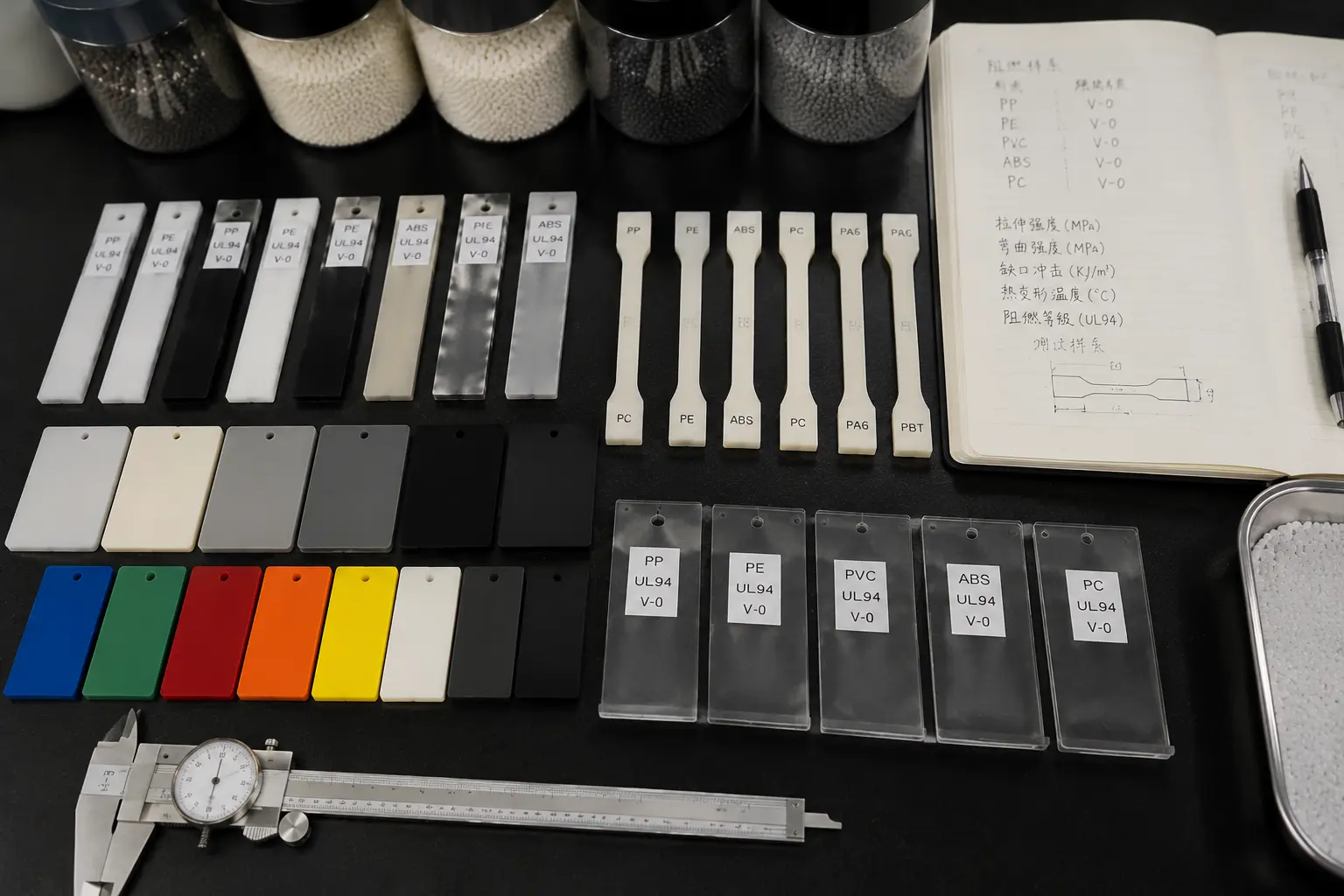
A flame retardant additive may look cheaper per kilogram, while masterbatch may reduce production handling, dust, feeding loss and dispersion problems. The real comparison is total formulation and processing cost — active ingredient cost, let-down ratio, feeding equipment, dispersion stability, dust and handling loss, carrier resin compatibility, mechanical property retention, UL94/LOI pass rate and production repeatability.
Where Buyers Get This Wrong
Three patterns we see repeatedly, all of them expensive.
Comparing price per kilo instead of price per kilo of active. A masterbatch at 50% active content costs twice what the number on the quote suggests, because half of what you are buying is carrier resin. Ask every supplier for active content in the same enquiry and normalise the quotes yourself — the ranking often reverses when you do.
Forgetting the carrier ends up in the part. At a 30% let-down ratio, roughly a third of what you added is somebody else’s polymer sitting in your product. If your base resin is a specific grade chosen for impact or flow, a mismatched carrier quietly undoes part of that choice. This is not an argument against masterbatch — it is an argument for asking what the carrier is before you buy.
Assuming a bench trial predicts production. Powder that disperses beautifully in a lab twin-screw can behave differently on a production line with different screw configuration, throughput and residence time. If you are switching form, qualify on the line that will actually run it, and against your worst incoming lot rather than a sample bag.
Frequently Asked Questions
What is the difference between flame retardant additives and flame retardant masterbatch?
Flame retardant additives are active ingredients or blends added during formulation. Flame retardant masterbatch is a pre-dispersed concentrate with a carrier resin for easier dosing and cleaner processing.
When should a compounder choose flame retardant additives?
A compounder should choose flame retardant additives when it needs direct recipe control, adjustable active loading, flexible cost control and in-house dispersion management.
When should a processor choose flame retardant masterbatch?
A processor should choose flame retardant masterbatch when it needs cleaner dosing, pre-dispersion, easier feeding, reduced powder handling and compatibility with extrusion or injection molding lines.
Is there an option other than additives and masterbatch?
Yes — a ready-made flame retardant compound, supplied as finished pellets with the flame retardant already dispersed. It removes dosing and dispersion entirely and is usually the better route above roughly 40% masterbatch addition, or for moulders without compounding capability. It costs more per kilogram and gives less formulation flexibility.
What information is needed to compare additives and masterbatch?
Share the base resin, processing method, powder feeding capability, target flame rating, part thickness, halogen-free or halogenated requirement, color, mechanical property needs and trial volume.
Final Thoughts
The form question answers itself once you know your own equipment. Own a twin-screw line and powder additives give you the lowest cost per kilo of active. No compounding capacity, and masterbatch removes the dispersion risk from your process. Above roughly 40-50% loading, neither is sensible and ready-to-mould compound is the honest answer. Tell us your line and volume and we will say which of the three we would sell you.
If you land on the powder side of this decision, the next question is not which chemistry but which grade your extruder can actually process. Particle size, surface treatment and active content decide that — the specification side of compounding flame retardants covers what to put on the enquiry.
If the decision lands on masterbatch, the next question is which one — and that comes down to carrier, active content and your process rather than chemistry. The four-step sequence is in how to choose a flame retardant masterbatch. For halogen-free grades the format decision is usually settled by loading: above roughly 40 % addition you are compounding, not dosing. That case is made in halogen free compound buying guide.