Quick answer: A halogen free compound is a formulated polymer material that meets a stated halogen-content requirement. In flame-retardant applications, it combines a base resin with a non-halogenated retardant system and other ingredients. Common routes include mineral-filled polyolefins and phosphorus- or nitrogen-based engineering-plastic formulations. Its strength, flexibility, processing behaviour and fire performance depend on the complete grade. “Halogen-free” alone does not establish low smoke, non-combustibility or application approval.
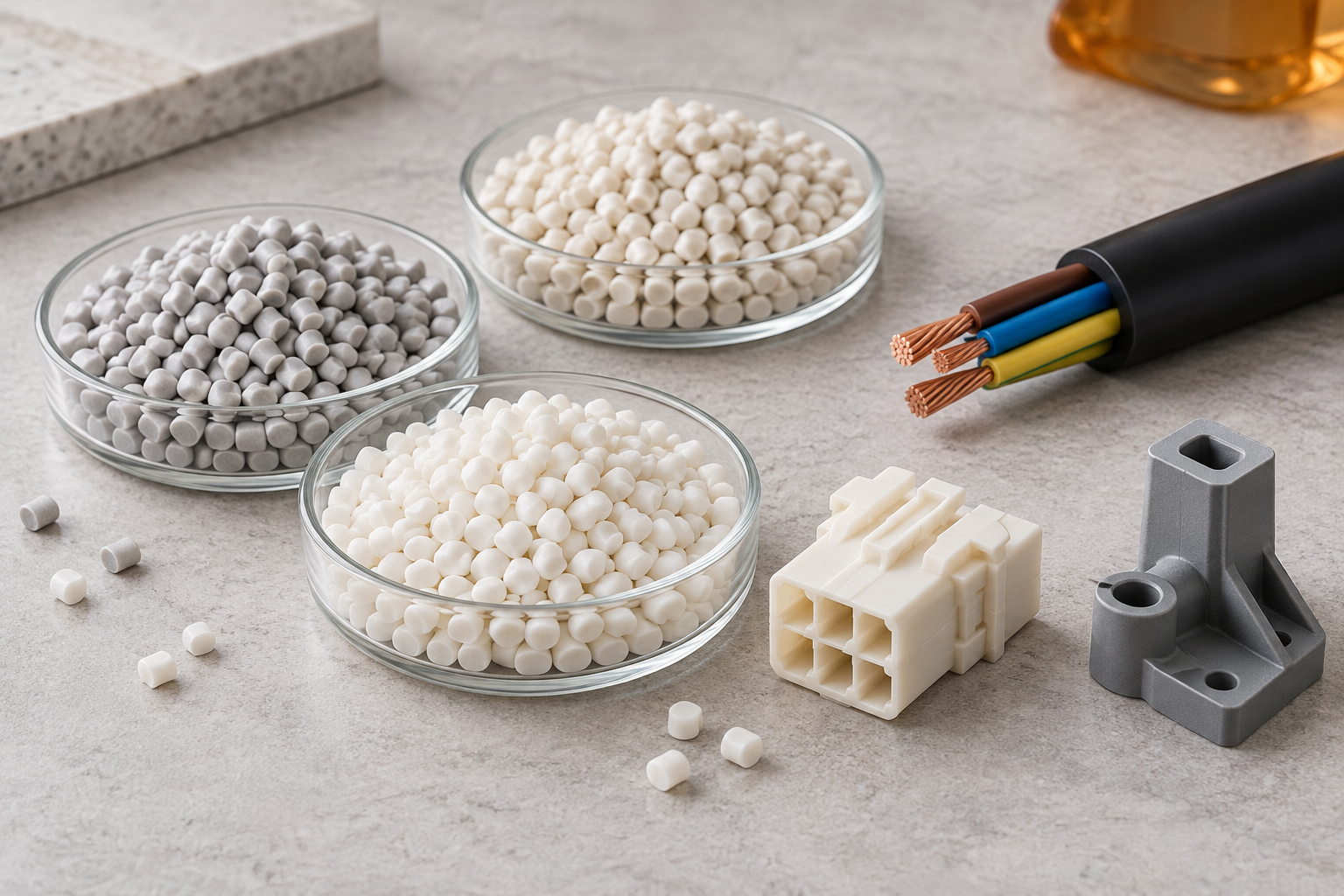
The term appears on cable-jacket specifications, connector data sheets and quotations for plastic granules. These materials may share a halogen-free requirement while serving very different jobs.
A flexible cable jacket and a rigid electrical housing should not be compared as if they were interchangeable products. Understanding the compound type helps explain which properties to compare, what the material can be used for and which documents actually support the claim.
What Is a Halogen Free Compound?
In plastics processing, a compound is a formulated material rather than a single chemical. It contains a base polymer and selected ingredients that establish the properties needed for processing and service. It is commonly supplied as pellets or granules for moulding or extrusion.
For a halogen-free flame retardant compound, the formulation must address two separate objectives: the specified halogen requirement and the required flame behaviour. The polymer, flame-retardant package, fillers, colourants and other ingredients all belong to the material being assessed.
There is also an important supply-form distinction. A finished compound is the grade you process. An additive is an ingredient used to develop that grade. A masterbatch is a concentrate intended for blending at an agreed ratio. A bag of halogen-free additive does not establish the properties of every material into which it is mixed.
For prepared material options, see our flame retardant compound overview. If the work involves developing a formulation, the relevant starting point is halogen-free flame retardant additives.
The phrase “halogen-free” also needs a defined basis. It may be used for a formulation declaration, an analytical limit or requirements associated with a particular application. For example, IEC 61249-2-21 concerns specified copper-clad laminate materials for printed boards. Its scope should not be treated as a universal specification for every cable jacket or moulded plastic.
Main Types of Halogen-Free Compounds
A useful classification considers both the polymer and the flame-retardant system. “Mineral”, “phosphorus” and “nitrogen” describe formulation routes, not three fixed sets of finished-material properties. Commercial grades can combine mechanisms and additional ingredients.
Mineral-filled polyolefin compounds
Aluminium hydroxide, often called ATH, and magnesium hydroxide, or MDH, are common mineral retardants. They absorb heat and release water as they decompose. Huber’s wire and cable additives brochure explains this mechanism and the formulation considerations associated with mineral-filled cable materials.
For the finished grade, consider the polymer blend, filler system, surface treatment and processing aids together. The resulting compound may be designed for flexibility, extrusion or a particular balance of mechanical properties. The mineral name alone does not tell you whether a grade suits your equipment or product.
Dow’s UNIGARD RE DFDE-1638 NT is one manufacturer example of a non-halogenated thermoplastic compound for cable jacketing. It illustrates a finished application grade, rather than a claim that all halogen-free granules have the same properties.
Phosphorus-based and phosphorus–nitrogen compounds
Phosphorus-based systems are used in several polymer families, including engineering plastics. Depending on the chemistry and formulation, their action can involve the gas phase, a protective surface layer or both. Nitrogen-containing ingredients may be used alongside them.
As a specific example, Clariant describes Exolit OP 1260 as a phosphinate-based system developed for thermoplastic polyesters, with combined gas-phase and condensed-phase action. This is additive information for formulation development. The final compound still needs its own relevant performance evidence.
An intumescent route creates a protective expanded layer when exposed to fire. Clariant’s Exolit AP 766, developed for polyolefins, provides a manufacturer example. The distinction matters: a system designed for one polymer family is not automatically a suitable replacement in another.
Nitrogen-based and other specialised formulations
Nitrogen-containing retardants also appear in specialised formulations. Their suitability depends on the resin and the other ingredients, including whether the material is reinforced. Grouping every nitrogen-based system under one promised loading or fire classification would hide those differences.
Clariant’s thermoplastics formulation overview shows how different systems are assigned to different polymer classes. Use such guidance to understand compatibility, then compare actual finished grades rather than buying from the chemistry label alone.
| Compound route | Typical selection context | Useful comparison question |
|---|---|---|
| Mineral-filled polymer blends | Cable and extrusion formulations | Does this grade provide the required flexibility, processing and test evidence? |
| Phosphinate-based engineering plastics | Specified polyamide or polyester components | Does the complete grade match the electrical, mechanical and fire requirements? |
| Intumescent polyolefin formulations | Selected moulded or extruded polyolefin parts | Is the system appropriate for the resin, processing method and geometry? |
| Nitrogen-based or combined systems | Resin-specific formulation development | What evidence supports this particular formulation and reinforcement? |
The table identifies questions to ask. It does not assign a universal fire rating or guarantee a property to an entire material family.
Properties That Matter in the Finished Material
Fire behaviour
Halogen content describes composition-related requirements. Flame performance describes behaviour under an identified test. Check the actual classification and its covered conditions rather than assuming that a non-halogenated package guarantees a particular result.
UL Solutions’ plastics combustion test overview distinguishes horizontal and vertical classifications and the observations involved. A material classification also has a defined scope; it does not establish every fire-related property of a finished product.
Mechanical performance and flexibility
Choose properties that correspond to the job. A jacket may need a specified combination of tensile strength, elongation and handling flexibility. A moulded housing may instead depend on stiffness, impact behaviour and dimensional stability. Put those requirements beside the fire requirement in the same material comparison.
Compare test methods and conditioning as well as the figures. If two data sheets describe different sample conditions, ask for clarification before treating a higher value as a straightforward improvement. Avoid replacing a working grade solely because another has a more impressive headline classification.
Processing behaviour
A finished compound comes with a processing window and handling guidance. Check the intended process, drying instructions where applicable and the recommended equipment conditions. Do not transfer a setting from an unrelated material simply because both are sold as halogen-free.
A useful trial plan states what must be observed: stable output, acceptable surface, dimensional consistency or a moulding requirement. Record the conditions used and separate a successful processing trial from completion of the material or product approval.
Electrical, thermal and service properties
For electrical components, the specified insulation, tracking and heat-related properties can be as important as flammability. BASF’s Ultramid overview illustrates why electrical applications are served by distinct modified grades, rather than a single generic nylon.
For other applications, record the relevant exposure requirements: moisture, oils, weathering or repeated handling. Ask what evidence addresses those conditions. A dry-room demonstration is not the same question as long-term performance in the intended environment.
Density and material cost
Price per kilogram is only one input to a comparison. If the part volume is fixed, compare the grade’s density as well. Also consider the material needed during trials, the processing route and the cost of completing qualification.
Keep this calculation specific to your component. A flexible jacket and a rigid moulded part have different material needs, so an average “halogen-free compound price” does little to settle a real substitution decision.
Where Are Halogen-Free Compounds Used?
Wire and cable: grades are used for specified jackets and other cable applications where the construction requires particular fire, gas or smoke performance. The cable design remains part of the assessment. Alphagary explicitly notes in its MEGOLON ECO introduction that cable-test performance depends on the complete cable design.
Electrical and electronic components: engineered formulations can serve housings, connector parts and other specified components. The material must meet the part’s mechanical and electrical needs alongside the relevant fire requirement.
Selected moulded and extruded polyolefin products: applications extend beyond cables. The Compound Company describes halogen-free polyolefin compounds for uses including structural parts and roof-liner applications. These are examples from that producer, not evidence that every halogen-free grade is approved for building use.
Application names help organise enquiries, but they do not replace a grade specification. For resin-based formulation routes, our flame retardant additives for plastics overview provides the next step.
Halogen-Free, HFFR and LSZH: How They Differ
Halogen-free refers to the stated halogen requirement. HFFR means halogen-free flame retardant. LSZH means low smoke zero halogen; LSHF is another term used in the cable-material market. Alphagary’s terminology guide explains these overlapping industry acronyms.
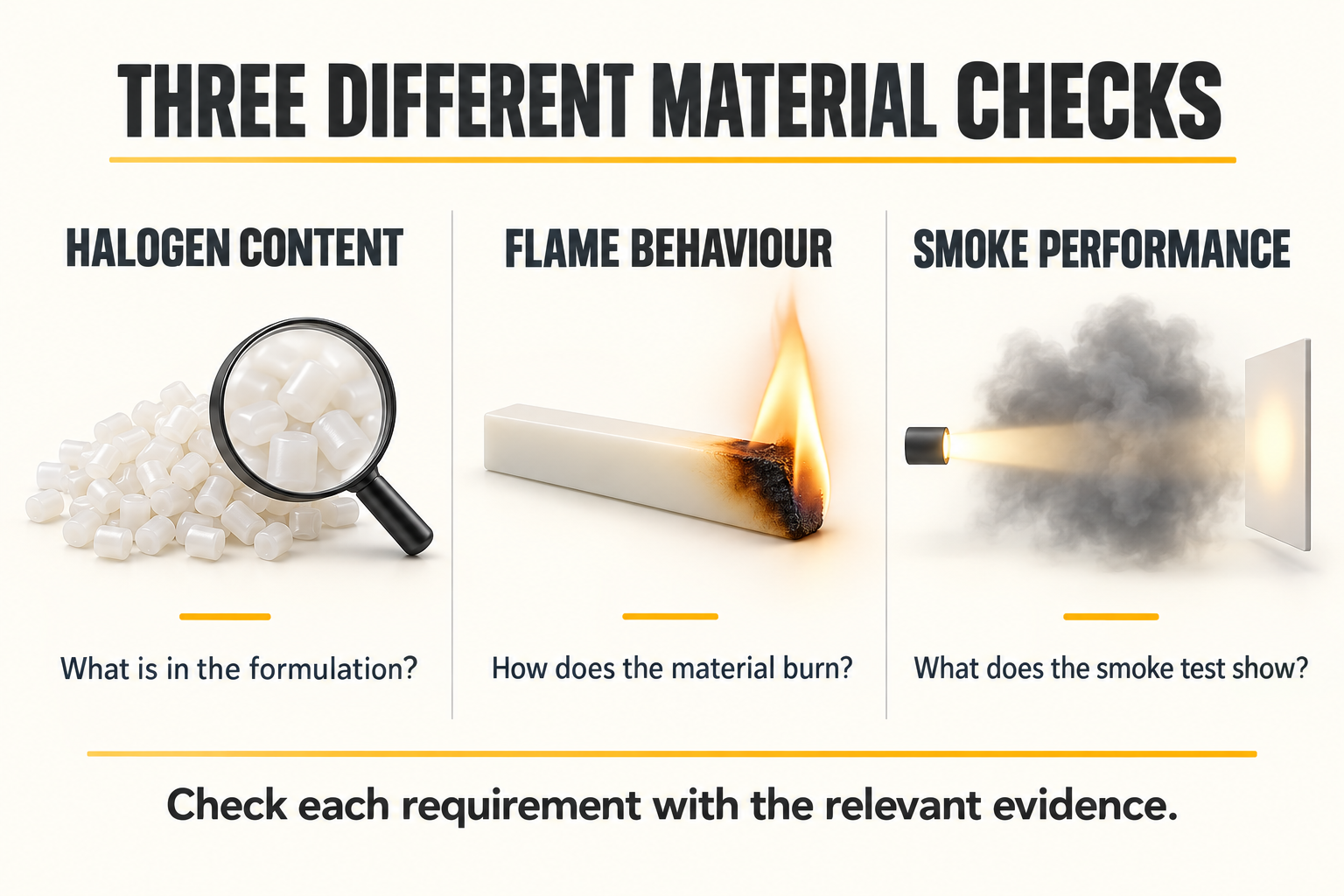
The acronyms are useful shorthand. The evidence behind them still needs to answer separate questions about composition, gases, smoke and flame behaviour.
| Claim or requirement | What to establish | What it does not establish alone |
|---|---|---|
| Halogen-free | The applicable definition, method and acceptance limit | Low smoke or a flame classification |
| Flame-retardant | The specified combustion test and result | Halogen content or universal fireproof behaviour |
| Low smoke | The relevant smoke-test evidence | Absence of all hazardous combustion products |
| RoHS compliant | Evidence addressing the restricted substances | A general ban on every halogen-containing ingredient |
For cable materials, IEC 60754-1 measures evolved halogen acid gas, with hydrofluoric acid outside that method’s scope. IEC 60754-2 assesses potential corrosivity through acidity and conductivity. Smoke density is addressed separately in the IEC 61034 series.
These methods answer different questions. Follow the applicable cable specification rather than treating an acid-gas result as proof of all smoke or toxicity properties. Our LSZH vs PVC guide expands the cable comparison.
RoHS is also separate. The European Commission’s RoHS overview identifies the restricted substances, including PBB and PBDE. RoHS compliance does not by itself establish that a material meets a separate halogen-free specification.
How to Choose a Suitable Grade
Start with the part and process. Record the base-polymer needs, processing method, colour, dimensions and essential service properties. Specify whether you need a finished compound or ingredients for further formulation.
Separate the acceptance requirements. Write the halogen, flame, smoke and other relevant requirements on separate lines. This gives the supplier a clear list of evidence to provide and prevents one reassuring label from covering an unanswered question.
Match documents to the actual material. Request a grade-specific data sheet, handling guidance and the relevant reports or recognition record. Check material identity and the conditions covered. Where a finished-product test is required, include that step in the approval plan.
Validate the proposed use. A hypothetical material change might improve one fire-related result while leaving flexibility or processing suitability unresolved. Compare the whole specification before accepting it. Do not assume either failure or success from the change in chemistry alone.
For the wider selection sequence, read how to choose flame retardants for plastics. Rectivas Materials works as a sourcing and technical partner and can help coordinate grade enquiries, samples and supporting documents with partner factories.
Frequently Asked Questions
Is a halogen free compound the same as a flame retardant?
No. Halogen-free describes a specified halogen requirement, while flame retardance describes performance under an identified fire test. A compound may be formulated to meet both, but each claim needs appropriate evidence. Ask for the definition used for halogen-free and the required flame classification. Keeping those two items separate makes the material specification clearer and supplier replies easier to compare.
Are all halogen-free compounds low smoke?
No. A halogen-free claim alone does not establish low-smoke performance. For a cable application, identify the relevant smoke requirement and request the corresponding evidence in addition to the required gas and flame results. LSZH terminology includes a low-smoke expectation, but the acronym is still shorthand. Check which material or cable construction was evaluated and what the reported conditions cover.
What is the difference between compound, additive and masterbatch?
A finished compound is a prepared formulation for processing. An additive is an ingredient used when developing that formulation. A masterbatch is a concentrate intended to be blended with another material under agreed conditions. The choice depends on who controls formulation and validation. Whatever supply form is used, establish the properties of the final material rather than transferring an ingredient’s description to it.
Does halogen-free mean RoHS compliant?
No. These are separate requirements. A halogen-free declaration does not demonstrate that every RoHS-restricted substance is within its applicable limit, and RoHS compliance does not establish a general absence of halogens. For an electrical or electronic application, request the evidence required for each claim. Keep the documents attached to the exact material designation used in the purchasing specification.
Can a cable compound be used for injection moulding?
Check the specific grade’s intended processing methods and application guidance. A material supplied for cable extrusion is not automatically suitable for a moulded component with different flow, dimensional or mechanical requirements. If the supplier supports both processes, request the relevant handling conditions and data. Validate the proposed moulded part against its own specification rather than relying on the cable application label.
How much flame retardant is needed?
There is no single loading for all halogen-free compounds. The answer depends on the polymer, retardant system, other ingredients and performance target. For a finished compound, evaluate the supplied grade rather than changing its formulation without a plan. For development work, use resin-specific guidance and validate the resulting material. Avoid applying a mineral-system recommendation to an unrelated phosphorus-based formulation.
What should I compare on two material data sheets?
Compare the grade identity, intended process and the properties relevant to your part. Check test methods and conditions alongside mechanical, thermal, electrical and fire-related results. Also compare density where it affects material consumption. Mark any missing evidence as unresolved rather than treating a blank as an equivalent result. This produces a useful comparison of materials instead of a list of marketing claims.
What should I send when requesting a suitable grade?
Send the application, processing method, essential material properties and the separate halogen, flame and smoke requirements. Include the intended colour and relevant dimensions, plus any customer document requirements. Explain whether you need finished pellets or formulation ingredients. A clear enquiry helps a sourcing partner or producer identify suitable candidates and state which requirements still need sample evaluation or further evidence.
Final Thoughts
Halogen free compound covers several formulated materials, with different polymers, retardant systems and end uses. Choose by the properties your part needs, then verify the halogen, flame and smoke claims separately. A documented finished grade can simplify material selection, but its evidence must still match the application. Start with the specification, compare suitable candidates and plan the remaining processing and approval checks before making a substitution.
— Rectivas Materials technical content team