Quick answer: Flame retardant formulations combine a base polymer with a fire-performance package and the other ingredients needed for a usable plastic. Adding more flame retardant does not automatically solve a failing part: the resin, reinforcement, pigments and processing history can change the result. A sound design starts with the required test and minimum thickness, then balances fire behaviour against mechanical properties, processing and cost.
A formulation can pass a small-scale flame test and still be unsuitable for the part. Perhaps the clip loses impact strength. Perhaps the melt becomes difficult to process, or the specified colour changes the behaviour seen in the natural material. These are formulation questions, even when the first symptom appears at the moulding machine.
This article focuses on thermoplastic formulations for moulded and extruded products. Coatings, treated wood and polyurethane foams have their own formulation methods. A useful starting composition for one of those materials should not be transferred into a plastic compound simply because both are described as flame retardant.
What Is a Flame Retardant Formulation?
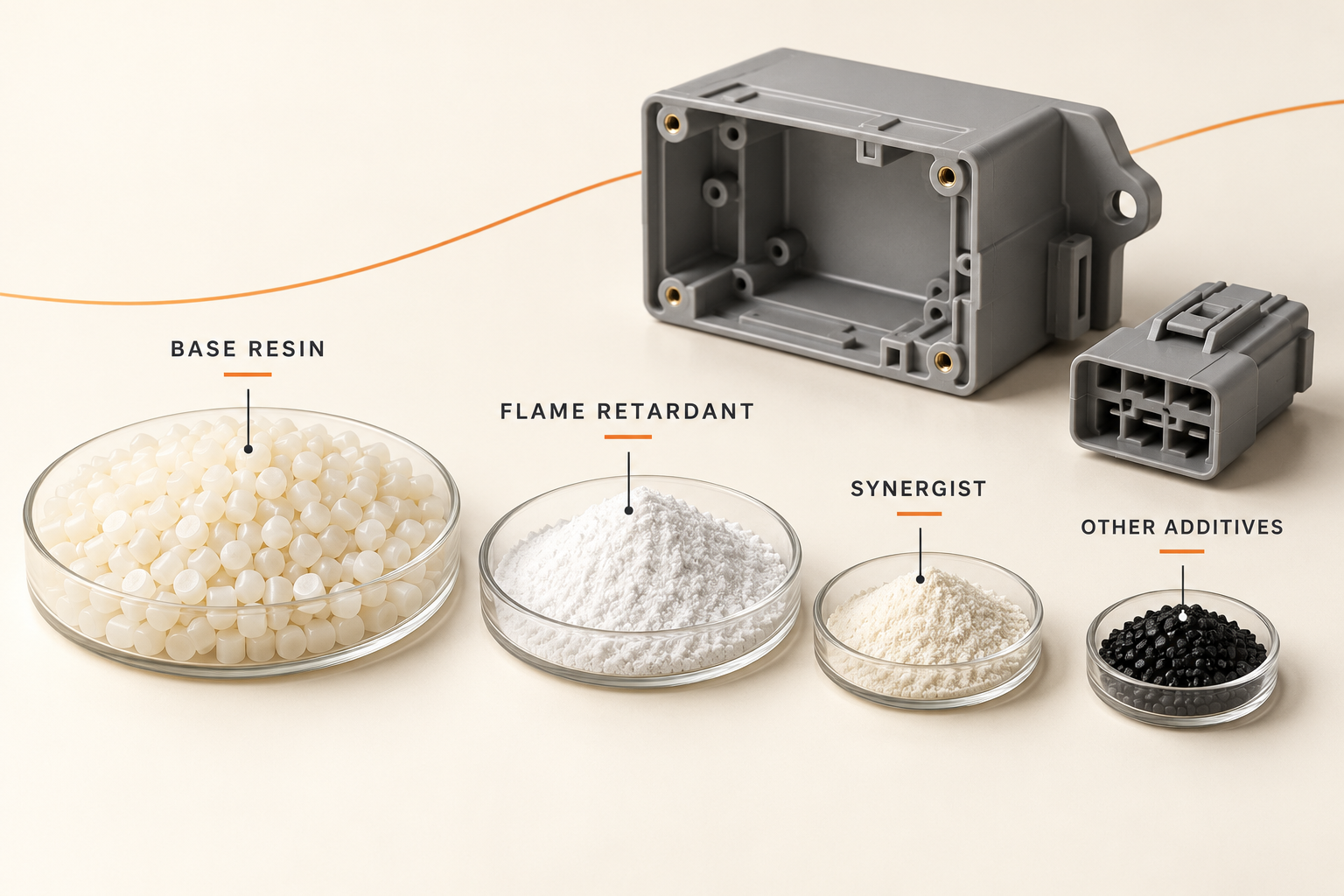
A flame retardant formulation is the complete composition designed to give a material specified fire behaviour while meeting its other requirements. It includes the polymer matrix, the flame retardant system and any supporting ingredients. The composition is only part of the specification: preparation, processing and evaluation conditions also determine what the material can deliver.
A flame retardant additive is one ingredient. A flame retardant package may contain several ingredients intended to work together. Neither description automatically tells you the properties of the finished formulation. The final material must still perform at the required thickness, colour and service conditions.
A useful technical brief therefore starts with the intended component. Identify the polymer, production process, fire test, thinnest section and essential mechanical properties. PMC Polymer Products’ formulation guidance explains why defining those requirements is central to a successful material development project.
For the ingredients supply route, the flame retardant additives range is the starting point. This guide explains how an ingredient fits into a formulation; it does not turn an additive listing into a guaranteed finished-plastic specification.
The Main Ingredients and Their Roles
Most designs contain several functional groups, but not every formulation needs every group below. Some commercial flame retardant products are already combined packages. Their components should be understood before adding another synergist or assuming that a separate ingredient is missing.
| Ingredient group | Role in the formulation | Design question |
|---|---|---|
| Base resin | Forms the polymer matrix and establishes the starting property profile | Which exact grade and processing window are required? |
| Flame retardant package | Modifies burning through the selected chemical or physical mechanisms | Is it designed for this polymer and target test? |
| Synergists and char-forming ingredients | Support the chosen system where a useful combination has been established | Does the combination improve the required result? |
| Reinforcement and impact modifiers | Adjust stiffness, strength or toughness | How does the changed composition affect fire behaviour? |
| Stabilisers and processing aids | Support thermal stability, processing and the required service life | Are they compatible with the rest of the package? |
| Pigments, fillers and other additives | Provide colour or additional functional properties | Is the final combination included in qualification? |
The base resin is an active design choice
PP, PE, PA, PBT and ABS differ in their processing and property requirements. Even grades within one polymer family are not automatically equivalent. Flow characteristics, reinforcement and the material’s existing additive package can change the starting point for development.
Record the full resin designation rather than only its family. If regrind or recycled content will be used, include its permitted range and source controls in the brief. Otherwise, the qualification formulation and the production formulation may quietly become different materials.
The fire-performance package must suit the matrix
Intumescent systems promote a protective expanded char. Mineral hydroxides provide an endothermic route with water release and a mineral residue. Other systems can act in the flame, in the solid material, or through a combination of mechanisms. The useful route depends on the polymer, test and processing constraints.
A chemistry name is not enough to select a grade. Particle characteristics, surface treatment and package composition can matter alongside the active chemistry. Use the flame retardant chemicals overview to identify chemistry families, then narrow the discussion to a supported polymer application.
Synergy must be demonstrated
A synergist is valuable when the combination performs better for the required objective than the alternatives being compared. Adding two ingredients labelled “flame retardant” does not establish synergy. Their relative proportions, thermal behaviour and interactions with the polymer still matter.
One established example is antimony trioxide used with suitable halogenated flame retardants, described in the LEHVOSS flame retardant brochure. This illustrates a supporting ingredient’s role; it is not a recommendation for every application. Halogenated formulations require substance-specific and application-specific review, just as non-halogenated formulations require a compatible package and appropriate evidence.
For a combined commercial package, determine whether the recommended dosage already includes its supporting ingredients. Adding extra components can change cost and properties without improving the fire result. Compare candidates with controlled formulations so that an apparent improvement has an identifiable cause.
Why Different Resins Need Different Designs
The table below gives design directions, not interchangeable recipes. A supplier recommendation needs the exact material and conditions behind it. Each candidate must be evaluated against the complete specification.
| Material example | Possible formulation direction | Requirements to keep visible |
|---|---|---|
| PP parts | A polymer-compatible phosphorus–nitrogen intumescent package | Thickness, char formation, impact strength and melt processing |
| Glass-reinforced PA6/PA66 parts | An engineering-plastic flame retardant package supported for the reinforced grade | Reinforcement, drying, electrical properties and thin-section requirements |
| Polyolefin-based cable materials | A suitable mineral hydroxide system with compatible polymer and surface treatment | Flexibility, filler dispersion, processability and required cable tests |
Published products show this application specificity. Clariant presents Exolit OP 1312 as a phosphinate-based system for PA6 and PA66, including reinforced grades. That is a different material-design context from a PP intumescent formulation. Sharing the description “halogen-free” does not make the two systems substitutes.
For mineral systems, Huber’s Vertex magnesium hydroxide information describes surface-treated grades intended to support processing and compound performance. The implication for development is practical: specify the additive grade and treatment, not only “MDH”. The polymer interface is part of the formulation.
What a Published Formulation Example Can Tell You
A documented product example is more useful than an unattributed recipe, provided its boundaries stay attached to the numbers.
Manufacturer example, not a universal recommendation: Clariant’s Exolit AP 766 product information gives a 20–22% by-weight dosage for PP homopolymer and glass-fibre-reinforced PP as usually sufficient for UL 94 V-0 at 1.6 mm. It also states that dosage can vary with the polymer grade, processing conditions and reinforcement.
The same page specifies a maximum polymer melt temperature of 250°C for incorporating that product. This is a processing condition for the named additive—not a temperature limit for all phosphorus–nitrogen systems.
Those details show how to read a formulation starting point: keep the product identity, polymer, concentration basis, test thickness and processing limits together. The product is a formulated powder package, so its addition percentage is not a masterbatch let-down ratio or the percentage of phosphorus in the compound.
If you are evaluating an ammonium polyphosphate flame retardant, establish whether you are buying an individual ingredient or a complete intumescent package. Do not replace a combined product with the same weight of one constituent and expect equivalent performance.
Balancing Fire, Mechanical and Processing Properties
A formulation needs an acceptance window across several properties. A single strong flame result is insufficient if the material cannot fill the mould, retain the specified strength or survive its intended service conditions.
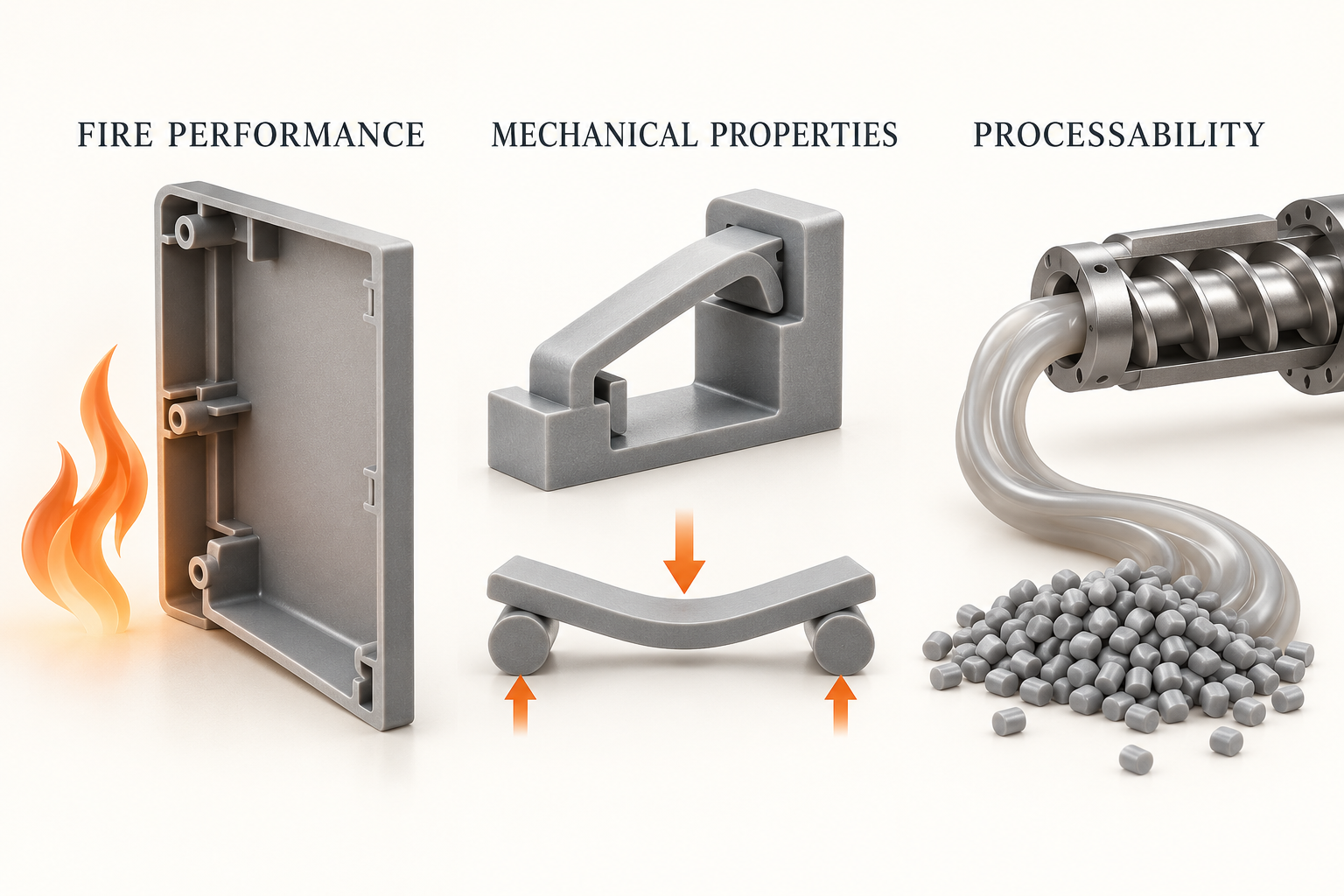
When loading rises, there is less room for the original polymer and more influence from the added ingredients. Flow, density, toughness or elongation may change. Adding an impact modifier to recover toughness then changes the complete composition again, which is why it must be evaluated as part of the final material.
Colour deserves the same treatment. A natural-colour trial is a starting point if the production part will be pigmented. Identify the pigment or colour concentrate and assess the proposed final composition. Do not wait until the purchasing specification is signed to discover that the colour used in production was absent from the trial.
Other additives can help or interfere. The separate flame retardant additive interactions guide covers those combinations in more detail. For this broader design stage, the useful rule is to keep a complete ingredient list and a clear reason for every addition.
Keep the Dosage Basis Clear
Formulation percentages can describe different denominators. Weight percentage of the complete compound is different from parts per hundred resin, often written as phr. Confusing them changes the composition before any chemistry is considered.
Illustrative arithmetic only: if 25 mass parts of an additive are combined with 100 parts of resin and nothing else, the total is 125 parts. The additive is 20 wt% of that mixture: 25 ÷ 125 × 100. This is a two-component calculation, not a proposed flame retardant recipe.
With additional ingredients, include every component in the total when calculating final weight percentages. For a supplied concentrate or combined package, distinguish its added mass from its individual active ingredients. Ask the supplier to define the declared content instead of assuming that “20% package” means “20% of one chemical”.
State the basis beside each dosage in the trial record. It should be possible for another person to reconstruct the batch without interpreting an unlabeled percentage or a shorthand note.
Develop and Verify the Complete Formulation
First define what the material must achieve. Then select a supported chemistry and run a controlled comparison. A useful initial trial holds the base resin and preparation conditions steady while examining the chosen package over an appropriate supplier-supported range.
Keep the formulation and processing records together: resin grade, additive grades, proportions, drying, batch identity, relevant melt conditions and specimen preparation. Material history matters when comparing results from separate trials. A change that looks minor on the purchase order may be significant in the compound.
UL’s plastics combustion testing overview describes several small-scale flame-test classifications. Select the method required for the application and retain the relevant specimen and conditioning details. A UL 94 classification does not, by itself, establish that a completed product meets every applicable fire requirement.
Evaluate mechanical, electrical and processing requirements alongside the selected fire test. If the application also specifies smoke, corrosivity or halogen content, arrange the relevant separate evidence. These properties should not be inferred from a halogen-free label or from a favourable flame result.
Hypothetical development scenario: a PP enclosure trial meets its chosen flame criterion but its snap-fit fails the specified mechanical check. Increasing flame retardant loading would not address that evidence. The next comparison should examine the resin and modifier options while maintaining the full fire-test assessment. There is no claimed customer case or measured result behind this example.
For the preparation and processing side, the existing compounding flame retardants guide examines raw-material specifications and line-related problems. Formulation design decides what to combine; controlled compounding helps establish whether that design has been made consistently.
What to Specify Before Requesting Ingredients
If you compound your own material, send the resin designation, reinforcement, process, required test and thickness with the ingredient enquiry. Add colour, critical mechanical targets and any substance restrictions. An additive supplier can respond more usefully to that brief than to “please quote a V-0 flame retardant”.
If you are specifying a finished material, request the proposed complete grade and its supporting results. Identify which changes require review: alternative resin, additive substitution, pigment, regrind or another relevant variable. Qualification should describe the material you intend to manufacture, not just the first promising laboratory blend.
Rectivas can coordinate ingredient sourcing and sample discussions with the factories involved. The composition, documentation and proposed test work need to be agreed for the specific project. There is no single formulation that can be quoted honestly as suitable for every polymer and fire standard.
FAQ
What ingredients are in flame retardant formulations?
The base polymer and flame retardant package are the starting components. Depending on the application, the formulation may also contain synergists, reinforcement, impact modifiers, stabilisers, pigments or processing aids. Some commercial packages already combine several functions. Identify every ingredient and its dosage basis before evaluating the material, because the finished composition determines the properties that need qualification.
Is there one formulation that works in every plastic?
No. Polymer chemistry, processing temperature, reinforcement and application requirements differ. A published composition can provide a starting point within its stated conditions, but it should not be treated as a transferable guarantee. Use evidence for the proposed polymer and additive grades, and evaluate the final formulation at the required thickness and process conditions before approving it for production.
Does halogen-free mean that the formulation is low-smoke?
No. Halogen content and smoke performance describe different properties. A formulation must meet the stated halogen definition, while smoke requirements need the appropriate test evidence for the application. The polymer, additive package and other ingredients all contribute to the final material. Specify smoke and corrosivity targets separately when they are required, rather than assuming a chemistry label covers them.
How much flame retardant should a formulation contain?
Start with the supplier’s supported guidance for the exact package, resin and application, then establish an acceptable range through controlled trials. There is no general percentage that guarantees a fire classification. Record whether the figure refers to total-compound weight, resin weight or a concentrate addition. Mechanical properties and processing requirements must remain part of the dosage decision throughout development.
Why does changing a pigment or modifier require review?
It changes the composition that was evaluated. The additional ingredient may alter dispersion, melt behaviour or the fire response, even when the base resin and main flame retardant remain the same. Review the change against the qualification scope and test as needed. Keep colour concentrates, modifiers and their suppliers identified so that production substitutions do not bypass the agreed material specification.
What should a formulation enquiry include?
Include the exact resin, reinforcement, production method, target fire test, minimum thickness and intended colour. Add essential mechanical or electrical properties, substance restrictions and the proposed trial scale. If you already have a baseline composition, identify what needs improvement and which ingredients may change. This helps separate an ingredient-supply request from a project that requires a complete material assessment.
Which documents help compare additive candidates?
Request a TDS, SDS, grade identification and relevant application guidance. Where a supplier provides test results, check the full formulation, concentration basis, specimen conditions and test method behind them. Agree the lot-control and certificate-of-analysis items needed for supply. A brochure result is useful context, but it cannot replace evidence for the actual material combination you plan to qualify.
Can Rectivas provide a guaranteed ready-made recipe?
A recipe cannot be guaranteed from a keyword or resin name alone. Rectivas works as a sourcing and technical coordination partner and can discuss supported ingredient options and samples with the relevant factory. The project brief, proposed formulation and validation requirements need agreement first. Final suitability depends on the complete material and the conditions under which it is processed and evaluated.
Final Thoughts
Flame retardant formulations work as complete material designs. Start with the part requirements, choose a compatible package, and retain the identity and purpose of every ingredient. Published examples help define trials when their conditions remain attached to the numbers. Send Rectivas the resin, process, thickness and required properties when discussing ingredients, so the sourcing conversation begins with a usable specification rather than a universal recipe.
— Rectivas Materials technical content team