Quick answer: Flame retardancy is not permanent. Three mechanisms degrade it over a part’s service life: migration (the additive physically leaves the polymer), hydrolysis (moisture chemically breaks it down), and thermo-oxidative ageing (heat degrades the polymer, the additive, or both). The classic symptom is a part that was certified V-0 quietly drifting to V-1 or V-2 after eighteen months in the field, with no change in the formulation or the process. If your product has a long service life or a warm, humid, or sunny environment, ageing belongs in the qualification programme — not in the warranty claims file.
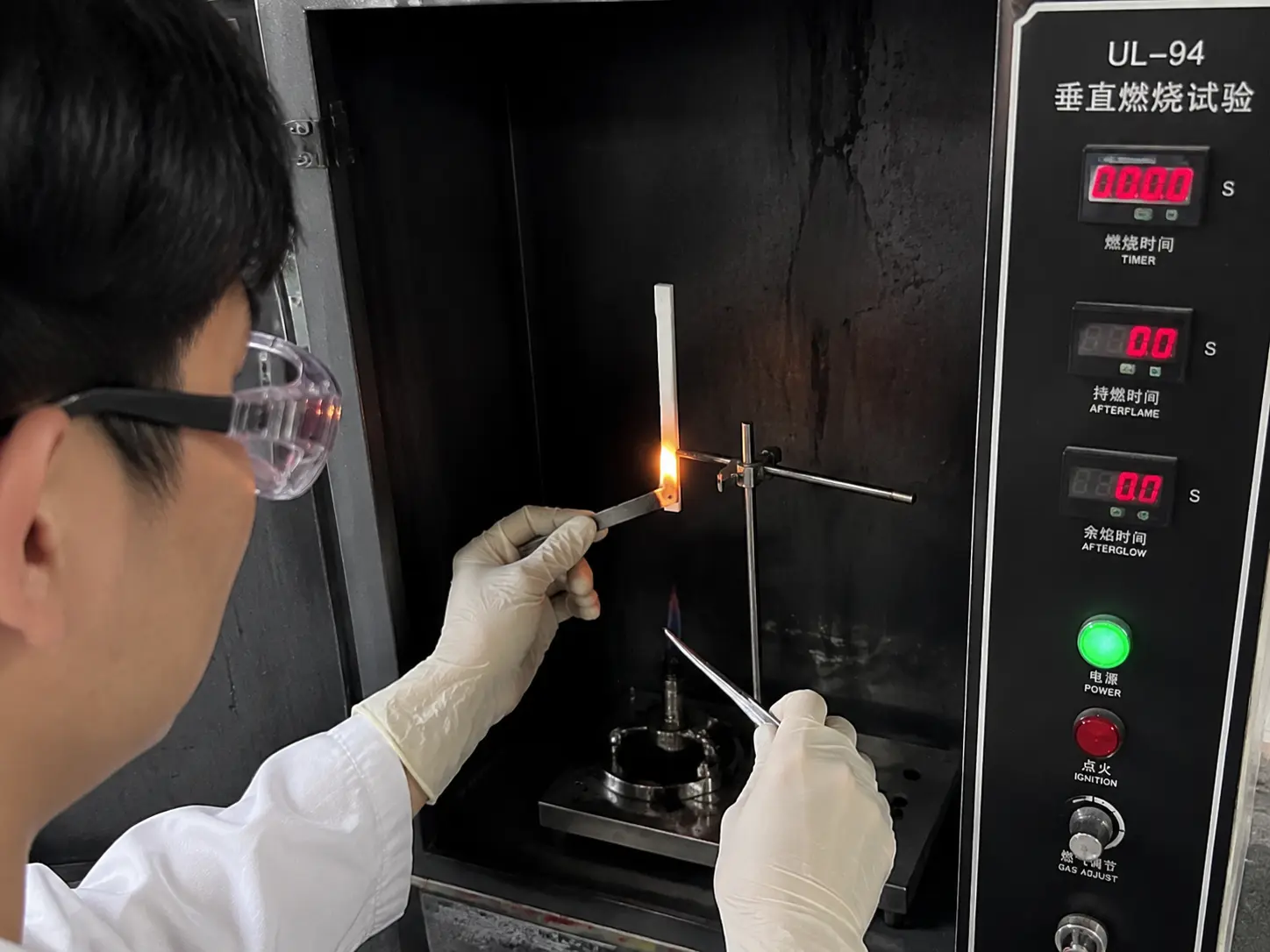
Every burn certificate on file in this industry describes a moment: the material as it was, days after moulding, conditioned and tested. Nobody’s fire happens on that day. It happens after the appliance has run warm for four years, or after the enclosure has sat in Gulf sunshine, or after the cable has cycled through humid summers in a plant room. Whether the flame retardant is still doing its job at that point is a separate question from whether it passed certification — and it is asked far less often than it should be.
Mechanism 1: Migration
Q: Do flame retardants leach out of plastic over time? Additive types can and do; reactive types cannot, because they are chemically bonded into the polymer.
Migration is a physics problem. Any small molecule dispersed in a polymer matrix will, given time and temperature, work its way toward the surface where its concentration is lowest. Once there it evaporates, wipes off, washes away, or blooms as a visible film. Everything that leaves is flame retardancy you no longer have.
Three factors govern the rate: molecular weight (small molecules migrate faster — this is the single biggest lever), temperature (roughly exponential, so a part running at 70 °C ages far faster than one at 25 °C), and compatibility with the host polymer. The chemistry families most exposed are small-molecule phosphate esters and any plasticizing flame retardant — which is exactly why the industry moved from TPP toward oligomeric BDP and RDP, a progression covered in our comparison of BDP, RDP and TPP. It is also the fundamental advantage of reactive chemistry like DOPO: a bonded phosphorus atom cannot migrate anywhere.
Mineral hydroxides and most polymeric brominated flame retardants are essentially immune to this mechanism — they are too large or too insoluble to move.
Mechanism 2: Hydrolysis
Some flame retardants react with water, slowly, and the products of that reaction are not flame retardant. RDP is the textbook case: its resorcinol linkage is more vulnerable than BDP’s bisphenol-A bridge, and in hot humid service the difference becomes measurable. We have seen a charger housing formulation pass V-0 fresh and fail after tropical warehouse storage — same parts, same batch, enough phosphate hydrolysed to cost the rating.
Hydrolysis also has a second-order effect worth knowing: in polyesters and polyamides, moisture attacks the polymer as well, cutting molecular weight. Lower molecular weight means lower melt viscosity means more flaming drips — so a humid-aged PBT part can fail on dripping even if its flame retardant is chemically intact. Ammonium polyphosphate deserves a mention here too: it is water-soluble to a degree, which is why APP grades for damp service are surface-coated or encapsulated rather than used raw.
Mechanism 3: Thermo-oxidative and UV Ageing
The third pathway attacks the polymer rather than the additive. Heat and UV generate free radicals that break polymer chains; the part becomes brittle, chalky, and — relevant here — changes how it behaves in a fire. A chain-scissioned polyolefin drips more. A degraded surface layer ignites more readily than the pristine one that was tested.
Two practical notes. First, this is why UV stabiliser packages and flame retardants have to be designed together: some flame retardants interfere with hindered amine light stabilisers, and an outdoor part can lose both properties faster than either datasheet predicts. Second, in a masterbatch application, the carrier ages too — an unstabilised carrier at 30% addition is 30% of your part with no UV protection, a point developed in our guide on carrier resin selection.
Which Systems Age Well
| System | Migration risk | Hydrolysis risk | Overall ageing behaviour |
|---|---|---|---|
| Mineral (ATH / MDH) | Very low | Very low | Excellent — the additive is a stable mineral |
| Polymeric brominated (e.g. PolyFR, DBDPE) | Low | Low | Good — high molecular weight is the protection |
| Phosphinate salts (DEPAL-type) | Low | Low to moderate | Good in engineering polymers; watch moisture in processing |
| Oligomeric phosphate esters (BDP) | Moderate | Moderate | Acceptable — the reason BDP displaced RDP and TPP |
| Small-molecule phosphate esters (TPP) | High | Moderate | Poor in warm service — blooming and loss over time |
| Uncoated APP intumescent | Low | High in damp service | Use coated or encapsulated grades where moisture is present |
| Reactive (DOPO, PolyFR-type bonded) | None | Very low | Best available — chemically part of the polymer |
The pattern is consistent enough to use as a heuristic: the more firmly the flame retardant is anchored — by molecular weight, by insolubility, or by chemical bonding — the better it ages. Efficiency and permanence tend to trade against each other, because the small mobile molecules that disperse and act efficiently are the same ones that leave.
How to Test It
Q: How do I check whether my part will still be flame retardant in five years? Age specimens under accelerated conditions, then re-run the burn test. The re-burn is the part people skip.
Choose conditions matching the service environment rather than running everything:
- Heat ageing — oven exposure at the part’s maximum service temperature (commonly 500–1000 h). The standard check for anything running warm: appliances, luminaires, motor housings.
- Humid ageing — 85 °C / 85% RH for 500–1000 h is the widely used benchmark. Essential for tropical markets, outdoor equipment and anything phosphate-ester based.
- UV / weathering — xenon arc or QUV per the relevant standard, for outdoor parts. Check surface condition and colour alongside the burn result.
- Thermal cycling — where the part sees repeated temperature swings, which drives migration faster than steady heat at the same average.
Then re-test: UL94 at the rated thickness, plus impact strength, plus a visual check for blooming. Comparing aged against unaged specimens from the same batch is what makes the result interpretable. This sits naturally at the end of the qualification sequence described in our guide on flame retardant sample evaluation.
Designing for Retention
- Prefer high molecular weight or reactive chemistry where service life is long. This usually costs more per kilogram and is usually worth it — a warranty return costs far more than the additive premium, an argument that belongs in the cost per part calculation rather than being treated as separate.
- Build in margin. A formulation that passes V-0 with nothing to spare has no room to lose anything. Where ageing is a real risk, target a comfortable pass rather than a marginal one.
- Design the stabiliser package alongside the flame retardant, not after it. Antioxidants and UV stabilisers protect the polymer, which protects the fire performance.
- Match the chemistry to the environment. Humid service argues against hydrolysis-sensitive esters and uncoated APP; hot service argues against small-molecule additives; outdoor service argues for both stabilisation and low-migration chemistry.
- Re-qualify after any change. A carrier swap, a resin grade change or a new PCR fraction can all shift ageing behaviour even when fresh burn results look identical.
If your part has a defined service life and you are not sure whether your current formulation will hold its rating across it, that is a testable question rather than a matter of opinion — send us the formulation, service environment and expected life and we will propose an ageing protocol and, where the current chemistry looks exposed, a more permanent alternative. The chemistry options by mechanism are mapped on our flame retardant chemicals hub.
FAQ
Do flame retardants expire?
The additive in a sealed bag has a storage shelf life, typically 12–24 months. Inside a finished part the relevant question is different: not expiry but retention — how much flame retardant is still present and functional after the part’s service exposure. That depends on chemistry, temperature and humidity rather than on a date.
Why did my part pass UL94 at launch and fail two years later?
Almost always migration or hydrolysis, occasionally polymer degradation increasing drip. Check for surface bloom, compare aged parts against a retained reference sample, and re-burn both. If the aged part fails and the retained sample passes, the formulation is losing flame retardant in service rather than having been wrong at the start.
Does accelerated ageing accurately predict real service life?
Directionally yes, precisely no. Accelerated tests rank formulations reliably — which is what you usually need — but translating hours in a chamber to years in the field involves assumptions that vary by mechanism and material. Use ageing tests to compare options and to catch weak systems, not to predict an exact date.
Which flame retardant is most permanent?
Reactive chemistry bonded into the polymer, followed by mineral hydroxides and high-molecular-weight polymeric additives. Small-molecule additives, especially plasticizing ones, are the least permanent. Permanence and efficiency generally trade against each other, so the right choice depends on how long the part has to last.
Final Thoughts
Efficiency and permanence trade against each other: the small mobile molecules that work best at low dose are also the ones most likely to migrate out over years. If your part has a long service life or sees heat and humidity, weight that in the selection rather than optimising for the initial rating. Ask us for the ageing profile of any system we propose – it is in the technical pack and we would rather discuss it upfront. Sunlight is its own ageing mechanism and behaves differently from heat: in mineral-filled jackets the stabiliser is adsorbed onto the filler, which is covered in weathering of UV resistant LSZH compound.
—— Rectivas Materials 团队 老陈