Quick answer: Flame retardant polypropylene fibers use a compatible additive system to change how PP behaves during fire exposure. The formulation must also survive spinning and drawing without making the fiber unusable. A successful result therefore depends on the chemistry, dispersion, resin and textile construction together. Select for the actual process and fabric test; a rating on a thick molded PP specimen does not establish performance in a lightweight nonwoven.
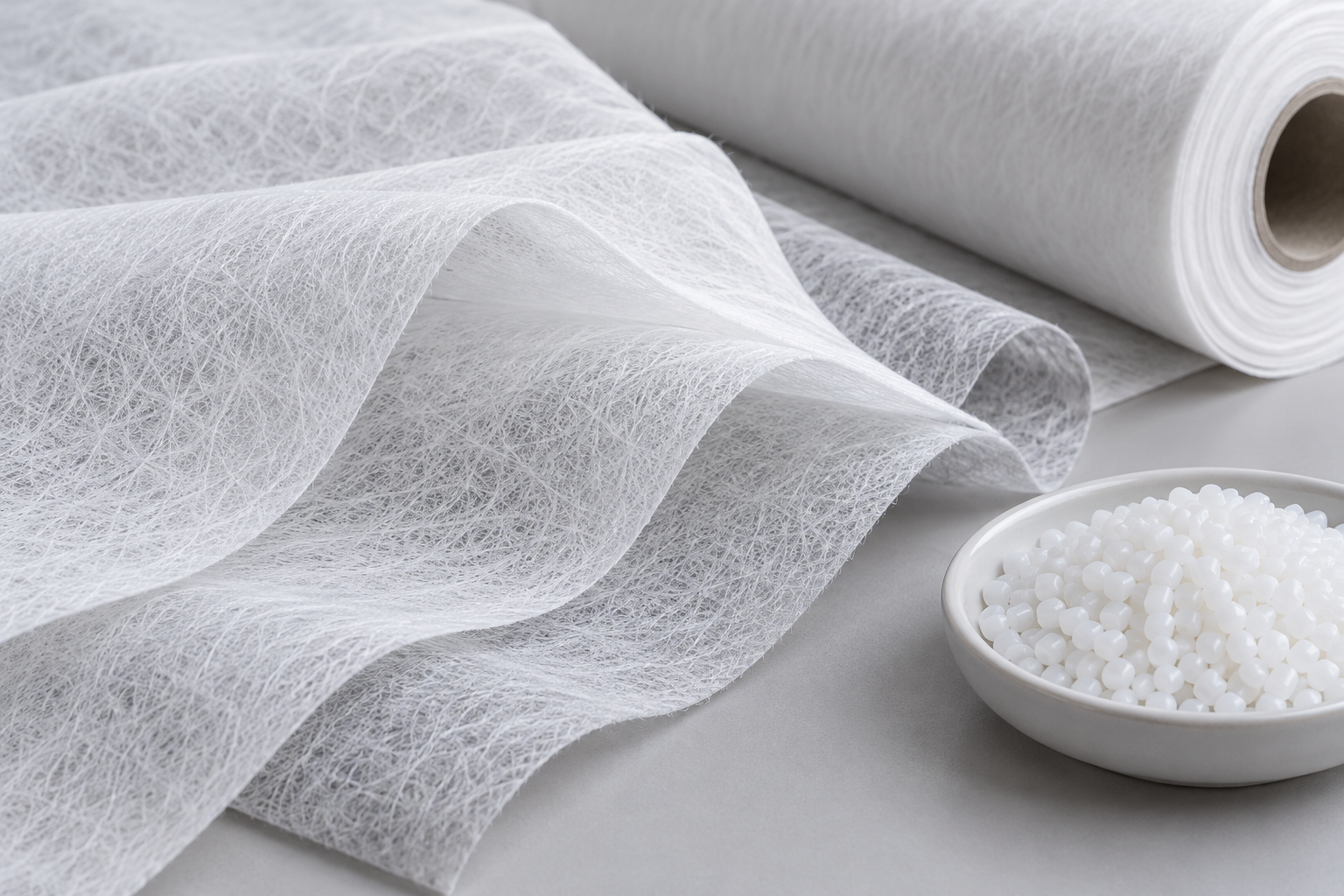
A PP grade can process well as a molded part and still be a poor candidate for fiber production. The material must pass through the spinning system, form a continuous filament and tolerate the intended drawing and fabric-making operations. Adding a flame retardant changes the formulation at every one of those stages.
This article explains how the material works and what evidence makes a fiber trial useful. It covers melt-incorporated systems and the distinction from textile finishing. It is not a universal recipe, a concentrate datasheet or an assurance that a particular textile will pass its end-use test.
What Makes Polypropylene Fibers Flame Retardant?
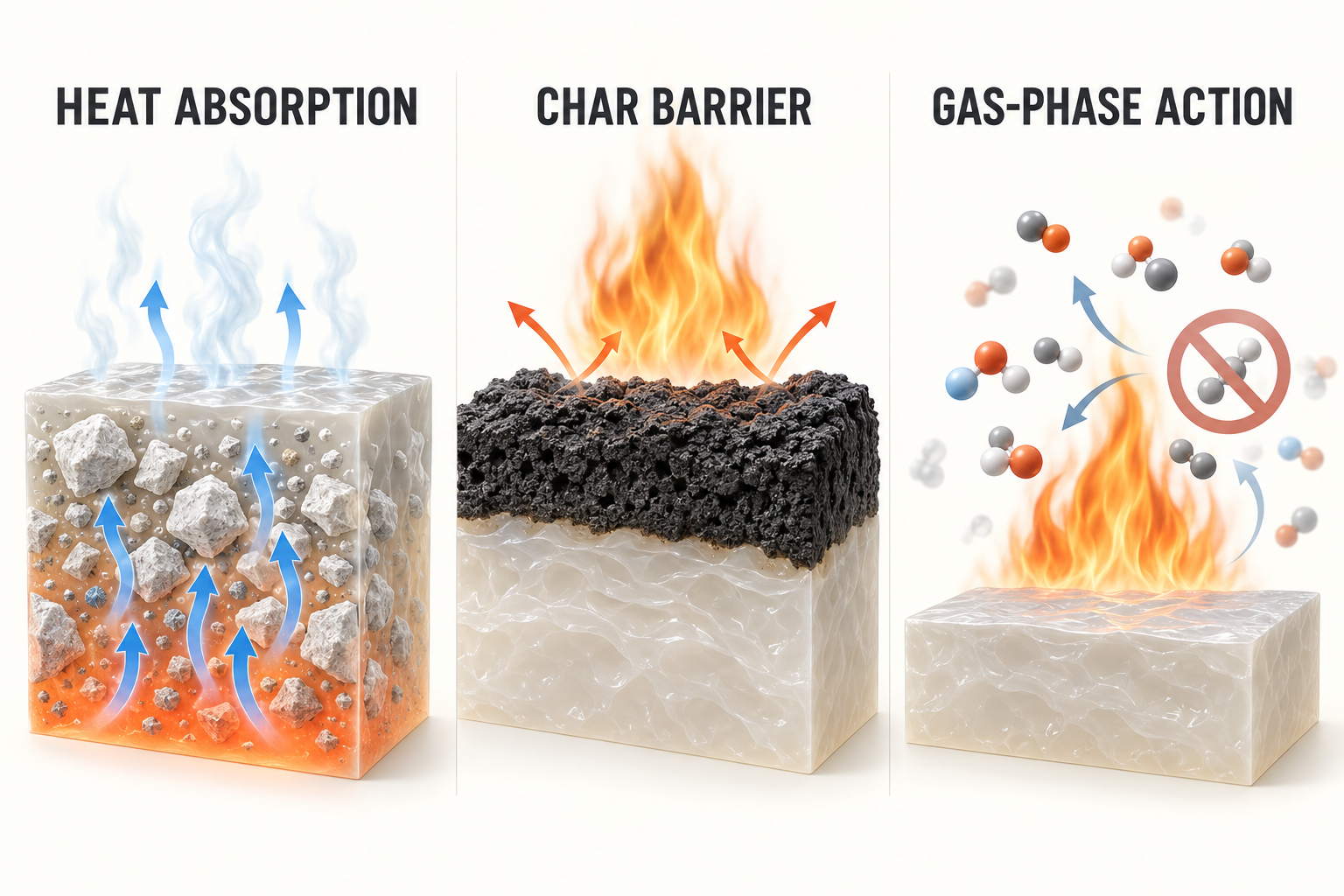
The flame retardant changes the processes that sustain burning. Depending on its chemistry, it can encourage a protective residue, absorb heat or interfere with reactions in the flame. A formulation may use more than one mechanism. The carrier in a masterbatch delivers the package into the resin; pellet shape itself does not provide the fire performance.
A 2021 study of modified intumescent PP fibers examined a phosphorus–nitrogen system incorporated during melt spinning. It reported protective char formation and gas release as parts of the mechanism. Its formulation and measured results belong to that experimental system. They are not specifications for an unrelated commercial masterbatch or proof for a different fiber construction.
The useful distinction is between altering the material and proving an application. A candidate additive may provide a plausible mechanism, yet the spun fiber and finished fabric still need evaluation. Describe the required behavior before selecting a chemistry, rather than treating the words “flame retardant” as a complete performance specification.
Why Fiber Production Needs Its Own Formulation Review
Fiber processing places demands on incorporation and melt behavior that a thick plaque does not reproduce. Identify the resin and spinning route first. Then review how the candidate is expected to behave through filtration, extrusion, filament formation, drawing and bonding. The relevant checks depend on the actual equipment and product.
For a trial, record pressure trends, visible deposits and filament interruptions alongside the production settings. Keep samples from clearly identified conditions. If several variables change during startup, separate those samples rather than assigning every improvement or defect to the flame retardant concentration.
Also establish which fiber properties must be retained. A material that meets a flame criterion but repeatedly breaks during drawing may not be a usable product. Strength, elongation, fineness and handling requirements should be part of the acceptance brief. Fabric makers may additionally need a particular softness, bonding response or appearance.
Tosaf’s fiber catalog lists a halogen-free flame retardant masterbatch specifically designed for fiber applications. This supports treating fiber suitability as a separate selection requirement. It does not establish that every halogen-free concentrate, or every PP carrier, is suitable for every spinning route.
Masterbatch Incorporation and Textile Finishing Are Different Routes
With melt incorporation, the additive package enters the polymer formulation before the fiber is made. A concentrate is normally combined with the chosen base resin according to grade-specific instructions. Its carrier and other ingredients become part of the fiber, so compatibility and the final blend composition matter.
A textile finish or coating is applied at a later stage. It changes the fabric through a different process and may introduce separate requirements for adhesion, flexibility, appearance or retention after exposure. A successful finish cannot be assumed to prove that the same chemistry will spin inside PP, or the reverse.
When requesting a sample, state which route you intend to use. Include any later coating or lamination in the description. Otherwise, two suppliers may propose fundamentally different treatments while appearing to answer the same request for flame retardant PP fabric.
| Route | Where the material is introduced | Evidence to request |
|---|---|---|
| Melt-incorporated masterbatch | Blended with the resin before spinning | Carrier and process compatibility, trial instructions and results on the relevant fiber or fabric |
| Textile finish or coating | Applied to an existing textile construction | Application conditions, relevant durability checks and results on the finished textile |
| Purchased flame retardant fiber | The fiber is supplied as an already formulated material | Exact fiber identity, handling specification and the scope of any reported performance |
Spunbond, Meltblown and Drawn Yarn Need Separate Briefs
“PP fiber” covers several production routes. Do not transfer a spunbond recommendation directly to meltblown material without a review. Likewise, a candidate developed for drawn tape or a relatively coarse yarn needs its own assessment before use in a fine filament application.
For nonwovens, describe both the fiber-making route and the fabric construction. Basis weight alone is incomplete: bonding, layers and any backing can affect the specimen being evaluated. For drawn yarn, include the intended fineness, drawing arrangement and the handling properties needed in the next operation.
Keep a written distinction between the trial material and the final commercial article. If qualification was performed on a laminated assembly, do not advertise the result as an unrestricted rating of loose fiber. If the tested specimen was a single nonwoven layer, identify changes before relying on it for a thicker assembly.
Our PP nonwoven flame retardant masterbatch page is the product route for a process-specific sample inquiry. This article provides the technical background; the product review establishes which candidate and documents are available for the application.
Why a Published Dosage Is Not a Universal Recipe
A paper or datasheet may report an additive level, but the number is meaningful only with its material and test conditions. Check whether it describes active ingredients in the final fiber or masterbatch added to the base resin. Those percentages are not interchangeable.
Hypothetical composition calculation: a concentrate containing 40% of a defined active package, used at 10% of final-blend mass, contributes 4% active package: 0.40 × 0.10 = 0.04. This is arithmetic only. It is not a PP fiber dosage recommendation and cannot predict a flame result or spinning suitability.
Research by Rault and colleagues on a halogen-free PP fiber masterbatch followed development through textile samples and evaluated the effect of construction. The study illustrates why an isolated ingredient percentage is insufficient: the final structure must be considered. Its experimental recipe should not be repackaged as a generic commercial recommendation.
For purchasing, ask the supplier to define the proposed grade, compatible resin, addition basis and trial conditions in writing. Record any changes made during the trial. Avoid turning a successful result at one combination into an unsupported range covering every PP fiber product.
Test the Construction That Will Be Sold
Start with the end-use requirement and the actual specimen. A loose yarn, a bonded web and a coated multilayer textile are different constructions. Identify the test method, conditioning, orientation and acceptance criteria before selecting samples for qualification.
UL explains that UL 94 is a small-scale plastics flammability classification with defined scope and limitations. A V-0 result on a molded plaque is therefore not a blanket approval for a PP nonwoven or a finished furniture assembly. Use the method required for the intended product.
Where the specification includes aging, cleaning or another exposure, agree how specimens will be prepared and evaluated afterward. Do not add a durability claim simply because the initial flame test passed. Likewise, halogen content, smoke behavior and mechanical retention require the relevant evidence rather than a single broad “safe” label.
| Question | Record before the trial | Why it matters |
|---|---|---|
| What is being made? | Fiber route, fineness and final fabric construction | Defines which candidate and specimen are relevant |
| What is the formulation? | Resin, concentrate, color and other additives | Links results to a repeatable material |
| What must pass? | Named method and acceptance criteria | Prevents unrelated classifications being treated as equivalent |
| What must remain usable? | Processing, mechanical and conversion requirements | Keeps flame performance tied to a manufacturable product |
A Trial Plan That Produces a Useful Decision
Begin with an agreed baseline and one clearly identified candidate. Keep resin and construction consistent where practical. Record the relevant production settings, label samples by condition and decide in advance which observations would justify adjusting or rejecting the candidate.
For example, a hypothetical spunbond trial might produce stable filaments but fabric outside the required tensile specification. The next step is to examine the full formulation, processing and bonding conditions with the supplier. Increasing the flame retardant level without investigating that result would answer a different question.
Before a repeat order, confirm which formulation and document revision were approved. A change in resin, pigment, basis weight or finishing operation should be reviewed against the original evidence. The aim is a traceable production recipe, not simply a bag labeled “FR masterbatch.”
For a concentrate inquiry, compare the PP flame retardant masterbatch range. If a non-halogenated system is required, also review the halogen-free masterbatch options. State that fiber suitability must be confirmed; these broader categories include processes with different requirements.
Frequently Asked Questions
Are flame retardant polypropylene fibers fireproof?
No. Flame retardancy describes behavior under specified exposure and test conditions. It does not establish that the fiber cannot ignite, melt or degrade in every situation. Ask which material and construction were tested, and compare the report with the intended use. A supplier adjective alone cannot define the relevant performance or replace an end-product qualification requirement.
Can an injection-molding PP masterbatch be used for fibers?
It requires a separate review. A carrier compatible with PP does not establish that the full concentrate can run through the intended filtration, spinning and drawing process. Request candidate-specific guidance and evaluate processing alongside fiber properties. A flame result on a thick molded specimen does not demonstrate suitability for fine filaments or for the final textile construction.
Is halogen-free masterbatch automatically suitable for nonwoven?
No. Halogen-free describes a composition requirement, while nonwoven suitability includes processing and product properties. Specify the accepted halogen definition, spinning route and final fabric requirements. Review the relevant documents for the proposed grade, then test representative samples. Do not infer smoke performance, skin-contact suitability or medical approval from a halogen-free description; those require their own applicable assessment.
What addition percentage should be used?
Use the selected grade’s recommendation as the basis for a controlled trial, not a number copied from an unrelated paper or molded-plastic application. Clarify concentrate composition and whether the ratio refers to final-blend or base-resin mass. The resin, process, fiber and fabric construction remain part of the evaluation. Arithmetic determines composition, but cannot determine a flame classification.
Does a fiber test result cover the finished fabric?
Only the documented scope of the evidence can answer that question. Fabric basis weight, bonding, layers and finishing help define the specimen, so a loose fiber result should not automatically be transferred to a textile assembly. Identify the required end-use method and qualify the relevant construction. Keep the sample identity and preparation conditions connected to the resulting report.
Can you arrange samples for PP nonwoven or drawn products?
Rectivas coordinates sourcing and sample discussions with partner factories for the application under review. Send the resin, production route, final product construction and named test requirement, together with essential mechanical properties and trial quantity. Candidate availability, recommended trial conditions and documentation are confirmed for the proposed grade. This is a material review, not a promise that an unspecified fabric will pass.
Final Thoughts
Flame retardant polypropylene fibers need chemistry that works with the resin and a process that produces usable fiber. Define the spinning route, final textile and required test together, then evaluate a documented candidate on representative samples. The useful outcome is a repeatable formulation with relevant evidence. Rectivas can coordinate the corresponding masterbatch sourcing discussion; grade-specific trials establish what the proposed material can actually deliver.
— Rectivas Materials technical content team