Quick answer: Work out which test actually governs your product before you buy anything, because a material optimised for one can fail the other outright. UL94 judges a small bar of plastic inside a device; ASTM E84 judges how flame travels across a 25-foot tunnel lined with your material. They are not interchangeable, and a V-0 report will not satisfy a Class A clause.
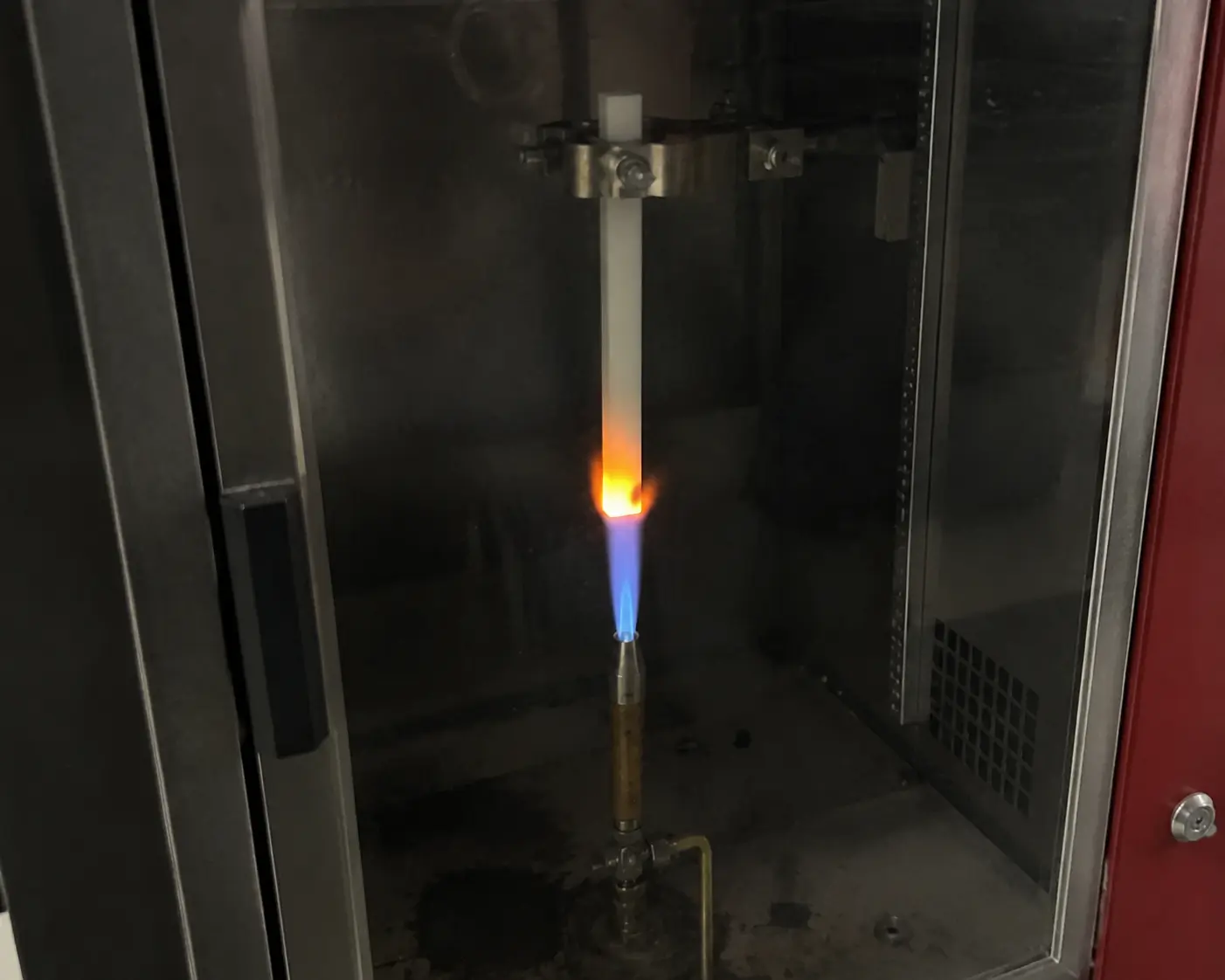
Every technical article on this site eventually cites a rating — V-0 at 1.6mm, GWIT 775 °C, CTI 400V — and buyers new to plastics sourcing reasonably ask what these tests actually measure and how they relate to each other. Here’s the map, in one place.
UL94: the ladder every plastic rating sits on
UL94 is the standard behind almost every flame rating referenced on this site. It has two test orientations and four common outcomes, from weakest to strongest:
| Rating | Orientation | What it requires |
|---|---|---|
| HB | Horizontal | Burns slower than a set rate — the entry-level, weakest rating |
| V-2 | Vertical | Self-extinguishes; flaming drips allowed |
| V-1 | Vertical | Self-extinguishes faster; no flaming drips, some afterglow allowed |
| V-0 | Vertical | Self-extinguishes within 10 seconds, no flaming drips — the common target across this site |
Two things matter more than the letter grade itself. First, thickness: every UL94 rating is certified at a specific wall thickness, and a V-0 at 3.0 mm says nothing about a 0.8 mm part — we repeat this warning across nearly every resin guide on this site because it’s the single most common spec-reading mistake. Second, drip tolerance: V-2 allows flaming drips, V-0 doesn’t, and that one clause can double your additive loading and cost. If you’re not sure your part actually needs V-0 versus V-2, that decision alone is worth revisiting before you commit to a formulation — see our how to choose flame retardants guide.
What about UL94 5VA and 5VB?
Above V-0 sits a separate, tougher tier of the same UL94 flammability test that most spec sheets never mention until an enclosure project demands it. Instead of a small Bunsen flame on a bar, the 5V procedure hits the specimen with a 125 mm, 500 W flame — five times — and adds a horizontal plaque test. 5VA means the plaque survives with no burn-through hole; 5VB allows a hole. The ratings matter for enclosures of larger equipment — think appliance housings, EV charging equipment, industrial control cabinets — where the fire scenario is a sustained internal fault, not a brief external ignition. Two practical warnings from our partner factory’s lab: a comfortable V-0 formulation does not automatically pass 5VA (the sustained flame defeats packages that rely on quick self-extinguishing), and 5VA is certified per thickness just like the vertical ratings, so the plaque thickness in the report has to match your wall.
ASTM E84: a completely different test, for a completely different material class
ASTM E84 — the Steiner tunnel test — measures how fast a flame front travels across a 24-foot horizontal sample and how much smoke it produces along the way. It exists for building and construction materials: wallboard, ceiling tile, flooring, insulation facing — not injection molded plastic parts. Results are reported as two indices against a red oak baseline (100) and inorganic cement board (0):
| Class | Flame spread index | Smoke developed index |
|---|---|---|
| Class A | ≤ 25 | ≤ 450 |
| Class B | ≤ 75 | ≤ 450 |
| Class C | ≤ 200 | ≤ 450 |
If your product is a building material — foam insulation, composite panel facing — ASTM E84 is the test your specifier actually means, not UL94. The two are not interchangeable, and a supplier quoting one when you asked for the other is a red flag worth following up on. We unpack the whole tunnel test — how the FSI and SDI indices are calculated, why thermoplastics behave oddly in the tunnel, and the formulation routes to Class A — in our dedicated ASTM E84 Class A guide.
Where the rest of the alphabet fits in
UL94 and ASTM E84 are the two most commonly confused, but they’re not the only tests referenced across this site. A quick map of the others, and where we cover each in depth:
- LOI (limiting oxygen index) — the minimum oxygen concentration needed to sustain combustion; higher is better. Referenced throughout our resin guides as a supporting data point alongside UL94.
- Glow wire (GWIT/GWFI, IEC 60695) — simulates an overheated conductor pressing into a part, the failure mode UL94’s open flame doesn’t test. Covered in depth in our nylon 66 and PBT guides.
- CTI (comparative tracking index) — measures resistance to electrical tracking failure, decisive for high-voltage connector design. Also covered on the PBT page.
- FM 4910 — a cleanroom-specific standard measuring fire propagation and smoke damage potential together; a compound can pass UL94 V-0 and still fail it. Detailed in our PP pipe and sheet guide.
- IEC 60332 — flame propagation on actual cable, tested on the finished construction rather than a small bar. Covered across our cable guides, including fire resistant vs flame retardant cable.
What we test in-house, and what we don’t
To be specific about our own capability: every formulation we recommend is burn-verified in our own UL94 vertical burn chamber, at the wall thickness you specify, alongside LOI measurement — that’s a bench-scale test we arrange on every project before quoting. ASTM E84 is a different scale of test entirely — a 24-foot tunnel furnace is specialized construction-testing infrastructure, not something an in-house plastics lab runs, and it sits with certified third-party labs. Where a project needs regulated-substance or standards documentation beyond our own UL94/LOI verification, we route it through an accredited laboratory for the third-party report.
Send us your resin, wall thickness and the exact rating your spec calls for — UL94 class, glow wire, CTI, or otherwise — and we’ll tell you plainly which tests apply and which we can run ourselves. Request a quote to start.
FAQ
What is the difference between UL94 HB and V-0?
HB is the lowest UL94 rating — a horizontal test requiring only a slow burn rate. V-0 is the highest common rating — a vertical test requiring self-extinguishment within 10 seconds with no flaming drips. Between them sit V-2 (drips allowed) and V-1 (no drips, some afterglow allowed).
What is ASTM E84 used for?
It measures flame spread and smoke production for building and construction materials — wallboard, insulation, flooring, ceiling tile — using a 24-foot horizontal tunnel test. It is not used for injection molded plastic parts, which are rated under UL94 instead.
Can a material have both a UL94 rating and an ASTM E84 class?
Only if it genuinely serves both applications — a rigid foam or composite panel used in construction could carry an ASTM E84 class, while a molded connector or housing made from the same base chemistry would be rated under UL94. The two tests don’t combine into one score; they’re reported separately for different product forms.
Which flame retardant test method matters most for my project?
Whichever one your actual spec cites — and it’s worth confirming rather than assuming. Molded and extruded plastic parts almost always cite UL94 (plus glow wire or CTI for E&E); cable jackets cite IEC 60332; building materials cite ASTM E84 or a regional equivalent. Quoting the wrong test wastes a formulation cycle.
One number that appears beside almost every rating deserves its own explanation, because it is the one most often over-read: the limiting oxygen index. It is the right instrument for development and batch checking, and the wrong one for a compliance file.
Final Thoughts
Pick the test your product is actually governed by before you buy anything, because a material optimised for one can fail the other outright. Building products answer to E84 and its smoke index; components inside devices answer to UL94. We pre-screen both routes at our partner factory’s lab, and our additive systems are organised by target standard rather than by chemistry – send the clause and we will match it.
—— Rectivas Materials 团队 技术工程师老陈