Quick answer: LSZH and LSF are not interchangeable purchase specifications. LSF commonly means low smoke and fume, but the label alone does not demonstrate halogen-free performance. LSZH combines low-smoke and zero-halogen claims, which still need evidence under the relevant methods and acceptance criteria. Check smoke emission, combustion-gas properties and flame propagation separately, and match each report to the actual material or cable being supplied.
A quotation says “LSF equivalent.” The project specification says “LSZH.” The cable looks right, its dimensions match and the price is attractive. Before approving the substitution, ask what the supplier means by equivalent and which reports support that statement.
The LSZH vs LSF question starts with terminology but ends with evidence. This guide focuses on translating labels into verifiable requirements. It does not select a cable for a particular building or replace the applicable installation specification.
LSZH vs LSF: The Important Difference
LSZH stands for low smoke zero halogen. LSOH and LS0H are common alternative spellings. LSF commonly stands for low smoke and fume. These abbreviations can appear in catalogues, cable descriptions and compound enquiries, but their use is not a substitute for a named standard and a defined performance requirement.
Prysmian explicitly cautions buyers against assuming an LSF-described cable will pass zero-halogen tests or have the required flame-retardant characteristics. Some such products use modified PVC. That warning supports checking the specific offer rather than assigning identical properties to every LSF product.
Eland Cables also distinguishes LSZH from LSF. The practical consequence is simple: a reduced-smoke claim does not answer a halogen-related requirement. Ask the supplier to define the abbreviation in the quotation, then identify the test evidence behind it.
| Description | What it communicates | What still needs verification |
|---|---|---|
| LSF | A low-smoke-and-fume description | Definition, smoke evidence, halogen-related evidence and flame requirements |
| LSZH / LSOH / LS0H | Low-smoke and zero-halogen claims | Methods, limits, tested specimens and applicable cable scope |
| Flame retardant | Resistance to flame propagation under a stated assessment | Smoke and combustion-gas performance separately |
| Fire resistant | A claim that needs defined circuit-integrity evidence | The exact test, duration and construction covered |
Low Smoke Does Not Establish Halogen-Free Performance
Smoke obscuration concerns how emitted smoke affects light transmission under defined burning conditions. Halogen-related testing addresses different chemical behavior. A material can be formulated to reduce smoke without removing halogen-containing polymers from its composition.
PVC contains chlorine in its polymer structure. Modifying its formulation to reduce smoke does not make that chlorine disappear. Conversely, choosing a halogen-free polymer does not prove that the complete compound or cable meets a low-smoke requirement. Other ingredients and the overall construction matter.
For a buyer, these are separate questions: what smoke result was obtained, and what evidence addresses the specified halogen or combustion-gas requirement? “Low smoke” answers neither question fully without a method, result and acceptance limit.
Be equally careful with “non-toxic.” A low-smoke or halogen-related result is not a comprehensive assessment of all combustion toxicity. Do not turn a narrower test claim into a guarantee that fire gases are harmless. Specify any additional toxicity requirement separately.
Three Test Questions That Must Stay Separate
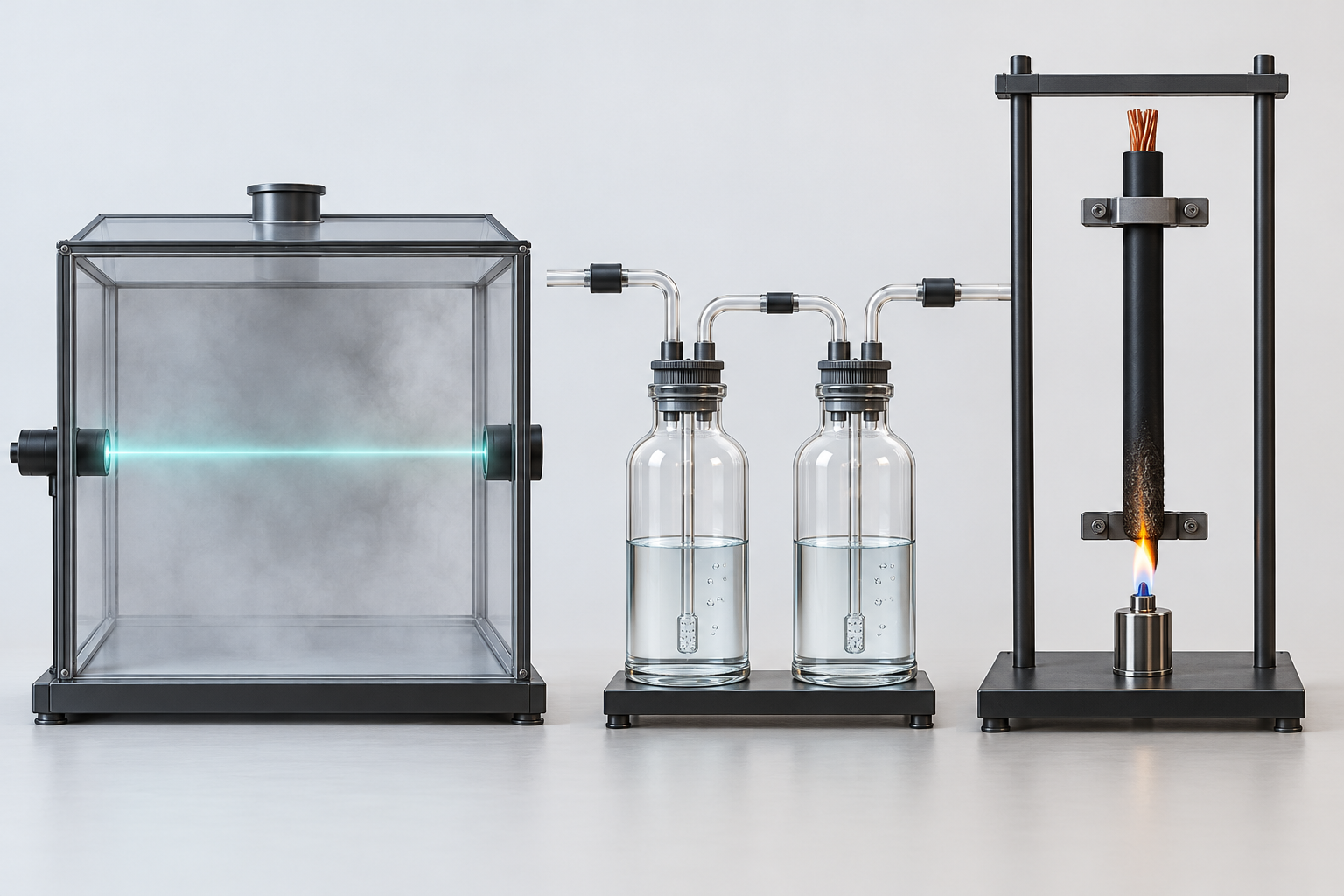
Smoke: the IEC 61034 series concerns smoke density from cables burning under defined conditions. Part 1 addresses apparatus and Part 2 addresses the procedure and evaluation. This is a cable-level assessment; a visual burn demonstration on a pellet does not reproduce it.
Combustion gases: IEC 60754-1 addresses halogen acid gas content, with scope limitations, including exclusion of hydrofluoric acid. IEC 60754-2 addresses acidity and conductivity of the gases captured under its procedure. These results do not constitute an unrestricted assay of every halogen or every toxic gas.
Flame propagation: the IEC 60332 series addresses different cable burning arrangements. A single-cable result does not establish the same behavior for a bundle. UL 94 material classifications also do not substitute for a required finished-cable test or installation listing.
Choose the required standard editions, specimens and acceptance criteria from the applicable cable or project specification. Avoid copying one familiar numerical threshold into every enquiry. A method identifies how a property is evaluated; the purchasing requirement must also say what result is acceptable.
| Question in your specification | Evidence to examine | Do not infer |
|---|---|---|
| How much smoke obscures light? | Required IEC 61034 cable report and criteria | Zero halogen from a smoke result |
| What halogen acid gas is evolved? | Required IEC 60754-1 material assessment | An all-halogen elemental analysis |
| What are acidity and conductivity? | Required IEC 60754-2 result and specimen scope | A complete toxicity evaluation |
| Does the specified cable resist flame spread? | Applicable IEC 60332 or other required cable assessment | Smoke, halogen or circuit integrity from flame spread alone |
The official IEC 61034-2 description explains the smoke procedure, while the IEC 60754-1 scope explains the material-level halogen acid gas assessment. These are starting points for understanding a report, not substitutes for the full methods.
A Compound Report Is Not a Complete Cable Approval
Distinguish the thing you buy from the thing the project qualifies. A cable factory may purchase an LSZH sheath compound, while the end customer purchases a completed cable. Evidence relevant to the compound does not automatically cover insulation, bedding, tapes, fillers and every other component.
Check whether the specification applies to individual non-metallic components, a representative combination or the finished cable. A compliant outer jacket cannot establish what an untested internal material contributes. Likewise, a report on one construction needs a justified scope before it is used for another size or design.
When discussing LSZH cable compound options, state the required material properties and the finished-cable tests separately. This helps a material supplier propose a relevant grade without suggesting that a compound data sheet constitutes a cable certificate.
If the quotation concerns halogen-free flame retardant additives, review the full formulation too. Adding a halogen-free FR package to a halogen-containing base polymer does not make the final blend halogen-free. The additive’s description is only one part of the evidence.
How to Review an LSF-to-LSZH Substitution
Consider a hypothetical procurement exercise, not a Rectivas customer case. A distributor submits an LSF replacement for an LSZH cable. The buyer receives a material data sheet and a single-cable flame report, but no smoke report and no relevant combustion-gas results.
Those documents do not establish the requested equivalence. The buyer lists the missing evidence, confirms the exact replacement construction and asks the project’s responsible technical reviewer to assess the proposal. A lower quote and a passing flame test do not close the smoke or halogen questions.
If the supplier later produces matching reports, review their specimen descriptions, methods, results and scope. If the reports describe a different product, clarify the relationship rather than assuming the trade name covers every variant. Keep a written record of the accepted substitution and its conditions.
The useful commercial question is whether the proposed product meets the same specified requirements at an acceptable delivered cost. Labels can start the comparison; they cannot finish it.
What to Request Before Approving the Order
Start with the project requirement, then build an evidence list. Request the exact product or material designation, manufacturer, construction and offered size range. Identify the report issuer, tested specimen, date, method edition, result and acceptance basis. Where certification is required, check its current scope with the issuing body.
Keep an SDS, technical data sheet and test report in their proper roles. An SDS addresses safety communication; a TDS lists material information; a test report describes a particular assessment. A familiar logo on any document does not expand what it demonstrates.
For a proposed flame retardant compound, agree on grade-specific data and application trials. Review extrusion behavior, mechanical properties, ageing requirements and relevant documentation alongside the fire-related evidence. A material change may need qualification work even when its acronym matches the old grade.
For purchasing teams, ask suppliers to quote against the same written requirements. Otherwise, an inexpensive LSF offer may be compared with an LSZH offer carrying a different evidence package. That is a scope difference before it is a price difference.
Our Recommendation for Cable Buyers
If the specification requires low smoke and halogen-related performance, write both requirements with their methods and acceptance criteria. If an offer says only LSF, ask what it means and request the missing evidence. If the offer says LSZH, perform the same scope checks rather than accepting the label as automatic approval.
For cable factories, give material suppliers the final construction and test targets early. For distributors, obtain reports for the product actually offered. For a wider comparison of PVC and LSZH material tradeoffs, use our LSZH vs PVC guide; the narrower question here is whether the labels and evidence match.
Frequently Asked Questions
Does LSF mean the same thing as LSZH?
No. LSF commonly describes low smoke and fume, while LSZH includes a zero-halogen claim. Commercial terminology can vary, so ask the supplier to define the offered description. Verify smoke, combustion-gas and flame performance against the required methods and limits. Do not approve a substitution solely because both descriptions sound related to reduced smoke or improved fire behavior.
Can an LSF cable contain PVC?
Yes. Some LSF-described cables use modified PVC formulations intended to reduce emissions. PVC contains chlorine in the polymer itself, so reduced smoke does not remove the need for halogen-related verification. Check the actual construction and relevant reports. Do not assume every product carrying the LSF abbreviation has the same formulation, performance or evidence package as another supplier’s product.
Does LSZH mean that fire gases are harmless?
No. Low-smoke and zero-halogen claims address particular characteristics, not every combustion hazard. Smoke obscuration, acidity, halogen acid gas and toxicity are different questions. A passing result under one method does not establish harmless emissions under every fire condition. If the application requires a specific toxicity assessment, include that requirement separately and verify the applicable report and specimen scope.
Does a flame test prove a cable is halogen-free?
No. Flame propagation testing evaluates behavior under the stated burning arrangement. It does not replace smoke or combustion-gas assessments. A halogen-containing formulation may resist flame spread, while a halogen-free formulation still needs its own flame-performance evidence. Keep the required properties separate and check that each report refers to the material or finished cable specified for your application.
Which reports should I request with an LSZH quotation?
Request the evidence named by the applicable cable or project specification, including smoke, combustion-gas and flame requirements where relevant. Confirm methods, editions, limits, results and specimen descriptions. Distinguish material reports from finished-cable reports, and check any certification scope separately. There is no universal document bundle that makes every LSZH-labelled product suitable for every installation or destination market.
Can an LSZH compound certify my finished cable?
No. Compound data can support material selection, but the complete cable has additional components and a defined construction. Qualification must address the requirements applicable to that finished product. Ask which properties were tested on the compound and which require cable specimens. Do not treat a jacket material report, technical data sheet or supplier declaration as automatic approval of every cable design.
Is an LSF-to-LSZH change always more expensive?
No universal premium applies. Material formulation, construction, processing, order size, documentation and qualification work all affect the comparison. Ask for equivalent performance scope before comparing quotations. A cheaper offer with missing smoke or combustion-gas evidence is not yet an equivalent alternative. Include trial and requalification costs where a change affects the approved material or cable construction.
Can Rectivas help select a material and arrange evaluation?
Rectivas is a sourcing and technical partner working with partner factories. Share the application, base material, required test methods and acceptance criteria so suitable options can be discussed. Sample availability, minimum order quantity, lead time and testing scope require confirmation for the specific proposal. Agree on the evaluation plan before treating material samples as finished-cable qualification evidence.
Final Thoughts
LSZH vs LSF is best resolved by matching claims to evidence. Low smoke alone does not establish halogen-free performance, and neither acronym replaces the required cable assessments. Define the methods, acceptance criteria and tested construction before approving a substitution. Rectivas can help discuss material options with partner factories once the application and evidence requirements are clear enough to support a meaningful comparison.
— Rectivas Materials Team, Ally