Quick answer: A UL Yellow Card is a listing for a finished plastic material — a specific compound, in specific colours, at specific thicknesses. That is why “does your flame retardant have a UL certificate?” has no yes-or-no answer: additives do not get cards, compounds do. If a customer is asking you for one, what they usually need is either your compound supplier’s card, or test data showing your formulation is capable.
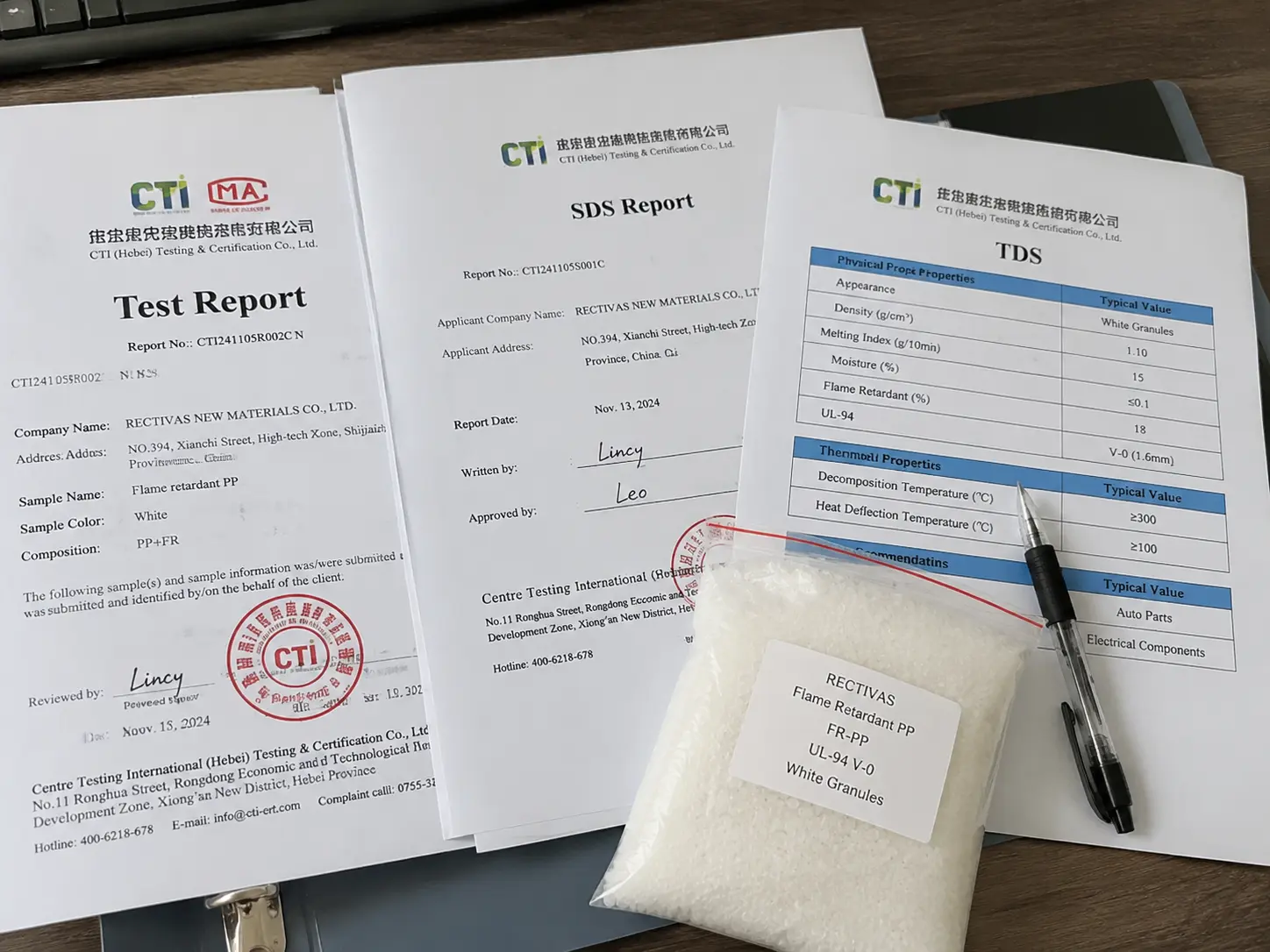
I handle compliance documentation, which means I spend a lot of time answering a question that cannot be answered as asked. A buyer needs “UL certified” material, their customer’s spec says so, and they ask whether our flame retardant is certified. The honest answer requires explaining a piece of how UL recognition actually works — and once it is explained, the buyer usually realises their real question was slightly different.
What Your Customer Is Actually Asking For
The request arrives in three different forms, and they need three different answers. Working out which one you are facing saves a lot of circular email.
| What they say | What they need | What to send |
|---|---|---|
| “Send us your UL certificate” | Evidence for their own compliance file | The Yellow Card of the compound you use, not of the additive |
| “Is the material UL approved?” | Confirmation the grade is recognised at their thickness and colour | The card plus the specific line covering that thickness and colour |
| “Can you prove it passes V-0?” | Capability evidence during development | Third-party test report at your wall thickness — a report is not a listing, and you should say so |
The mistake that costs the most is treating a card as transferable. A listing covers the grades, colours and thicknesses actually evaluated. Add a colour or thin a wall and you are outside its scope, whatever the certificate number says. Check the scope line before you quote a customer, not after they audit you.
What a Yellow Card Actually Is
Q: What is a UL Yellow Card? A recognition document for a specific plastic material grade, listing the properties UL has verified and the exact conditions under which each applies.
Formally it is a Plastics Recognition Card under UL’s Recognized Component programme, and it exists so that an equipment manufacturer can specify a material without re-testing it themselves. A typical card lists:
- Flammability classification — UL94 rating (HB, V-2, V-1, V-0, 5VB, 5VA) at each tested thickness
- RTI (Relative Thermal Index) — long-term thermal ageing performance, electrical and mechanical, at given thicknesses
- Electrical properties — CTI (tracking), HWI (hot wire ignition), HAI (high-amp arc ignition), arc resistance
- Colours covered — either specific colours or “ALL” where the whole range was qualified
- The material designation — a specific grade name from a specific manufacturer
Everything on the card is tied to those qualifying conditions. That is where the practical value lies, and also where the misreadings happen.
The Three Axes That Limit Coverage
A Yellow Card is not a blanket approval of a material. Its ratings are bounded on three axes at once, and a specification is only satisfied if all three line up.
| Axis | How it works | Common mistake |
|---|---|---|
| Thickness | A rating applies at the listed thickness and above — never below | Designing a 0.8 mm wall against a card that says V-0 at 1.5 mm |
| Colour | Only the colours listed are covered; pigments can change results | Qualifying in natural, then producing in black without checking |
| Grade | The exact material designation, from the named manufacturer | Assuming a “same chemistry” material from elsewhere is covered |
The thickness axis catches the most people, and it is worth restating the counter-intuitive part: a small number on the card is the impressive one. V-0 at 0.4 mm is a far more capable material than V-0 at 3.0 mm. We unpack the physics of why in our article on thin-wall flame retardancy, and the colour axis in our guide to colour matching.
Why an Additive Supplier Cannot Hand You a Yellow Card
Q: Does your flame retardant have UL approval? No supplier of flame retardant additives can answer yes, because the programme does not recognise additives that way.
UL recognition applies to the plastic material as it will be moulded. A flame retardant is an ingredient of that material, and an ingredient has no UL94 rating of its own — the rating is a property of the compound: this polymer, this loading, this filler, this colour, at this thickness. Change the base resin and the same additive gives a different result.
So the position in the supply chain determines who can hold the card:
- Compound and resin producers hold Yellow Cards for their grades. If we supply you a finished flame retardant compound, that grade is the kind of material a card can describe.
- Additive and masterbatch suppliers do not hold cards for the additive itself. What we provide instead is test evidence — UL94 and LOI results from our partner factory’s burn lab on your resin, plus third-party reports arranged through an accredited laboratory.
- You, the moulder, may need your own recognition if you compound in-house, because then you are the material manufacturer.
What buyers usually mean when they ask the question is one of three different things: “will this material let my finished part pass certification?”, “can you give me test data I can submit?”, or “is the material on a UL list I can reference in my file?” Those have different answers, and telling us which one you need saves a week of crossed emails.
What We Can and Cannot Provide
Stated plainly, because vagueness here wastes everyone’s time:
- We can develop a formulation to your target rating at your thickness, verify it with UL94 and LOI at our partner factory’s lab before shipment, provide TDS/SDS/COA with batch traceability from the ISO 9001 certified factories we source from, and arrange third-party test reports on specific batches.
- We can supply the same formulation consistently, which is what makes your own certification hold across future production — a certificate earned on one batch is only worth anything if every batch after it matches.
- We cannot hand you a UL Yellow Card for a flame retardant additive, because no such card exists in the programme.
- We cannot make our test data substitute for your certification. Our results tell you the formulation is capable; the test that counts for your file is on your part, from your process, at your thickness.
How to Run the Certification Route
- Find out what the specification actually requires. “UL certified material” can mean a recognised material from a card, or a rating your part must achieve, or a full end-product listing. These are three different projects with three different costs.
- If a recognised material is genuinely required, buy a compound or resin grade that already carries a card covering your thickness and colour — that is the fastest and cheapest route, and it is a legitimate reason to choose compound over additive.
- If your part needs a rating, develop the formulation, pre-screen at bench scale, then test the production article. Pre-screening cheaply before booking certification is the whole point of our partner burn lab.
- Check the full test stack early. Electrical parts rarely need only UL94 — glow wire and CTI usually come with it, and they can conflict. Our guide on UL94, glow wire and CTI covers how to sequence them.
- Lock the supply. Once certified, a change of additive supplier, carrier, colour or glass content can invalidate what you paid for. Requalification cost is real and belongs in the sourcing decision — the accounting is in our cost per part guide.
If you are holding a specification that says “UL certified” and you are not sure which of the three meanings applies, send us the clause itself — we will tell you what it actually requires and which parts of it we can support, including the parts we cannot. What documentation we issue as standard is on our downloads page, and how to audit any of it in our guide to sample evaluation.
FAQ
Does a Yellow Card cover every colour of a material?
Only the colours listed. Some cards are qualified across all colours, many name specific ones. Since pigments can affect both flammability and tracking performance, adding a colour generally means additional testing rather than assuming coverage.
My material is V-0 on the card at 1.5 mm. Is my 1.0 mm part V-0?
No. Ratings extend upward in thickness, never downward. A 1.0 mm section needs its own qualification, and thinner walls are genuinely harder to rate, not easier.
Can I use a supplier’s UL94 test report instead of a Yellow Card?
It depends what your customer requires. A test report is evidence that a formulation is capable; a Yellow Card is a recognised listing your customer can reference directly in their own file. Where the specification names recognised material, a report is not a substitute — ask which one the clause means before assuming.
If I buy a UL recognised compound, is my finished product UL listed?
No — these are different levels. Recognised material is a component recognition; a finished product listing covers the whole assembly and involves its own evaluation. Using recognised material makes that process easier, but it does not complete it.
Certification confusion clusters in electronics more than in any other market, because the part has to satisfy flammability, tracking and thermal ageing rules that are all listed separately. If that is your sector, the full standards map is on our flame retardant for electronics page.
Final Thoughts
So the honest answer to “does your flame retardant have a UL certificate” is that it cannot. What we can put behind your submission: formulation development, UL94 pre-screening at your thickness, TDS, SDS and COA with third-party reports, and the batch consistency under ISO 9001 that keeps your listing valid. Want a material that already holds a card? Ask about finished compound. Building cable is where material-level recognition stops: in Europe the CPR class belongs to the finished cable, as laid out in why an LSZH compound cannot carry a Euroclass.
—— Rectivas Materials 团队 阿丽