Rectivas Materials · Flame retardant manufacturer and formulation partner sales@rectivas.com  ·  WhatsApp +86 180 3191 1520

Flame Retardant for Electronics

Electronics is the largest end market for flame retardants and the one where a UL94 rating settles the least. A plastic part inside an appliance is structure and insulation at the same time, so it gets judged on tracking resistance, glow wire ignition and long-term heat ageing as well as burn rating. We supply the flame retardant layer that has to satisfy all of them at once.

StandardsUL94 · GWIT · CTI · RTI
FormsPowder · masterbatch · compound
Main systemPhosphinate · MCA · brominated
Hard partElectrical specs, not the burn rating
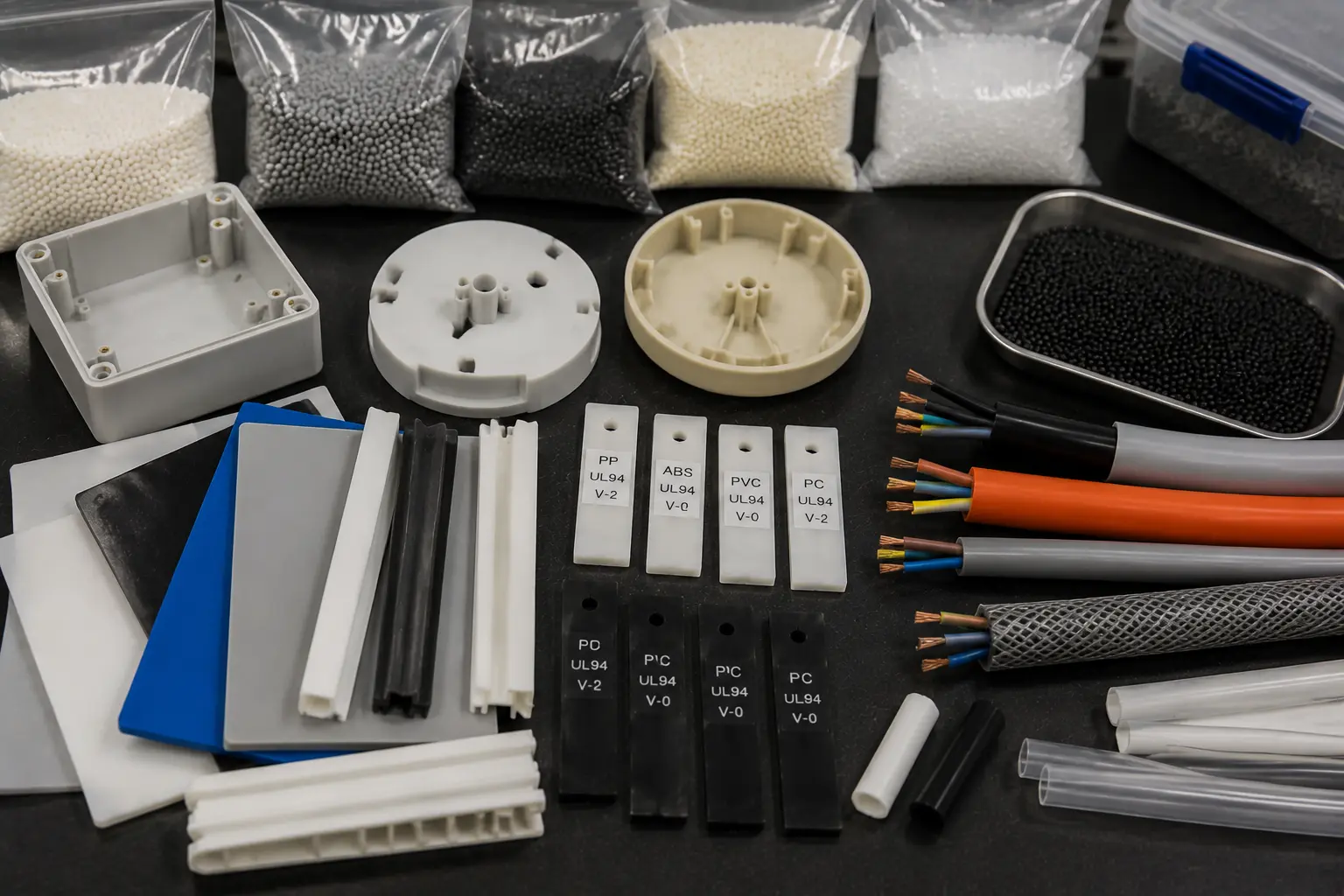
Flame retardant housing plaques in production colours screened for UL94 rating Fig. EE01 — housing plaques at rating thickness

A rating earned at 1.6 mm says nothing about the 0.8 mm wall you actually mould.

E&E supply
Form — powder / MB / compound
Goal — V-0 plus CTI and glow wire
Use — connectors, switches, housings
01 / 07Why Electronics Is Different

V-0 Is the Entry Ticket

In most industries the flame rating is the specification. In electronics it is the part everyone remembers to ask for, and then three other requirements decide whether the material actually ships. Two of them are electrical, one is about time, and none of them is covered by a UL94 grade.

Judged by: burn rating + tracking + glow wire Binding constraint: electrical properties, not flammability Timescale: RTI over the device service life
EE-01

Tracking Is Where Halogen Costs You

Dust, humidity and voltage together carbonise a plastic surface into a conductive path. IEC 60112 measures the voltage a material survives; UL 746A sorts the result into performance level categories where PLC 0 is the strongest — the same counter-intuitive numbering that confuses people on a UL Yellow Card.

  • PLC 0 = CTI ≥ 600 V, and 600 V is the ceiling of the test method
  • Brominated plus antimony packages usually land in PLC 2–3
  • Detail: UL94, glow wire and CTI compared
EE-02

The Glow Wire Gate

A loose terminal glowing red is the real appliance failure mode, so IEC 60335-1 puts plastic parts carrying more than 0.2 A in unattended appliances — fridges, washing machines, dishwashers — through glow wire testing rather than trusting a flame rating.

  • GWIT ≥ 775 °C plus GWFI > 850 °C clears unrestricted use
  • Otherwise the part itself is tested at 750 °C, burning ≤ 2 s
  • V-0 does not predict this — the mechanisms differ
EE-03

Thin Walls Move the Target

Connector bodies and housings keep getting thinner, and a UL94 grade is bound to the thickness it was tested at. A compound rated V-0 at 1.6 mm can drop to V-2 at 0.8 mm, where there is less material to form char and heat penetrates faster.

  • Rate at your real wall, not the datasheet default
  • Thinner sections need higher loading, not the same
  • Detail: thin-wall flame retardancy
02 / 07Standards

The Standards Map

Electronics stacks flammability, electrical and thermal-ageing requirements that are tested separately and can be failed independently. A material sheet that quotes only a UL94 grade has answered one line of this table.

StandardWhat It TestsTypical E&E Requirement
UL 94 / IEC 60695-11-10Small-flame vertical burning, flame removedV-0 at the actual wall thickness; 5VA or 5VB for large enclosures
IEC 60695-2-13 (GWIT)Lowest temperature at which a glowing element ignites the material≥ 775 °C for unrestricted use in current-carrying appliance parts
IEC 60695-2-12 (GWFI)Glow wire flammability index on test plaques> 850 °C, quoted together with GWIT
IEC 60695-2-11 (GWT)Glow wire applied to the finished part, not a plaque750 °C with flame ≤ 2 s — the fallback route
IEC 60112 / UL 746A (CTI)Resistance to conductive tracking under contaminationPLC 0 (≥ 600 V) for high-voltage or dirty environments
UL 746A HWI / HAIHot-wire and high-current arc ignitionSet by the electrical function of the part
UL 746B (RTI)Relative thermal index — long-term ageingSeparate electrical and mechanical RTI values
IEC 60335-1Household appliance safety; invokes glow wireApplies above 0.2 A in unattended appliances
IEC 62368-1IT and AV equipment safety, replacing 60950-1 and 60065References material flammability classes
IEC 61249-2-21The halogen-free definition used in electronicsBr ≤ 900, Cl ≤ 900, total halogen ≤ 1500 ppm

One clarification worth making early: “RoHS compliant” and “halogen-free” are different requirements, and they get used interchangeably in enquiries every week. RoHS restricts two brominated groups, PBB and PBDE. Most current brominated flame retardants — DBDPE and brominated polystyrene among them — are fully RoHS compliant while being nowhere near the IEC 61249-2-21 halogen limits. We supply both halogen-free and brominated systems, so we have no reason to blur the distinction: tell us which of the two you actually need. If the driver is a customer policy rather than a test result, the migration guide covers what changing over really costs.

03 / 07By Component

Where We Supply Into

Component type decides the resin, and the resin decides which flame retardant chemistry is even available. Below is the usual mapping, and where our supply stops.

ComponentTypical ResinUsual SystemRelated Page
Connectors & terminal blocksGlass-filled PA66, PA6, PBTPhosphinate + reinforcement; halogen-free where CTI is highFR nylon · FR PBT
Switches, breakers, socketsGlass-filled PA66, PBTHalogen-free phosphorus; CTI and GWIT bind togetherGlass-filled FR
Appliance housings & internalsABS, HIPS, PPBrominated + antimony for cost, or phosphorus under a halogen policyFR ABS
Enclosures & power adaptersPC, PC/ABSPhosphate esters with anti-drip; transparency sometimes requiredFR PC · BDP / RDP
Copper clad laminate / PCBEpoxy resin systemsReactive DOPO chemistry, built into the resinHalogen-free PCB material
Films, tapes & insulation partsPET, PETG, PPBrominated or phosphorus at thin gaugeFR PET film · FR PETG
Precision moving partsPOMGenuinely difficult — we say so rather than oversellFR POM

Where our supply ends: we make the flame retardant layer, not the device. We do not produce metal contacts, laminate or press copper clad board, supply finished prepreg, or certify equipment. For PCB work we supply into the resin formulator rather than the board shop, and for POM we would rather tell you the chemistry is limited than sell a package that will disappoint at the burn bench.

04 / 07Systems

Chemistry for Electronics

Three practical routes cover most E&E work. Which one is open to you is usually decided by whether the part is reinforced and how high the tracking requirement is — not by preference.

S-01

Phosphinate for Glass-Filled Nylon

Aluminium diethylphosphinate is the mainstream halogen-free route for reinforced PA66 and PA6. It survives polyamide melt temperatures and supports the high CTI that connectors and switchgear need.

  • Thermally stable through PA66 processing
  • Supports PLC 0 targets where halogen cannot
  • Glass fibre wicks melt to the flame — expect higher loading
S-02

MCA for Unfilled Nylon Only

Melamine cyanurate is efficient and cheap in unfilled polyamide, and close to useless once glass fibre goes in. It works by promoting dripping that carries heat out of the flame zone, and reinforcement is precisely what stops the part dripping.

  • Excellent in unfilled PA6 and PA66
  • Reinforced grade? Switch chemistry, do not raise dosage
  • A clean single-variable test if you are unsure
S-03

Brominated, and What It Costs Electrically

Brominated systems with antimony trioxide remain the most efficient way to V-0 in ABS and HIPS at the lowest loading. The trade is electrical: tracking typically sits at PLC 2–3 and glow wire performance is unremarkable.

One more failure mode worth naming: appliance compounds are rarely just resin and flame retardant. Impact modifiers, light stabilisers, pigments and lubricants are usually in there too, and several of them interact with flame retardant chemistry in ways that show up as an unexplained drop from V-0 to V-2 after a seemingly unrelated formulation change.

05 / 07Selection

What Decides an E&E Formulation

Nine inputs. With these we can propose a real system instead of a product list.

01UL94 grade at the real wall thickness
02CTI / PLC requirement
03GWIT, GWFI or GWT requirement
04Base resin and glass fibre content
05Halogen policy: RoHS or IEC 61249-2-21
06Colour and surface requirements
07Continuous service temperature / RTI
08Target market (UL, IEC, CQC)
09Annual volume and preferred form
06 / 07Capability

How We Support E&E Manufacturers

Electronics certifies once and then buys for years. The value is not in a single passing sample — it is in every later lot behaving like the one that earned the approval.

  • C-01Halogen-free phosphorus packages for reinforced PA and PBT, and brominated packages for ABS and HIPS — designed against your electrical targets, not only a burn grade
  • C-02All three formats: powder, masterbatch, and ready-to-mould compound in our FR-PA6, FR-PA66, FR-PBT, FR-PC, FR-ABS and FR-PPO grades
  • C-03UL94 pre-screening in our own burn lab at your specified thickness, before you commit to certification testing
  • C-04Antimony-lean and antimony-free package design where policy or tracking demands it
  • C-05Dispersion and colour matching support — housings usually carry a colour target as tight as the flame spec
  • C-06TDS / SDS / COA, plus third-party reports through CTI (Hebei) Testing & Certification
  • C-07Batch traceability under ISO 9001 from our SHJ-75 compounding line — the part that keeps your approval valid

What we cannot do: we cannot give you a Yellow Card for an additive, because Yellow Cards are issued for finished materials rather than additives, and our test data does not replace your own certification. That distinction is worth reading in full before your next customer audit: what a UL Yellow Card actually covers.

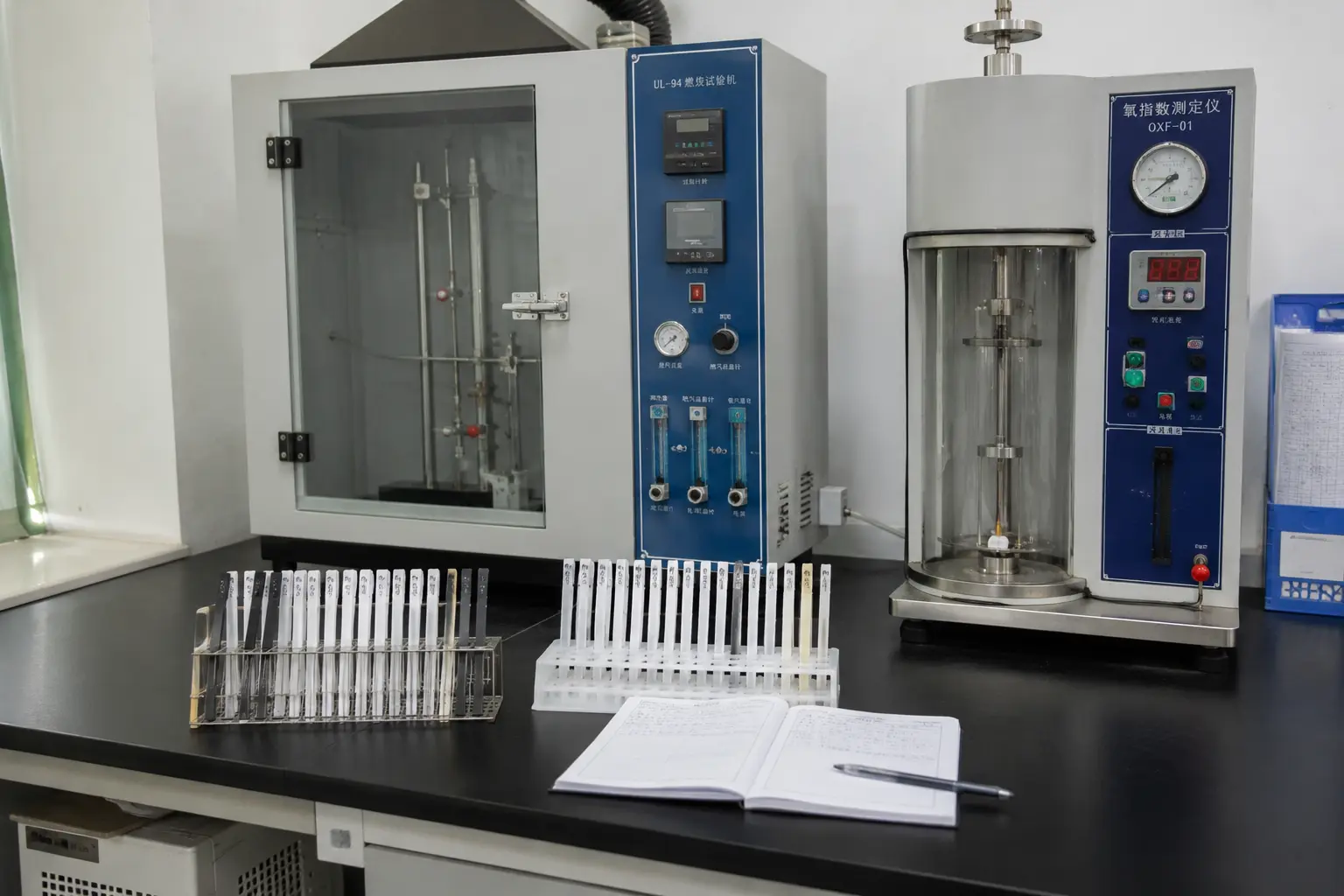
UL94 and LOI flame testing equipment used to pre-screen electronic grade flame retardant compoundsFig. EE02 — in-house burn screeningRated at your wall thickness, not the datasheet default.
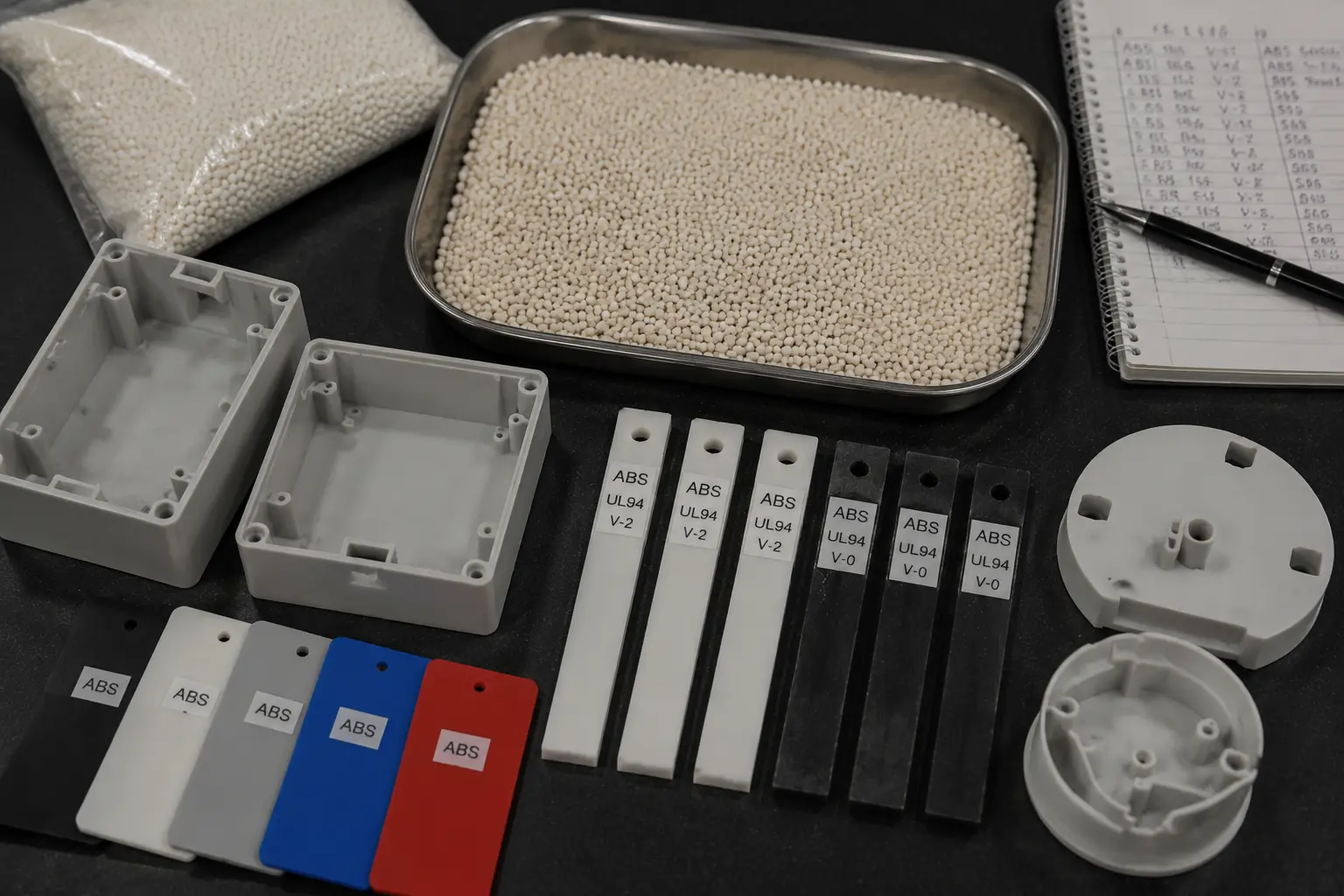
Moulded electrical application samples of flame retardant compound for electronic componentsFig. EE03 — moulded application samplesSample bars in the resin and colour you actually run.

Which Requirement Will Actually Block You

Electronics specifications stack several tests that fail for unrelated reasons. In our experience the burn rating is rarely the one that holds a project up — here is what usually does.

If Your Spec IncludesWhat It Forces, and What It Rules Out
CTI 600 V (PLC 0)Effectively forces halogen-free. Brominated plus antimony leaves residues that track more readily, typically landing at PLC 2–3. This is an electrical decision, not an environmental one.
GWIT ≥ 775 °CRules out relying on gas-phase chemistry. A hot element sitting against the part gives bromine no flame to interrupt — you need char. V-0 does not predict this result.
Wall below 1 mmHigher loading than the datasheet suggests, and a rating measured at 1.6 mm tells you nothing about your part.
"RoHS and halogen-free"Two different requirements. RoHS restricts only PBB and PBDE; halogen-free means IEC 61249-2-21 at Br ≤900, Cl ≤900, total ≤1500 ppm. Confirm which one binds before anyone quotes.

Practical sequencing: find the hardest requirement in your list first and design to that, rather than starting from UL94 because it is the familiar one. For most connector and appliance work the binding constraint is tracking or glow wire. Send the full clause list with your wall thickness and we will tell you which of your targets fight each other — that conversation is cheaper before tooling than after.

07 / 07FAQ

Questions From Electronics Manufacturers

Direct answers for design, compliance and procurement teams.

Does a UL94 V-0 rating mean the part will pass glow wire?

No, and assuming it does is a common way to lose a month. UL94 applies a small flame and then takes it away, which rewards gas-phase chemistry that interrupts the flame reaction. The glow wire test presses a hot element against the material and keeps it there — there is no flame to interrupt, so what counts is char formation and thermal stability. Efficient brominated systems often reach V-0 comfortably and still miss GWIT 775 °C. Specify and test the two separately.

Why does a 600 V CTI requirement usually mean halogen-free?

Because tracking is about what the surface leaves behind under voltage and contamination. Brominated packages with antimony trioxide tend to form a conductive carbon path more readily, which typically puts them in PLC 2 or 3. Phosphorus and nitrogen-phosphorus systems track better and are the realistic route to PLC 0 — CTI at or above 600 V, which is also the upper limit of the test method. In electronics, going halogen-free is frequently an electrical decision that happens to also satisfy an environmental policy.

Is “RoHS compliant” the same as “halogen-free”?

No. RoHS restricts two brominated groups, PBB and PBDE. Most brominated flame retardants in current use are fully RoHS compliant, so a RoHS certificate tells you nothing about halogen content. Halogen-free in electronics means IEC 61249-2-21: bromine ≤ 900 ppm, chlorine ≤ 900 ppm, total halogen ≤ 1500 ppm. When an enquiry says “RoHS, halogen-free” we ask which one is the actual requirement, because the answer changes the chemistry and the price.

Which system should I use for glass-filled nylon connectors?

Aluminium diethylphosphinate, in practice. It handles PA66 processing temperatures and supports high CTI. What does not work is melamine cyanurate: it relies on promoting dripping to carry heat away, and glass fibre stops the part dripping, so most of the effect disappears. Reinforced grades also need more flame retardant than unfilled ones, because the fibres wick molten polymer toward the flame.

Do you supply additives, masterbatch or finished compound?

All three. Powder additives if you compound in-house, masterbatch where dosing on the moulding line suits you better, and ready-to-mould compound in our FR-PA6, FR-PA66, FR-PBT, FR-PC, FR-ABS and FR-PPO grades. Above roughly 40–50% additive loading, compound is usually the more sensible route than trying to dose that much on a moulding machine.
Discuss Your E&E Specification

Send the burn grade with its thickness, the CTI and glow wire values you have to meet, your base resin and glass loading, and whether the halogen requirement is RoHS or IEC 61249-2-21. We will propose a system, pre-screen it at your wall thickness in our own burn lab, and tell you honestly which of your targets fight each other.

Include in your inquiryEE-RFQ
  • Flame specUL94 grade and the wall thickness it applies at
  • ElectricalCTI / PLC target, GWIT / GWFI / GWT values
  • ComponentConnector, switch, housing, enclosure, CCL, film
  • Base resinPA6 / PA66 with GF%, PBT, ABS, PC, PC/ABS
  • Halogen policyRoHS only, or IEC 61249-2-21 halogen-free
  • Market & volumeTarget market(s) and annual tonnage