Quick answer: Flame retardant plastics fail UL 94 V-0 when the tested formulation and specimens do not meet every required criterion. Start with the recorded failure: prolonged burning, excessive afterglow, cotton ignition or burning to the clamp. Then compare specimen preparation, thickness, ingredient identity, effective additive content and processing history. Adding more flame retardant before identifying the failed criterion can waste trials and leave the real problem unchanged.
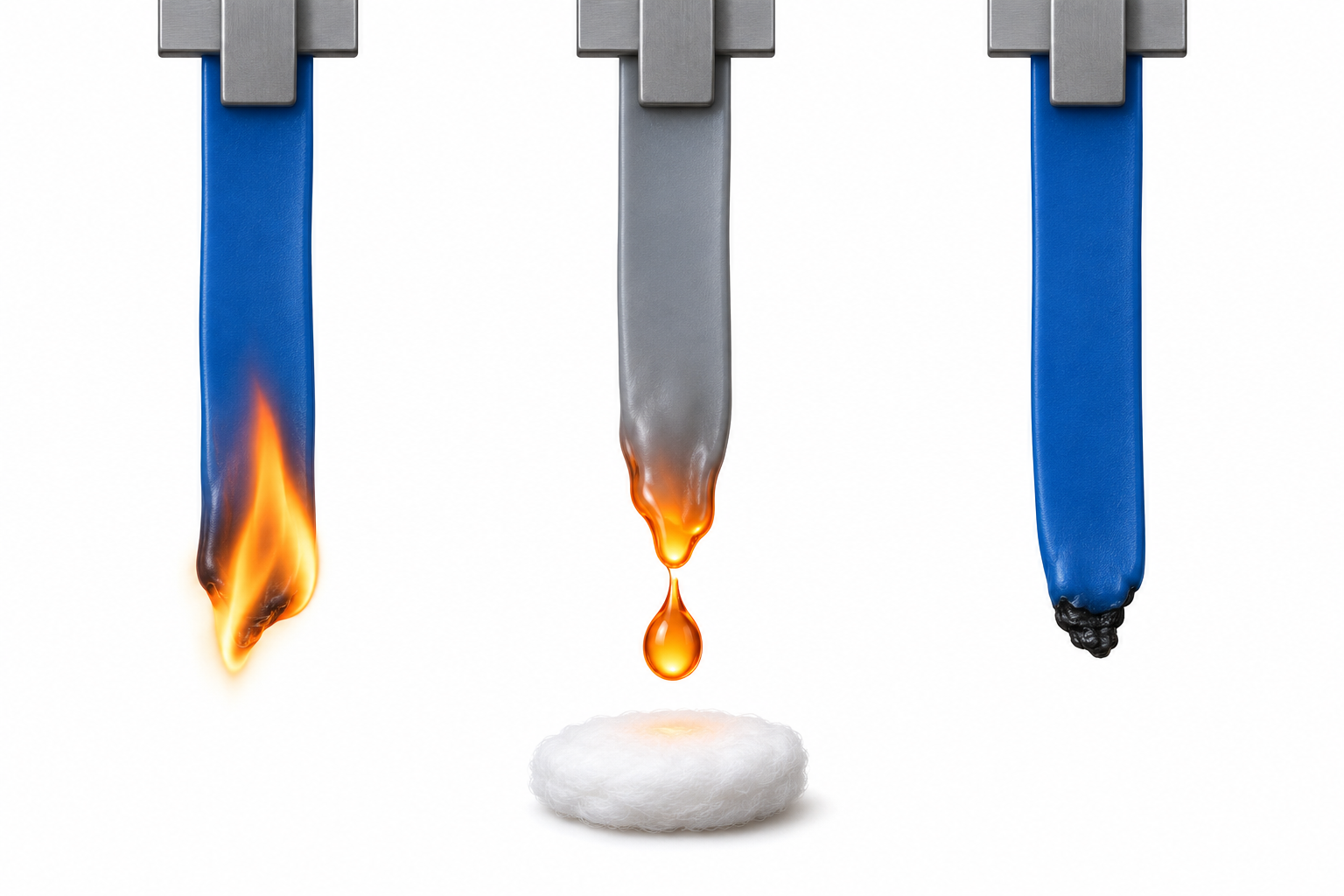
Start With the Failure Record, Not the Additive Percentage
“It failed V-0” is a result, not a diagnosis. A specimen that burns too long poses a different question from one that extinguishes quickly but ignites the cotton below it. A batch with scattered results needs a different investigation from a formulation that fails consistently.
Ask for the individual specimen observations and timings, the preparation record and the exact material identification. Preserve failed specimens where practical. A video can help explain what happened, but it does not replace a properly documented test.
This article provides an investigation framework rather than a universal repair recipe. For a full comparison of the classifications, use the separate UL 94 ratings guide. Here, the priority is choosing the next useful check after an unsuccessful trial.
Which V-0 Criterion Was Missed?
UL Solutions’ combustion test guidance describes the vertical test criteria. Its V-0 summary includes individual afterflame times no longer than 10 seconds, a total no longer than 50 seconds across ten flame applications, and combined afterflame and afterglow after the second application no longer than 30 seconds. Burning must not reach the clamp, and falling material must not ignite the cotton indicator.
Use the current applicable standard and laboratory instructions for the full procedure and classification decision. The summary above does not cover specimen preparation, all procedural details or recognition requirements.
| Recorded observation | First question | Useful starting evidence |
|---|---|---|
| Afterflame time exceeds the applicable limit | Is the flame-retardant package appropriate and present at the intended active level? | Individual timings, recipe and ingredient identities |
| Falling material ignites cotton | What was the melt and dripping behavior? | Droplet observations and the complete formulation |
| Glowing persists after visible flame ends | Has afterglow been recorded separately? | Timing record and residue observations |
| Burning reaches the clamp | Are the specimen and formulation representative of the intended material? | Specimen identification, preparation and recipe |
| Results vary across specimens | What changed between samples or production periods? | Traceability, measurements and processing records |
These are investigation prompts, not one-to-one diagnoses. A single observation can have several causes. Keep alternative explanations open until a controlled comparison separates them.
Check Thickness, Color and Specimen Preparation First
Before changing a recipe, confirm that the tested specimens correspond to the requirement. Compare measured thickness, the exact resin grade, color designation, reinforcement and preparation history with the material evidence being cited. Do not use a different specimen simply because its result looks more favorable.
UL’s plastics recognition program material identifies thickness recognition and colors to be tested as relevant topics. A rating should therefore stay attached to its documented scope rather than being treated as a property of a generic resin name.
Record conditioning and specimen preparation using the laboratory’s current requirements. If two trials used different preparation, do not label the difference a formulation improvement until the comparison is repeated consistently. The same discipline applies when comparing a supplier’s data with locally prepared specimens.
For incoming materials, keep the original grade label and batch details. “FR nylon” or “V-0 ABS” on a purchase description is too broad to identify the formulation behind a disputed result. Ask for the exact material and relevant supporting document.
Separate Flame Inhibition From Dripping Control
A material may stop burning on the strip yet produce falling material that ignites the indicator. In that case, reviewing only the visible flame duration misses the observation that prevented the intended classification. Do not reduce the failure report to a single stopwatch value.
Daikin’s technical explanation of PTFE anti-dripping additives describes fibrillation and the resulting network that supports the melt. It illustrates why some formulations use a separate component to modify dripping behavior alongside the flame-retardant package.
This is an example of a formulation function, not a recommendation to add PTFE to every material. Grade compatibility, incorporation, customer restrictions and the full material specification still apply. A supplier’s successful example is not a transferable guarantee.
Also avoid assuming that the absence of visible drips solves every failure. Continued burning and afterglow require their own assessment. An adjustment that changes one observation should be evaluated against the complete test outcome and the properties required in service.
Verify Active Content and the Complete Recipe
Check the recipe as weighed, not only the formulation sheet as written. A concentrate addition percentage is not the same quantity as the active flame-retardant content in the finished material. Carrier resin, pigments and other additions belong in the mass balance.
For a hypothetical arithmetic example, a concentrate containing 50% active ingredient and used at 10% of the final blend supplies 5% active ingredient by mass. This calculation explains the basis only; none of these percentages is a recommended V-0 formulation.
Review whether percentages refer to the final compound, a resin-only basis or parts per hundred resin. Comparing values expressed on different bases can make a recipe appear unchanged when the effective level differs. Keep the units and denominator beside each formulation entry.
Include synergists and other functional ingredients in the review. Changing a supplier grade or omitting a companion component can change the package even if the main chemical name remains the same. For formulation sourcing, begin with the relevant flame retardant additives, then confirm the whole system.
Investigate Dispersion and Production Variation
When some specimens perform differently, map them to their production history. Were they molded from the same pellet sample? Did they come from startup, stable production or a restart? Were feed rates, material preparation and sampling consistent?
Review the physical distribution of ingredients and the feeding records before declaring a chemistry ineffective. Surface appearance alone cannot prove homogeneous incorporation. Select checks suited to the material, with the compounder or laboratory identifying appropriate methods and representative sampling.
A concentrate can simplify handling, but it does not eliminate verification. If using flame retardant masterbatch, confirm carrier compatibility, active content and the intended processing route. A nominally identical let-down ratio cannot resolve a carrier mismatch or inconsistent incorporation.
Keep a retained reference sample from the last acceptable run where available. Comparing a disputed batch with an identified reference under the same preparation and test conditions is more informative than comparing it with an old catalog statement.
Reinforcement and Other Ingredients Can Change the Problem
A formulation developed for unreinforced resin should not be assumed suitable for a glass-filled version. Treat the reinforcement type and content as part of the material identity. Likewise, investigate a color or additive change as a change to the recipe, even when its percentage looks small.
As one manufacturer example, Clariant’s OP 1312 guidance identifies intended polyamide applications and states that the required dosage can vary with the polymer grade, processing conditions and glass-fiber reinforcement. This supports application-specific evaluation rather than a universal dosage rule.
For a color change, compare the complete color concentrate, including its carrier and other ingredients. If several components changed together, an unsuccessful test cannot identify which one mattered. A controlled return to the reference recipe is a better starting experiment than blaming the pigment immediately.
Do not rank possible causes by how expensive the ingredient is. A low-cost processing aid can deserve investigation just as much as the main flame retardant. The relevant question is what changed and whether that change can be isolated.
Review Heat History, Moisture and Reprocessing
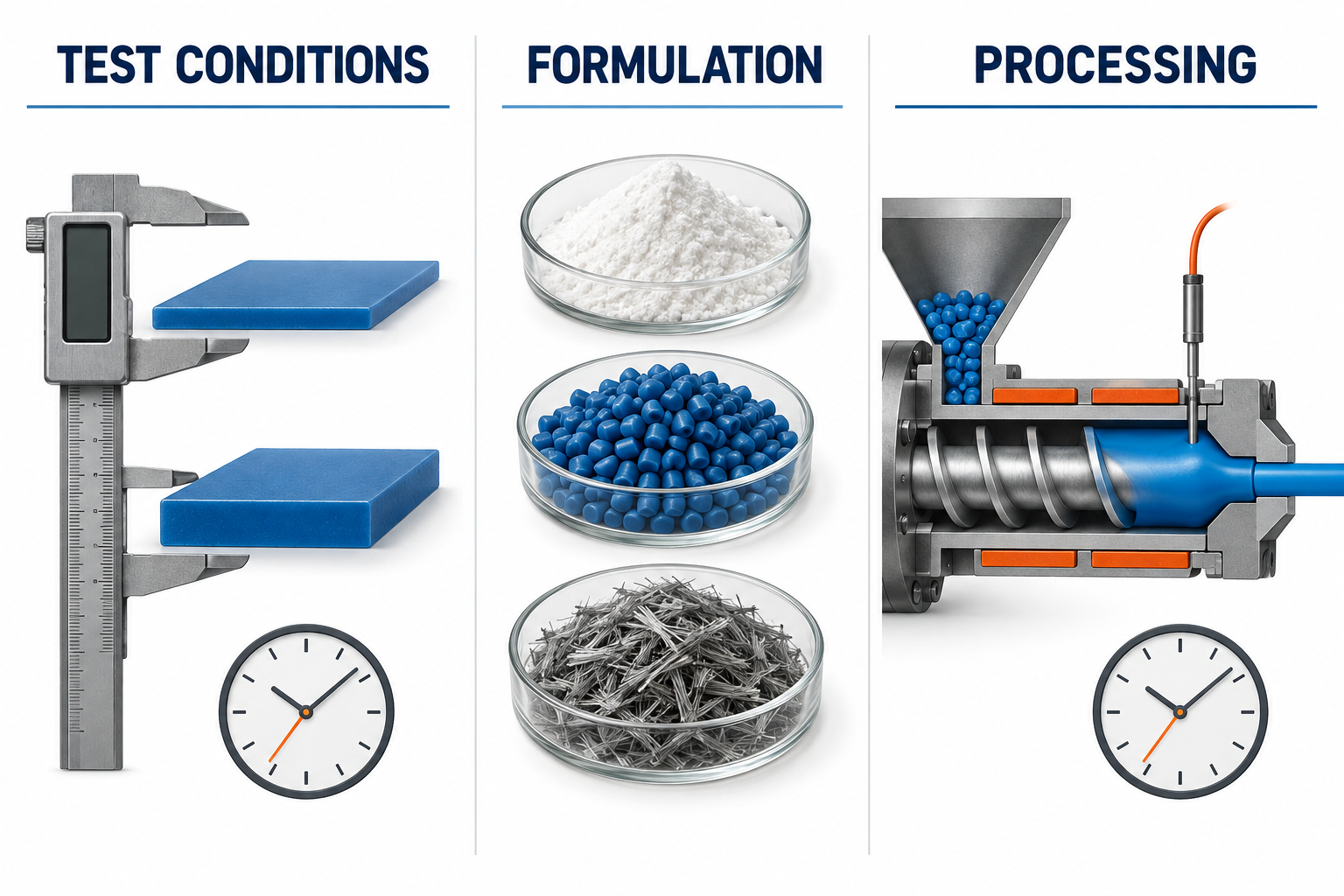
Check whether the material was processed within the selected grades’ instructions. Record actual melt measurements where available, rather than relying only on barrel settings. Include material holding and interruptions in the review, because a steady-run sample may not represent restart material.
Coperion’s technical discussion considers temperature peaks and residence time alongside material treatment. These variables belong together when reviewing thermal exposure. An unchanged controller setting does not prove an unchanged processing history.
Review moisture preparation against the resin and additive instructions. Record any regrind or recycled feed and its source. A change in material history is a variable to investigate, not automatic proof of damage or a reason to reject all recycled material.
Separate observations from conclusions. Discoloration, odor or bubbles may justify further investigation, but they do not independently identify why a fire test changed. Confirm the suspected mechanism with suitable evidence before selecting a corrective action.
A Practical Comparison: Why More Additive May Miss the Cause
Consider a hypothetical molding trial. The reference recipe performs acceptably, but a new colored version produces cotton ignition during testing. The team responds by increasing the main flame retardant and changing the molding profile at the same time.
Even if the next trial improves, the team has learned little about the cause. The color concentrate, active-content calculation and melt behavior still need comparison. Changing several variables together also makes the successful result harder to reproduce.
A better investigation preserves the reference formulation, verifies the test conditions and evaluates one justified change at a time where practical. The aim is not to maximize additive content. It is to produce a repeatable material that meets the intended requirements without unacceptable mechanical, electrical or processing penalties.
Our Recommendation: Build a Small, Traceable Trial Plan
If you formulate compounds, start with the failed criterion and the latest known acceptable reference. Define a hypothesis and what evidence would support or reject it. Record the complete recipe and keep specimens linked to the production batch.
If you process purchased compounds, avoid repairing the formulation without first involving the material supplier. Provide the exact grade, color, thickness, preparation and failure record. A documented flame retardant compound may be a more practical route where formulation resources are limited, but its evidence must match the intended application.
| Trial stage | Record | Decision it supports |
|---|---|---|
| Establish the reference | Exact recipe, grade, color and sample history | Whether the comparison is meaningful |
| Classify the observation | Individual timings, dripping, residue and preparation | Which investigation path to follow |
| Test a hypothesis | One planned change and representative samples | Whether the suspected variable explains the result |
| Confirm the material | Repeatability and required finished properties | Whether the change is suitable for the application |
Rectivas Materials works as a sourcing and technical partner. We can help coordinate candidate material information and supplier discussions. A proposed additive change still needs appropriate testing; a recommendation is not a certification or a promise that every formulation will pass.
Frequently Asked Questions
Why do flame retardant plastics fail UL 94 V-0?
Possible explanations include an unsuitable formulation, an unintended active level, different specimen conditions or inconsistent processing. Start with the actual failed observation and the exact material identity. A result by itself does not identify the cause. Compare the disputed material with a documented reference before selecting a recipe change or deciding that the additive is defective.
Will adding more flame retardant always solve the failure?
No. A higher addition level cannot correct every problem and may introduce other property or processing penalties. First verify the failed criterion, active-content calculation and complete recipe. If the issue involves incorporation, dripping behavior or a mismatch in the comparison conditions, increasing the main additive may leave that issue unresolved. Use controlled trials to test a specific hypothesis.
Can cotton ignition be the problem even if the strip extinguishes?
Yes. The observations made on the strip do not fully describe what happens to material that falls away. Ask the laboratory for the complete record rather than a single flame-duration value. Review the formulation’s melt behavior with the supplier and evaluate any proposed correction against all required criteria, not only whether the next specimen appears to extinguish quickly.
Can changing color require another evaluation?
A color change should be reviewed against the material’s documented recognition scope and the complete recipe. A color concentrate may introduce a carrier and other ingredients as well as pigment. Keep those identities in the comparison. If results change, isolate the variables under consistent conditions rather than assuming either that all colors behave identically or that the pigment alone caused the failure.
Does passing a thicker specimen prove the thinner part is suitable?
Do not use a different thickness as a substitute for evidence covering the intended requirement. Keep the tested material and recognition conditions attached to the result. When the application changes, ask which existing evidence applies and what additional evaluation is needed. A favorable result from a convenient specimen cannot by itself resolve the suitability of a different part.
Should I replace the additive or buy a finished compound?
That depends on your formulation and validation resources. Compounders may prefer control over individual additives, while processors may benefit from a documented finished material. In either case, first understand the failure and the intended requirement. Changing the supply form without matching the exact grade, application and supporting evidence can simply move the same uncertainty to a different purchase.
What information should I send to the supplier?
Provide the exact resin and additive grades, full formulation basis, reinforcement, color and processing history. Include specimen thickness, preparation conditions and the individual failure observations. Identify any changes from the last acceptable material. This gives the supplier a concrete comparison to review and makes a proposed trial more useful than a request for a generic V-0 additive.
Does a successful trial certify the finished product?
A successful development trial is useful evidence, but it should not be described as finished-product certification. Identify who performed the test, which procedure was used and what material conditions it covered. Confirm the recognition or approval requirements for the intended product separately. Keep development observations, formal test reports and certification claims distinct in purchasing and technical communication.
Final Thoughts
When flame retardant plastics fail UL 94 V-0, the most useful next step is a better-defined investigation. Preserve the failed observations, match the comparison conditions and trace the complete formulation through production. Then evaluate a justified change with the required finished properties in view. Rectivas Materials can help coordinate additive, masterbatch or compound sourcing discussions, while application-specific testing establishes whether the proposed material meets the requirement.
— Rectivas Materials Team · Chen (老陈)