Quick answer: UL94 rates plastics on a ladder: HB (slow horizontal burning), then V-2, V-1, V-0 (vertical, increasingly strict), then 5VB and 5VA for enclosures. V-0 allows no more than 10 seconds afterflame per application and 50 seconds total across the ten flame applications, with no flaming drips that ignite the cotton. The two facts most often missed: V-1 and V-2 have identical time limits and differ only on dripping, and a rating belongs to a specific thickness and colour, not to the material as such.
We run this test at our partner factory’s lab on every project, so what follows is the criteria as they are actually applied, plus the two places I most often see buyers lose money on a misread.
The Ladder and What Each Rung Requires
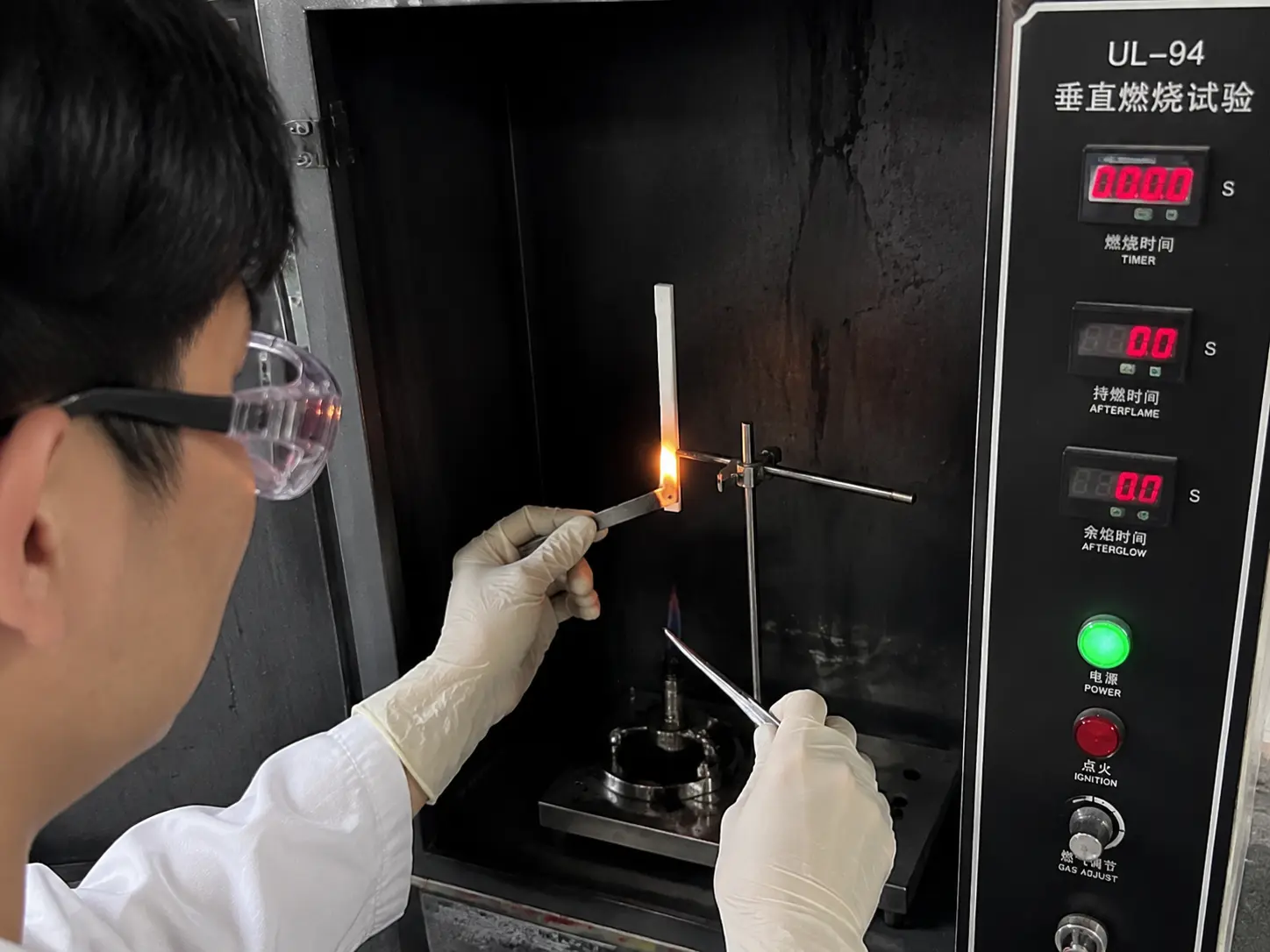
The vertical tests use five bars of 127 mm × 12.7 mm, clamped vertically, with the burner applied to the lower end for 10 seconds, removed while the afterflame is timed, then applied a second time. Five bars with two applications each is where the “ten flame applications” in the criteria comes from.
| Rating | Afterflame per Application | Total, 10 Applications | Drips That Ignite Cotton | Afterglow |
|---|---|---|---|---|
| V-0 | ≤ 10 s | ≤ 50 s | Not permitted | ≤ 30 s |
| V-1 | ≤ 30 s | ≤ 250 s | Not permitted | ≤ 60 s |
| V-2 | ≤ 30 s (same as V-1) | ≤ 250 s (same as V-1) | Permitted | ≤ 60 s |
| HB | Horizontal test. Burn rate ≤ 40 mm/min at 3.0–13 mm thickness, or ≤ 75 mm/min below 3.0 mm — or burning stops before the 100 mm mark | |||
| 5VB | Larger flame, five applications of 5 s. Burning stops within 60 s. Burn-through (a hole) is allowed | |||
| 5VA | Same as 5VB, but no burn-through permitted. The highest UL94 rating | |||
V-0 also requires that no specimen is completely consumed and that nothing burns up to the holding clamp. Those two conditions are rarely the binding ones, but they do fail the occasional thin, high-flow grade.
The Ten Applications Nobody Counts
Here is the arithmetic that catches people. V-0 caps each individual afterflame at 10 seconds and the sum across all ten applications at 50 seconds. Fifty divided by ten is five. So a compound averaging 6–7 seconds per application passes every individual limit comfortably and still fails V-0 on the total.
That failure mode is invisible if you only look at the worst bar, which is what most people do when they read a test sheet. It also means consistency matters as much as peak performance: five bars at 5 seconds pass, while four bars at 3 seconds and one bad bar at 25 seconds fail twice over — once on the individual limit, once on the total.
A case from this spring. A customer sent us a report to review and could not understand the fail; every reading on it was under 10 seconds. The total was 58. Their moulding shop had been running two cavities with slightly different fill, and the thinner-filling cavity produced bars that burned about four seconds longer each time. Nothing was wrong with the formulation — the four seconds per bar times ten applications was the whole gap. They re-tested with bars from one cavity and passed at 44 seconds.
V-2 to V-0 Is a Dripping Problem
Look at the V-1 and V-2 rows again: the time limits are identical. The only difference in the whole classification is whether flaming drips ignite the cotton indicator underneath.
This has a direct practical consequence that saves real money. If your compound is sitting at V-2, the instinct is to raise the flame retardant loading — and that is usually the wrong move, because your times already qualify for V-1. What you have is a dripping problem, and dripping is solved with well under 1% of an anti-drip additive such as PTFE rather than with several percent more flame retardant.
The same logic runs in the opposite direction on the limiting oxygen index, where dripping improves the measured number. A compound can be climbing on LOI and stuck at V-2 for exactly one reason, and more flame retardant will not fix it.
HB Is Barely a Flame Retardant Requirement
This is the section that will cost us a few orders, and it should be said anyway.
HB asks only that a horizontal specimen burns slower than 40 mm/min, or stops before the 100 mm mark. Plenty of unmodified plastics already do that at moulding thickness — filled polyolefins, many engineering resins, anything with meaningful mineral content. If your specification says HB, there is a real chance you need no flame retardant at all, or a small fraction of what you are being quoted.
We had an enquiry for a halogen-free V-0 package for an internal appliance bracket, quoted accordingly, and the loading was high enough that the customer pushed back on price. On the second call we asked to see the clause. The drawing called for HB. Their existing mineral-filled PP was already passing HB without any additive; the V-0 figure had been carried over from a different part on the same assembly. The correct answer to that enquiry was that they did not need us for this component — which is also the answer that gets you asked back for the parts where V-0 is genuinely required.
So: before you buy to a rating, confirm which rating the drawing actually requires, and whether it applies to this part or to a neighbour. The same over-specification pattern shows up in automotive interiors, where FMVSS 302 is a far lower bar than V-0 and many materials already comply untreated.
5VA and 5VB: One Hole Apart
Both use a larger flame, five applications of five seconds, and require burning to stop within 60 seconds. The single difference is burn-through: 5VB may develop a hole, 5VA may not.
That one distinction decides enclosure work. Where a standard requires the outer enclosure of unattended equipment to hold up, it typically calls for 5VA, because a hole in an enclosure lets fire out. This is a materially harder target than V-0 and usually means a different formulation rather than a higher dose of the same one — thicker sections, more char, and often a change of base resin.
VTM: The Ladder for Film and Tape
If your part is too thin to stand up in the clamp, the V ratings do not apply to it. Thin materials go through VTM instead, where the specimen is wrapped around a 12.7 mm mandrel to form a tube before testing.
The classification mirrors the V series: VTM-0 and VTM-1 permit no drips that ignite the cotton, VTM-2 permits them, and the afterflame limits follow the same pattern. This is the rating that applies to films, tapes, insulating layers, battery separators and flexible circuit substrates — so if you are working on flame retardant PET film or a coated tape, VTM-0 rather than V-0 is almost certainly the target on your drawing.
Worth flagging because we see it confused in enquiries: a film supplier claiming “V-0” has either tested something thicker than the film, or means VTM-0. Those are different tests and not interchangeable on a compliance document.
Both Sets of Bars Have to Pass
This one is missed often enough to be worth its own section, and it is where otherwise sound formulations lose their rating.
UL94 does not test one set of specimens. It requires two, conditioned differently:
- Group 1: 23 ± 2 °C at 50 ± 5% relative humidity for at least 48 hours
- Group 2: oven-aged at 70 ± 1 °C for at least 168 hours — seven days — then cooled in a desiccator for at least 4 hours
The rating requires both groups to meet the criteria. A week at 70 °C is enough to move some additives: a portion of a low-molecular-weight flame retardant can migrate toward the surface or partially volatilise, and hydrolysis-sensitive chemistry can lose activity if any moisture is present. The oven group then burns measurably longer than the fresh group.
The practical consequence is that a formulation designed with no margin will pass on fresh bars and fail after conditioning. When we pre-screen at our partner factory’s lab we run the aged group as well, because a result from fresh bars alone flatters the compound — and the mechanisms behind that drop are the subject of how flame retardant performance ages. If a supplier shows you UL94 data without saying which conditioning group it came from, ask.
A Rating Is Not a Material Property
The last misconception is the most expensive, and it is worth stating bluntly: a UL94 rating belongs to a combination of material, thickness and colour — not to a material.
- Thickness. A rating holds at the thickness tested and thicker, never thinner. “V-0 at 3.0 mm” says nothing about your 1.2 mm wall, and the physics of why is covered in thin-wall flame retardancy.
- Colour. Each colour is qualified separately, because pigments change the burning behaviour — see colour matching in flame retardant compounds.
- Grade. The listing covers a specific grade from a specific producer, not a chemistry family.
Which is why the scope on a UL Yellow Card matters more than the rating printed on it, and why “our material is V-0” is an incomplete sentence until someone says at what thickness and in what colour.
FAQ
What is the difference between V-0 and V-2?
Two things. V-0 caps afterflame at 10 seconds per application and 50 seconds across ten applications, against 30 and 250 for V-2. And V-0 permits no flaming drips that ignite the cotton, while V-2 does. Note that V-2 shares its time limits with V-1 — dripping alone separates those two.
Is V-0 the highest UL94 rating?
No. 5VA is, followed by 5VB, then V-0. The 5V tests use a larger flame and are aimed at enclosures rather than components. V-0 is the highest of the standard vertical bar ratings, which is why it is often described that way loosely.
Why did my compound fail V-0 when every reading was under 10 seconds?
Almost certainly the 50-second total across ten applications. Ten applications averaging over five seconds fails on the sum even when no single reading breaks the individual limit. Check the total on the report, and check whether the bars came from one cavity or several.
Do I need a flame retardant to pass HB?
Often not. HB only requires burning slower than 40 mm/min at 3–13 mm, and many unmodified or mineral-filled resins already achieve it. If your drawing says HB, verify the base resin’s performance before buying an additive package. We would rather tell you that than sell you something the part does not need.
Does a V-0 rating at 1.6 mm cover a 0.8 mm wall?
No. Ratings extend upward in thickness only. A thinner section has less material to form char and less thermal mass, so it behaves worse and must be tested in its own right. Rate at the wall you actually mould.
My part is a 0.15 mm film. Can it be V-0?
Not through the V test — a film cannot support itself in the vertical clamp. Thin materials are rated VTM-0, VTM-1 or VTM-2, with the specimen wrapped around a 12.7 mm mandrel. VTM-0 is the film equivalent of V-0. Treat a “V-0 film” claim as a question to ask rather than an answer.
Which rating should I specify?
Whichever the governing standard for your product demands — not the highest one available. Over-specifying costs loading, mechanical properties, colour options and money. For electronics the burn rating is usually only one of several requirements anyway; tracking and glow wire sit alongside it, as set out in UL94, glow wire and CTI compared.
Final Thoughts
Read a rating as three facts, never one: the class, the thickness it was earned at, and the colour. Anything short of that is not a specification you can buy against. When you are ready to source, additives suit compounders with their own line, masterbatch suits moulders dosing in-house, and finished compound already carries the rating. Send your wall thickness and we will pre-screen at that thickness, not at 1.6 mm.
—— Rectivas Materials 团队 技术工程师老陈