Quick answer: Evaluate a flame retardant sample in three layers, in this order: check the documents (TDS, SDS, COA — do the batch numbers actually match the sample?), run incoming lab checks (appearance, moisture, ash or loss-on-ignition, particle size, density), then qualify on your line (small trial, burn test, mechanical properties, and ageing if the part has a service life). Skipping straight to the burn test is the most common mistake — it tells you the sample works, not that the next twenty tonnes will.
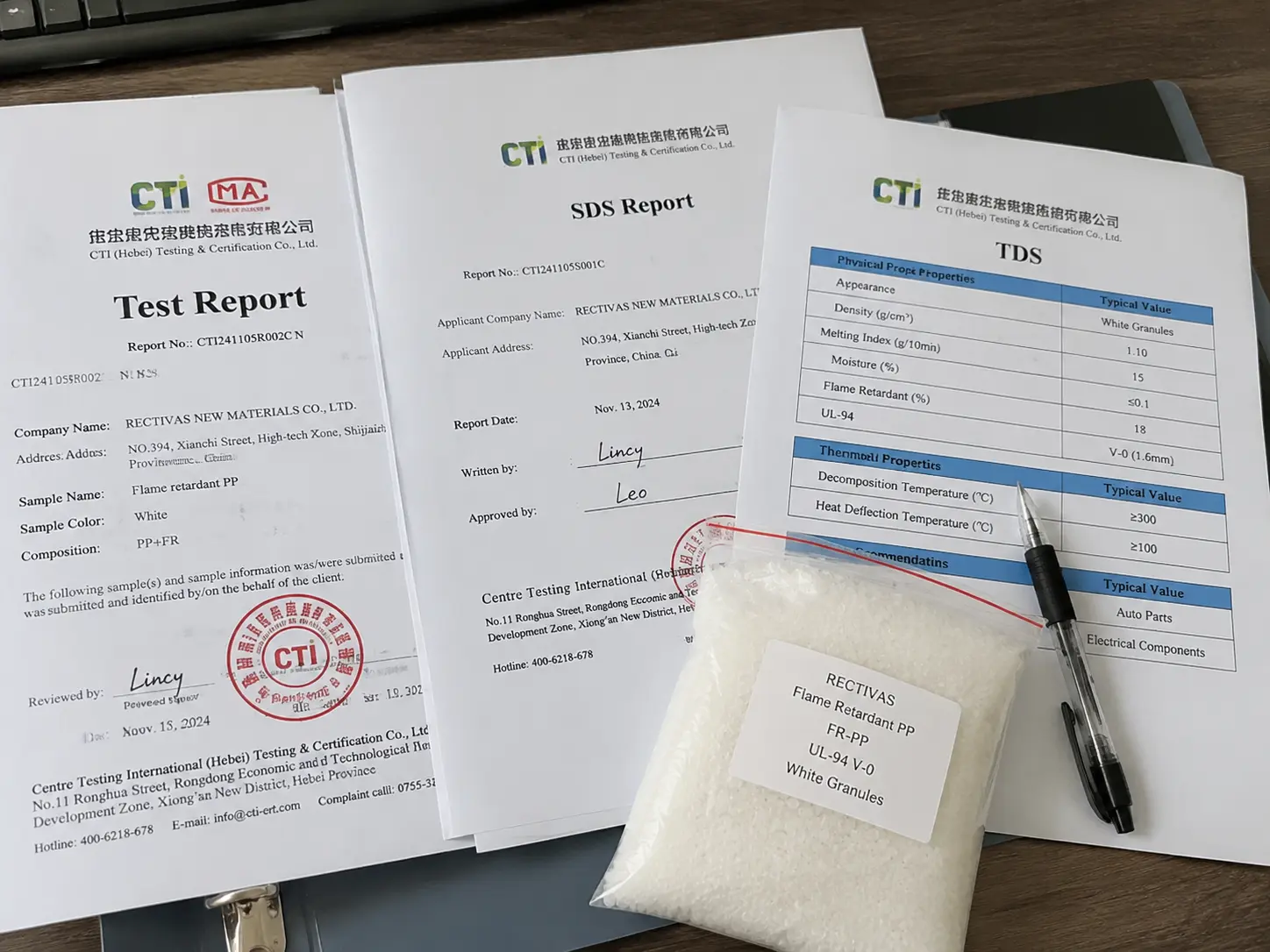
I run quality and compliance at Rectivas, which means I spend a lot of time on both sides of this process — preparing sample documentation for customers evaluating us, and reviewing incoming raw material for our own production. The pattern I see from the buyer side is remarkably consistent: a sample arrives, someone moulds a few bars, the bars pass UL94, and the material is approved. Six months later a shipment behaves differently and nobody can explain why, because nothing was ever measured that would show what changed.
A proper evaluation is not much more work. Here is the sequence, with what each layer actually catches.
Layer 1: The Documents
Q: What documents should come with a flame retardant sample? TDS, SDS and a COA tied to the specific batch you received — if any of the three is missing or generic, that is information in itself.
Read these three things before anyone opens the bag:
- Does the COA batch number match the bag label? A COA that is clearly a template with no batch-specific values, or that references a different lot, means you cannot connect the test data to the material in front of you. This is the single most revealing check in the whole process, and it takes ten seconds.
- Is the company name consistent across TDS, SDS and COA? Mismatched names usually mean the material was bought in and relabelled. Not automatically disqualifying, but you should know whether you are buying from the producer or a reseller — the distinction and how to test it is covered in our comparison of flame retardant distributor vs manufacturer.
- Does the SDS follow GHS format with a real revision date? An SDS that has not been revised in eight years, or that omits section numbering, suggests documentation is not being actively maintained — which matters when a customs authority or your own customer’s auditor asks for it.
- Are compliance claims specific? “RoHS compliant” alone is weak. “RoHS 2011/65/EU as amended, tested per IEC 62321, report reference X” is a claim someone can verify. Same for REACH — ask whether SVHC screening covers the current candidate list, which updates twice a year.
What our own documentation looks like, and which reports we can issue through an accredited laboratory, is set out on our TDS / SDS / COA downloads page — a reasonable benchmark for what to expect from any supplier.
Layer 2: Incoming Laboratory Checks
These are the tests that give you a fingerprint of the material, so that a future batch can be compared against it. None require exotic equipment, and together they take an afternoon.
| Check | What it tells you | Catches |
|---|---|---|
| Appearance & colour | Consistency vs the reference sample | Contamination, wrong grade, degraded material |
| Moisture content | Storage and handling quality | Wet material that will void or embrittle your parts |
| Ash content / loss on ignition | Inorganic fraction — a proxy for active content | Under-dosed masterbatch, substituted filler |
| Particle size (powder) | Dispersion behaviour to expect | Coarse lots that will cause specks in thin sections |
| Bulk density / pellet size (masterbatch) | Dosing and hopper behaviour | Feeder calibration drift, hopper segregation |
| MFI (masterbatch) | Carrier consistency between lots | A silently changed carrier grade |
Ash content deserves a note. For mineral and antimony-containing systems it is a cheap and surprisingly good indicator of whether the active loading is what the TDS claims — a masterbatch quietly diluted from 55% to 45% active will show up here long before it shows up as a failed burn test. It is the check I would keep if I could only keep one.
Layer 3: Line Qualification
Q: How much material do I need for a proper trial? Enough to run at production conditions long enough for the process to stabilise — typically 25–50 kg for injection moulding, more for extrusion.
A handful of hand-mixed bars tells you the chemistry works. It does not tell you the material will run. Four things to measure at this stage:
- Burn test on production-condition parts — at the actual wall thickness of the rated section, from parts moulded at production settings, not from thick plaques moulded slowly.
- Mechanical properties — impact especially. Flame retardant loading almost always costs some impact strength, and you need to know how much before it appears as field failures rather than as a number on a report.
- Processing behaviour — screw torque, melt temperature, any plate-out on tooling after a few hundred shots, colour stability at extended residence. Plate-out in particular only appears after a run of some length, which is why short trials miss it. The diagnostics are in our guide on masterbatch dispersion problems.
- Ageing, if the part has a service life — heat ageing for parts running warm, humid ageing (85 °C/85% RH is a common benchmark) where the part sees humidity, and UV for outdoor use. Then re-burn. A rating that degrades after ageing is a rating you do not really have.
The Failure Mode Everyone Should Plan For
Sample material is not always representative of production material. Sometimes this is innocent — a sample compounded on a lab line genuinely disperses better than the same formulation on a production line. Sometimes it is not. Either way, the protection is the same: establish your acceptance criteria from the sample, then apply them to the first production shipment.
Concretely, that means writing down the numbers you measured in Layer 2 with tolerances around them, and testing the first bulk delivery against those numbers before it goes into a certified production run. If the ash content of your first tonne differs materially from the sample, you want to know that in your incoming inspection, not in a customer’s fire test.
I will also say plainly what we ask of our own customers: tell us the acceptance criteria you intend to apply, before we ship the sample. A supplier who is confident in batch consistency has no reason to object, and it converts a vague approval into a specification both sides can measure against. How we handle that internally — batch traceability from raw material to shipped lot under ISO 9001 — is described on our quality control page.
A Minimum Viable IQC Standard
If you have no incoming inspection procedure for flame retardant materials today, this is a defensible starting point that takes an hour to write:
- Every delivery: check COA batch number against bag labels; visual inspection against retained reference sample; moisture check.
- Every delivery, or first delivery of each batch: ash content within ±2% absolute of the qualified value.
- First delivery of each new batch: burn test on parts from a short production run.
- Annually, or on any supplier change: full requalification including mechanicals and ageing.
- Retain a labelled reference sample of the qualified material, sealed, for comparison. This costs nothing and settles disputes.
If you are preparing to evaluate us, ask for the documentation set with the sample and tell us what you intend to test — send the resin, target rating and your acceptance criteria and we will ship the sample with the paperwork already aligned to them. If the specification you are working to says “UL certified”, read UL Yellow Card explained first — the phrase means three different things.
FAQ
What should a flame retardant COA contain?
The batch number, production or test date, and measured values for the properties that define the grade — typically appearance, active or ash content, moisture, particle size or MFI, and any grade-specific parameter. A COA with only “conforms” against each line is a compliance statement, not a certificate of analysis.
Can I rely on the supplier’s UL94 test report instead of testing myself?
Use it as evidence the formulation is capable, not as proof your part will pass. The supplier tested their compound at their thickness on their equipment; your resin, wall thickness, colourant and process are different. For a certification submission, the test that counts is the one on your part.
How do I check whether two suppliers’ materials are actually equivalent?
Compare active content (by ash or loss-on-ignition), not price per kilogram. Then run both at the loading each supplier specifies for your target rating and compare cost per finished part, plus mechanical properties. Two masterbatches quoted at the same price can differ by 20% in active content — the calculation is worked through in our loading ratio guide.
How long should I keep retained samples?
At minimum, for the life of the production lot they qualify, plus any warranty period on the finished product. For safety-relevant parts, matching your product’s field life is more defensible. Retained samples are the only way to answer “did the material change?” after the fact.
Of the bench checks described here, oxygen index is the one that most reliably catches a shifted batch, because it moves continuously while a UL94 rating does not. What the value can and cannot be used to prove: limiting oxygen index.
Final Thoughts
Three layers, in this order: check the documents, run incoming tests, then validate on the line. Ash content is the cheapest single check for whether loading matches the COA. Build that routine once and it protects every subsequent lot. Our quality system and document pack are designed to be audited this way – if a supplier resists a straightforward IQC routine, that itself is information. For heavily filled cable grades, ash content and lot-to-lot MFI are the two IQC checks worth adding — the reasoning is in LSZH cable compound production.
—— Rectivas Materials 团队 阿丽