Quick answer: Choose halogen-free flame retardants when compliance or smoke drives the project (RoHS, REACH, LSZH cable, enclosed spaces). Choose brominated flame retardants when the end market allows them and you need maximum efficiency at the lowest loading and cost — ABS housings are the classic example.
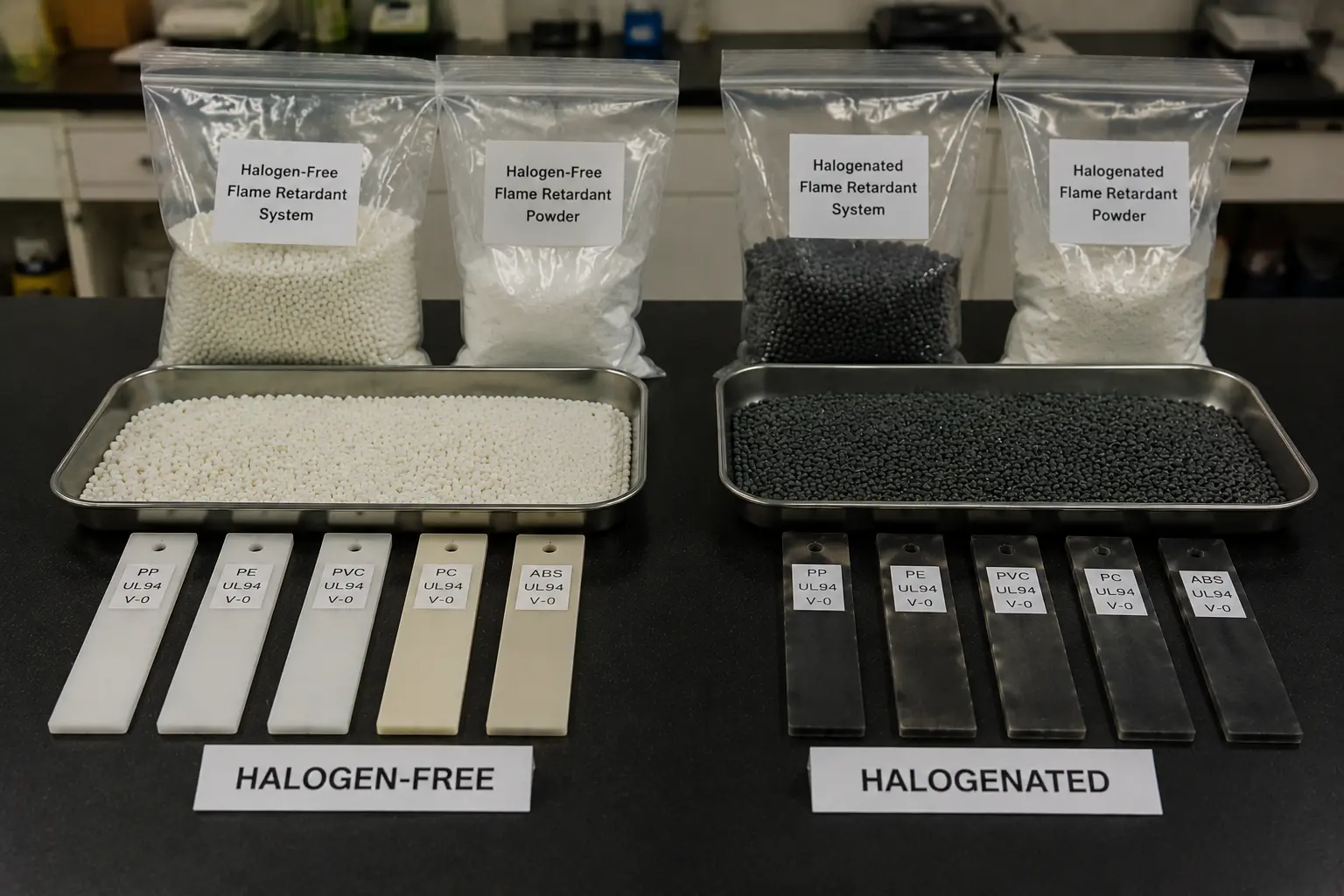
Halogen-free flame retardants are usually selected for low-smoke, LSZH, RoHS, REACH or customer restricted-substance requirements. Halogenated (typically brominated flame retardant) systems may still be selected when the application allows them and the project needs high flame efficiency, lower loading or cost control.
The Short Answer: Compliance vs Efficiency
- Choose halogen-free for compliance. Fits applications where buyers need non-halogenated materials, low-smoke performance, LSZH cable direction or RoHS/REACH support. Common in cables and electrical parts.
- Choose brominated / halogenated for efficiency. Can be efficient at lower loading and may support cost-sensitive or legacy formulations when the end market allows them. Needs regulatory confirmation.
- Test both when cost and compliance conflict. For strict UL94, low-smoke, mechanical or cost targets, compare both directions through sample testing and customer compliance review before locking the formulation.
Halogen-Free vs Halogenated Flame Retardant Matrix
Use this matrix before requesting samples. It helps procurement and technical teams compare non-halogenated and brominated/halogenated flame retardant systems by compliance, smoke, efficiency, loading, cost and polymer fit.
| Decision Factor | Halogen-Free | Brominated / Halogenated |
|---|---|---|
| Compliance pressure | Strong fit for RoHS, REACH, LSZH or customer restricted-substance needs | Must be confirmed against market and customer restrictions |
| Smoke performance | Preferred for low-smoke and enclosed-space applications | May need smoke and toxicity review depending on formulation |
| Flame efficiency | May require higher loading or synergist design | Often efficient at lower loading in selected polymers (e.g. ABS with antimony trioxide synergist) |
| Cost target | Can cost more depending on chemistry and loading | Often cost-effective when regulations allow |
| Polymer fit | Common for PC, PC/ABS, PA, PP and LSZH cable compounds | Common in selected ABS, PVC and legacy formulations |
| End-use market | Electrical, cable, transport, export and OEM compliance projects | Cost-sensitive or legacy applications where accepted |
When to Choose Halogen-Free Flame Retardants
Choose halogen-free flame retardants when the project is driven by non-halogenated material requirements, low-smoke performance, LSZH cable specifications, RoHS, REACH or customer restricted substance lists:
- LSZH and low-smoke — wire, cable, enclosed parts and applications where smoke performance is as important as flame rating
- RoHS / REACH support — non-halogenated systems and documents for restricted-substance review
- Engineering plastics — common direction for PC, PC/ABS, PA and selected PP applications
- OEM approval — useful when customer specifications mention halogen-free, non-halogenated or low-smoke requirements
When to Consider Brominated / Halogenated Flame Retardants
Brominated flame retardants may still be considered when the application and market allow them, and the project needs high flame retardant efficiency, lower loading, proven legacy performance or stronger cost control:
- High efficiency — selected brominated systems deliver strong flame performance at lower loading in suitable polymers
- Cost control — practical where regulation, market and customer specification allow halogenated systems
- Legacy formulations — useful when an existing formulation already depends on halogenated chemistry
- Regulatory review — requires careful confirmation of RoHS, REACH, restricted substances and final customer requirements
Do Not Compare Only Flame Retardant Efficiency
A brominated system may look more efficient or lower cost, while a halogen-free system may reduce compliance risk, smoke concerns and customer approval friction. The real comparison spans end-use market, RoHS/REACH needs, smoke density target, UL94/LOI target, required loading level, processing temperature, mechanical property retention, color and customer approval risk.
Frequently Asked Questions
What is the difference between halogen-free and halogenated flame retardants?
Halogen-free flame retardants avoid halogen chemistry and are often selected for low-smoke, RoHS, REACH or customer restricted-substance needs. Halogenated (brominated) flame retardants can offer high flame efficiency and cost advantages where they are allowed.
When should buyers choose halogen-free flame retardants?
Buyers should choose halogen-free flame retardants when the application requires non-halogenated materials, low smoke, LSZH cable performance, RoHS or REACH support, or customer restrictions on halogenated systems.
When are brominated flame retardants still considered?
Brominated flame retardants may still be considered when the end market allows them and the project needs high flame retardant efficiency, lower loading, cost control or compatibility with legacy formulations — ABS housings are a common example.
What information is needed to choose between halogen-free and halogenated systems?
Share the base resin, end-use market, target flame rating, smoke requirement, RoHS or REACH needs, color, mechanical property limits, processing temperature and expected trial volume.
A regulatory footnote worth adding to this comparison, because it shifts the calculus: brominated chemistry has not been banned as a class, but a REACH restriction is in preparation against the non-polymeric aromatic additives that make up most of it. See brominated flame retardant regulations for what that scope covers and what it deliberately leaves out.
Final Thoughts
We supply halogen-free and brominated systems both, so we have no reason to push you either way. The decision belongs to your standard, your cost per part and your regulatory exposure – not to a preference. Send the clause you have to meet and the resin you run, and we will tell you which route is cheaper for your part, including when staying halogenated is the right call.
If the decision lands on halogen-free, the next question is which one — and the answer is decided by your resin and processing temperature more than by cost. the full list of halogen-free flame retardants, with the loading each family needs and where each stops working, is set out separately. If you land on halogen-free, the commercial half of the decision — RoHS is not halogen-free, and what that misreading costs — is in choosing a halogen free compound.