Quick answer: Brominated flame retardants have not been banned as a class, and nothing here requires you to act today. Five PBDE congeners and HBCD are prohibited as persistent organic pollutants; TBBPA is under a US EPA risk evaluation; and ECHA is drafting a REACH restriction aimed specifically at non-polymeric aromatic brominated additives. If your product carries long re-certification cycles, that scope is the line to watch — not bromine itself.
We sell both brominated and halogen-free systems, so this article has no side to take. What follows is the regulatory position as of August 2026, with the specific numbers, and an honest note about which of our own products sit inside the scope of what is coming.
What Is Actually Banned
Two groups are prohibited outright, and both went through the Stockholm Convention as persistent organic pollutants rather than through REACH. That distinction matters: POPs listings are global and close to permanent, whereas REACH restrictions are EU-specific and negotiated.
The PBDE family. Tetra-, penta-, hexa-, hepta- and decaBDE are listed. These were the workhorses of electronics housings for decades, which is why they keep surfacing in recycled feedstock long after production stopped. Commission Delegated Regulation (EU) 2025/1482, published 28 October 2025, cut the unintentional trace contaminant limit for the sum of the five listed PBDEs from 500 mg/kg to 10 mg/kg in general mixtures and articles.
HBCD. Hexabromocyclododecane, used in essentially all polystyrene insulation until recently, is listed with a narrow set of expired exemptions. For XPS and EPS this has already been settled by the market: polymeric FR is the replacement.
The recycling limits are where people misread the regulation, so they are worth setting out precisely. Recovered material gets its own, higher thresholds — the legislator understood that recycled streams cannot reach 10 mg/kg:
| Material Category | Sum of Listed PBDEs | From |
|---|---|---|
| General mixtures and articles | 10 mg/kg | In force |
| Articles containing recovered material | 350 mg/kg | 30 Dec 2025 |
| Articles containing recovered material | 200 mg/kg | 30 Dec 2027 |
| Toys and childcare articles with recovered content | 350 mg/kg → 10 mg/kg | Phased |
If you buy WEEE-derived PCR, the number that should drive your sourcing decision is 200 mg/kg in 2027, not the 350 you have to meet today. We cover the screening side of this in flame retardants in recycled plastic — XRF for a fast total-bromine indication, laboratory analysis for congener confirmation.
What Is Under Restriction Now
This is the active file, and it is the one worth watching. On 18 December 2024 ECHA submitted an investigation report to the Commission concluding that aromatic brominated flame retardants used as non-polymeric additives in articles pose significant environmental risk, on the grounds that they are persistent, bioaccumulative and toxic, or very persistent and very bioaccumulative.
ECHA then opened a formal Call for Evidence running 21 January to 18 March 2026, covering these substances in electrical and electronic products, construction products and textiles. A restriction dossier under Annex XV of REACH is in preparation.
Read the scope wording carefully, because every qualifier in it is doing work:
- Aromatic — benzene-ring bromine chemistry, which is the bulk of commercial BFR
- Non-polymeric — small molecules, not brominated polymers
- Additive — physically mixed into the polymer, not chemically bonded to it
The reasoning is persistence and bioaccumulation, not acute toxicity — the same basis on which PBDE and HBCD were listed, and a distinction that gets lost constantly in general coverage. A substance can be low in acute toxicity and still be restricted for staying in the environment indefinitely. We go through that logic properly in are flame retardants toxic.
And one point that halogen-free advocates tend to leave out: the Commission gave ECHA a dual mandate. Alongside the brominated restriction dossier, ECHA is also preparing an investigation report on organophosphorus flame retardants. Phosphorus chemistry is not sitting outside this process — it is one step behind in the same queue.
TBBPA: The One Everyone Asks About
TBBPA is the highest-volume BFR in the world and the question we get most often, so it deserves its own treatment.
The US EPA released a draft risk evaluation under TSCA on 12 June 2026, with public comment closing 17 August 2026. EPA’s draft finding is unreasonable risk to workers, driven by inhalation exposure across three conditions of use, and unreasonable risk to the environment from releases to surface water during certain processing and disposal activities. EPA is under court order to complete ten final risk evaluations by 31 December 2026.
Two things are worth being precise about here, because the headline reads worse than the mechanism.
An unreasonable-risk finding is not a ban. Under TSCA, a final risk evaluation that identifies unreasonable risk obliges EPA to then develop a risk management rule, which is a separate process with its own comment periods and normally takes years. Nothing about the June 2026 draft makes TBBPA unavailable today.
Where the risk was found matters for how it applies to you. EPA’s findings centre on worker inhalation and on water releases during processing and disposal — the manufacturing and end-of-life ends of the chain, not consumers holding a finished part. That is the same exposure-pathway distinction that decides whether a hazard classification is relevant to your application at all.
There is also a chemistry point specific to TBBPA that changes its regulatory position. In epoxy laminates and copper clad laminate — its largest single use — TBBPA is mostly consumed as a reactive monomer that becomes part of the cured resin backbone, not as an additive dispersed in it. A molecule bonded into the network does not migrate the way a dispersed one does, which is precisely the property the ECHA restriction is built around. That is why the ECHA scope says non-polymeric additive, and why halogen-free PCB material is a separate discussion from housings and connectors.
The Line Regulators Are Actually Drawing
Once you stop reading these files as a list of banned names and start reading them as a shared rationale, they become predictable. Regulators are targeting mobility and persistence, and bromine content is only a proxy for it. Molecular size and how the flame retardant is held in the polymer are what actually decide exposure.
| Type | Examples | Why It Can or Cannot Migrate | Regulatory Exposure |
|---|---|---|---|
| Small aromatic additive | Legacy PBDE; DBDPE | Free molecule, small enough to leave the matrix and be taken up biologically | Highest — the active ECHA scope |
| Polymeric brominated | Brominated polystyrene; polymeric FR for EPS/XPS | Too large to cross biological membranes or be absorbed | Low — outside the non-polymeric scope |
| Reactive brominated | TBBPA in cured epoxy; brominated polyols | Covalently bonded into the network; cannot bloom or leach as itself | Low in the article; real at manufacture and disposal |
| Non-aromatic / inorganic | Antimony trioxide; mineral hydroxides | Not aromatic bromine chemistry; different hazard profile entirely | Separate files, separate arguments |
This is the same direction of travel we described in reactive vs additive flame retardants: the industry’s real trajectory is not additive-to-reactive, it is small molecule to large molecule. Regulation is now the main force behind that.
Where this lands on the product line we supply, stated plainly: we supply DBDPE, which is a non-polymeric aromatic additive and therefore sits inside the scope ECHA is preparing a dossier on. It is legal, it is fully RoHS compliant, and it is the mainstream PBDE replacement in ABS and HIPS. It is also the product in our range with the most regulatory uncertainty over a five-to-ten year horizon, and you should factor that into decisions with long re-certification cycles. Any supplier telling you DBDPE has no regulatory horizon is either not reading the files or hoping you are not.
RoHS Compliant Is Not Halogen-Free
This confusion costs real money, and it appears in enquiries every week.
RoHS restricts ten substance groups. Only two of them are brominated: PBB and PBDE. Every other brominated flame retardant — DBDPE, TBBPA, brominated polystyrene — is fully RoHS compliant. A RoHS certificate tells you nothing whatsoever about halogen content.
Halogen-free in electronics has a separate definition, IEC 61249-2-21: bromine ≤ 900 ppm, chlorine ≤ 900 ppm, total halogen ≤ 1500 ppm. So a material can be RoHS compliant and carry 15 times the halogen a halogen-free specification permits, with both statements true simultaneously.
When an enquiry arrives saying “RoHS, halogen-free” we ask which one is the binding requirement, because the answer changes the chemistry, the loading and the price. The component-by-component version of this sits on our flame retardant for electronics page.
What This Means for Your Formulation
Four common positions, and what we would actually advise in each.
You are using DBDPE in ABS or HIPS. Nothing is required today. But if your product carries multi-year certification cycles, treat the ECHA dossier as a planning input and get a halogen-free package qualified in parallel — not to switch now, but so that switching later is a decision rather than an emergency. The realistic cost of that move is set out in alternatives to halogenated flame retardants.
You are using TBBPA in laminate. Its reactive use is structurally different from additive use and its regulatory position reflects that. Watch the TSCA outcome in December 2026, but do not reformulate on the strength of a draft.
You buy recycled feedstock. This is the one with a hard deadline. Screen at congener level, qualify against your worst incoming lot rather than an average, and check your sourcing against the 2027 figure of 200 mg/kg.
Your driver is a customer halogen-free policy, not a law. Then the legal position is beside the point — the clause is the requirement. Just establish whether the clause means RoHS or IEC 61249-2-21 before anyone quotes, and remember that a policy can be renegotiated where a regulation cannot.
What We Supply, and What We Will Not Claim
We supply brominated systems with antimony trioxide synergists, and we supply phosphorus, nitrogen and mineral halogen-free systems. Both lines are real, so we have no commercial reason to overstate the risk on one or the safety of the other.
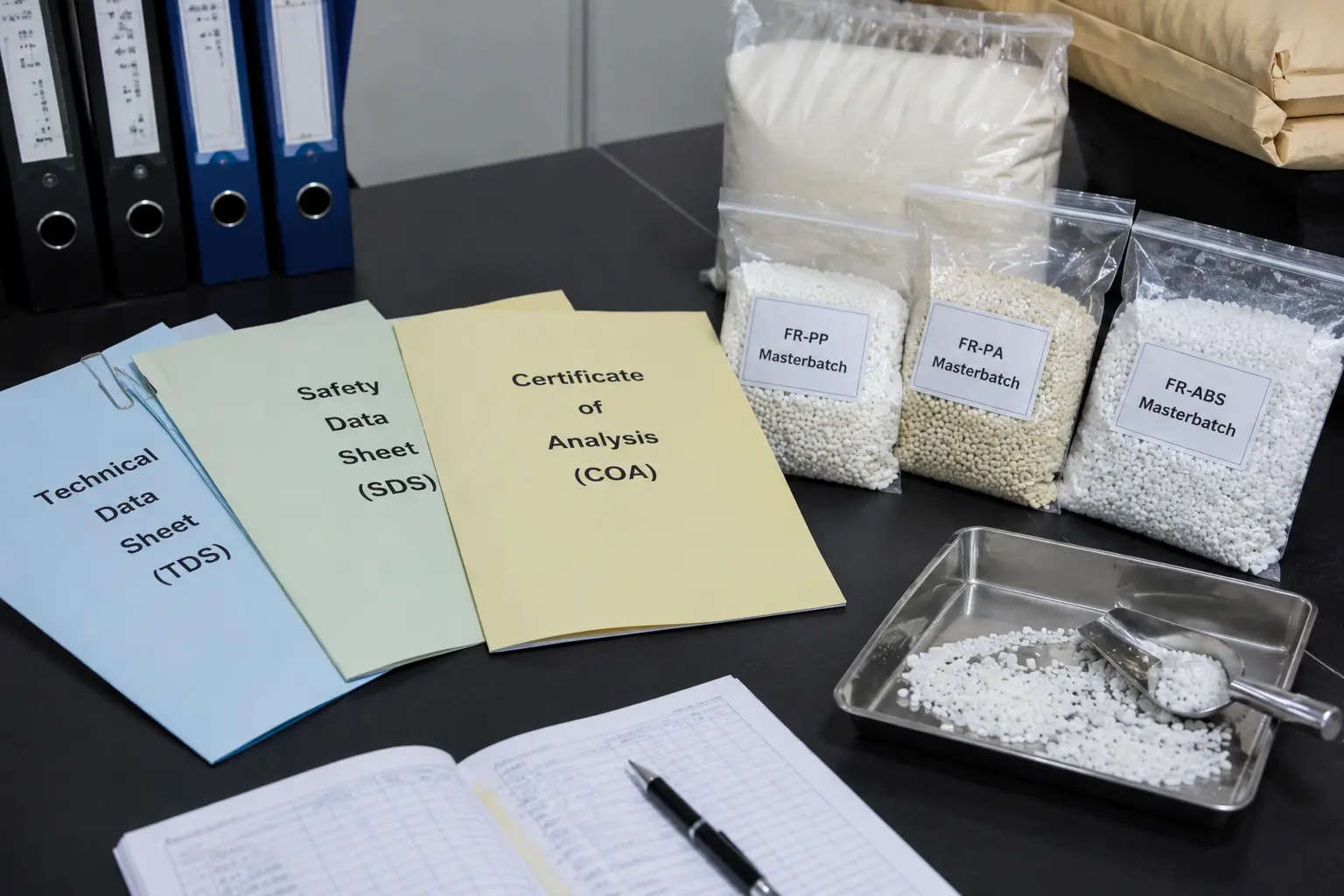
What we will not do: act as your regulatory consultant, or certify your finished article. POPs congener analysis is a laboratory service and the feedstock is yours before it is ours. We provide TDS, SDS, COA and third-party reports arranged through an accredited laboratory, and we will tell you which of our products sit in which regulatory category — but the compliance file for your product is yours to build. The documents you will need for import are listed in flame retardant import documents.
And the claim we specifically will not make: that halogen-free is automatically the safe long-term answer. ECHA is preparing an investigation report on organophosphorus flame retardants in the same mandate that produced the brominated dossier. Anyone presenting phosphorus as permanently unregulated is selling certainty that does not exist.
FAQ
Is TBBPA banned?
No. TBBPA is legal and in high-volume use worldwide. The US EPA published a draft TSCA risk evaluation on 12 June 2026 finding unreasonable risk to workers from inhalation and to the environment from water releases during processing and disposal, with comment closing 17 August 2026. A final unreasonable-risk finding would then require EPA to develop a separate risk management rule, which takes years. It is a file to track, not a reason to stop shipping.
Are brominated flame retardants banned in the EU?
Not as a class. Five PBDE congeners and HBCD are banned as persistent organic pollutants. Everything else is legal, and ECHA is currently preparing a REACH restriction dossier aimed specifically at non-polymeric aromatic brominated flame retardants used as additives in electronics, construction products and textiles.
Will DBDPE be restricted?
It falls inside the scope ECHA is working on, which is the honest answer. It is legal now and is the mainstream PBDE replacement, but it is a small aromatic additive, which is exactly the profile the restriction addresses. If your re-certification cycle is long, plan for the possibility. If your product turns over quickly, the risk is largely commercial rather than technical.
Does RoHS allow brominated flame retardants?
Yes, with two exceptions. RoHS restricts PBB and PBDE only. DBDPE, TBBPA and brominated polystyrene are all RoHS compliant. If you need low halogen content you must specify IEC 61249-2-21 — Br ≤ 900 ppm, Cl ≤ 900 ppm, total ≤ 1500 ppm — because RoHS will not deliver it.
Is halogen-free automatically safer?
Not automatically, and it is worth resisting that framing. Halogen-free avoids the specific problems of persistent aromatic bromine chemistry and of acid gas in a fire. It brings its own trade-offs: much higher loading, mechanical loss, and phosphorus chemistry that is itself now under ECHA investigation. Safer against which failure mode is the question worth asking.
Do the same rules apply outside the EU?
Only partly. POPs listings for PBDE and HBCD are global through the Stockholm Convention, so those are restricted almost everywhere. REACH restrictions are EU-only, and TSCA outcomes are US-only. If you sell into several regions, the binding requirement is usually whichever market is strictest — in practice, the EU — which is why most exporters formulate to that and ship one grade.
Final Thoughts
Nothing here requires you to act today, but two things belong in your planning: the ECHA restriction scope covers non-polymeric aromatic additives, and recycled content limits tighten again in 2027. We supply brominated and halogen-free systems both, so we will tell you honestly which of our products carry regulatory horizon and which do not. Ask for that read before your next re-certification cycle. Regulation is one cost driver; feedstock is the other, and it moved faster this year — see decabromodiphenyl ethane price drivers.
—— Rectivas Materials 团队 阿丽