Quick answer: Flame retardant powder is a solid additive or additive blend incorporated into plastics to help control burning. Powder describes its physical form, not a single chemistry or a guaranteed fire rating. Mineral hydroxides, phosphorus-based systems and other powders work differently. The useful choice depends on the resin, application and powder grade, including particle size, surface treatment, moisture and dispersion in the finished material.
What Is Flame Retardant Powder?
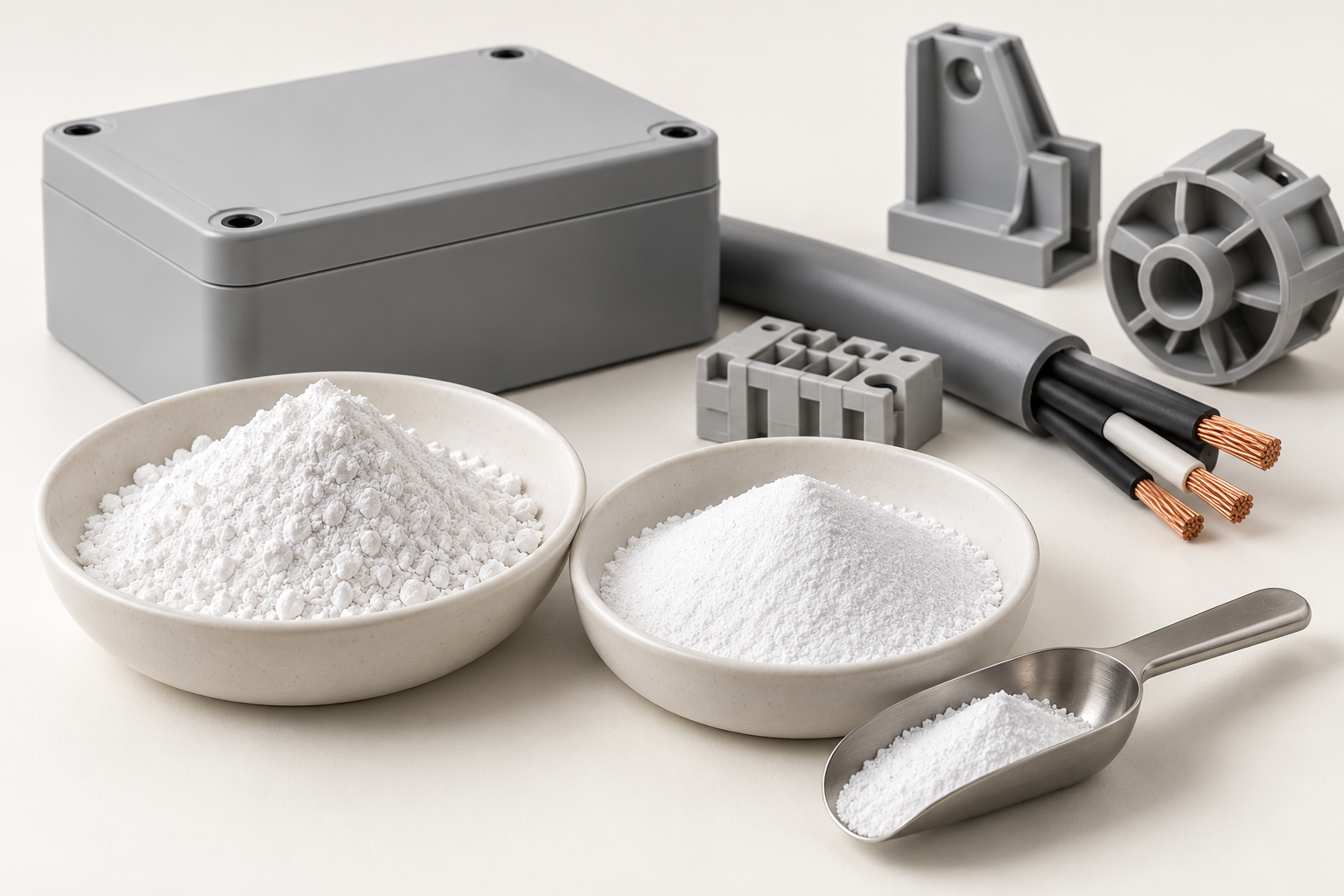
A flame retardant powder is supplied as solid particles for incorporation into a material. In plastics, it may be a named chemical, a treated mineral grade or a formulated mixture containing several ingredients. After mixing and processing, those ingredients become part of the polymer formulation. Their effect must be evaluated in that final material.
The term is useful when discussing delivery, handling and feeding. It is less useful as a complete material specification. Two bags described as white flame retardant powder can contain different chemistries, different particle distributions and different supporting ingredients. A matching appearance says little about whether they are interchangeable.
A powder additive is also different from a flame-retardant plastic powder. The latter may already contain a polymer and its additives, for example a powder material designed for a particular polymer processing method. This article covers additive powders used in plastic formulations, rather than finished polymer powders, extinguishing agents or treatments mixed with water for surface application.
For the wider category, the flame retardant additives range includes several delivery forms. The physical form should support the process, while the chemistry must suit the polymer and performance requirements.
Main Types of Powder Additives
Powders are better grouped by chemistry and function than by colour. Some absorb heat during decomposition; others influence decomposition reactions, promote a protective residue or support another flame retardant. These categories overlap in formulated blends. A product described as phosphorus-based may also contain nitrogen-bearing ingredients or other components.
| Powder family | Examples and role | Important distinction |
|---|---|---|
| Mineral hydroxides | Aluminium hydroxide (ATH) and magnesium hydroxide (MDH); endothermic decomposition and water release contribute to their effect. | Thermal behaviour, loading and surface treatment differ between grades and mineral types. |
| Phosphorus-based powders | Ammonium polyphosphate, phosphinates and formulated phosphorus-containing packages. | They are different chemical families, with different resin compatibility and mechanisms. |
| Nitrogen-containing powders | Melamine derivatives, used alone in suitable systems or with other components. | A nitrogen-containing ingredient is not automatically a complete intumescent package. |
| Halogenated solid additives | Selected solid brominated additives used in compatible formulations. | Chemical identity, supporting additives and current application requirements must be checked. |
| Synergists and formulated blends | Supporting powders or combinations intended to work as an additive package. | A supporting powder cannot be assumed to provide the same effect by itself. |
Public product information illustrates why the distinctions matter. Clariant Exolit AP 766 is a white powder based on phosphorus and nitrogen synergism, developed for polyolefins and acting through intumescence. Exolit OP 1312 is also a white powder, but its stated applications include polyamide. These are examples of named manufacturer products, not specifications for Rectivas grades.
For mineral systems, Huber describes its SB aluminium hydroxide grades for thermoset composites and highlights differences in particle size distribution. This is a useful reminder that even one chemical family contains application-specific grades. A generic chemical name is the starting point, not the entire specification.
The flame retardant chemicals overview provides routes into individual chemical families. Choose that level of detail before comparing supplier samples or treating one powder as a substitute for another.
How Powder Flame Retardants Work
Powder is a delivery form. Once dispersed in a polymer, the additive’s chemistry determines how it responds to heat and burning. Its role may include heat absorption, changes in the reactions that generate combustible gases, interference with flame reactions, or formation of a protective surface residue. A formulated system may combine several effects.
Mineral hydroxides release water as they decompose and absorb heat during that process. They also leave a mineral residue. This does not make every mineral-filled plastic suitable for every fire requirement. The resin, additive content and other formulation components still influence the result, as do the conditions under which the material is tested.
Intumescent systems develop an expanded protective char. An acid source, a carbon-forming component and a gas-generating function may be distributed across several ingredients or combined in a supplied package. Adding one ingredient bearing an intumescent-related name does not necessarily reproduce a complete system. For further detail on that chemistry, see ammonium polyphosphate flame retardants.
Other solid additives act through different pathways or support the main system. The practical question is whether the selected package performs in the specified material. It is not whether a powder can be described with a single impressive mechanism. Mechanism explains the intended action; testing establishes the observed result.
Typical Uses in Plastics and Composites
Powder additives are used where a formulator can incorporate and distribute solid ingredients reliably. Plastic compounding is an important route, but thermoset composites and other formulated materials also use powder grades. Each application puts different demands on viscosity, thermal stability, appearance and the properties retained after addition.
Wire and cable compounds: Mineral-based powders are used in suitable polymer systems where flame performance and smoke behaviour are relevant. The additive must also fit flexibility, extrusion and electrical requirements. A mineral ingredient alone does not establish a low-smoke, zero-halogen classification for a finished cable; those claims require evidence appropriate to the material and cable construction.
Moulded thermoplastic parts: Powders can be incorporated during compounding before pellets are moulded into housings, connectors or other parts. The selected system needs to work in the specific resin and reinforcement package. Part colour, wall thickness and mechanical demands affect which results are relevant.
Thermoset composites: Suitable powders can be dispersed into resin systems before curing. Their particle distribution and loading can affect the viscosity of the uncured mixture and its ability to wet reinforcement. A grade designed for one composite process may be inconvenient in another, even when the chemical family is appropriate.
Specialised formulations: Adhesives, coatings and foams may also use solid flame retardants. These applications should not be treated as extensions of a thermoplastic recipe. Incorporation, curing or foaming behaviour changes the design problem. The present guide keeps its main focus on plastics and composites.
Powder Properties That Affect Performance
The grade’s physical characteristics can affect how consistently its chemistry reaches the polymer. A formulation may use a suitable flame retardant yet still suffer from inconsistent feeding, visible agglomerates or poor distribution. These problems are not resolved by asking only for the additive’s chemical purity.
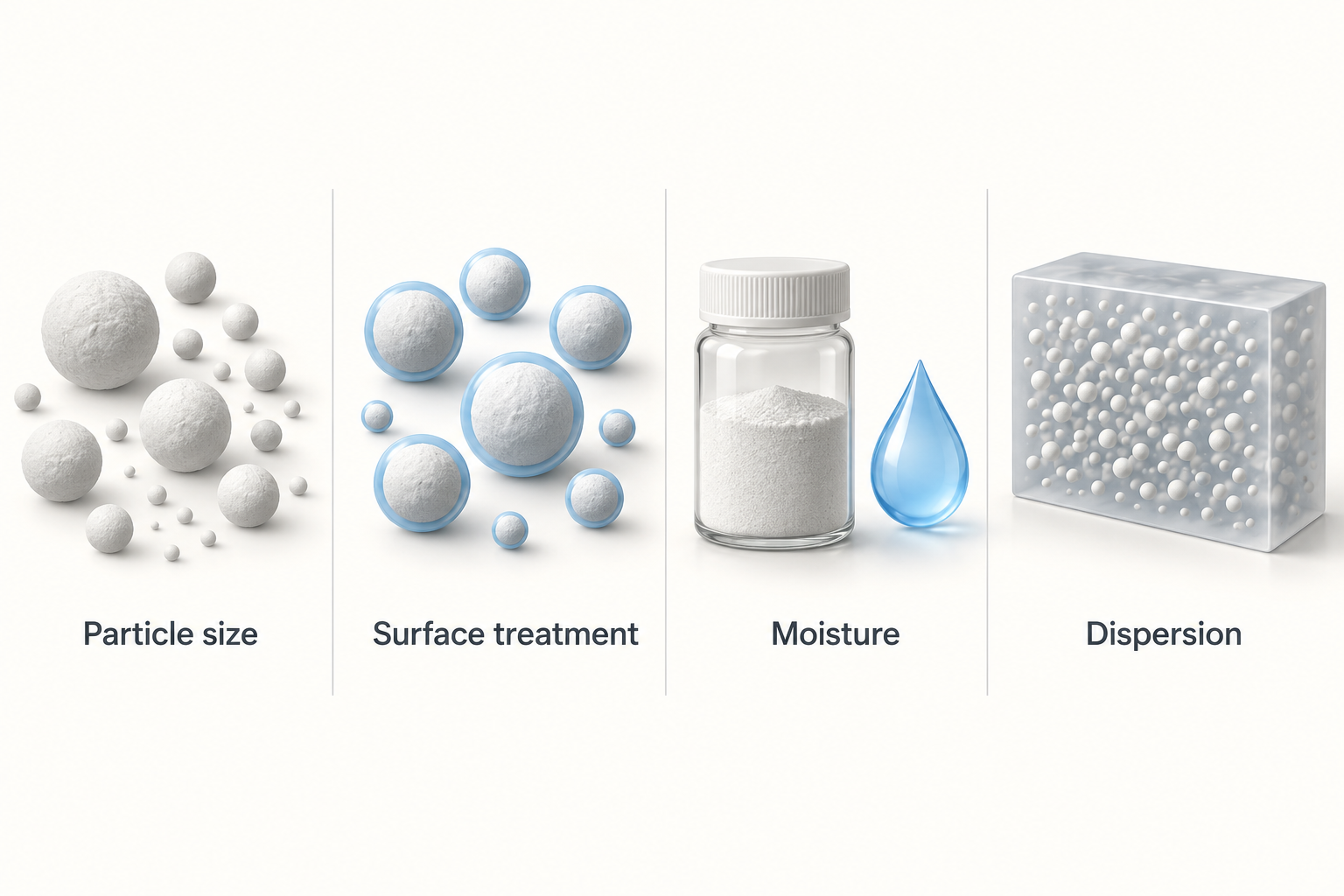
Particle size distribution: A median value describes only part of a distribution. The coarser fraction and agglomerates may matter when the finished material needs a smooth surface or thin sections. Compare the measurement method as well as the numbers. Values obtained by different methods should not be assumed to represent identical populations.
Finer is not automatically better. Changing particle size can change surface area, handling and interaction with the polymer. The useful grade is one that delivers the required distribution and processing behaviour, rather than the smallest particle number available.
Surface treatment: A coating or treatment changes the interface between particles and the surrounding material. It can influence wetting, dispersion and other processing behaviour, but the effect depends on the treatment and resin. Huber’s Vertex magnesium hydroxide information distinguishes surface-treated grades and their intended handling and compounding benefits. Treated and untreated powders should therefore be compared as separate grades.
Moisture: Water content needs a defined limit and measurement method. Storage after opening can matter, and resin drying requirements do not disappear because the additive arrives dry. Follow the grade-specific instructions rather than inventing one drying temperature for all powder chemistries.
Bulk density and flow: Bulk density concerns the packed powder, not the density of the solid chemical alone. It affects the volume occupied in packaging and feeding equipment. Powders with the same chemical content may feed differently if their packing and flow characteristics differ.
Thermal stability: The additive must remain suitable through the intended processing conditions before providing its fire-related function. A decomposition measurement is useful information, but it is not automatically a safe processing setpoint. Residence time, shear and the full formulation affect behaviour.
What a Powder Specification Should Tell You
A useful specification connects the delivered material to its intended use. The technical data sheet explains the grade; a certificate of analysis records agreed batch results; and the safety data sheet provides handling and hazard information. These documents serve different purposes. None should be treated as a substitute for the others.
| Information | Why it matters | Question to clarify |
|---|---|---|
| Identity and grade | Separates a chemical from a formulated package. | Is it a single substance, treated grade or blend? |
| Particle distribution | Helps assess dispersion and finish. | Which limits and measurement method apply? |
| Moisture and treatment | Influences incorporation and storage. | What is controlled, and what handling is required? |
| Application evidence | Shows the conditions behind performance claims. | Which resin, composition, colour and thickness were tested? |
Consider this hypothetical purchasing situation. A compounder receives two samples described as the same mineral powder and approves the cheaper one after comparing chemical content. During a trial, feeding becomes less consistent and the surface finish changes. This is an illustrative scenario, not a Rectivas customer case. Particle distribution, treatment and moisture would be sensible items to compare before blaming the chemistry alone.
The lesson is to define a grade equivalence check before a substitution. A successful small trial also needs follow-up under representative production conditions. The more important the appearance, thin-section behaviour or retained properties, the less useful a comparison based only on the bag description becomes.
Using Powder Without Assuming a Fire Rating
Powder normally requires controlled incorporation into the formulation. Mixing it with finished pellets immediately before moulding is not automatically equivalent to dispersing it during compounding. Whether direct feeding is appropriate depends on the equipment, additive package and validated process. A supplier’s application instruction should address that intended route.
For detailed process and raw-material questions, see compounding flame retardants. This guide does not prescribe a screw design or universal feeding method. It explains why powder selection and incorporation need to be considered together.
A powder also has no universal addition rate. The required amount depends on resin chemistry, other ingredients, reinforcement, part requirements and the grade’s function. A synergist dosage is not comparable with the loading of a complete mineral or intumescent system. Published examples should retain their original product and test conditions.
UL’s plastics combustion testing information describes ratings for tested plastic specimens and the relevance of thickness. A powder advertised for V-0 applications is therefore not proof that any plastic containing it will be V-0. Separate the additive recommendation, the test report and recognised material documentation when assessing a claim.
Practical Advice Before Requesting a Sample
If you formulate or compound, start with the resin grade, process and performance target. Ask for a powder grade matched to those conditions, then compare its physical specification and supporting application evidence. Record the other ingredients in the trial so a later colour or filler change does not silently create a different formulation.
If you mould parts without powder feeding or compounding capability, clarify the incorporation route first. An appropriate concentrate or finished compound may be more convenient. The point is to choose a usable supply form, rather than buying a raw additive solely because its kilogram price looks attractive.
If you purchase on behalf of technical colleagues, obtain their requirements before comparing quotations. Include packaging, sample availability, agreed batch limits and documents. Rectivas can coordinate grade enquiries, quotations and samples with supplying factories. Final suitability remains a matter for evaluation in the intended material and application.
FAQ
Is flame retardant powder one chemical?
No. The term describes a physical form and function, rather than one chemical identity. It can refer to a mineral hydroxide, a phosphorus-containing additive, another solid flame retardant or a formulated mixture. Ask for the product identity and grade specification. A white appearance does not establish chemistry, compatibility or equivalent performance in a plastic formulation.
Is all flame retardant powder halogen-free?
No. Halogen status depends on the chemical composition, not whether the product is a powder. Both halogen-free and selected halogenated additives can be supplied as solids. Request documentation for the exact grade and clarify the relevant application requirement. The finished material also contains a resin and other ingredients, so its composition needs separate consideration.
Can powder be added directly during injection moulding?
Only when the grade and process are suitable for that route and the result has been validated. Loose powder mixed with pellets may not feed or disperse consistently. Ask whether the additive requires a compounding stage or controlled feeding arrangement. If the equipment cannot provide this, discuss a compatible concentrate or finished compound instead of assuming direct addition will work.
Does a finer powder give better flame retardancy?
Not automatically. Particle distribution can influence dispersion, surface finish and interaction with the polymer, but fire performance also depends on chemistry and the full formulation. A finer grade may bring different handling or viscosity behaviour. Compare grades in the intended material and use the supplier’s measurement method when interpreting particle data, rather than choosing by one size number.
How much flame retardant powder should be used?
There is no addition rate that applies to every powder or plastic. Start with grade-specific guidance for the resin and target, then evaluate the complete formulation. Confirm whether the stated amount is a final weight percentage or another basis. Reinforcement, pigments and other ingredients can change the outcome, so a published example is not a universal recipe.
What affects the price of flame retardant powder?
Chemistry, grade, particle control, surface treatment, packaging, order quantity and commercial terms can affect a quotation. Compare products against the same technical requirement before comparing price per kilogram. A cheaper powder that needs a different incorporation route or fails the required properties may not reduce material cost. Ask for a current quotation with its specification and delivery basis.
Which documents should accompany a sample?
Request a technical data sheet, safety data sheet and the available certificate of analysis for the sample batch. Ask which values are guaranteed specifications and which are typical data. Supporting application reports should identify the tested formulation and conditions. MOQ, packaging and lead time are commercial details to confirm separately; they should not be guessed from a technical sheet.
Does the additive powder have its own UL Yellow Card?
A powder recommendation is different from recognition of a finished plastic material, as explained in our UL Yellow Card guide. When a supplier cites UL evidence, request the exact material designation, file reference and scope, then check what it covers. Do not transfer a rating from a tested compound to an additive or to a new formulation. Thickness, colour and material identity need to match the intended use.
Final Thoughts
Flame retardant powder is a useful supply form when its chemistry, physical grade and incorporation route fit the material. Start with the intended application, then compare specifications and test the finished formulation. Rectivas can help coordinate powder enquiries and samples through supplying factories. Share the resin, processing route and performance requirements so the discussion starts with a relevant grade rather than a generic white powder.
— Rectivas Materials Technical Content Team