Quick answer: A nitrogen based flame retardant uses a nitrogen-containing compound to help reduce the flammability of a material, either as the main additive or within a combined system. Common examples include melamine and its derivatives. Their roles differ: some absorb heat, some contribute gases during decomposition, and others support protective char formation. The right choice depends on the polymer and application, rather than nitrogen content alone.
What Is a Nitrogen Based Flame Retardant?
Nitrogen-based flame retardants are a family of compounds used to influence how a material behaves when heated or exposed to flame. The label covers several chemical structures and applications. It does not identify one ingredient, one reaction pathway or a finished formulation.
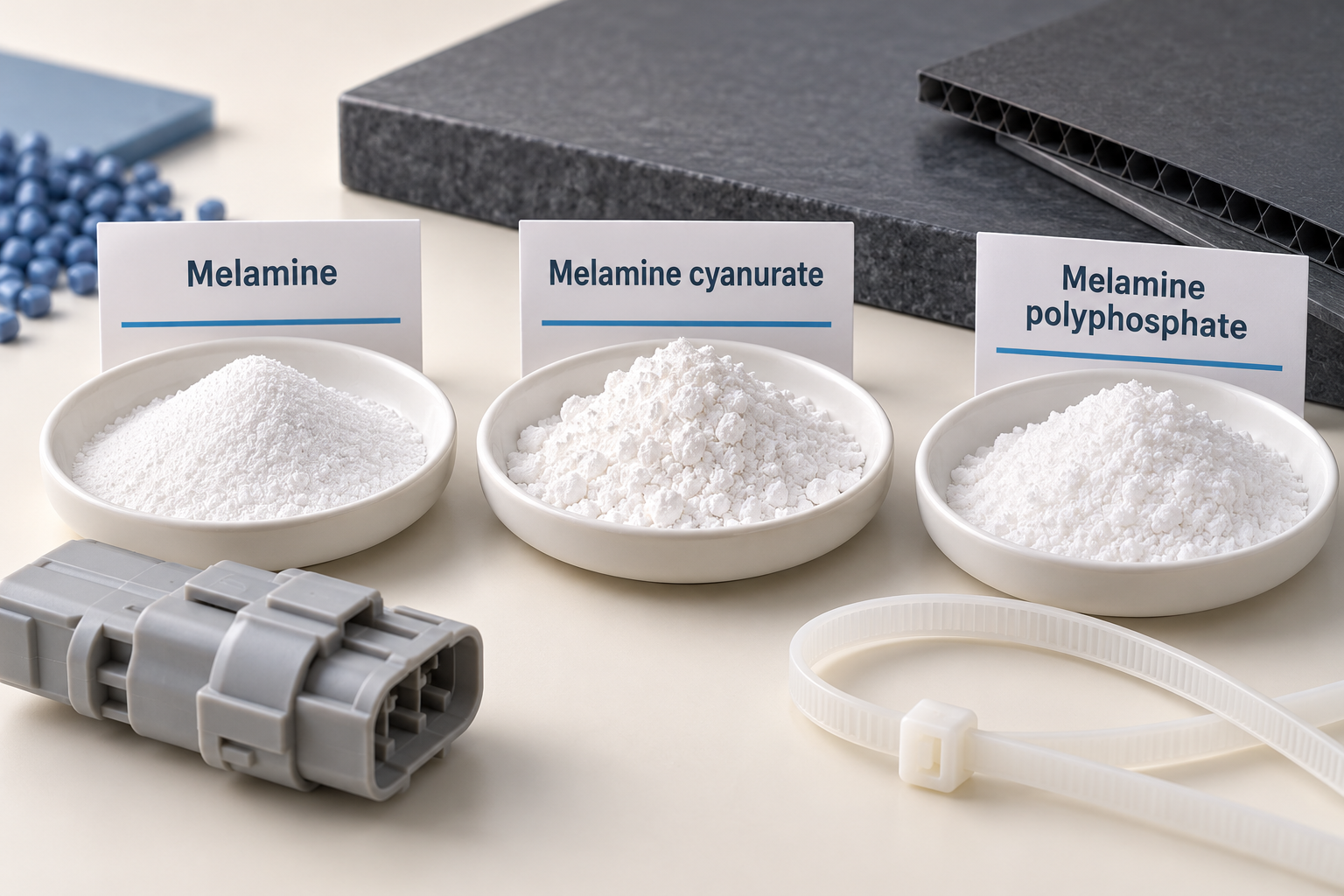
In commercial plastics discussions, melamine-based compounds are especially familiar. Melamine cyanurate, melamine phosphate and melamine polyphosphate belong to this wider group, but they are chemically different materials. Their names should not be shortened to “nitrogen additive” when specifying a grade or comparing substitutions.
There is also overlap between classifications. A substance can contain both nitrogen and phosphorus and therefore appear in more than one technical category. Ammonium polyphosphate, for example, contains both elements but is commonly discussed as a phosphorus or inorganic flame retardant. The classification highlights a useful feature; it does not describe the whole chemistry.
For the wider material landscape, the flame retardant chemicals overview separates individual families. Here, the focus is the nitrogen-containing group: its main types, possible functions and application boundaries.
Main Types and Their Differences
A useful starting distinction is whether the ingredient supplies nitrogen alone within its flame-retardant chemistry or also includes another active element, particularly phosphorus. A second distinction is its intended role: the principal flame retardant, a supporting ingredient or part of a supplied blend.
Melamine and a melamine salt are not interchangeable names. Reacting melamine with another substance creates a different chemical identity, and that difference can affect thermal behaviour, solubility, interaction with the polymer and the applicable safety information. A formulation should identify the actual material and grade.
| Type | What distinguishes it | How to interpret its role |
|---|---|---|
| Melamine | A nitrogen-rich organic compound, used directly in some systems. | An ingredient for specified formulations, rather than a universal plastic additive. |
| Melamine cyanurate (MC or MCA) | A compound formed from melamine and cyanuric acid; contains no phosphorus in its chemical structure. | Used in suitable polyamide systems and as a component of other packages. |
| Melamine phosphate and related salts | Combine nitrogen-bearing chemistry with phosphate functionality. | Their contribution depends on the particular salt, polymer and accompanying ingredients. |
| Melamine polyphosphate (MPP) | A phosphorus–nitrogen flame retardant with condensed phosphate chemistry. | Often evaluated in combined engineering-plastic systems; distinct from MC. |
| Other nitrogen-containing compounds | Include selected triazine, guanidine, urea and related derivatives. | A broad category with specialised uses, not a list of drop-in substitutes. |
The Nitrogen-Based Flame Retardants chapter in the Non-Halogenated Flame Retardant Handbook treats several distinct groups, including melamine-based compounds, ammonia-based materials and nitrogen-based radical generators. This breadth is why a plastics introduction should explain the important commercial distinctions without suggesting that every nitrogen-containing molecule has the same purpose.
For product-specific information, the melamine cyanurate flame retardant page covers MC, while the melamine polyphosphate flame retardant page covers MPP. Those pages handle individual material enquiries; this article explains where they sit in the wider family.
How Nitrogen-Containing Systems Work
The mechanism depends on both the additive and the surrounding material. An ingredient can absorb heat during decomposition, contribute gases, influence polymer breakdown or assist formation of a protective residue. More than one effect may occur in a working formulation.
Heat absorption: Endothermic reactions consume energy. When they occur in a useful temperature range, they can contribute to cooling the heated material. Timing matters. An additive that changes too early may affect processing, while one that responds too late may not provide the intended protection.
Gas generation: Decomposition can release gases that influence the region near the burning surface. In an intumescent system, generated gases can help expand a developing char. The amount, timing and composition of those gases depend on the chemistry and conditions; “nitrogen-based” does not mean every product releases only nitrogen gas.
Residue and char support: Some nitrogen-containing ingredients work with phosphorus-containing components to help develop or retain a protective condensed-phase structure. Its usefulness depends on continuity, adhesion and stability during exposure. A larger-looking residue is not automatically a better barrier.
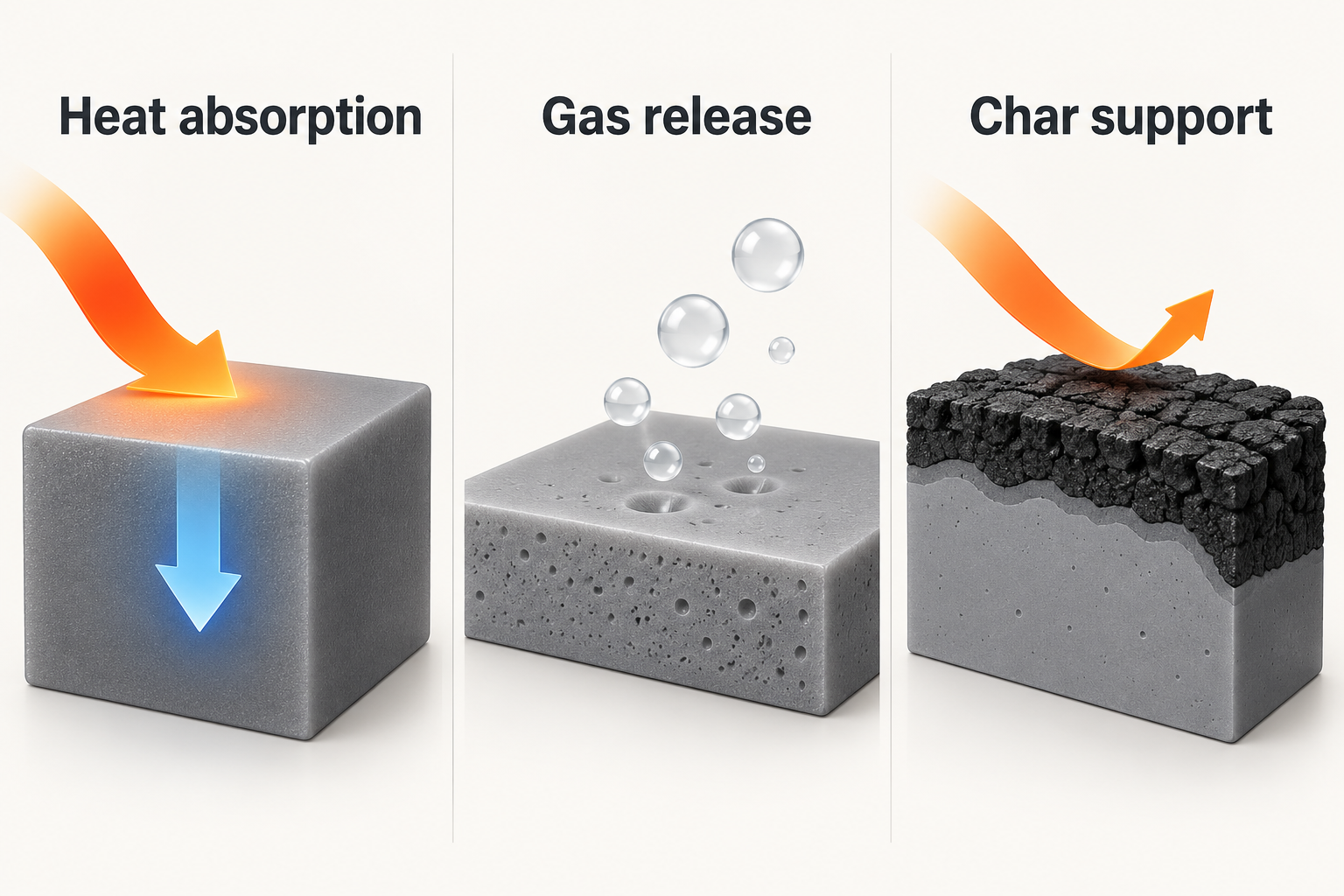
The pinfa nitrogen flame retardant overview describes several potential mechanisms. These are possible functions, not a checklist that every nitrogen additive fulfils. A material may work mainly through one route in a particular polymer and differently in another formulation. The observed burning behaviour also includes the response of the base resin, fillers and other additives.
This distinction is useful when reading a technical sheet. A mechanism statement explains the intended action. An application report shows what happened in a specified material. Both are useful, but a mechanism alone cannot establish the fire classification of a new plastic part.
Why Nitrogen and Phosphorus Are Often Combined
Nitrogen and phosphorus can provide complementary functions. In some systems, phosphorus-containing components support development of a protective residue while nitrogen-containing ingredients contribute to expansion or other reactions. Such combinations are important in intumescent formulations, but their success depends on the complete package.
The word “synergy” should describe an established improvement under defined conditions. It is not a guarantee that mixing any nitrogen powder with any phosphorus powder will improve performance. The reaction temperatures and chemical interactions need to fit each other and the polymer.
MPP already contains phosphorus and nitrogen within one chemical family. MC does not contain phosphorus in its structure, although a formulation containing MC may also include a phosphorus-based additive. Keeping the ingredient composition separate from the formulation composition prevents misleading comparisons.
APP provides another example of overlapping categories. It contains ammonium and phosphate chemistry, yet is commonly grouped with phosphorus-based or inorganic flame retardants. It should not be presented as interchangeable with MPP simply because both names contain “polyphosphate”.
Once supporting ingredients are added, changes elsewhere in the formulation can also matter. The guide to flame retardant additive interactions explains why combinations need evaluation rather than assumptions based on individual ingredient descriptions.
Typical Uses in Plastics and Other Materials
Unreinforced polyamide: Melamine cyanurate is an established candidate in suitable nylon formulations. BASF’s archived 2015 Melapur MC technical information distinguishes performance in unfilled or mineral-filled compounds from glass-fibre-reinforced compounds. This historical manufacturer example illustrates an application boundary; obtain current grade guidance for a new project.
Reinforced engineering plastics: Reinforcement changes the material’s burning and melt behaviour. Combined systems are therefore evaluated against the actual resin and fibre content. MPP may serve as part of an appropriate package, but the particular grade and accompanying components must be specified. It is not a direct replacement for MC by name alone.
Polyolefin formulations: Nitrogen-containing ingredients appear in some phosphorus–nitrogen intumescent packages. The complete package needs a suitable residue-forming response in the polymer. Adding a single nitrogen-bearing ingredient to polypropylene is not equivalent to using an evaluated intumescent system.
Foams and coatings: Selected melamine-based ingredients are also used in polyurethane foams and intumescent coatings. These applications involve different processing and formulation requirements from thermoplastic compounding. A coating ingredient or foam recommendation should not be transferred into a plastic recipe without technical justification.
Application lists are a way to identify candidates, not proof that every grade suits every listed resin. Clariant, for example, describes Exolit OP 1312 as a phosphinate-based system for polyamides. That named product illustrates how a commercial package is defined by a specific chemistry and application; it should not be relabelled a generic nitrogen additive.
Benefits and Practical Limits
Nitrogen-containing systems offer useful options for formulating without intentionally added halogenated flame retardants. Depending on the chemistry, they can support fire performance, colourability or a combined phosphorus–nitrogen approach. These advantages belong to a particular system and application, rather than automatically to the whole family.
The trade-offs can include additive loading, dispersion, moisture sensitivity, thermal compatibility and changes in mechanical or electrical properties. A successful burning result is only one requirement. The material still has to fill the mould, survive assembly and perform in service.
Consider a hypothetical connector project that changes from unreinforced nylon to a glass-filled grade. Purchasing asks to retain the same MC additive because the resin is still called nylon. This is an illustrative decision scenario, not a Rectivas customer case. The sensible response is to reopen the material evaluation, because reinforcement changes the formulation and the relevant evidence.
Keeping the same additive supplier would not make the old result transferable. Equally, switching suppliers would not solve the problem without defining the new requirements. The first task is to identify which material property changed and whether the original application guidance still applies.
For an OEM, this also affects documentation. The grade designation, formulation, colour and thickness behind a report need to match the intended application. A family name such as “nitrogen-based” is too broad to serve as the material identity in an approval decision.
Halogen-Free Does Not Mean Hazard-Free
Halogen content, chemical hazard classification and fire performance answer different questions. A material can be halogen-free and still require specific handling precautions or regulatory review. Neither “nitrogen-based” nor “melamine-based” should be used as a substitute for checking the exact chemical and grade.
Melamine and its reacted derivatives are distinct substances. Residual constituents and the composition of a supplied blend also matter. pinfa’s discussion of melamine classification explains why users should distinguish melamine itself from melamine-based flame retardants and consult supplier safety data. Its dated overview is background; current product documentation remains necessary for a purchase decision.
Request a current safety data sheet for the destination market, together with the relevant composition or compliance statements. Check the revision date and the exact material designation. A supplier’s statement about one derivative, grade or market does not cover every member of the nitrogen family.
What to Confirm Before Choosing a Grade
Start with the application brief rather than the nitrogen percentage. Identify the resin, reinforcement, processing method and target test. Include the required thickness, colour and properties that must remain acceptable. Those details determine which supporting evidence is relevant.
| Question | Information to provide | Why it matters |
|---|---|---|
| Which material? | Resin grade, reinforcement, pigments and other major ingredients. | Establishes the actual formulation context. |
| Which requirement? | Target test, thickness and retained properties. | Prevents comparison of unrelated performance claims. |
| Which additive role? | Single ingredient, synergist or supplied complete package. | Clarifies what additional components may be needed. |
| Which evidence? | Current TDS, SDS, batch specification and applicable test documentation. | Connects the proposed grade to its identity and use. |
If you compound materials, ask how the grade should be incorporated and which conditions were used in its application evaluation. If you purchase finished pellets, confirm the finished compound designation rather than requesting a raw powder by a family name.
For procurement, compare quotations against the same technical scope. Confirm sample availability, packaging, order quantity and delivery terms with the supplier. Rectivas can coordinate grade enquiries, samples and quotations with supplying factories; suitability needs to be established in the intended material.
FAQ
What is an example of a nitrogen based flame retardant?
Melamine cyanurate is a familiar example, particularly in suitable polyamide applications. Melamine itself and several melamine salts also belong to the wider nitrogen-containing group. Some members, including melamine polyphosphate, contain phosphorus as well. Give the full chemical name and product grade when discussing a sample, because the family label does not establish equivalent composition or performance.
Are MC and MPP the same material?
No. MC means melamine cyanurate, while MPP means melamine polyphosphate. Their chemical structures and intended roles differ. MPP contains phosphorus as well as nitrogen; MC does not contain phosphorus in its chemical structure. A formulation may use either within a broader package, but they should not be substituted at the same loading without application-specific guidance and evaluation.
Why combine nitrogen and phosphorus flame retardants?
They can provide complementary functions in an appropriate system, including support for gas generation and protective residue formation. The benefit depends on the selected ingredients, polymer and conditions. Calling a combination synergistic does not establish its performance by itself. Use evidence for the proposed package, then evaluate fire behaviour and retained properties in the complete material.
Can a nitrogen additive guarantee UL 94 V-0?
No additive family guarantees that result in every plastic. A classification concerns a tested material under defined conditions, as outlined in UL plastics fire testing information. Resin grade, reinforcement, colour, thickness and processing can affect the outcome. Ask for the formulation context behind a claim and check whether recognised material documentation is required. A supplier’s additive recommendation is not recognition of your finished compound.
Are nitrogen-based flame retardants always safe?
No class-wide safety conclusion follows from the presence of nitrogen or the absence of halogens. Review the exact substance, grade composition, residual constituents and intended exposure conditions. Obtain the current supplier safety data sheet and applicable market documentation. Melamine and its reacted derivatives should be identified separately, and a statement about one product should not be transferred to another.
How much nitrogen flame retardant should be added?
There is no universal loading for the family. The amount depends on whether the product is a primary additive, supporting ingredient or formulated package, as well as the resin and performance target. Start with grade-specific guidance and confirm the calculation basis. Evaluate the final composition, including reinforcement and colour, rather than borrowing a percentage from an unrelated application.
What information is needed for a quotation?
Provide the chemical or proposed package, resin and reinforcement, processing route, performance target and intended sample or order quantity. Include required packaging and destination so commercial terms can be compared consistently. If the grade is undecided, send the application brief first. Price and minimum order quantity depend on the actual supply proposal and should be confirmed directly.
Which documents should come with the sample?
Request the current technical data sheet and safety data sheet, plus available batch analysis and application evidence for the proposed grade. Distinguish controlled specifications from typical values. Check whether any test report represents the additive, a particular compound or a finished product. The material designation and relevant conditions should be clear before using a report in an approval process.
Final Thoughts
A nitrogen based flame retardant is best understood through its chemical identity, role and intended application. MC, MPP and other nitrogen-containing materials offer different formulation options; a shared family name does not make them interchangeable. Start with the resin and performance requirements, then review the proposed grade and its evidence. Rectivas can coordinate enquiries and samples for relevant chemical grades through supplying factories.
— Rectivas Materials Technical Content Team