Quick answer. To compare PP cable filler yarn tensile strength, ask for the breaking force, linear density and elongation at break for the same yarn construction. Compare breaking force in newtons and tenacity in cN/tex under an agreed test method. After a flame retardant masterbatch change, check heat shrinkage separately and run the yarn through the intended cable process before approving the change.
Start with the unit on the datasheet
Two quotes can both list “tensile strength” and describe different measurements. One supplier reports the force needed to break the specimen in newtons. Another reports that force divided by the yarn’s linear density, for example in centinewtons per tex. That second quantity is breaking tenacity. Before comparing numbers, find the unit, check the specimen description and confirm that both suppliers are reporting the same statistic, such as a minimum or a mean.
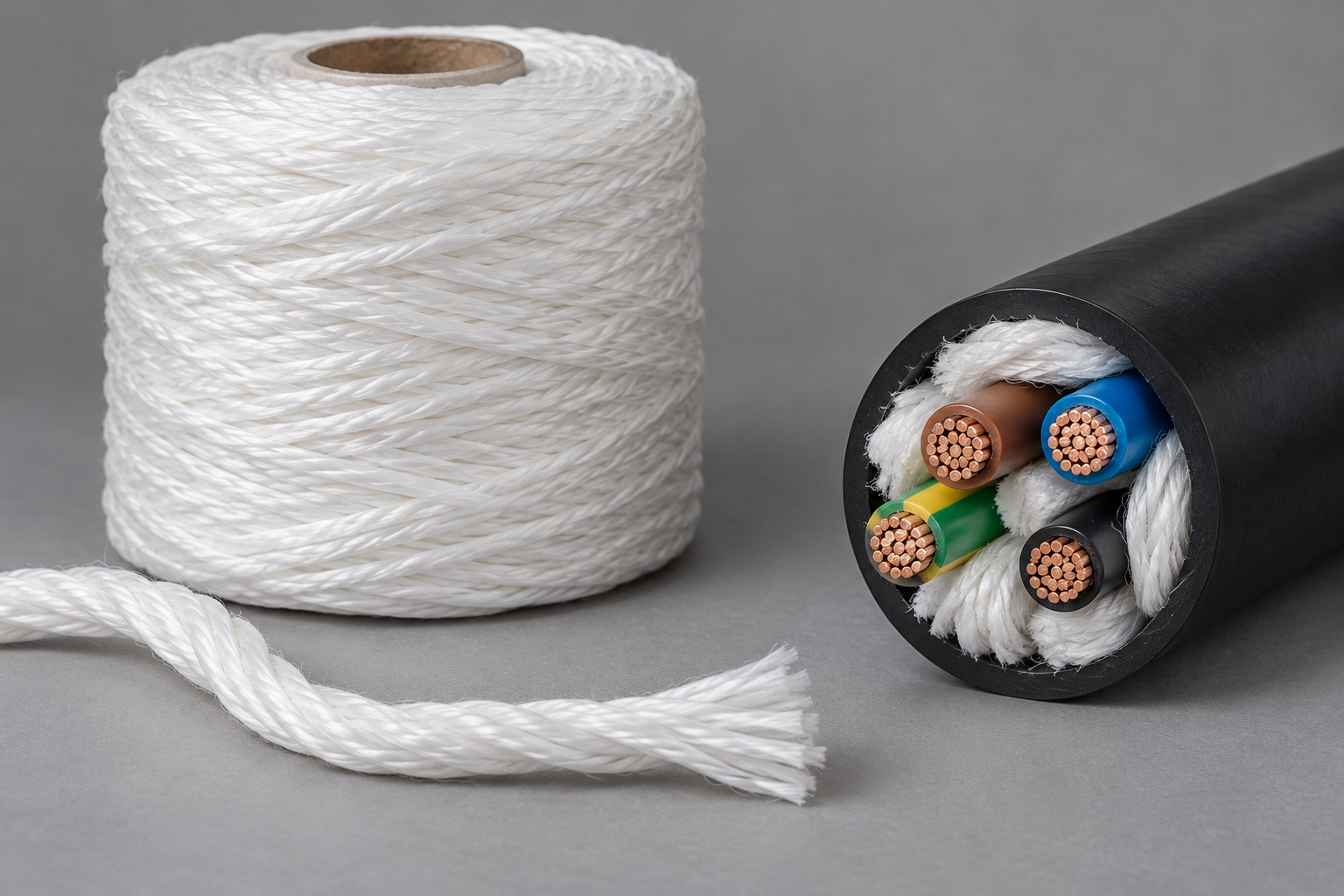
Actual cable filler specifications illustrate this difference. The HTS PP filler yarn datasheet lists pulling strength in newtons, along with elongation and heat shrinkage. Ashraf’s PP filler specification lists its tensile entry in g/D. If you receive that notation, confirm that it means gram-force per denier before converting it. The specifications illustrate how suppliers present data. Their product limits should be read in the context of the grades and methods they describe.
Linear density is mass per unit length. A tex is one gram per thousand metres. A denier is one gram per nine thousand metres, so divide denier by nine to obtain tex. For a specimen with a known linear density, multiply the breaking force in newtons by 100 to obtain centinewtons, then divide by tex to calculate breaking tenacity in cN/tex. Use the measured or agreed linear density for the same construction tested. A nominal label can be useful at quotation, but identify that basis on any calculated result.
| Property | Typical unit | What it tells you |
|---|---|---|
| Breaking force | N | Force at rupture for the tested strand or assembly |
| Linear density | tex or denier | Mass per length for the specimen or specified construction |
| Breaking tenacity | cN/tex or gf/denier | Breaking force relative to mass per length |
| Elongation at break | % | Extension at rupture relative to the starting gauge length under the agreed method |
| Heat shrinkage | % | Change in length after the specified heat exposure and measurement procedure |
Compare breaking force and tenacity together
Consider two hypothetical samples. Sample A breaks at 60 N and measures 1,200 tex. Its breaking tenacity is 6,000 divided by 1,200, or 5.0 cN/tex. Sample B breaks at 50 N and measures 800 tex. Its breaking tenacity is 5,000 divided by 800, or 6.25 cN/tex. Sample A carries more force before breaking. Sample B carries more relative to its linear density. These numbers illustrate the calculation only. They are not typical product values or approval limits.
Choose the comparison according to the decision. When you are checking a replacement yarn of the same construction and size, breaking force and elongation are directly relevant to its behavior under handling tension. When comparing candidates of different linear densities, tenacity helps explain whether the force difference tracks with the amount of material. Check the cable fit separately. A normalized strength result cannot tell you whether a filler occupies the required space between the cores or runs cleanly off the package.
Check whether the reported breaking force and elongation come from comparable specimens. A result for one split tape, a twisted bundle or a finished filler rope describes the sample actually loaded into the machine. If the supplier sells several constructions under one family name, get the results for the exact item and agree which construction must be used for comparison. See the cable filler yarn guide for the distinction between yarn, rope and tape in purchasing descriptions.
Agree on the test method before ordering samples
Ask the laboratory to identify the method and edition, the form in which the specimen will be tested, the conditioning, the gauge length and the test speed. The grips and initial tension also matter when comparing a flat, fibrillated or twisted sample. If a specimen slips or breaks at the grip, have the laboratory review the result under the agreed procedure and identify how it was treated. Retain the individual results and note which values are used for acceptance.
ASTM D2256/D2256M describes a single-strand tensile method for yarns within its scope and covers breaking force, elongation and the calculation of tenacity. ISO 2062 describes single-end tests for textile yarns from packages and expressly excludes polyolefin tape. If your filler is produced from fibrillated PP film, ask the laboratory to confirm whether the specific construction fits the proposed method and whether the customer specifies another procedure. Put the agreed method on the sample request.
A datasheet can help shortlist samples even if its test setup is unclear. For approval, request a report or run a side-by-side comparison with the same procedure for the incumbent and trial materials. Record the package or batch ID and the number of specimens. A mean describes the center of the results, while a minimum or another agreed acceptance statistic answers a different question. Decide which result will govern before looking at the numbers.
Track the masterbatch change on the line
When comparing reports from different suppliers, first ask each one to identify the package and specimen represented by the figures. Confirm whether an advertised linear density is nominal or was measured for the batch. If a quote gives a breaking-force minimum and a typical linear density, a conversion using those figures is only an estimate. Request the paired measurements if you need a tenacity result for approval. That keeps the comparison useful when a specification sheet and a batch report use different reporting conventions.
Keep a reference package made before the formulation change. For both reference and trial packages, record the PP grade and lot, recycled or filler content if used, target linear density, and whether the yarn is slit, fibrillated or twisted. Record the actual masterbatch addition rate and its basis. Note changes to line speed, draw settings or cooling. If the recipe and drawing conditions both change, document both so a new test result can be traced to the package that produced it.
For the first comparison, aim to hold the construction and target linear density constant where practical. Measure the actual linear density, then compare breaking force, tenacity and elongation for the two packages. If the operator has to lower the output or adjust the draw to produce a stable yarn, keep those rolls separately identified. They can be useful for evaluating an alternate operating point, especially if the resulting throughput and consistency are acceptable to production.
Heat shrinkage deserves a separate entry. Ask for the temperature, duration, load or restraint, and length measurement procedure agreed for the yarn. Two percentages obtained under different heat exposures are difficult to compare. Use the same procedure for the control and trial where the buyer requires a comparison. Then confirm whether the result is suitable for the cable line’s own handling and processing conditions.
For sample sourcing, send your current yarn specification and the details of the line to the PP cable filler yarn masterbatch application team. Share the PP grade, expected filler construction, mechanical checks and finished cable test requirement. For projects with a halogen restriction, also discuss halogen-free masterbatch options and the documentation needed for the project. General PP concentrate selection is covered on the PP flame retardant masterbatch page.
| Stage | Compare or record | Acceptance question |
|---|---|---|
| Yarn production | Formulation, measured feed, line settings, stable package IDs | Can the yarn be produced consistently? |
| Lab checks | Linear density, breaking force, tenacity, elongation and heat shrinkage under the agreed conditions | Does the filler meet the agreed mechanical and thermal criteria? |
| Cable line trial | Unwinding behavior, feed interruptions, placement and cable geometry | Does the filler work in the intended cable construction? |
| Finished cable tests | Cable ID, complete construction and applicable test method | Does the cable meet the specified product requirements? |
Use the right evidence for cable approval
A filler yarn report shows how the submitted yarn performed in the stated tests. For cable manufacture, check whether the yarn unwinds and feeds reliably, stays in place during assembly and produces the required cable geometry. If a trial introduces feed interruptions, identify the package, tension settings and failure point before attributing the problem to the masterbatch. The same package ID should appear in the mechanical test record and the cable trial log.
Confirm fire performance on the cable specimen required by the buyer’s specification. For example, IEC 60332-1-2 describes a vertical flame propagation test for a single insulated conductor or cable, including optical fibre cable within its scope. The test specimen is the specified cable or conductor. Keep that evidence alongside the yarn checks. Each record answers a different question when the buyer approves the new formulation.
Before releasing a bulk order, agree which sample and specification the order refers to. A useful approval record identifies the yarn construction, nominal and measured linear density, report numbers, package IDs, cable construction and any conditions of approval. Retain a reference sample according to your quality procedure and ask suppliers to identify changes that affect the approved formulation or construction. That gives purchasing and production a common record when comparing the next shipment.
Frequently asked questions
What tensile strength should PP cable filler yarn have?
Start with the cable maker’s specification and the performance of an approved reference yarn. Agree on the construction, test method and acceptance statistic before setting a minimum breaking force or tenacity. Check elongation, heat shrinkage and handling on the intended cable line alongside the tensile result. The required limits depend on the filler and the cable design.
Can I compare a value in newtons with one in g/denier?
First confirm that g/denier means gram-force per denier. Then obtain the linear density of the same specimen or construction and convert the results to a common basis. Also check the test setup and the statistic being reported. A comparison is most useful when specimen form and test conditions are comparable and the conversion basis is recorded.
Why does elongation at break matter for filler yarn?
Elongation at break describes how far the specimen extended before rupture in the agreed test. It gives useful context when two yarns have similar breaking force but behave differently during handling. Review it with the cable line observations. If the yarn stretches or feeds unevenly in production, check the applied tension, package and construction before adjusting the formulation.
Is heat shrinkage part of a tensile test?
Heat shrinkage is normally recorded separately because it measures length change after a specified heat exposure. Ask for the temperature, exposure time, any load or restraint and the measurement procedure. Use the same conditions for your comparison. If the cable maker uses a separate thermal acceptance requirement, list it next to the tensile criteria on the sample request.
Does switching to flame retardant masterbatch always lower strength?
The result depends on the resin, additive package, linear density, yarn construction and processing conditions. Keep an incumbent sample and compare it with a traceable trial package under the same method. Record changes to drawing, cooling and output during the trial. This gives you evidence for the offered formulation and the operating conditions under which it was made.
Which data should I send when requesting a masterbatch sample?
Send the PP grade, current filler recipe, yarn construction, target linear density and relevant test requirements. Include the breaking force or tenacity, elongation and heat shrinkage limits if the cable maker specifies them. Share any finished cable fire test requirement and the trial quantity so the candidate can be reviewed against the intended process and product.
Final thoughts
Compare the same yarn construction under the same method, and keep the specimen’s linear density with the force and elongation results. Then check shrinkage and cable line performance before sending the appropriate cable specimen for testing. Rectivas Materials can help coordinate masterbatch selection and samples with partner suppliers when you provide the base resin, filler construction and acceptance requirements.