Quick answer: If your connector has to clear UL94 V-0 and a glow wire requirement at the same time, the brominated route usually stops being an option — not because it burns, but because gas-phase chemistry has nothing to interrupt when a hot element simply sits against the part. Glass-filled PBT with a phosphinate package is the route that carries both, and it carries high CTI with them.
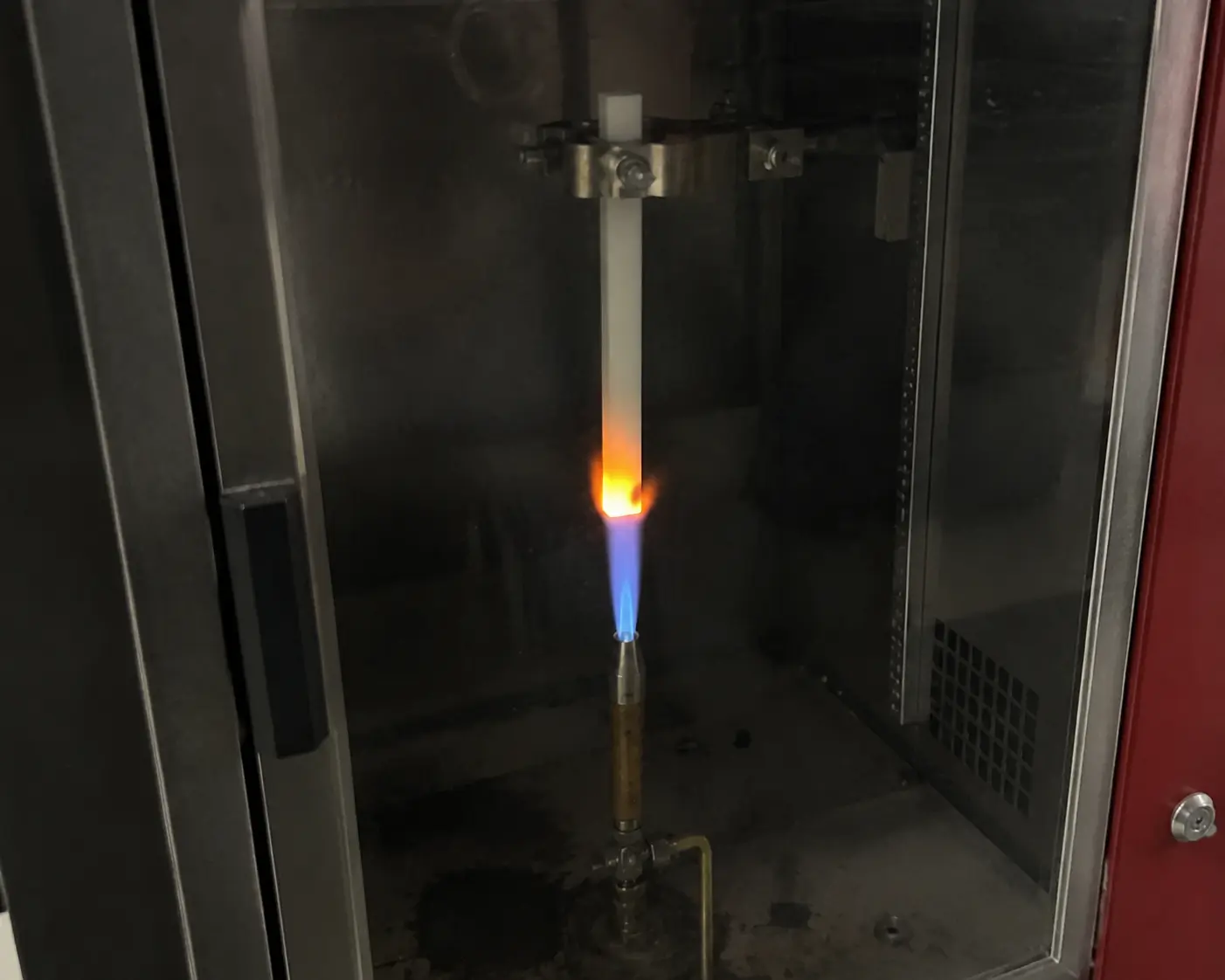
PBT is the quiet workhorse of the connector world. It molds precisely, stays dimensionally stable, barely absorbs moisture, and keeps its electrical properties in humid heat — which is why relays, terminal blocks, coil formers, sensor housings and automotive connectors are full of it. Almost all of those parts carry a fire requirement, so “PBT” in practice usually means “flame retardant PBT.” Here is how the chemistry is chosen in 2026.
Why PBT owns the connector job
A quick answer for buyers comparing resins: against PA66 (the other connector standard), PBT absorbs far less water, so its electrical properties and dimensions do not drift with humidity, and it molds with lower shrinkage variation. Against cheaper resins it brings heat resistance and stiffness with glass fiber. Its weak spot is hydrolysis — hot, wet environments attack the polyester backbone — and, like every glass-filled resin, the fibers candlewick a flame, so the neat resin’s borderline burn behavior gets worse with reinforcement, not better. A serious FR package is not optional in GF grades.
What to Use, by What You Have to Pass
Connector specifications almost never arrive as one requirement. Here is what each combination actually forces, so you can check your own case before asking anyone for a quote.
| What You Must Pass | Workable Route | Why the Other One Fails |
|---|---|---|
| V-0 only, CTI undemanding, no glow wire clause | Brominated + antimony. Lowest cost, lowest loading | Nothing fails — do not pay for halogen-free you were not asked for |
| V-0 + glow wire (GWIT ≥ 775 °C) | Phosphinate, typically with MPP, in GF15–GF30 | Gas-phase bromine has no flame to interrupt under a sustained hot element; char is what survives it |
| V-0 + CTI 600 V (PLC 0) | Phosphinate, halogen-free by necessity | Brominated plus antimony typically tracks at PLC 2–3; the residue is the problem |
| All three, at 0.8 mm or thinner | Phosphinate + MPP, and expect higher loading than the datasheet implies | Thin walls have less material to form char — a 1.6 mm rating tells you nothing here |
The two things worth checking before you commit to a supplier: first, that any quoted V-0 comes with the thickness it was measured at — a rating from a 1.6 mm bar is not a rating for your 0.8 mm housing. Second, that the glow wire figure is stated separately rather than implied by the burn rating, because passing one does not predict the other. If a datasheet gives you V-0 and stays silent on GWIT, assume it has not been measured.
The two flame retardant routes for PBT
| Property | Brominated + Sb₂O₃ | Halogen-free phosphinate (DEPAL type) |
|---|---|---|
| Typical loading (GF30 PBT) | ~12–18% | ~15–25 phr (+ N-synergist) |
| UL94 | V-0 @ 1.6 / 0.8 mm | V-0 @ 0.8 mm achievable |
| CTI (tracking index) | Low — roughly 175–275 V class | 400–600 V — the headline advantage |
| Glow wire (GWIT) | Moderate | 775 °C+ on current grades |
| Cost | Lower; antimony price exposure | Higher additive cost |
| Where it wins | Cost-driven industrial & legacy E&E | EV/HV connectors, new E&E designs, halogen-free specs |
Both are proven; the market answer depends on which spec line rules your part. For the brominated route the synergist logic is the same bromine-antimony teamwork we detailed in the antimony trioxide flame retardant guide; for the exit logic, our halogen-free vs halogenated flame retardants comparison walks the trade-offs.
The CTI story: why EV connectors went halogen-free
Comparative Tracking Index measures how well an insulating surface resists forming a conductive carbon track under voltage and contamination. In a 12 V harness it is a footnote. In a 400–800 V EV battery system it decides creepage distances — and therefore connector size. Here brominated PBT has a structural problem: the halogen chemistry that quenches flames also promotes carbon tracking, dragging CTI down. Phosphinate-based halogen-free PBT holds CTI in the 400–600 V class, letting designers keep high-voltage connectors compact. That single property, more than any regulation, is why the EV supply chain standardized on halogen-free FR-PBT — usually in signal orange for HV identification. If your part is an EV connector, terminal block or busbar insulator, the halogen-free route is effectively pre-decided.
Glow wire and the 0.8 mm reality
Like its neighbor PA66, PBT lives under two fire exams: UL94 for open flame and the IEC 60695 glow-wire tests (GWIT/GWFI) simulating an overheated conductor — mandatory thinking for unattended appliances under IEC 60335-1. Modern connector walls keep shrinking, so certification at 0.8 mm is the current benchmark, and a compound that only holds V-0 at 1.6 mm is a generation behind. When you spec, send the full line: UL94 class at your wall, plus GWIT/GWFI targets on the finished part. We covered the same exam-stacking for polyamide in the flame retardant nylon 66 guide — PBT vs PA66 is usually decided by moisture and dimensional needs, not by the FR package, since both resins take the same two chemistry routes.
Processing watch-outs
- Dry, always. PBT hydrolyzes in the melt if moisture rides in — molecular weight drops, parts embrittle, and the failure gets blamed on the FR package. Dry to ≤0.02% before molding.
- Respect the window. PBT processes around 250–270 °C; both FR systems survive it, but overheating a phosphinate compound shows up as gassing and plate-out. Stable residence time beats high melt temperature.
- Recycle streams carefully. Regrind mixing brominated and halogen-free FR-PBT contaminates both certifications. Segregate by system, not just by resin.
How Rectivas supports FR-PBT projects
FR-PBT is a standing grade in our lineup — halogen-free, connector-oriented — and we supply both routes as powder packages and pre-dispersed concentrates for molders and compounders. Loading ladders run on our partner factory’s twin-screw line and burn in the UL94 vertical chamber at our partner factory at the wall you specify, with LOI data and an accredited third-party laboratory reports in the document pack. Tell us: resin and glass content, the thinnest wall, the UL94/GWIT/CTI lines from your customer’s spec, color (HV orange included), and your halogen policy. We answer with the package, the economics of both routes where both qualify, and a burn-tested sample. Request a quote to start the match.
FAQ
Is PBT naturally flame retardant?
No. Neat PBT burns and drips, and glass-filled grades wick flame along the fibers. Any UL94 V-0 or glow-wire requirement needs a compounded flame retardant package — brominated + antimony or halogen-free phosphinate.
What flame retardant is used in PBT connectors?
Two commercial systems: brominated flame retardants with antimony trioxide (economical, long track record) and halogen-free metal phosphinates with nitrogen synergists — the current default for EV and new E&E designs, reaching V-0 at 0.8 mm and GWIT 775 °C in GF30 grades.
Why do EV high-voltage connectors use halogen-free PBT?
CTI. Halogen-free phosphinate PBT holds a Comparative Tracking Index of 400–600 V, versus a much lower class for brominated grades. Higher CTI permits tighter creepage distances, keeping 400–800 V connectors compact — a design advantage regulations alone would not force.
PBT or PA66 for a flame retardant connector?
Both take the same two FR routes, so the resin choice is about everything else: PBT wins on moisture indifference, dimensional stability and electricals in humid heat; PA66 wins on toughness and higher temperature capability. Cost is close — run the comparison on your actual part geometry and environment.
Does flame retardant PBT lose mechanical properties?
Some — any 15–25% additive load costs a little elongation and impact. Glass reinforcement recovers stiffness and strength, which is why FR-PBT is almost always specified as GF15–GF30. Ask for datasheet mechanicals measured on the FR grade itself, not the base resin.
PBT almost never gets specified on its own. It sits in the same assembly as polyamide connectors, an ABS housing and a PC adapter shell, each with its own flame retardant route — how the set fits together is mapped under flame retardant for electronics.
Final Thoughts
For connectors the decision usually comes down to two things: whether the grade is reinforced, and how high the CTI requirement runs. Glass-filled PBT with a phosphinate package covers most of that space, and where a 600 V tracking class is specified, halogen-free stops being optional. We supply the additive package for compounders and FR-PBT as ready-to-mould compound for moulders. Send your wall thickness and CTI target and we will pre-screen before you commit.
—— Rectivas Materials 团队 技术工程师老陈