Quick answer: The same flame retardant masterbatch behaves very differently across processes. Injection moulding is the most forgiving — high shear, short residence, thick sections. Profile extrusion needs melt strength and tolerates less thermal drift. Blown film is the hardest by a wide margin: at 30–100 µm, any particle larger than the film gauge is a gel or a bubble break, so particle size and dispersion matter more than chemistry. Cast film and extrusion coating sit between the two. Match the process before you match the chemistry, because a masterbatch qualified on one line can fail outright on another.
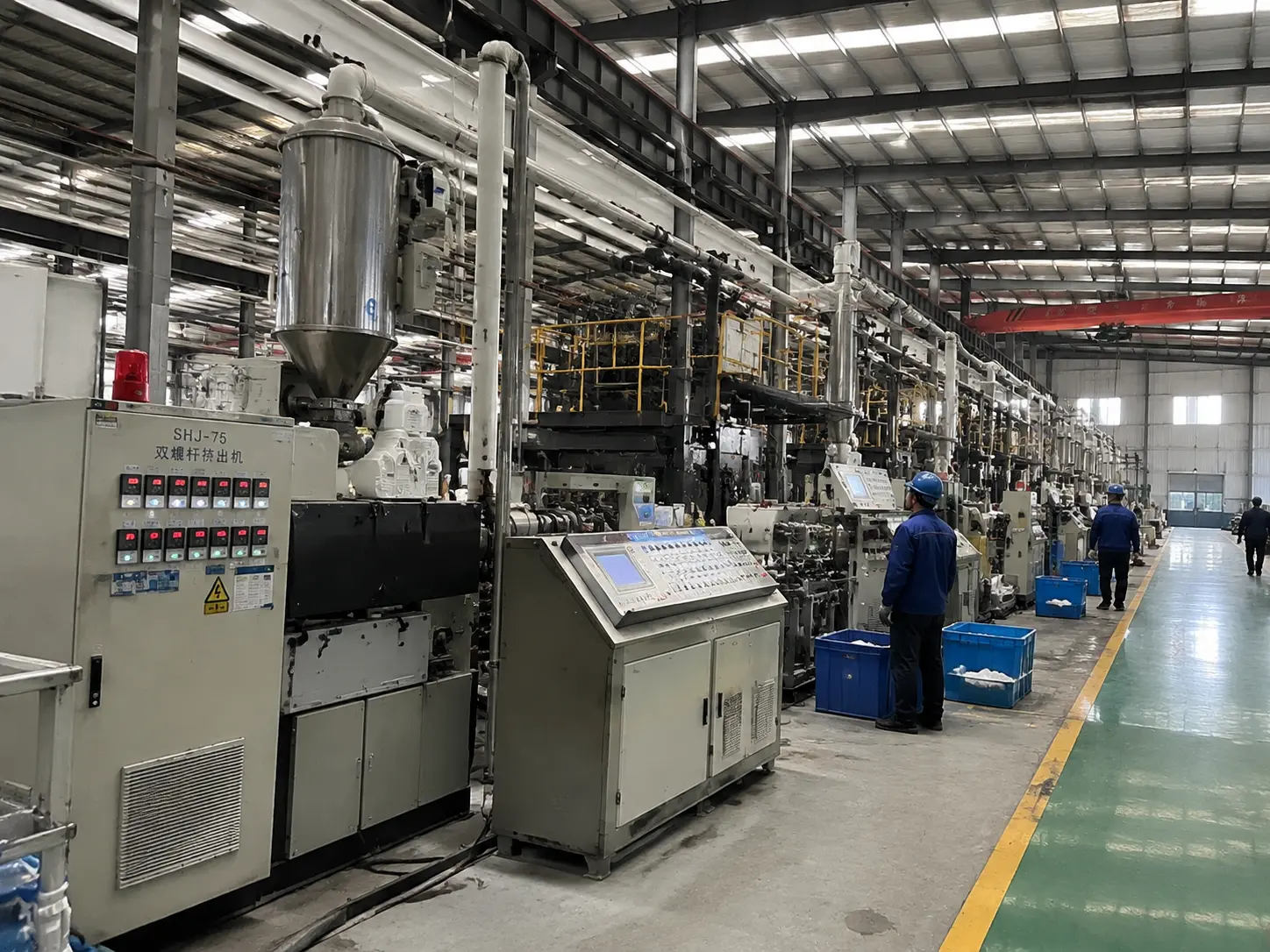
A customer once told me our masterbatch “didn’t work,” which is always the start of an interesting conversation. It had run perfectly in their injection moulding shop for two years. They had then tried it on a blown film line making the packaging for the same product. Same material, same loading — and a web that broke every four minutes. Nothing was wrong with the masterbatch; it was simply never designed for a 60 µm film. That failure mode is entirely predictable, and this article is how to predict it.
The Four Processes at a Glance
| Process | Difficulty | Critical requirement | Typical failure if ignored |
|---|---|---|---|
| Injection moulding | Most forgiving | Back pressure for dispersion; avoid overheating at long residence | Specks, plate-out on tooling, colour drift |
| Profile / pipe extrusion | Moderate | Melt strength; consistent dosing over long runs | Sagging, dimensional drift, die build-up |
| Cast film / sheet / coating | Demanding | Fine particle size; filtration-friendly formulation | Die lines, screen pack blinding, surface defects |
| Blown film | Hardest | Particle top-cut well below film gauge; bubble stability | Gels, web breaks, unstable bubble, pinholes |
Injection Moulding: Use the Back Pressure
Injection moulding gives you three advantages the other processes do not: real shear from the screw, a thick section that tolerates a stray agglomerate, and short residence time that limits thermal exposure. Most flame retardant systems run here without special measures.
The three things that still catch people: back pressure is your main dispersion tool and is usually set too low for 30% masterbatch addition; residence time in a hot barrel during interruptions can degrade heat-sensitive additives, so purge rather than letting material sit; and thin-wall sections quietly become a film problem — a 0.6 mm wall has the same particle-size sensitivity as sheet, even though the rest of the part does not.
Profile and Pipe Extrusion: Melt Strength and Consistency
Q: Why does my extruded profile sag after adding flame retardant? High filler loadings change melt rheology, and mineral systems in particular reduce melt strength.
Extrusion punishes different things than moulding. Runs last hours, so dosing accuracy over time matters more than instantaneous mixing quality; a feeder that drifts 5% across a shift produces material that fails at one end of the roll and passes at the other. Die build-up accumulates over a long run rather than showing immediately. And the melt has to hold its shape between die and calibration, which heavily filled compounds do less well.
Practical responses: use gravimetric dosing, keep the melt temperature at the low end of the workable range to preserve melt strength, and expect to re-tune the die and calibration rather than assuming settings transfer from the unfilled compound. For pipe and sheet specifically, our article on flame retardant polypropylene pipe and sheet covers the formulation side of this.
Blown Film: The Hard Case
Q: Can flame retardant be added to blown film? Yes, but the formulation must be built for it — a moulding-grade masterbatch will not run.
Everything about blown film works against particulate additives. The film is 30–100 µm thick, so a 50 µm agglomerate is a hole. The bubble is stabilised by melt strength that fillers reduce. There is no screen pack coarse enough to catch problem particles without blinding. And film applications usually need optical properties that mineral loadings destroy.
What actually works:
- Specify particle top-cut against film gauge, not as a general “fine grade.” For 50 µm film we would target d97 below 10 µm — the same discipline described in our article on flame retardant PET film.
- Favour chemistries that need low loading. This is where halogenated systems retain a genuine advantage — 12% brominated plus synergist is achievable in film; 25% intumescent generally is not.
- Accept the property cost honestly. Flame retardant film will have lower clarity, lower tear strength and a narrower processing window than the same film without it. If your specification demands optical-grade clarity and V-0, one of those two requirements has to move.
- Consider coextrusion. Putting the flame retardant in one layer of a three-layer structure keeps the outer layers clean, and often reaches the fire specification with less total additive. This is the route most successful FR film producers end up on.
Cast Film, Sheet and Extrusion Coating
These sit between extrusion and blown film in difficulty. There is no bubble to stabilise, which removes the hardest constraint, but gauge is still thin and surface quality still visible. The specific issue here is screen pack blinding: a coarse or poorly dispersed masterbatch clogs filters, driving pressure up until the line has to stop. If you are seeing rapid screen pack pressure rise after introducing a flame retardant, the material is telling you its particle size distribution is wrong for the process.
Extrusion coating adds adhesion to the list — high additive loadings can reduce bond strength to the substrate, which is a real constraint in coated fabrics and laminates. The tarpaulin case, where the coating carries the flame retardancy and the fabric carries the strength, is covered in our article on flame retardant tarpaulin.
What This Means When You Order
The practical takeaway is short. When requesting a flame retardant masterbatch, state the process, not just the polymer. “FR masterbatch for PE” is not a specification; “FR masterbatch for LLDPE blown film, 60 µm gauge, target UL94 VTM-0” is. The second version lets us size particles, choose a carrier with appropriate melt strength, and tell you honestly if what you are asking for is achievable at that gauge.
The related decisions — how much to add, what carrier to use, and what to do when dispersion goes wrong — are covered in our guides on loading ratio, carrier resin selection and dispersion troubleshooting. For a process-specific recommendation, send us the process, gauge or wall thickness, resin grade and target rating — the full masterbatch range is on our flame retardant masterbatch page.
FAQ
Can I use the same flame retardant masterbatch for injection moulding and film?
Usually not. A moulding grade is optimised for cost and loading efficiency, with particle sizes that are invisible in a 2 mm wall and fatal in a 50 µm film. Film grades cost more because the particle size distribution is tightly controlled. Ask for a film grade explicitly rather than assuming the standard product transfers.
Why does my screen pack blind so quickly after adding flame retardant?
Oversized particles or agglomerates. Either the grade’s particle size distribution is too coarse for the process, or dispersion is inadequate and agglomerates are surviving to the filter. Check both — a fracture-face inspection of purged melt distinguishes them.
What UL rating applies to flame retardant film?
Thin materials are usually rated under UL94 VTM-0, VTM-1 or VTM-2 rather than the V ratings used for bars, because the vertical bar test does not suit films. Confirm which your customer means — VTM-0 and V-0 are different tests and not interchangeable in a certification file.
Does flame retardant affect heat sealing in film applications?
It can. Additives migrating to the surface, or high mineral loadings at the sealing layer, reduce seal strength and can narrow the sealing window. In coextruded structures this is a strong argument for keeping the flame retardant out of the sealant layer entirely.
Final Thoughts
Process decides more than most datasheets admit. Blown film is the most punishing case because particle size competes with film thickness; injection moulding is the most forgiving. Match the grade to the process before you compare prices. Our masterbatch line is specified by process as well as by resin – tell us which line it runs on and we will point at the right particle size and carrier.
If you compound rather than buy masterbatch, the process-matching question shifts to grade specification — particle size against your screw configuration, and decomposition temperature against your barrel profile. Covered in compounding flame retardants.
Process fit is one input among four. If you are still selecting a grade rather than running one, the carrier and active content questions come first — see how to choose a flame retardant masterbatch.
—— Rectivas Materials 团队 老陈