Quick answer: Polyethylene is one of the most flammable commodity plastics (LOI around 17–18, heavy flaming drip), and the right flame retardant depends on the part more than the resin: brominated + antimony trioxide for molded parts and film where loading must stay low, intumescent ammonium polyphosphate (APP) systems for halogen-free film and sheet, and mineral ATH/MDH — usually in an EVA/PE blend — for wire and cable. PE’s low processing temperature (roughly 180–220 °C) is the one thing working in your favor: almost every flame retardant chemistry survives it.
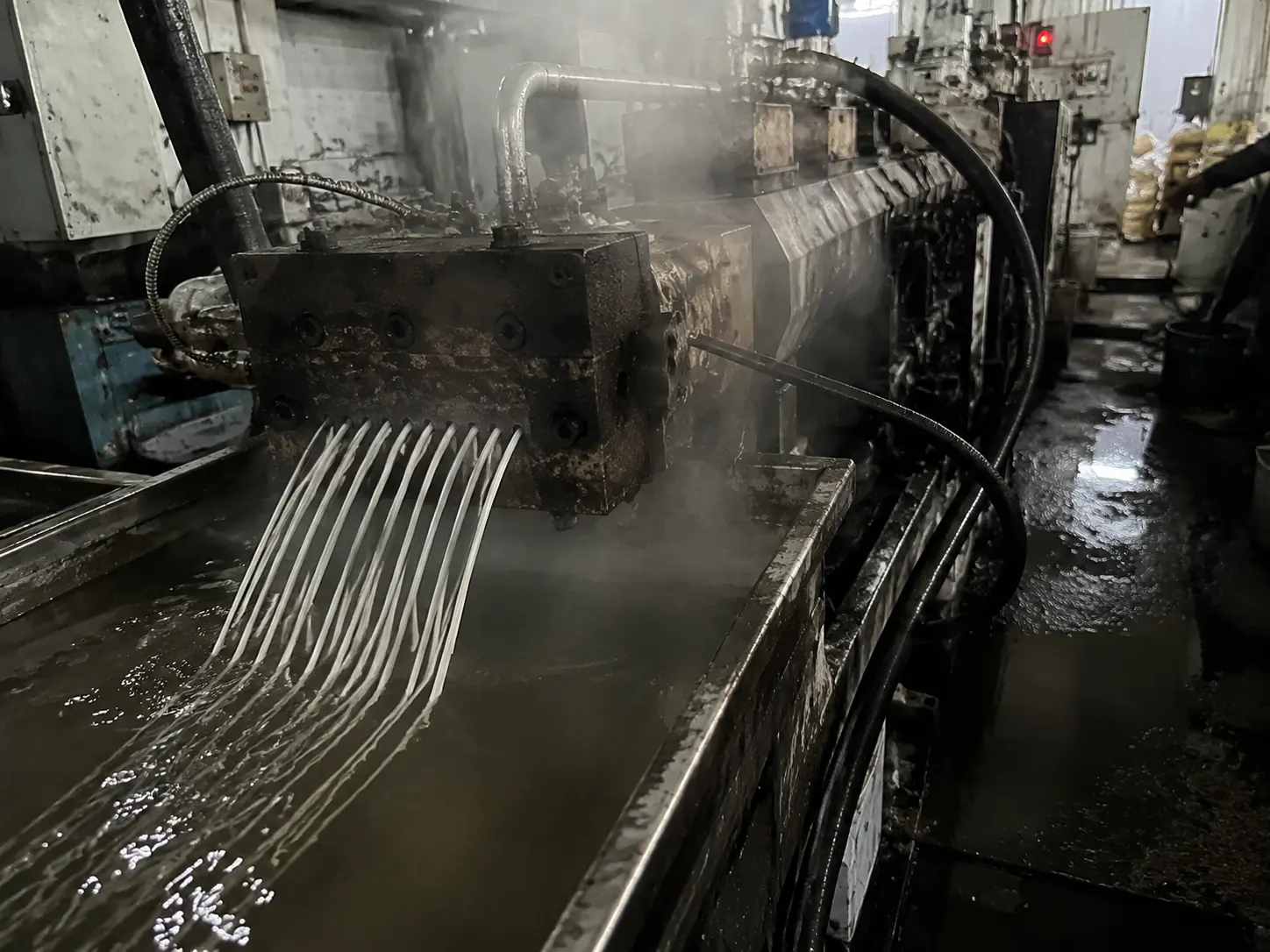
PE is everywhere — film, pipe, cable jacket, tanks, crates — and it burns like the paraffin wax it chemically resembles. No aromatic rings, no char-forming backbone: it melts, drips, and feeds the fire. That makes flame retardant polyethylene a bigger formulation jump than most buyers expect, and it makes the “which system” question worth ten minutes before you ask for pricing.
Why PE needs a different playbook
Three properties drive every decision:
- It is fuel. A pure hydrocarbon chain with high heat of combustion. Neat PE ignites easily and burns fast — there is no free ride like PVC’s built-in chlorine.
- It drips. Low melt viscosity means flaming drips in a vertical burn. Whether your spec treats drips as pass or fail (V-2 tolerates flaming drips, V-0 does not) changes the required package completely.
- It processes cool. 180–220 °C for most extrusion and molding. This is the good news: heat-sensitive chemistries that are ruled out in nylon or PC — APP intumescents, high mineral loads — are all on the table for PE.
Matching the system to the PE application
Here is the honest selection map. Note it is organized by part, not by resin grade — HDPE pipe and LDPE film are different problems even though both are “polyethylene.”
| Application | Preferred system | Typical loading | Why |
|---|---|---|---|
| Blown film / sheet (thin wall) | Brominated + Sb₂O₃, or APP intumescent for halogen-free | ~5–12% / ~20–25% | Thin films can’t carry mineral loads; fine particle size critical for film quality |
| Injection molded parts, crates | Brominated + Sb₂O₃ | ~8–15% | Lowest loading for the rating, keeps impact strength |
| Wire & cable jacket / insulation | ATH/MDH mineral in EVA/PE blend | ~55–65% | Low smoke, halogen-free — the LSZH standard route |
| Pipe / conduit (HDPE) | Intumescent APP or brominated, by spec | ~15–25% / ~10% | Char barrier suits thick walls; halogen policy decides |
Two notes on that table. First, the mineral row is really an EVA story: pure PE cannot bond enough ATH/MDH to work, so cable compounds blend EVA (or a grafted PE) as the polar host — that is the chemistry behind our flame retardant cable compounds. Second, the brominated rows are where the brominated flame retardant additives + antimony synergy earns its keep: PE tolerates the chemistry well and the loading stays low enough that film and molded parts keep their mechanicals.
The drip problem: V-2 vs V-0 in polyethylene
Ask what rating the part actually needs before you pay for V-0. In UL94, V-2 allows flaming drips; V-0 does not. For a dripping resin like PE this one line in the spec swings the formulation cost more than any other:
| Target | What it takes in PE | Relative cost |
|---|---|---|
| UL94 V-2 | Modest brominated dose — drips allowed, they just can’t burn long | Low |
| UL94 V-0 | Higher dose + anti-drip aid (PTFE micro-powder or char former) | Noticeably higher |
| Cable standard (IEC 60332) | Tested on finished cable, not the bar — mineral LSZH route | Compound-level economics |
We see over-specification constantly: a warehouse pallet spec asking for V-0 when the insurer’s checklist actually says “flame retardant per UL94” — which V-2 satisfies. That difference is real money at PE volumes. When in doubt, pull the end customer’s exact test clause before formulating; the decision logic is laid out in our guide on how to choose flame retardants.
2026 angle: flame retardant recycled PE
The newest requirement hitting PE RFQs is not a new standard — it is recycled content. Packaging and construction buyers now arrive asking for flame retardant compounds on rPE or PCR-blended bases, and current research is following: 2025 studies benchmark intumescent APP systems on recycled HDPE specifically, because recycled feedstock behaves differently — residual contaminants can catalyze degradation and shift burn behavior batch to batch. Practical translation: an FR package validated on virgin resin needs re-testing on your actual rPE stream, and incoming-lot consistency matters more, not less. If your product roadmap includes PCR content, tell your flame retardant supplier now, not after the first failed audit.
Additive or masterbatch: how PE plants actually dose
PE converters split cleanly into two camps. Compounders with twin-screw capacity buy powder additive packages and disperse in-house. Film blowers and molders without compounding lines dose a pellet concentrate at the throat — for them we build the package into a PE-carrier concentrate so it lets down cleanly at the machine; that product line is covered on our flame retardant masterbatch for PE page. Film is the demanding case: undispersed particles become holes and gels in a 50 μm web, so carrier melt index and particle fineness are specified against your film grade, not taken off a shelf. If you are still weighing the two supply forms, the trade-off logic is in additives vs masterbatch.
How Rectivas runs a PE project
Same loop as every resin we handle: you send the PE type (HDPE/LDPE/LLDPE, melt index), the part and wall thickness, and the exact fire clause. We bracket loadings on the twin-screw line, burn the ladder in the UL94 vertical chamber at our partner factory, and ship the passing sample with an accredited third-party laboratory report plus TDS/SDS/COA. One recent film job is representative: a 80 μm LDPE construction film kept gelling with a customer’s previous FR concentrate — the fix was not chemistry but carrier: matching the masterbatch carrier MI to the film resin and tightening particle size got clean film and the flame rating in the same trial.
Request a quote with your PE grade, application and fire clause — we will recommend the system, the form (powder or masterbatch), and send a burn-tested sample.
FAQ
Is polyethylene flame retardant by itself?
No — it is one of the least fire-safe commodity plastics. Neat PE has an LOI around 17–18, ignites easily, burns with high heat release and sheds flaming drips. Any fire rating requires an additive package.
What is the best flame retardant for polyethylene?
Depends on the part: brominated + antimony trioxide for molded parts and film at the lowest loading, intumescent APP systems for halogen-free film and thick sections, and ATH/MDH mineral systems (in an EVA/PE blend) for low-smoke cable. PE’s low processing temperature keeps all three routes open.
Can flame retardant polyethylene film stay thin and clear?
Thin, yes — with a finely dispersed package matched to the film grade; poor dispersion shows up immediately as gels and holes. Fully clear is harder: most effective packages add haze, so specify the real optical requirement (true clarity vs. contact clarity) up front.
Does UL94 V-2 vs V-0 matter for cost in PE?
Significantly. V-2 tolerates flaming drips, which dripping-prone PE can meet at a modest brominated dose. V-0 requires suppressing drips entirely — higher loading plus an anti-drip aid — and costs noticeably more per kilogram. Confirm which one your end spec actually requires before formulating.
Can recycled polyethylene be flame retarded?
Yes, and demand is growing fast, but packages validated on virgin resin must be re-verified on the actual recycled stream — contaminants in rPE shift burn behavior and batch consistency. Plan for incoming-lot QC on the recyclate, not just the additive.
Final Thoughts
PE is easy chemistry and hard mechanics: it takes flame retardant readily but drips badly, and film applications punish any particle that is too large. Mineral routes need high loading, brominated routes need less. Our PE masterbatch covers film and moulding work – tell us the gauge or wall thickness and whether the application is film, pipe or moulded.
—— Rectivas Materials 团队 技术工程师老陈