Quick answer: “Flame retardant polystyrene” splits into two unrelated jobs. HIPS electronics housings run brominated additives (DBDPE, brominated polystyrene) with antimony trioxide, same playbook as ABS. EPS/XPS building insulation used to run HBCD — banned under the Stockholm Convention and EU POPs since 2016 — and has fully switched to a polymeric brominated flame retardant sold as PolyFR. Different foam, different molecule, same bromine-based mechanism.
Two products share one name and nothing else. A laptop shell and a foam insulation board are both “polystyrene,” but one is solid HIPS running through an injection press and the other is a gas-blown cellular foam — different processing, different fire behavior, different flame retardant history entirely. Buyers searching “flame retardant polystyrene” usually mean one or the other; worth checking which before reading a datasheet.
HIPS and general-purpose PS: the additive route
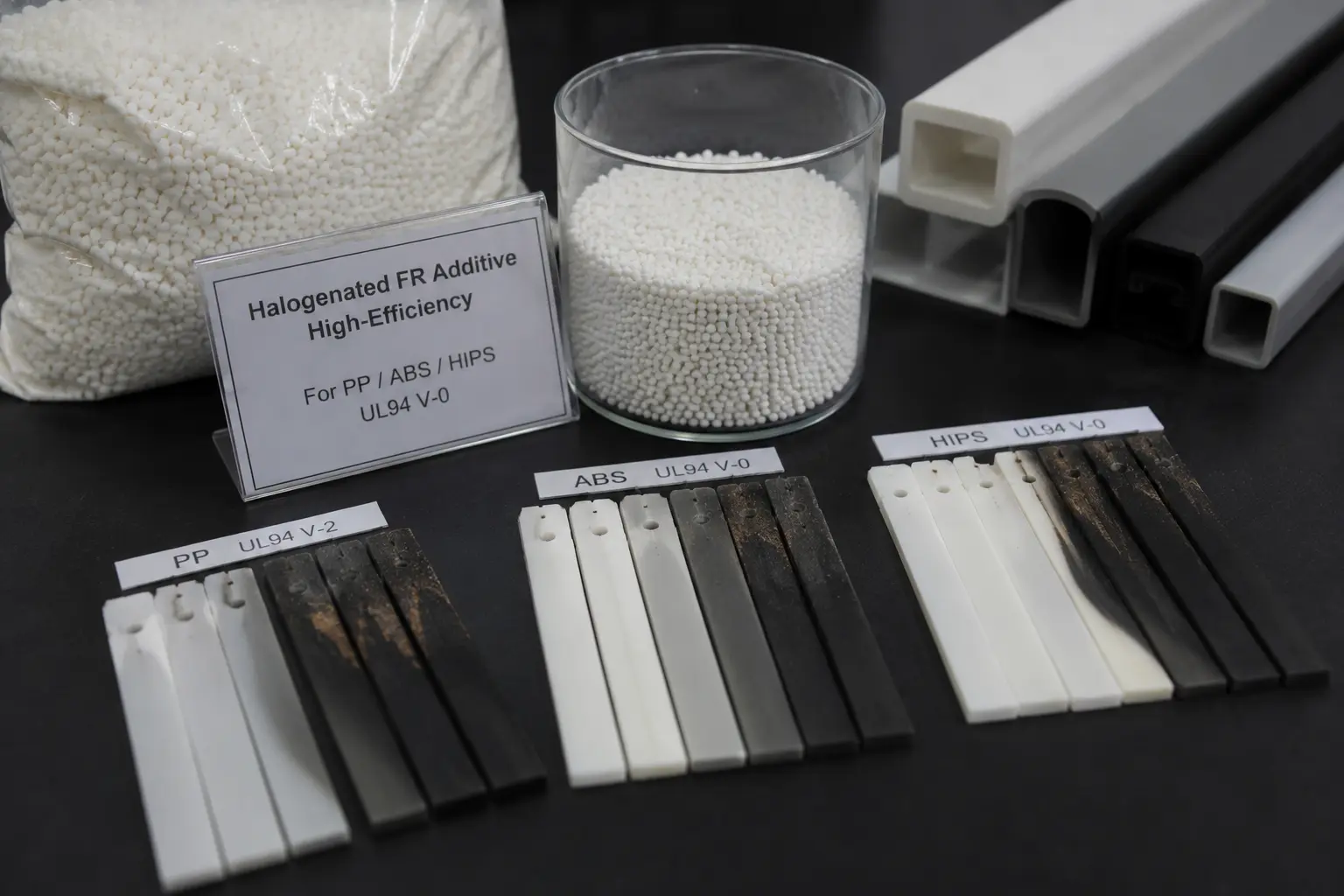
High-impact polystyrene burns the way its cousin ABS does — drips, moderate LOI, no char to speak of — and it takes the same fix. Brominated additives with antimony trioxide reach UL94 V-0 at loadings similar to ABS:
| System | Typical loading | Fit |
|---|---|---|
| DBDPE + Sb₂O₃ | 10–16% | Lowest cost per rating point, any dark or opaque color |
| Brominated polystyrene + Sb₂O₃ | 12–18% | Polymeric — low bloom, good heat stability |
| Halogen-free (phosphinate/intumescent) | Higher loading, resin-dependent | Where compliance rules out halogen — less common in commodity HIPS |
This is the same chemistry map as ABS housings: television and monitor back-covers, appliance shells, electrical enclosures. If your part is HIPS, the formulation logic, standards and packages are identical to what we cover for flame retardant ABS, and the bromine source itself is detailed on our DBDPE page.
EPS/XPS insulation: the HBCD story
Rigid foam insulation is a different animal — and it just went through the biggest flame retardant transition in the building materials industry. For decades, EPS and XPS foam used HBCD (hexabromocyclododecane) almost exclusively: cheap, effective, easy to dose into the foam bead before expansion.
Then the regulatory floor gave way. HBCD was listed under the Stockholm Convention on Persistent Organic Pollutants in 2013 and restricted under the EU POPs Regulation from 2016 — it bioaccumulates and does not break down. The insulation industry had one real problem to solve: HBCD had no simple drop-in replacement. The molecule that worked was banned, and nothing chemically identical existed.
What replaced it: PolyFR
The industry answer is a polymeric brominated flame retardant, commercialized under the trade name PolyFR — a high-molecular-weight brominated polymer built specifically to drop into EPS/XPS foam lines with minimal process change. By 2018, major insulation producers — Dow, Owens Corning, Kingspan among them — had converted their EPS and XPS lines away from HBCD entirely. If you are buying insulation-grade EPS/XPS today, HBCD should not be in the picture at all; ask for the PolyFR or equivalent designation on the COA.
Note what this means for anyone still holding legacy stock or recycled foam: pre-2016 HBCD-containing EPS scrap is a genuine compliance problem in recycling streams, not just a historical footnote. Regrind and recycled-content foam should be screened for HBCD before it enters a new build.
Why HIPS and EPS never shared a fix
It is worth asking why the electronics side (HIPS) never needed the same HBCD-scale cleanup the insulation side did. Two reasons: dose and exposure. Foam insulation is installed by the square kilometer in occupied buildings and landfilled at end of life — HBCD’s bioaccumulation and persistence became a population-scale exposure question. HIPS housings are a much smaller volume per unit, more contained, and DBDPE and brominated polystyrene never carried HBCD’s specific toxicology profile. Same element, same general mechanism, very different regulatory fate — a useful reminder that “brominated” is not one substance but a family, and each member stands on its own record. We map that family in full on our brominated flame retardants examples guide.
How Rectivas supports flame retardant PS work
For HIPS and general-purpose PS housings, we supply the same brominated additive packages as our ABS line — DBDPE or brominated polystyrene with antimony trioxide, dosed and burn-verified for your wall thickness. We do not manufacture PolyFR-type insulation-grade polymeric flame retardants or foam-grade masterbatch; that is a specialized foam-industry supply chain. For HIPS and PS parts, resin and target rating, and we will match a package and prove it at our partner factory’s UL94 chamber. Request a quote to start.
FAQ
What flame retardant is used in polystyrene?
Depends which polystyrene. HIPS and general-purpose PS housings use brominated additives — DBDPE or brominated polystyrene — with antimony trioxide. EPS/XPS foam insulation now uses a polymeric brominated flame retardant (PolyFR), having fully replaced HBCD since around 2018.
Is HBCD still used in polystyrene foam?
No. HBCD was listed under the Stockholm Convention in 2013 and restricted under EU POPs from 2016. Major EPS/XPS producers converted to PolyFR-type polymeric brominated flame retardants industry-wide by 2018. Legitimate current-production insulation should not contain HBCD.
Is recycled EPS/XPS safe from HBCD?
Not automatically. Foam manufactured before the mid-2010s transition may still contain HBCD, and it can enter recycling streams. Recycled-content insulation should be screened and documented for HBCD absence before use in a new build.
Do HIPS housings need the same flame retardant as ABS?
Essentially yes — HIPS and ABS share the same burn behavior and the same brominated-additive playbook: DBDPE or brominated polystyrene with antimony trioxide at similar loadings. If you already have an ABS-qualified package, it is the right starting point for HIPS.
Why wasn’t HIPS affected by the HBCD ban?
Because HIPS electronics never used HBCD in significant volume — it dosed DBDPE and brominated polystyrene instead. HBCD’s ban was specifically about its own bioaccumulation profile at foam-insulation scale, not a blanket restriction on all brominated chemistry in polystyrene.
Final Thoughts
Polystyrene is easy to ignite and drips heavily, so anti-drip and char support matter more than raw efficiency. For EPS and XPS insulation the market has already moved to polymeric FR after the HBCD ban, and that is the route to specify for anything new. Our additive systems cover the styrenics case – tell us whether the part is foam or solid, and the standard it answers to.
—— Rectivas Materials 团队 技术工程师老陈