Quick answer: The most common brominated flame retardants (BFRs) still in commercial use are decabromodiphenyl ethane (DBDPE), brominated polystyrene, tetrabromobisphenol A (TBBPA) and ethylene bis(tetrabromophthalimide) — almost always paired with an antimony trioxide synergist to hit UL94 V-0. The older PBB, PBDE and HBCD families are the ones that got banned under RoHS and the EU POPs Regulation, and as of 2026 the PBDE limit has been cut to 10 mg/kg. So “brominated” does not mean “illegal” — it means you have to know which molecule you are buying.
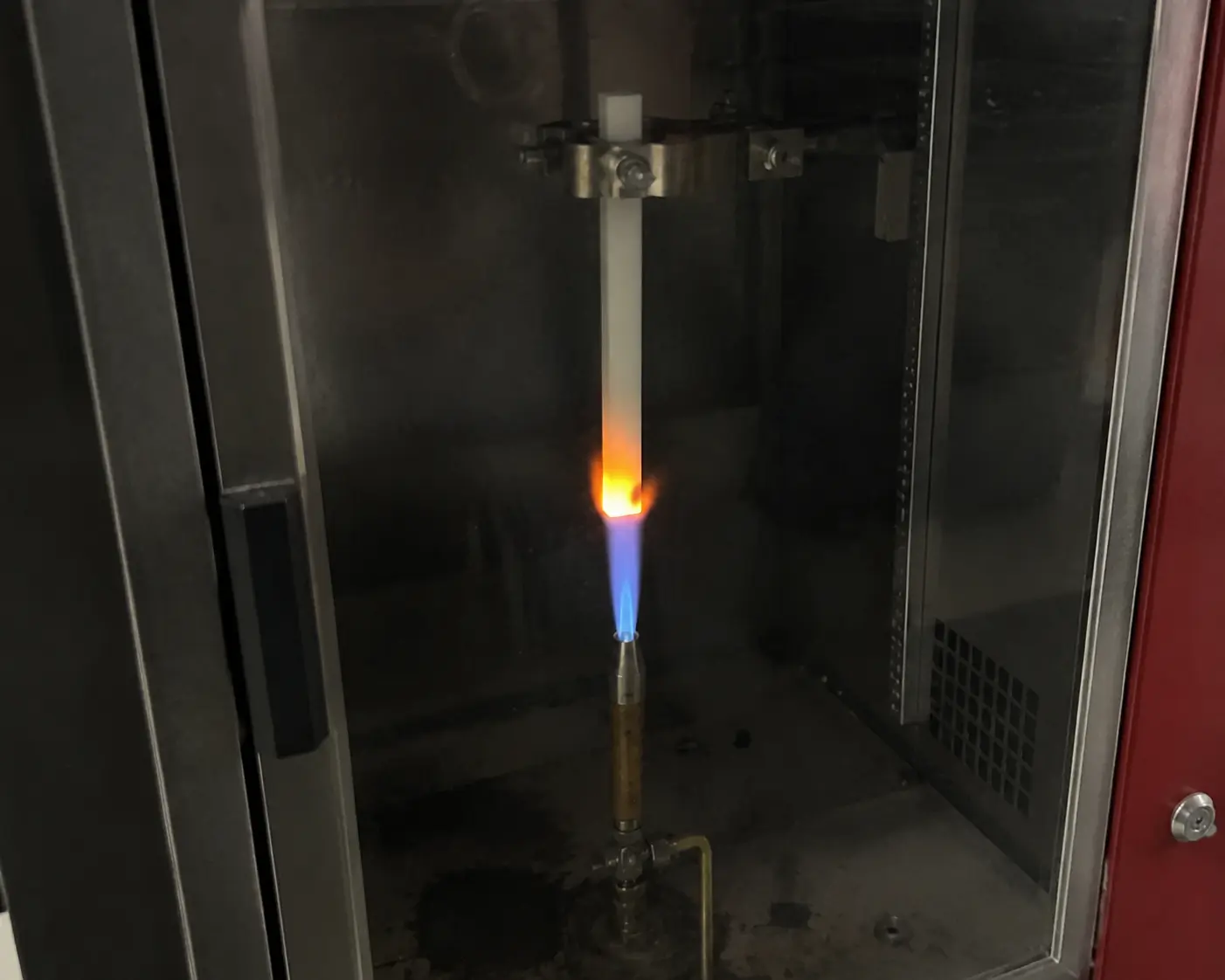
Buyers ask us this constantly: “Give me examples of brominated flame retardants, and tell me which ones I can actually still ship to Europe.” Fair question. The regulatory picture moved again in late 2025, so a list you found three years ago is probably out of date. Here is the working reference we give our own customers.
What are brominated flame retardants?
Are they a single chemical? No. “Brominated flame retardant” is a whole family of organic molecules that carry bromine atoms. When the plastic burns, bromine radicals interrupt the combustion chain reaction in the gas phase — they starve the flame instead of just cooling it. That gas-phase mechanism is why bromine is so efficient at low loadings.
Almost no one runs bromine alone. In practice it is co-formulated with antimony trioxide (Sb₂O₃) as a synergist. The antimony forms antimony bromide/oxybromide species that carry the bromine deeper into the flame, so you get the same UL94 rating at a lower total additive load. Typical bromine-to-antimony ratios sit around 3:1. This is the classic “efficiency first” system for resins like ABS, HIPS, PP and PE — and it is exactly the chemistry behind our brominated flame retardant additives.
Common brominated flame retardants examples
Which ones will you actually see on a TDS? The market has largely moved off the legacy PBDE-based products onto thermally stable, higher-molecular-weight replacements. Here are the examples that still matter in 2026, sorted by what they are used for.
| Example (common name) | Typical resins | Bromine level | 2026 status |
|---|---|---|---|
| Decabromodiphenyl ethane (DBDPE) | PP, PE, HIPS, PBT, PA | ~82% | In use — main non-PBDE replacement |
| Brominated polystyrene (BPS) | PA6, PA66, PBT (glass-filled) | ~68% | In use — high thermal stability, polymeric |
| Tetrabromobisphenol A (TBBPA) | Epoxy (FR-4 PCB), ABS | ~59% | In use (reactive in PCB); under REACH review |
| Ethylene bis(tetrabromophthalimide) | PP, PE, TPE, elastomers | ~67% | In use — UV-stable, low bloom |
| Bis(tribromophenoxy)ethane | ABS, HIPS | ~70% | In use — good flow, low warp |
| Decabromodiphenyl ether (decaBDE) | (legacy) HIPS, textiles | ~83% | Restricted — POPs / REACH |
Two practical notes from the shop floor. First, the top four rows are the workhorses today — they are high-molecular-weight or polymeric, so they do not bloom to the surface and survive high processing temperatures on a twin-screw line. Second, all of them still need the antimony synergist to hit V-0; drop the antimony to save cost and your LOI collapses.
Which brominated flame retardants are banned?
This is where most buyers get burned — literally on a customs hold. The banned list is specific. It is not “all brominated chemistry”; it is a defined set of legacy molecules that bioaccumulate. Here is the current picture after the 2025–2026 regulatory tightening.
| Substance | Regulation | Limit / status | Since |
|---|---|---|---|
| PBBs (polybrominated biphenyls) | RoHS | Banned >1000 ppm in EEE | 2006 |
| PBDEs (penta, octa, deca…) | RoHS + EU POPs | Limit cut 500 → 10 mg/kg | Nov 2025 |
| HBCD / HBCDD | EU POPs / Stockholm | Banned (was EPS/XPS insulation) | 2016 |
| Aromatic BFRs (non-polymeric) | REACH Annex XVII | Call for Evidence open (Jan–Mar 2026) | Proposal pending |
The headline for 2026: on 28 October 2025 the EU published a revision of the POPs Regulation that slashed the combined limit for the five PBDEs from 500 mg/kg down to 10 mg/kg, in force from 17 November 2025. And in January 2026 ECHA opened a formal Call for Evidence on certain non-polymeric aromatic brominated flame retardants in electronics, construction products and textiles, with a REACH restriction being prepared. Translation: the direction of travel is one-way. If you are speccing a new product for a European customer, do not design around a molecule that is already in ECHA’s crosshairs.
Notice what is not on the banned list: DBDPE, brominated polystyrene, ethylene bis(tetrabromophthalimide). These are the compliant workhorses, which is why the whole market migrated to them. Our brominated grades are built on this non-PBDE chemistry and ship with an accredited third-party laboratory Testing report on the RoHS/REACH regulated substances so your incoming QC has paperwork, not promises.
Brominated vs chlorinated flame retardants
Bromine is not the only halogen used for flame retardancy. Chlorinated flame retardants — chlorinated paraffins, Dechlorane Plus — do the same gas-phase job, and buyers often lump the two together as “halogenated.” So which do you choose?
| Property | Brominated | Chlorinated |
|---|---|---|
| Efficiency (per kg) | Higher — lower loading for V-0 | Lower — needs more |
| Thermal stability | Good (modern grades) | Lower — can limit process temp |
| Typical use | Engineering plastics, E&E | Wire & cable, polyolefins, rubber |
| Regulatory pressure | High on legacy grades | High on SCCPs / MCCPs |
Both families sit under the same RoHS/REACH scrutiny, and both share the same downside: smoke and corrosive acid gas when they burn. If low-smoke, low-toxicity performance is a hard requirement — think enclosed spaces, transit, LSZH cable — halogen chemistry is the wrong tool no matter how you tune it. For a deeper trade-off breakdown, see our full comparison of halogen-free vs halogenated flame retardants.
When to switch to non-halogenated flame retardants
We tell customers to reach for brominated systems when efficiency and cost per V-0 point are the priority and the end market allows halogen — for example a cost-sensitive ABS housing that only has to pass UL94 V-0 at 1.6 mm. But there are three signals that it is time to move to a halogen-free flame retardant system instead:
- The spec cites low smoke or LSZH. Bromine cannot meet IEC 60332 cable requirements with the low smoke and zero halogen your customer expects. That is a mineral (ATH/MDH) or phosphorus job.
- The buyer is in a RoHS/REACH-sensitive channel. If procurement is already nervous about “halogenated,” a phosphorus or nitrogen-phosphorus system removes the whole conversation.
- The part is recycled or food-adjacent. Halogen content complicates recycling streams and end-of-life sorting.
Not sure which way to go for your resin and standard? Our engineers wrote a full selection walkthrough — start with how to choose flame retardants for plastics, then send us the resin, wall thickness and target rating.
How Rectivas supplies compliant brominated systems
We supply both routes. If bromine is genuinely the right call for your economics, we supply pre-synergized brominated flame retardant masterbatch and powder blends built on non-PBDE chemistry — DBDPE and brominated-polystyrene bases with the antimony ratio already dialed in for your resin. Every lot is compounded on our partner factory’s SHJ-75 twin-screw line and burn-tested at our partner factory in a UL94 vertical chamber before it ships. TDS, SDS and a third-party test report on RoHS/REACH substances come with every order, so your customs and incoming QC are covered.
Tell us your resin, the UL94 rating and wall thickness, and the destination market. We will tell you honestly whether a brominated or halogen-free grade wins on your numbers — and send a sample to prove it. Request a quote with your specs and we will turn it around fast. On the question behind the restrictions — what the safety profiles actually look like across chemistries — see are flame retardants toxic.
FAQ
Are all brominated flame retardants banned?
No. Only specific legacy families — PBBs, PBDEs and HBCD — are banned or tightly restricted under RoHS and the EU POPs Regulation. Modern replacements like DBDPE, brominated polystyrene and ethylene bis(tetrabromophthalimide) are still legal and widely used, provided you stay under the RoHS threshold for the restricted substances.
Is TBBPA banned?
Not currently. Tetrabromobisphenol A is still used, mostly as a reactive flame retardant bonded into FR-4 epoxy for printed circuit boards, where it is chemically locked in. It is under REACH review, so if you are designing a new product it is worth watching — but it is not on the RoHS or POPs banned list today.
Are brominated flame retardants RoHS compliant?
The compound can be, if it uses non-PBB/non-PBDE chemistry and the finished material stays under 1000 ppm for those restricted substances. Ask the supplier for a third-party test report on the RoHS substances — a compliant brominated grade should have one. If they can’t produce it, walk away.
Brominated or halogen-free for UL94 V-0?
Both can reach V-0. Brominated + antimony trioxide gets there at a lower loading and lower cost, which suits cost-driven parts like ABS housings. Halogen-free (phosphorus or mineral) is the answer when the spec demands low smoke, LSZH or a halogen-free declaration — common in cable, transit and enclosed-space applications.
Knowing which brominated molecules exist is one question; knowing which you are still free to specify is another. Five PBDE congeners and HBCD are prohibited outright, and a REACH restriction is now being prepared against non-polymeric aromatic additives — the current standing of each is tracked in brominated flame retardant regulations.
Final Thoughts
Knowing the family names is useful mainly for reading a datasheet and a regulatory file. What matters commercially is that most current brominated products are legal and RoHS compliant, while the specific molecules that were banned are still turning up in recycled feedstock. We supply DBDPE and brominated systems alongside halogen-free ones, and will give you the regulatory read on each before you commit to a long certification cycle.
Most of these brominated products depend on an antimony synergist to reach their rating, which makes antimony pricing a live issue for anyone using them. The options for reducing or removing it are in cutting or replacing antimony trioxide.
For the other side of this picture — what is available once you leave brominated chemistry — see the full list of halogen-free flame retardants, organised by family and by the resin each one actually suits. Once a shortlist exists the next question is usually cost, and how brominated quotes should be compared is covered in DBDPE price and quote structure.
—— Rectivas Materials 团队 技术工程师老陈