Quick answer: ASTM E84 Class A is two thresholds, not one — a Flame Spread Index of 0–25 and a Smoke Developed Index of 450 or less. The second one is where projects actually fail: halogenated systems routinely clear the flame spread number and lose the rating on smoke alone. If you are developing a panel or profile, screen smoke early rather than after booking tunnel time.
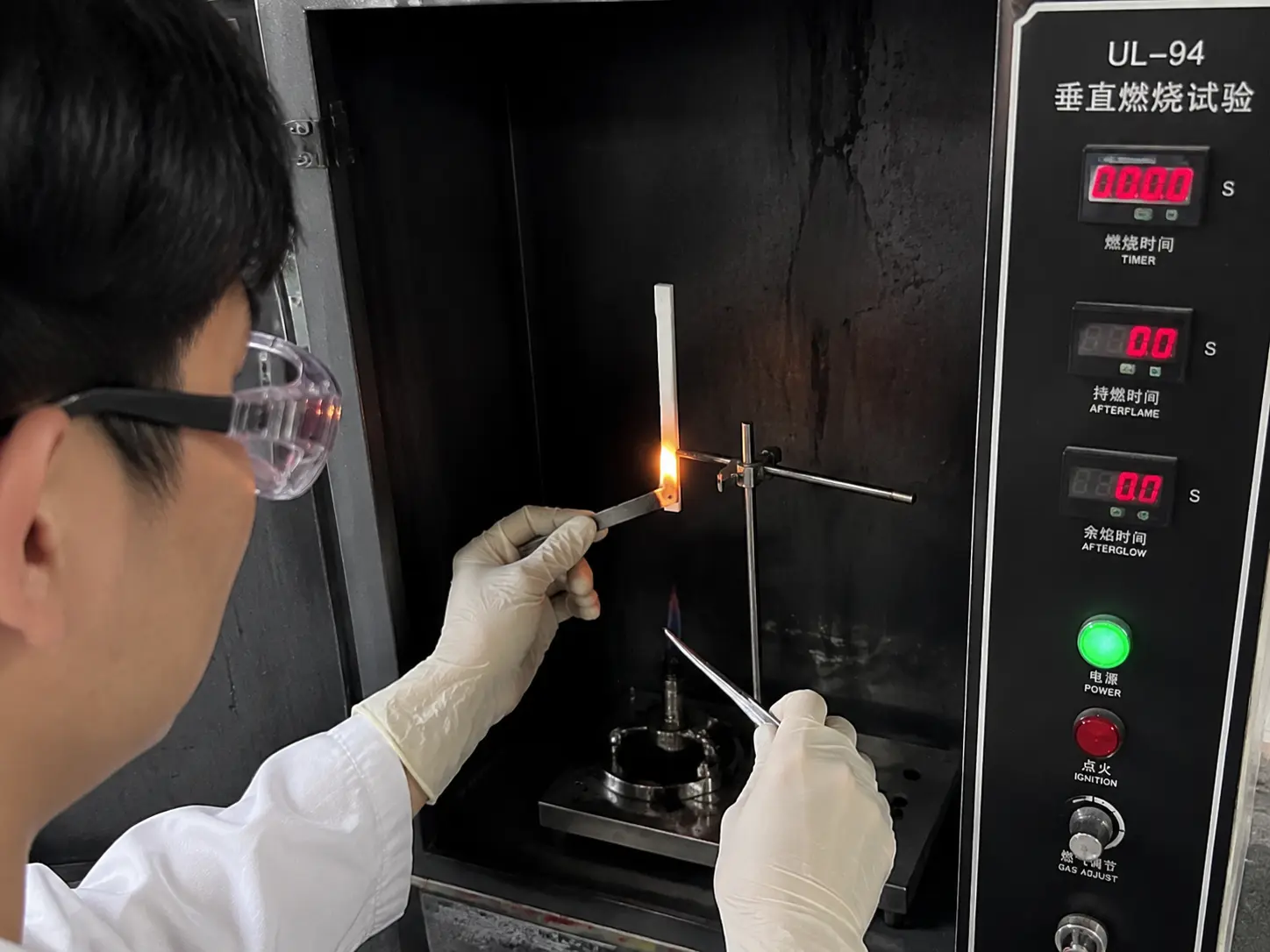
Every few weeks we get an RFQ that reads roughly the same way: “Our PP sheet failed E84, architect specs Class A, can your additive fix it?” Fair question — but E84 is a very different animal from the UL94 bar tests most plastics people know. Before you spend $2,000–5,000 per tunnel run at a certified lab, it is worth understanding exactly what the test measures and where the two numbers come from.
What ASTM E84 Actually Measures
Q: Is E84 a pass/fail test? No — it produces two index numbers, and the building code decides what class those numbers earn.
ASTM E84 (also published as UL 723, and historically NFPA 255) is the Steiner tunnel test. A specimen roughly 24 feet long and 20 inches wide is mounted face-down on the ceiling of a horizontal tunnel. Twin gas burners at one end hit it with about 89 kW of flame while air flows through the tunnel. For 10 minutes, the lab tracks two things:
- Flame Spread Index (FSI) — how far and how fast the flame front travels along the specimen, calculated against two calibration points: inorganic reinforced cement board = 0, and select-grade red oak flooring = 100.
- Smoke Developed Index (SDI) — how much the smoke obscures a light beam at the tunnel exhaust, again indexed with red oak = 100.
So a material with FSI 20 spreads flame at only a fifth the rate of red oak. That relative scale is the whole point — it lets a code official compare a PVC wall panel, a mineral-filled PP sheet and a painted gypsum board on one axis.
Class A, B and C: The Numbers That Matter
| Classification (IBC / NFPA 101) | Flame Spread Index | Smoke Developed Index | Typical code use |
|---|---|---|---|
| Class A (Class 1) | 0–25 | ≤450 | Exits, corridors, assembly spaces, most commercial interiors |
| Class B (Class 2) | 26–75 | ≤450 | Rooms and enclosed spaces, depending on occupancy and sprinklers |
| Class C (Class 3) | 76–200 | ≤450 | Lower-risk rooms; often only acceptable with sprinklers |
Two details buyers routinely miss:
- The smoke limit is the same 450 for all three classes. We have seen halogenated panels post an FSI of 15 — comfortably Class A territory — then blow the rating on smoke alone. Flame spread and smoke are separate hurdles; you must clear both.
- “Class 1” and “Class A” are the same thing. Older specs and some insurance documents use the numbered system. Do not let a spec writer make you test twice for one rating.
ASTM E84 vs UL94: Don’t Mix Them Up
Q: My material is UL94 V-0, is that Class A? No. The two tests answer different questions and neither substitutes for the other.
| ASTM E84 | UL94 | |
|---|---|---|
| Scale | Full-scale: 24 ft specimen in a tunnel | Bench-scale: 125 × 13 mm bar over a Bunsen flame |
| What it rates | The building product as installed (sheet, panel, liner) | The molding material for enclosures and components |
| Output | FSI + SDI indices → Class A/B/C | V-0 / V-1 / V-2 / HB rating at a given thickness |
| Who asks for it | Architects, building code officials, insurers | Electronics, appliance and automotive OEMs |
| Smoke measured? | Yes (SDI, hard limit 450) | No |
A UL94 V-0 compound is a promising starting point for a Class A panel — it tells us the flame retardant chemistry is working — but tunnel behaviour depends on the finished product’s thickness, surface, substrate and mounting. That is why our partner factory’s lab pre-screens with UL94 and LOI, then the customer runs the finished sheet at a certified tunnel lab. For a map of the wider testing landscape — the full UL94 ladder including 5VA, LOI and glow wire — see our flame retardant test methods overview; if you are still deciding on the chemistry itself, start with our guide on how to choose flame retardants for plastics.
Why Thermoplastics Are Tricky in the Tunnel
Here is the honest part most suppliers skip: the Steiner tunnel was designed around materials that stay put on a ceiling — wood, gypsum, mineral panels. Thermoplastics melt. A PP or PE sheet can soften, sag and drip away from the flame front, which sometimes produces an artificially low FSI that does not reflect real fire behaviour. Code bodies know this: foam plastics, for example, generally cannot qualify as interior finish on an E84 number alone and get routed to room-corner tests like NFPA 286 (IBC Chapter 26).
Practical consequences for a compounder or sheet extruder:
- Expect the lab to mount your sheet on wire or rods to keep it in place — agree the mounting method before testing, because it changes results.
- Melt behaviour is a formulation variable. High mineral loadings raise melt viscosity and hold the sheet together; char-forming intumescent systems build a crust that stops both sag and flame spread.
- Smoke is usually the harder index for plastics. Burning polymer smokes far more than red oak. This is where chemistry choice dominates.
Formulation Routes to Class A
Q: Which flame retardant gets a plastic sheet to Class A? There is no single answer, but the two workhorse routes we specify most often are mineral hydroxides for low smoke, and intumescent phosphorus systems for char.
For smoke-critical targets, magnesium hydroxide flame retardant (MDH, and its lower-temperature sibling ATH) is the default: the filler releases water vapour, dilutes fuel gases and leaves an inert oxide layer, cutting both heat release and smoke at the same time. That is the same logic that makes these minerals the backbone of LSZH cable compounds. For thinner sheet where a 55–65% mineral loading would wreck mechanicals, an intumescent package built on ammonium polyphosphate swells into a foamed char at 8–25% loading and shuts the flame front down with far less filler.
One case from last year: a customer extruding 3 mm PP wall liner panels for cold-storage rooms came to us after two failed tunnel runs — FSI was fine at 20, but SDI came back over 500 with their bromine-based package. We rebuilt the formulation around an APP-based intumescent system with a synergist, had it pre-screened (UL94 V-0 at 1.6 mm on our FR-PP base, LOI 30), and their third tunnel run landed FSI 20 / SDI 380. Same resin, same line, different chemistry. If your product is PP sheet or duct, the resin-side details live in our article on flame retardant polypropylene pipe and sheet.
PVC deserves its own note: rigid PVC is one of the few commodity plastics that can approach Class A with a comparatively light additive package, because the chlorine backbone self-extinguishes — but smoke suppressants are usually needed to stay under SDI 450. And for wire and cable, E84 is the wrong test entirely — plenum and riser cables run NFPA 262 and UL 1666 instead; our comparison of fire resistant vs flame retardant cable maps out that separate ladder.
How to Run an E84 Project Without Wasting Money
- Confirm the exact spec first. “Class A” per IBC interior finish? An insurance (FM) requirement? A cleanroom spec like FM 4910? These are different tests with different economics.
- Pre-screen at bench scale. UL94, LOI and cone calorimeter data predict tunnel behaviour well enough to kill weak candidates for a fraction of the cost. We arrange UL94 and LOI on customer formulations before any sample ships.
- Test the production article. Thickness, colourant, foaming and even embossing shift FSI/SDI. Certify what you will actually sell.
- Document the chain. A tunnel report is only as good as the batch traceability behind it — our COA links each lot back to the tested formulation, which is what an AHJ or insurer will ask for in an audit.
The additive side of that chain — choosing between mineral, phosphorus and halogenated packages for your resin and thickness — is exactly what our engineering team does daily across flame retardant additives for plastics, and specifically for construction products on our flame retardant building materials page. Send us your resin, target thickness and the spec language, and we will come back with a starting formulation and bench-screen data before you book tunnel time. Request a quote or a lab sample here.
FAQ
Is ASTM E84 Class A the same as UL 723 or NFPA 255 Class A?
Effectively yes. UL 723 is the same Steiner tunnel method published by UL, and NFPA 255 was the (now withdrawn) NFPA edition. A report to any of the three uses the same FSI/SDI scale and class limits.
What FSI and SDI do I need for Class A?
Flame Spread Index of 25 or less and Smoke Developed Index of 450 or less. Miss either number and the product drops out of Class A regardless of how good the other one is.
Does a Class A rating mean the material is non-combustible?
No. Class A is a surface burning classification, not non-combustibility. Non-combustible materials are qualified under ASTM E136, a completely different furnace test. A Class A plastic panel still burns — it just spreads flame slowly and within smoke limits.
Can flame retardant masterbatch achieve Class A, or do I need powder additives?
Both routes work; it depends on your line. Sheet extruders without high-intensity mixing usually prefer masterbatch for dispersion safety, while compounders running twin-screw lines often buy powder for cost. Loadings for tunnel-rated sheet are on the higher end, so carrier compatibility needs checking — that is a standard part of our sampling process.
How much does an ASTM E84 test cost and how long does it take?
Certified labs in the US typically charge on the order of $2,000–5,000 per run with lead times of two to six weeks, plus specimen shipping. Which is exactly why pre-screening the formulation at bench scale first is the cheapest insurance you can buy.
Final Thoughts
Class A is two thresholds, not one, and the smoke index is where halogenated systems usually lose it. If you are developing a panel or profile for building use, screen smoke early rather than after the tunnel booking. Mineral and intumescent routes handle that half far better – see our mineral hydroxide and APP intumescent systems, or start from the building materials overview.
That smoke index is where most halogenated systems lose Class A, and it is measured differently again for cable and rail. The three methods and their pass criteria are set out in smoke density and toxicity testing.
—— Rectivas Materials 团队 老陈