Quick answer: Yes, many common plastics can burn when exposed to sufficient heat and an ignition source. Some soften or melt first; others char or decompose without melting. Flame-retardant grades can behave differently, but a fire rating does not make plastic universally fireproof. To choose fire-rated plastics, identify the exact grade, required test, thickness and colour, then check evidence that matches the intended application.
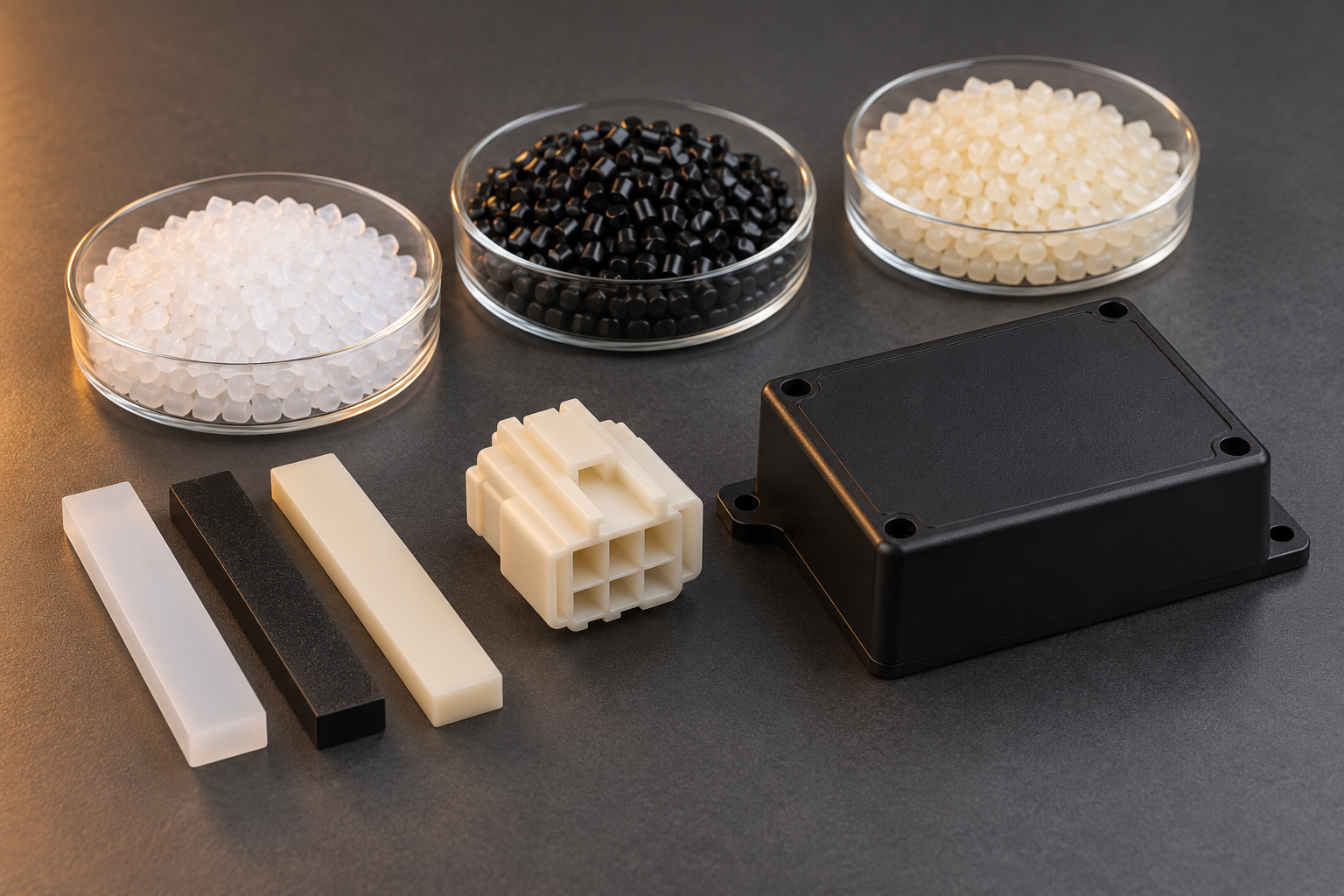
A plastic enclosure, cable jacket and structural panel can all be described as “fire resistant”, yet that description may refer to different tests. The useful question is what the material must do when exposed to the conditions relevant to your product.
This guide explains the difference between melting and burning, why resin names alone are not enough, and how to turn a broad request for a non-flammable plastic into a material specification you can actually check.
Does Plastic Burn or Melt?
Plastic can do both. Melting is a physical change: the material loses its solid shape. Burning is a chemical reaction that releases heat. A softened or melted part has not necessarily ignited, while a burning part may also melt and drip.
For many thermoplastics, heating leads to softening or melting, followed by thermal decomposition. Decomposition can release combustible gases, which may ignite when the surrounding conditions allow it. Crosslinked thermosets do not normally melt into a reusable liquid; they may instead decompose and form char. NIST-hosted polymer flame-retardant chemistry material illustrates this distinction.
That is why “does plastic burn or melt?” is not an either-or question. A part can lose its geometry before flames appear. Stopping a flame and keeping a component dimensionally stable are separate design objectives.
Consider a connector housing. Its material may meet the required flammability classification, but the connector still needs suitable heat resistance and mechanical performance. A fire rating alone does not tell you whether a latch stays engaged or a housing retains its shape during normal service.
When reviewing a data sheet, keep the thermal properties and the flammability result in separate rows of your comparison. Do not treat a high melting temperature, heat-deflection temperature or continuous-use temperature as a substitute for a combustion test.
Which Plastics Burn More Readily?
The polymer family is a starting point, not the final answer. Ensinger identifies common unmodified plastics such as PE, PP, POM, PA and PET as readily flammable, while describing several high-performance polymers, including PPS and PEEK, as inherently self-extinguishing. It also notes that modification can improve the flame behaviour of materials such as polyamide and polycarbonate. See its flame-resistant plastics overview.
Those broad differences help build a shortlist. They do not assign one permanent fire rating to every grade bearing the same resin name.
| Material family or form | Useful selection question | What the name cannot prove |
|---|---|---|
| PE and PP | Is this a standard grade or a documented flame-retardant formulation? | A resin name does not establish the required fire classification. |
| PA, POM and PET | Which exact formulation and test result are being offered? | Engineering performance does not automatically establish fire performance. |
| PC and PC blends | Does the record identify the grade, colour and relevant thickness? | A result for one PC grade is not a result for every PC blend. |
| PPS, PEEK and other inherently resistant polymers | Does the specific grade meet both the fire requirement and the other design needs? | Inherent resistance is not universal non-combustibility or application approval. |
| Flame-retardant modified grades | What evidence supports the complete formulation being supplied? | “FR” on a quotation does not identify a test or acceptance criterion. |
Use this table to decide which documents to request, rather than to predict a pass or fail. If you are keeping a familiar base resin and considering modification, our overview of flame retardant additives for plastics explains the supply route. Choose the target requirement before comparing additive systems.
What Does “Non-Flammable Plastic” Actually Mean?
“Non-flammable plastics” is a common search phrase, but an unqualified label gives too little information for material selection. Ask the supplier to translate it into a named test, a result and the conditions covered.
- Flame-retardant modified: the formulation has been designed to improve a specified aspect of burning behaviour.
- Self-extinguishing: flaming stops after the ignition source is removed under the stated conditions.
- Inherently flame resistant: the polymer structure contributes to resistance, rather than that behaviour depending entirely on added retardants.
- Non-combustible: a separate claim that needs the applicable non-combustibility evidence. Do not infer it from a self-extinguishing result.
Even polymers with inherent resistance, and formulations containing flame retardants, can burn under sufficiently severe thermal exposure. NIST’s discussion of fire and combustible materials explains why composition and exposure conditions matter.
A useful enquiry is therefore “Does this grade meet the specified classification at the relevant thickness?” rather than “Is this plastic impossible to burn?” The first question can be answered with evidence. The second asks for an unlimited guarantee that a material rating cannot provide.
Likewise, do not accept “fire resistant plastic” as a complete purchase description. Keep the term as a convenient heading, then write the actual requirement underneath it. This helps the designer, purchaser and supplier discuss the same performance target.
What a Fire Rating Can—and Cannot—Tell You
UL 94 is widely used to classify the flammability of plastic materials for parts in devices and appliances. It evaluates specimens under defined test conditions; it is not a promise about every possible fire.
The HB classification concerns horizontal burning behaviour. V-0, V-1 and V-2 belong to a vertical test with criteria covering afterflame behaviour and other observations. The classifications also distinguish whether flaming particles ignite the cotton indicator: that ignition is not permitted for V-0 or V-1, but is permitted for V-2. This is more precise than saying that V-0 plastic “never drips”. UL Solutions explains the combustion tests and classifications.
For the detailed differences, read our UL94 V-0, V-1 and V-2 guide. Here, the essential selection point is to compare results obtained within the relevant test and specimen conditions.
A V-0 result does not by itself establish heat release, smoke generation, combustion-product hazards or an hourly fire-resistance rating. The published UL 94 scope and limitations distinguish these properties from its small-scale flammability assessment.
A building panel, cable system or transport interior may therefore need evidence beyond a material’s UL 94 classification. Establish the applicable product requirements before deciding which reports are sufficient. Avoid choosing a familiar rating simply because it appears on more supplier brochures.
Scale matters too. NIST research on ignitability and fire growth examines material behaviour across different configurations and scales. For procurement, this reinforces a practical distinction: a material screening result and an assessment of the finished product answer different questions.
Check the Grade, Thickness and Colour Together
The most useful document is one that clearly identifies the material you plan to use. A broad statement such as “our nylon is V-0” leaves the actual supply specification unresolved.
UL recognition records distinguish material designations, colours and thickness-related information. UL’s plastics recognition webinar series covers these dimensions of recognition. Its colour codes and abbreviations reference helps interpret entries such as colour coverage and minimum thickness.
Hypothetical example: you are comparing two materials for a thin-wall enclosure. One supplier sends a V-0 claim with no supporting record. Another provides a record for a named grade, but the thickness shown is greater than your intended wall thickness.
Neither quotation yet answers the full question. The first needs supporting evidence. The second needs confirmation that the proposed application is covered, or appropriate evaluation where it is not. This example does not predict that either material will fail; it shows why the purchasing decision is still incomplete.
Do the same check for the intended colour. Do not assume that a natural-colour result automatically covers a separate colouring operation. Read the stated coverage and ask how the finished formulation relates to the recognised or tested material.
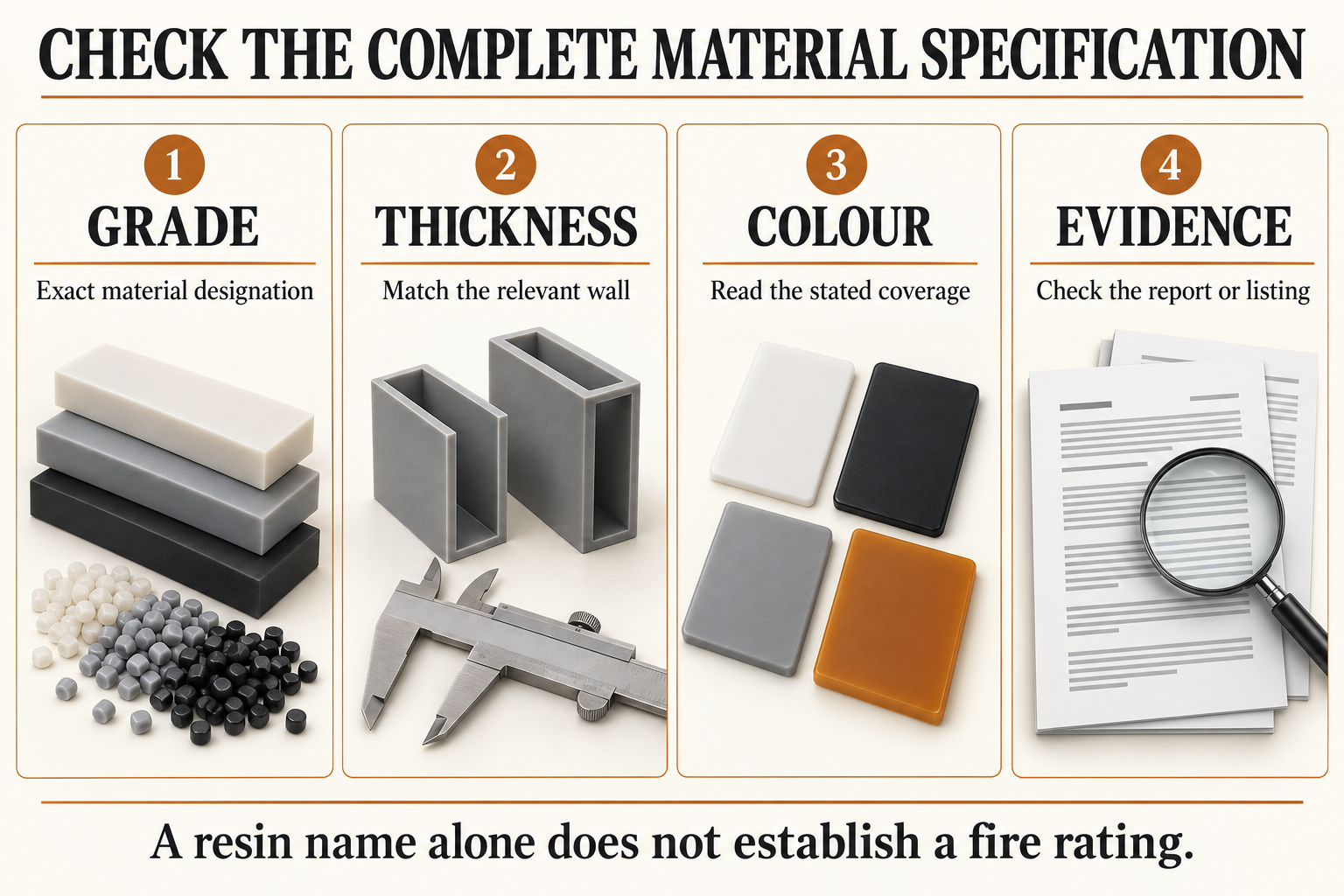
Our guide to the UL Yellow Card for flame-retardant materials explains the document checks in more detail. UL’s own Yellow Card reading guide is the primary reference for interpreting the recognition record.
Also distinguish a laboratory test report from a recognition listing. A report records the tested sample and result. If a recognised material is required, establish that recognition separately. Keep the document type visible in your comparison sheet so a seller’s “tested” statement is not mistaken for the different evidence your project requires.
How to Choose Fire-Rated Plastics
1. Write the application requirement first
Start with the part and the requirement it must meet. Record the specified test, target classification, thinnest relevant wall, intended colour and any separate product evaluation. Ask the product designer or certification contact to resolve an unclear requirement before you request material quotations.
This makes supplier replies comparable. Otherwise, one quotation may describe pellets, another a moulded specimen and another an end-product approval, while all three use the same short phrase “fire rated”.
2. Keep the other material needs in the specification
List the mechanical, thermal, electrical and appearance requirements alongside flammability. Include processing method and any material restrictions specified by the customer. A replacement still has to work as the part you are making.
Make these requirements explicit rather than asking for the “best” fire-resistant resin. For example, record whether transparency, impact performance or a particular moulding process is essential. Suppliers can then explain compromises instead of recommending a grade based on its fire classification alone.
3. Choose the supply form that fits your process
| Your starting position | Possible route | What to establish before ordering |
|---|---|---|
| An existing grade already has suitable evidence | Retain the documented grade | Application coverage and supply identity; modification may be unnecessary. |
| You develop and compound your own formulation | An additive system | Compatibility, formulation ownership and validation of the finished compound. |
| You need a concentrate for a controlled blending process | A masterbatch | Carrier compatibility, recommended blending conditions and final-material testing. |
| You want a prepared material for moulding or extrusion | A finished compound | Exact grade, processing guidance and supporting fire-performance documents. |
| The application requires additional fire properties | An application-specific evaluation | The additional tests before treating a material classification as sufficient. |
Compare flame retardant additives if you will develop the formulation. Consider a flame retardant masterbatch when a concentrate fits your blending process, or a flame retardant compound when you need a prepared grade.
The fire rating belongs to the evaluated material, not automatically to any mixture containing a particular additive or concentrate. Ask who will validate the final formulation and what sample or production conditions that evaluation will cover.
4. Compare evidence before comparing price
Request the grade-specific technical data sheet, relevant fire-test evidence and processing information. If recognition is required, verify the listing. Ask the supplier to identify any gap between the offered material and your requested specification in writing.
For samples, agree on what you are trying to establish. A moulding trial may answer a processing question without completing the fire-performance evaluation. Keep both actions in the approval plan and record who is responsible for each.
Once these points are settled, the guide to choosing flame retardants for plastics takes the next step into system selection. Rectivas Materials can help coordinate sourcing, samples and supporting documents with partner factories.
Frequently Asked Questions
Can plastic melt without burning?
Yes. A thermoplastic can soften or melt before any sustained flaming occurs. Melting describes loss of solid shape; burning involves a chemical reaction. If heating continues, decomposition and ignition may follow, depending on the material and exposure. For a component, review dimensional and thermal requirements separately from flammability, because a part can become unusable without visibly burning.
Is self-extinguishing plastic non-flammable?
Not necessarily. Self-extinguishing describes what happens after the ignition source is removed under particular test conditions. It does not prove that the material cannot ignite or continue burning under a different exposure. When a supplier uses the term, request the corresponding test and conditions, then decide whether that evidence addresses the intended application rather than relying on the adjective alone.
Does UL 94 V-0 mean the plastic is fireproof?
No. V-0 is a classification within a defined small-scale vertical flammability test. It is not a universal fireproof designation, nor does it alone establish smoke performance or an hourly fire-resistance rating. Treat the result as one item in the material specification. The product still needs the other properties and any separate evaluation required for its intended use.
Are all grades of the same resin equally flammable?
No. A resin family can include different formulations and grades, so a result for one product does not establish the performance of another. Use the exact material designation when asking for documents or quotations. In your comparison sheet, keep that designation attached to the reported classification and its conditions; a shortened entry such as “nylon V-0” removes information you need.
Do I always need a flame-retardant additive?
No. First establish the requirement and check whether the existing grade already has suitable evidence. A different documented grade may also be an option. Additives become relevant when you are developing or modifying a formulation, but their use still requires evaluation of the finished material. Buying a retardant before defining the target can create unnecessary formulation work and an unclear approval process.
What documents should I request for fire-rated plastic?
Request a grade-specific technical data sheet and the relevant test report or recognition record, depending on the project requirement. Check that the material identity and reported conditions match the offer. Ask for processing guidance and clarification of any uncovered requirement. Keep the document revision and supplier confirmation with your approval record so the basis for choosing the material remains traceable.
Can I change the colour without checking the rating?
Check the documented colour coverage before making the change. A recognised or tested grade may have defined colour conditions, and a separate colouring operation needs to be assessed against them. Ask the supplier to confirm the intended finished formulation. Keep the colour designation on the purchase specification so the approved material and the material delivered for production can be compared directly.
Should I buy additives, masterbatch or finished compound?
Choose according to who will formulate the material and validate its performance. Additives suit formulation development; masterbatch is a concentrate for an agreed blending process; finished compound supplies a prepared grade for processing. Compare these routes against your equipment, staff and approval responsibilities. Whichever form you choose, establish the evidence needed for the final material rather than assuming the supply form guarantees a rating.
Final Thoughts
Plastic can melt, burn or self-extinguish, depending on the material and exposure. Choosing fire-rated plastics means replacing a broad label with a verifiable specification: exact grade, relevant test, thickness, colour and application requirements. Start by checking the material you already use. If a new formulation is needed, compare the appropriate additive, masterbatch or compound route and agree how its final performance will be validated.
— Rectivas Materials technical content team