Quick answer: With rigid PVC you are usually not buying flammability performance at all — roughly 57% chlorine in the backbone already gives it an LOI near 45 and self-extinguishing behaviour. What you are actually buying is smoke suppression and antimony reduction, which is a different product conversation and a different price. If you are still deciding between PVC and LSZH rather than formulating PVC, start with LSZH vs PVC cable jackets instead — this page assumes PVC is already the choice.
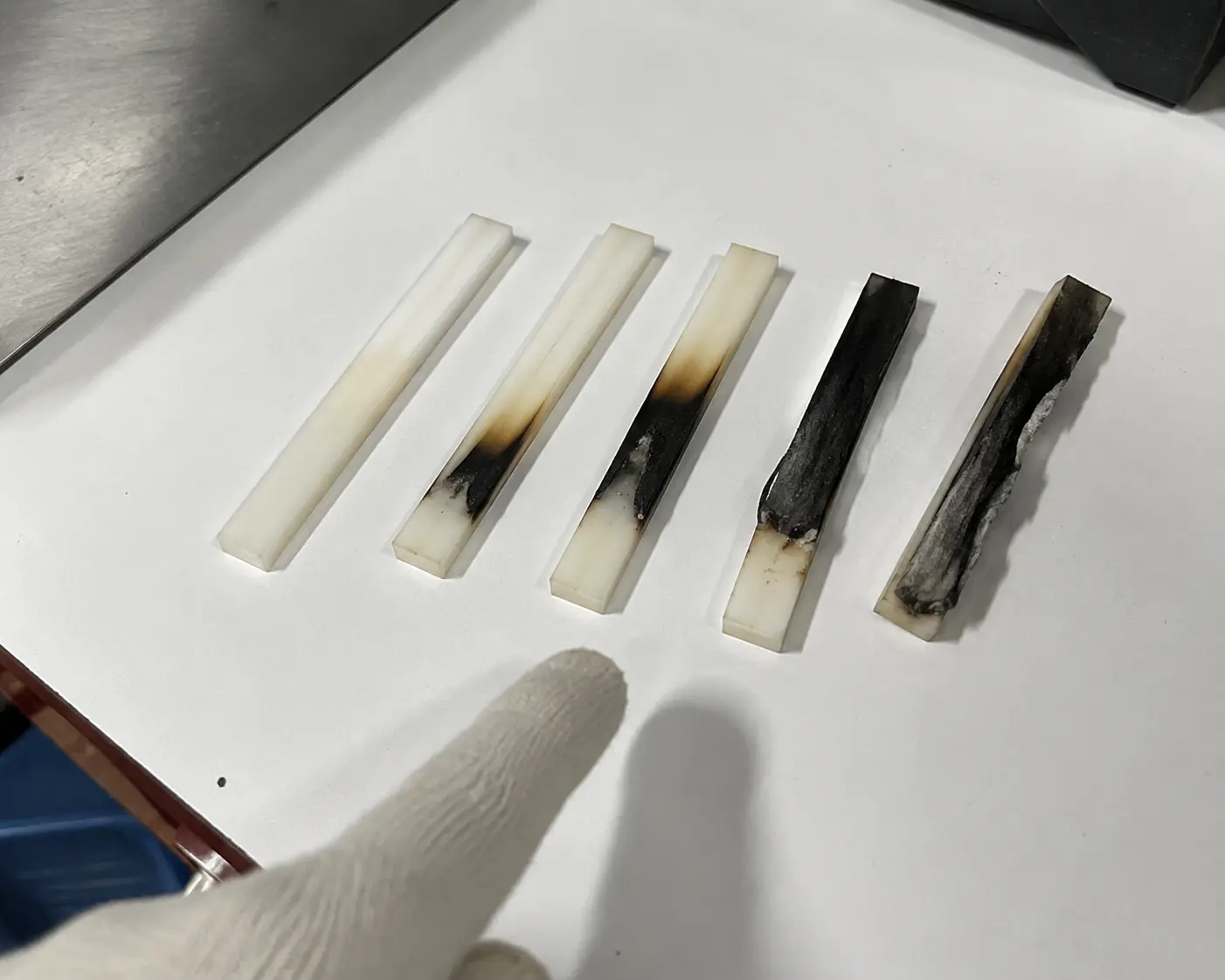
PVC is a paradox in fire safety. Ask any formulator: “PVC is flame retardant” and “PVC cable failed the flame test” are both true statements, and buyers get caught between them constantly. The resolution is one word — plasticizer — and once you see it, every PVC fire spec makes sense.
Why flexible PVC loses its built-in flame retardancy
Unplasticized PVC is one of the most fire-safe commodity polymers made: the chlorine on every repeat unit releases HCl in a flame, which quenches the radical chain reaction — the same gas-phase mechanism brominated additives are paid to deliver. Rigid pipe and profile pass most flame tests with nothing added.
Then we make it flexible. A typical cable jacket carries 30–40 phr of plasticizer — and general-purpose phthalates like DOP/DOTP are, chemically, just combustible esters. At those loadings roughly a quarter of the compound is fuel. LOI collapses from ~45 to the low twenties, and the material burns and drips like the commodity it now resembles. Every flame retardant decision in flexible PVC is a fight against the plasticizer.
The flexible PVC toolkit: what each additive actually does
| Additive | Role | Typical dose | Notes |
|---|---|---|---|
| Antimony trioxide (Sb₂O₃) | Synergist — reactivates PVC’s own chlorine | 3–8 phr | Biggest single LOI lever; price-volatile since 2024 |
| Zinc borate | Smoke suppression + char promotion | 2–8 phr | Can replace a large share of the antimony — see below |
| ATH / MDH mineral fillers | Heat sink, dilution, smoke reduction | 20–60 phr | Cheap LOI points; watch flexibility and viscosity |
| Phosphate ester plasticizer | Plasticizes without adding fuel | Partial DOP/DOTP swap | Attacks the root cause; costs more per phr |
The craft is in the combination. A well-balanced Sb₂O₃ / zinc borate / MDH package can push a flexible compound past LOI 36 — genuinely hard-to-ignite cable territory — while a lazy single-additive fix either fails smoke or wrecks the hand of the compound. If the deeper antimony mechanism interests you, we broke it down in our antimony trioxide flame retardant guide.
Flame retardant PVC cable: LOI targets and the smoke problem
Cable is the biggest flexible-PVC fire application, and it has two exams. The first is flame spread — IEC 60332-1 on single cables, the bundled tray tests above it — and the working rule is that compounds below LOI ~26 struggle while LOI 30+ passes with margin. That is why “LOI 30” appears in so many cable compound specs; our own PVC flame retardant systems for cable are built around that floor.
The second exam is smoke, and it is where PVC pays for its chlorine. Burning PVC produces dense smoke and acidic HCl gas — the things that kill visibility and corrode electronics in a fire. Smoke suppressants (zinc borate, molybdenum compounds, MDH) are therefore not optional garnish in a cable compound; in enclosed-space projects they are the difference between winning and losing the spec. And when the spec says low-smoke zero-halogen, PVC is disqualified entirely — that job moves to polyolefin LSZH chemistry, covered on our flame retardant cable compounds page. Knowing which side of that line your project sits on is the first question to settle.
Sheet and tape: same fight, different pass marks
Flame retardant PVC sheet — construction membranes, wall panels, thermoformed trays — runs the same chemistry at lower plasticizer loadings. The wrinkle is that building products answer to construction fire codes (surface burning characteristics, not UL94 bars), so the formulation is tuned for flame-spread index and smoke density rather than a vertical bar test. Say which code governs your market when you inquire; it changes the target.
Flame retardant PVC tape — electrical insulation tape — is the thin-wall extreme: a ~0.13–0.18 mm film that must self-extinguish instantly to earn its place wrapping electrical joints. At that thickness there is no room for high mineral loads, so tape grades lean on antimony efficiency and flame-retardant plasticizer choice. It is a neat proof that “PVC + the right package” scales from a 3 mm jacket down to a film thinner than paper.
2026 trend: formulating antimony-lean
The antimony price shock of 2024–2025 (China export controls, prices nearly 4x at the peak) plus ECHA’s SVHC scrutiny changed PVC formulation priorities. The good news for PVC specifically: zinc borate is a proven partial substitute — industry data supports replacing antimony trioxide with zinc borate at up to ~75% of the load while holding flame performance, with better smoke numbers as a bonus. Antimony-lean PVC packages went from cost-optimization exercise to standard request within a year, and it is now the first alternative we quote alongside any conventional package. If a full halogen exit is on your roadmap instead, start with the trade-off logic in halogen-free vs halogenated flame retardants.
How Rectivas runs a flexible PVC project
Send us three numbers and a document: the plasticizer type and phr, the LOI or flame-test target, the smoke requirement, and the spec sheet it all comes from. We formulate the package — conventional, antimony-lean or smoke-priority — as a powder blend or as pellet concentrate via our flame retardant masterbatch for PVC, run the LOI ladder and burn tests in-house, and ship the passing sample with an accredited third-party laboratory third-party paperwork. A recent cable-plant case: a customer’s 90 °C jacket compound sat at LOI 27 and kept failing a bundled-tray spec; rebalancing to an Sb₂O₃/zinc borate/MDH package took it to LOI 33 with visibly lighter smoke — same extruder settings, two phr cheaper than their old formula at post-shock antimony prices.
Request a quote with your compound details and target spec — we will propose the package and prove it in the burn chamber before you commit. For how PVC cable sits alongside LSZH and the other cable families, see our flame retardant for wire and cable overview.
FAQ
Is PVC naturally flame retardant?
Rigid PVC, yes — its chlorine content gives it an LOI around 45 and it self-extinguishes. Flexible PVC, no: the plasticizer that softens it is combustible, dropping LOI to 21–23. Cable, sheet and tape are all flexible PVC, which is why they need flame retardant packages despite “PVC being flame retardant.”
What LOI does a flame retardant PVC cable compound need?
LOI 30+ is the common spec floor for flame retardant cable duty; well-formulated Sb₂O₃/zinc borate/mineral packages reach 33–36. Below LOI ~26, compounds struggle with IEC 60332 flame-spread tests, especially bundled configurations.
Can zinc borate replace antimony trioxide in PVC?
Partially, yes — industry data supports substituting up to ~75% of the antimony trioxide with zinc borate while maintaining flame performance, usually with improved smoke suppression. A full 100% swap typically costs LOI, so most antimony-lean packages keep a reduced Sb₂O₃ core.
Is flame retardant PVC the same as LSZH?
No — they are opposites on the halogen axis. Flame retardant PVC uses chlorine chemistry and emits HCl and dense smoke when burned. LSZH (low smoke zero halogen) compounds are halogen-free polyolefins for enclosed spaces where smoke and acid gas are unacceptable. If the spec says LSZH, PVC cannot bid.
Why does PVC tape self-extinguish so quickly?
Electrical tape grades combine PVC’s chlorine, an antimony synergist and flame-retardant plasticizer selection in a film only ~0.15 mm thick — there is minimal fuel mass, and the package is tuned for instant self-extinguishment since the tape sits directly on electrical joints.
An LOI around 45 is an unusual luxury, and it changes what the additive package is even for. Where PVC sits relative to every other resin, and why the number can mislead in both directions, is covered in limiting oxygen index.
Final Thoughts
With rigid PVC you are rarely buying flammability performance – the chlorine already provides it. You are buying smoke suppression and antimony reduction, which is a different product conversation and a different price. Zinc borate covers most lean-antimony packages and zinc stannate removes antimony entirely. Tell us your current formulation and target smoke clause and we will work out the replacement ratio.
Antimony reduction is a recurring theme in PVC work specifically, because the chlorine is already doing the flame retardant job. The substitution routes and starting ratios are set out in cutting or replacing antimony trioxide.
Flexible PVC and rigid PVC are different formulation problems — the plasticiser is what burns here, while rigid grades self-extinguish on their own chlorine and need smoke work instead. The rigid side is covered in fire retardant PVC compounds.
—— Rectivas Materials 团队 技术工程师老陈