Quick answer: Thin walls are harder to flame retard, not easier. A formulation certified V-0 at 1.6 mm can drop to V-1 or V-2 at 0.8 mm with no other change, because a thin section has less thermal mass to absorb heat, less material to form a protective char, and a higher surface-to-volume ratio feeding the flame. Every UL94 rating is tied to a specific thickness for exactly this reason. Going thinner usually means raising loading, switching to a more efficient chemistry, or both — while simultaneously needing better flow to fill the part.
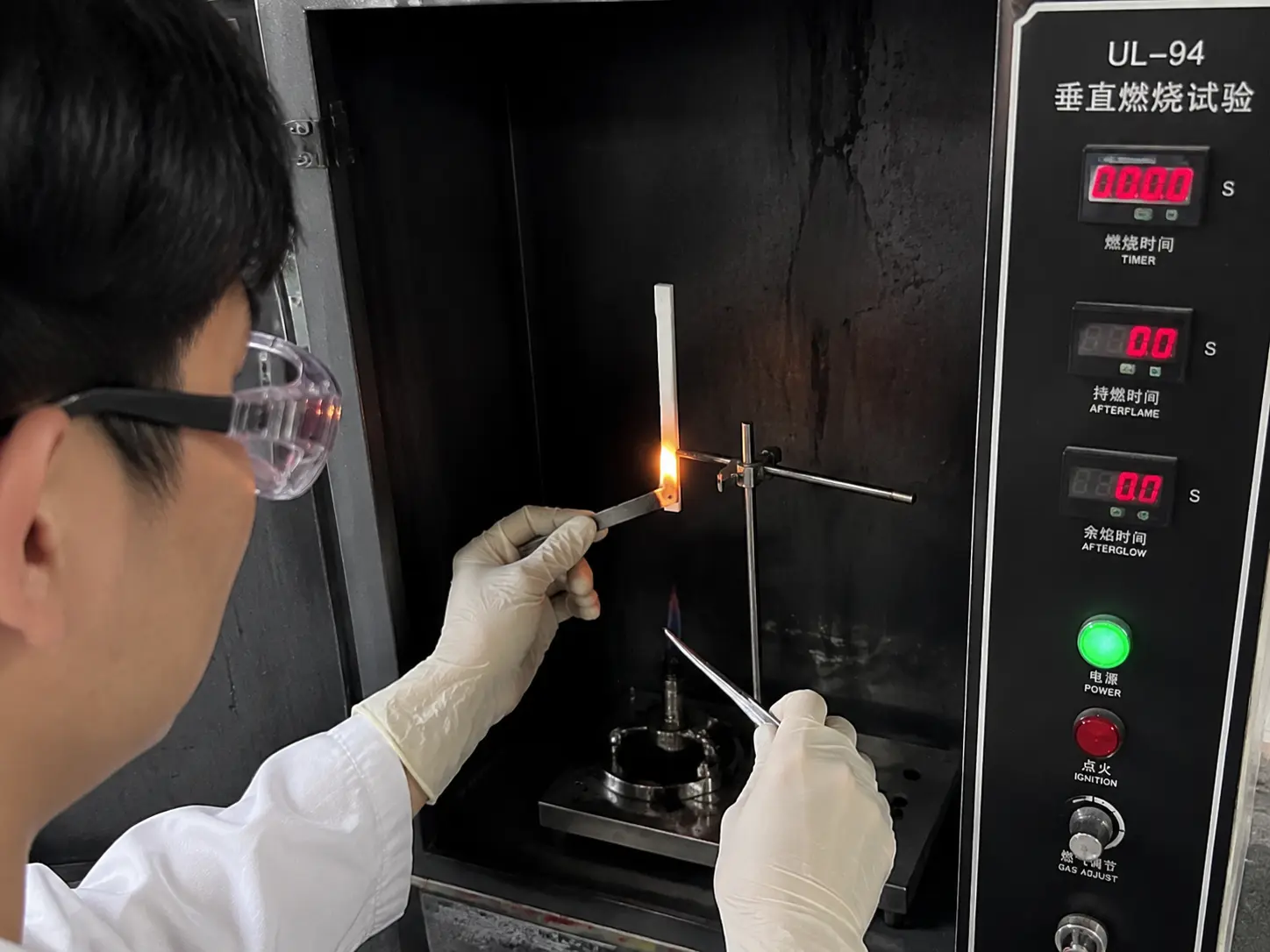
We repeat one warning across nearly every resin guide on this site: a UL94 rating is meaningless without its thickness. It earns the repetition because it is the single most common spec-reading error in this industry — a buyer sees “V-0” on a datasheet, designs a 0.8 mm wall, and discovers at certification that the rating was earned at 3.0 mm. This article explains why thickness matters so much physically, and what to do when the part has to get thinner anyway.
The Physics of a Thin Section
Q: Why is it harder to achieve V-0 in thin walls? Three effects work against you at once, and all of them get worse as thickness falls.
- Less thermal mass. A thick specimen absorbs heat into its bulk, so the surface stays cooler and pyrolysis is slower. A thin one heats through almost immediately — there is nowhere for the energy to go.
- Less material to build char. Condensed-phase systems work by converting surface polymer into a protective char layer. That layer needs material to form from. In a 0.5 mm wall, a char layer of any useful thickness consumes a large fraction of the wall itself.
- Higher surface-to-volume ratio. More surface per unit of material means more area exposed to flame and more efficient release of pyrolysis gases into it.
There is a fourth effect specific to the vertical test: thin specimens lose rigidity quickly when hot, so they sag, curl or drip earlier — and V-0 forbids flaming drips. Anti-drip additives become more important as walls get thinner, not less.
Why Ratings Are Thickness-Specific
UL94 certification records the thinnest thickness at which a material achieved a rating, and the rating applies at that thickness and above — never below. A material rated V-0 at 1.5 mm is considered V-0 at 2.0 mm and 3.0 mm; it says nothing about 1.0 mm.
Two practical consequences that cost real money when missed:
- Reading a datasheet in the wrong direction. “V-0 (3.0 mm)” is a weak claim, not a strong one. The impressive figure is a small number, not a large one — V-0 at 0.4 mm is a far more capable material than V-0 at 3.0 mm.
- The thin section is what governs. Your part’s rating is determined by its thinnest rated wall, not its average. A housing that is mostly 2 mm with a 0.9 mm louvre section must be qualified at 0.9 mm.
How UL94 sits alongside the other tests, and what the ladder from HB through V-2 to 5VA actually measures, is covered in our overview of flame retardant test methods.
Loading Does Not Scale Linearly
| Wall thickness | Difficulty for V-0 | What typically changes |
|---|---|---|
| 3.0 mm | Straightforward | Most systems reach it at modest loading |
| 1.6 mm (the common benchmark) | Standard target | The thickness most datasheets quote |
| 0.8 mm | Demanding | Higher loading; anti-drip becomes essential; chemistry choice narrows |
| 0.4 mm | Specialist | Only the most efficient systems; engineering polymers territory |
The relationship is not proportional. Halving the wall does not mean doubling the additive — sometimes a modest increase suffices, and sometimes no achievable loading gets there because the chemistry itself has hit its limit. When that happens, adding more is not the answer; changing mechanism is. Phosphinate salts paired with melamine polyphosphate are the standard route to V-0 at 0.4–0.8 mm in glass-filled polyamide and PBT, which is why that combination dominates connectors — see our pages on aluminium diethylphosphinate and melamine polyphosphate.
The Contradiction at the Heart of Thin-Wall Design
Q: Why is thin-wall moulding of flame retardant compounds so difficult? Because the two requirements pull in opposite directions.
Thin walls demand high melt flow to fill before freezing. Flame retardancy demands high additive loading, which raises viscosity and reduces flow. Add glass fibre for stiffness — common in exactly the connectors and housings that are being thinned — and the conflict tightens further, since fibres both raise viscosity and bring the candlewick effect described in our article on glass-filled plastics.
Practical responses, in the order we usually try them:
- Start from a higher-flow base resin than the unfilled equivalent would need. This is the cheapest lever and it is often overlooked.
- Choose efficient chemistry so the loading required is lower. At thin walls, additive efficiency buys flow as well as flame performance — the mechanisms are compared in our guide on flame retardant mechanisms.
- Fix the gating and venting. Thin-wall filling is as much a tooling problem as a material one; more gates and shorter flow lengths solve problems that no formulation can.
- Question the wall thickness. Occasionally the honest answer is that 0.6 mm was chosen for weight or cost without anyone checking whether the fire requirement was achievable there. Finding that out during design is far cheaper than during certification.
What to Specify When You Ask for a Thin-Wall Grade
Three numbers turn a vague request into a solvable problem: the thinnest wall that must carry the rating (not the average wall), the flow length to fill, and the full test stack — because at thin walls the glow-wire and tracking requirements that often accompany UL94 get harder in parallel, and optimising for the burn test alone tends to break something else.
Send us those three along with the resin and we will tell you what is achievable, including when we think it is not — a thin-wall enquiry where the honest answer is “not at that thickness with this polymer” is better delivered at quotation than after tooling. Send the specification and we will burn-test at your actual thickness before quoting a loading. The thickness rule also governs how a UL listing reads — see UL Yellow Card explained.
FAQ
Does V-0 at 1.6 mm mean my 0.8 mm part is V-0?
No. Ratings apply at the certified thickness and above, never below. A 0.8 mm section needs its own qualification, and a formulation that passes at 1.6 mm frequently does not pass at half that.
Is a material rated V-0 at 3.0 mm better than one rated V-0 at 1.5 mm?
The opposite. The smaller the thickness on the certificate, the more capable the material. Reading these numbers backwards is one of the most common errors in flame retardant procurement.
Can I just add more flame retardant to pass at a thinner wall?
Sometimes, up to a point. Beyond it, more additive wrecks flow and mechanicals without buying the rating, because the chemistry has reached its efficiency limit. At that stage the answer is a different mechanism, not a larger dose.
Why do connector makers care so much about 0.4 mm?
Miniaturisation. Electronic connectors keep shrinking while retaining their electrical and fire requirements, so wall sections that were 1 mm a decade ago are now a fraction of that. This is the pressure that made phosphinate-plus-MPP packages in glass-filled polyamide the industry standard for the application.
Wall thickness is only one of the constraints a modern connector carries. Tracking resistance and glow wire ignition apply to the same 0.4 mm section at the same time, and flame retardant for electronics covers how those three pull against each other.
Thickness sensitivity applies to oxygen index too, which is why a value measured on a thick bar tells you little about a thin wall. That comparison discipline, along with the other three questions worth asking about a quoted figure, is in limiting oxygen index.
Final Thoughts
Thin wall is where flame retardant chemistry runs out of room, and no amount of extra dosing fixes it past a point – flow and mechanicals collapse first. Rate at the wall you actually mould, never at the datasheet default. PC deserves a separate note here, because its limit at thin wall is dripping rather than ignition — see flame retardant polycarbonate at thin wall. For connectors and thin sections our phosphinate packages are the practical route; send the real thickness and we will pre-screen at it rather than at 1.6 mm.
—— Rectivas Materials 团队 老陈