Quick answer: There is no conversion table between flame retardant standards, and anyone who hands you one is selling you a liability. UL94, ASTM E84, EN 13501-1, GB 8624, FMVSS 302 and EN 45545-2 measure different physical quantities on different specimen geometries for different regulators. The question to answer is not “what is V-0 in European terms” but “which market, which product category, which clause” — and then test against that.
We get asked for the conversion table most weeks. This article is the honest version of that answer: a map of what each standard governs, why the mappings do not exist, and the four places we watch buyers lose money on the assumption that they do.
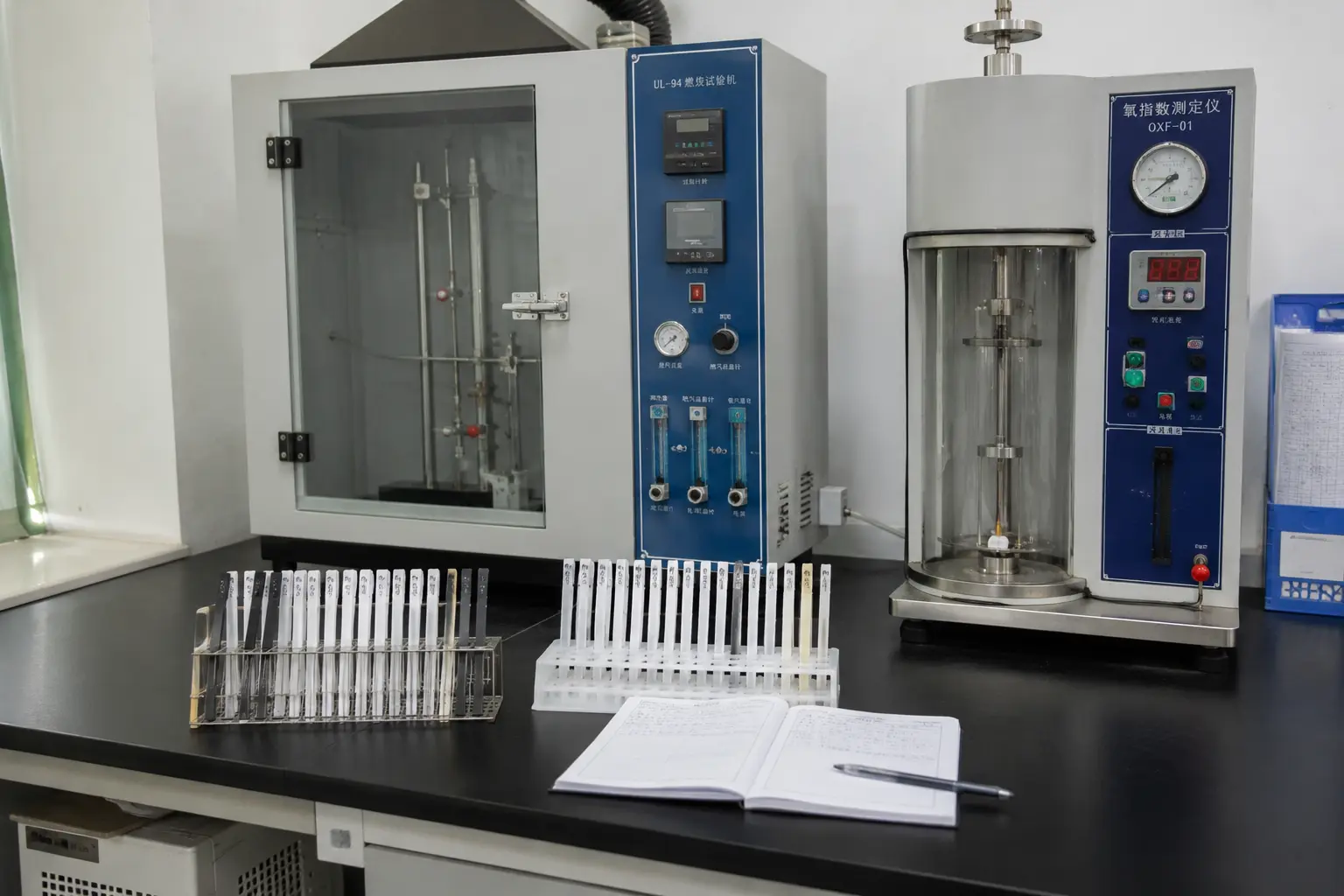
The Map, Organised by What You Make
Buyers look for standards by product category, not by country, so that is how this is arranged. The right-hand column is where we go deeper on each.
| Product | Standard | What It Measures | Classes |
|---|---|---|---|
| Plastic parts (global baseline) | UL 94 / IEC 60695-11-10 | Self-extinguishing behaviour of a small bar after a small flame is removed | HB, V-2, V-1, V-0, 5VB, 5VA, VTM |
| GB/T 2408 | China’s method for the same horizontal and vertical burning behaviour | Aligned in method with IEC 60695-11-10 | |
| Electrical & electronic parts | IEC 60695-2-13 (GWIT) IEC 60695-2-12 (GWFI) IEC 60112 (CTI) | Ignition by a sustained hot element; resistance to conductive surface tracking. Neither is a flame test | GWIT ≥ 775 °C · GWFI > 850 °C · CTI PLC 0–5 |
| Building materials | ASTM E84 (Steiner tunnel) | Flame spread along a 25-foot tunnel ceiling, plus smoke | Class A: FSI 0–25, SDI ≤ 450 |
| EN 13501-1 | Reaction to fire, with separate smoke and droplet ratings | A1, A2, B, C, D, E, F + s1–s3 + d0–d2 | |
| GB 8624-2012 | China’s burning behaviour classification for construction products | A, B1, B2, B3 — four classes, not seven | |
| Wire & cable | IEC 60332-1/-3, 61034, 60754, 60331 | Flame propagation, smoke density, acid gas, circuit integrity — four separate tests | Pass/fail per clause |
| CPR (EU) · NEC (US) | Regional listing regimes built on top of those tests | Euroclass B2ca–Fca · CMP/CMR/OFNP via NFPA 262, UL 1666 | |
| Automotive | FMVSS 302 / ISO 3795 | Horizontal flame spread rate in an interior specimen | ≤ 102 mm/min — a low bar |
| Rail | EN 45545-2 | Requirement sets by component and vehicle operation type | HL1–HL3; HL3 requires LOI > 32 |
| Development metric | ASTM D2863 / ISO 4589-2 / GB/T 2406 | Minimum oxygen % that sustains burning — a comparator, not a fire scenario | A number, not a class |
| Composition | IEC 61249-2-21 | Defines “halogen-free” — not a fire test at all | Br ≤ 900, Cl ≤ 900, total ≤ 1500 ppm |
Why There Is No Conversion Table
Three structural reasons, and none of them is going to be fixed by a better lookup table.
They measure different physical quantities. UL94 measures seconds of afterflame. ASTM E84 measures how far and fast flame travels along a ceiling. LOI measures an oxygen concentration. GWIT measures a temperature. CTI measures a voltage. There is no unit conversion between seconds, millimetres per minute, percent oxygen, degrees Celsius and volts, because they are not describing the same phenomenon.
They use incompatible specimen geometry and ignition sources. A 127 mm bar with a small burner behaves nothing like a 25-foot tunnel lined with the material, which behaves nothing like a bundle of cables in a vertical tray. Scale changes fire behaviour qualitatively, not proportionally — which is exactly why large-scale tests were created instead of extrapolating from small ones.
They answer to different regulators with different aims. UL94 exists to let a component be recognised for use inside a device. EN 13501 exists so a building official can approve a wall. FMVSS 302 exists so a vehicle can be sold. A rating earned for one purpose has no standing in another’s file, however similar the physics looks.
Test Method Versus Performance Class
A distinction that clears up a lot of confusion once you have it: most of the documents above are test methods, and the required class comes from somewhere else entirely.
ASTM E84 does not define Class A — the building code does, using E84 results. ASTM D2863 does not require LOI 32 — EN 45545-2 does, using D2863 to measure it. IEC 60695-11-10 does not require V-0 — your customer’s specification does.
So when someone asks “is our material compliant?”, the answer needs two halves: which method was used, and which class the governing document demands. A test report alone is capability data. It becomes compliance only against a named clause — the same distinction that separates a test report from a recognised listing on a UL Yellow Card.
The Second Half of Every Class
Here is a pattern that runs across all of these systems and catches people in every one of them: a fire class is almost never a single number, and the part everyone quotes is the easy half.
- ASTM E84 Class A needs a Flame Spread Index of 0–25 and a Smoke Developed Index of 450 or less. Two independent thresholds, both mandatory.
- EN 13501-1 ratings are written as three parts — B-s1,d0 — where the letter is reaction to fire, the s is smoke and the d is flaming droplets. Specifying “Class B” without the suffixes has not specified the requirement.
- Cable stacks four separate tests: propagation, smoke density, acid gas and sometimes circuit integrity. Passing one tells you nothing about the others.
- UL94 pairs afterflame time with a dripping condition — which is the whole difference between V-1 and V-2.
And there is a chemistry regularity behind this worth knowing before you pick a system. Halogenated packages tend to be efficient on the primary class and weak on the smoke half. We have seen halogenated panels post an E84 flame spread index of 15 — comfortably inside Class A — and then lose the rating on smoke alone. Mineral and phosphorus systems generally run the other way: more loading needed for the primary number, much easier on smoke and acid gas. That single trade-off explains most of why cable and rail specifications trend halogen-free while cost-driven enclosure work does not.
So when you read a supplier’s claim, find the second half. If it is missing, it is usually missing for a reason.
Find the Binding Constraint First
The practical method, and it is the opposite of how most projects start. Do not begin with UL94 because it is the standard you know. Begin by listing every requirement across your whole market footprint, translate each into a material property, and then find which single one is hardest.
In our experience the binding constraint is usually not the burn rating. For electronics it is normally tracking resistance or glow wire. For cable it is smoke or acid gas. For building products it is the smoke index. For rail it is the LOI floor plus smoke and toxicity. The burn rating is the requirement everyone remembers to ask about and rarely the one that decides the formulation — the same conclusion we reached in the multi-standard qualification article.
Design to the hardest constraint, verify the rest follow, and the remaining markets become test campaigns rather than development projects.
Four Ways This Goes Wrong
1. Offering UL94 V-0 against a building requirement. V-0 says a small bar self-extinguishes. A building official wants to know how flame travels across a wall of the stuff. These are not comparable, and a V-0 report will not satisfy an E84 Class A clause. Worse, halogenated systems that pass V-0 easily can fail E84 on the smoke index alone.
2. Assuming EN 13501 Class B equals GB 8624 B1. They look parallel and are not. EN 13501-1 has seven classes plus separate smoke and droplet suffixes; GB 8624-2012 has four. There is no official one-to-one correspondence, the test methods and thresholds differ, and no amount of similar naming makes a Chinese B1 certificate usable in a European file or the reverse. If you sell into both, you test in both.
3. Treating FMVSS 302 as proof of flame retardancy. At 102 mm/min the bar is low enough that many unmodified interior materials already pass. Passing it does not make a material flame retardant in the sense any other standard means, and it says nothing about a part that will also need V-0 for its electrical function.
4. Submitting an LOI value as certification data. LOI is the right tool for development and incoming inspection and the wrong one for a compliance file, unless a specification names it — which, in rail and in some Chinese and cable procurement, it genuinely does.
What This Costs in Practice
A case that shows the shape of the problem. A customer making LED driver housings for the EU, North America and China arrived with one report — UL94 V-0 at 1.5 mm — and the expectation that it covered all three markets. It covered none of them completely.
North America wanted the enclosure at 5VA rather than V-0, because an enclosure that burns through lets fire out. The EU route ran through IEC 62368-1, which referenced the equivalent burning test but also brought a glow wire requirement their report said nothing about. China needed its own certification with testing to Chinese methods, regardless of what the American report showed.
The useful part of that conversation was the conclusion, and it is the reason this article is not just bad news: they did not need three formulations. They needed one formulation and three test campaigns. A single halogen-free package covered 5VA at their wall thickness and cleared the glow wire requirement; what had to be repeated was the testing and the paperwork, not the development. They had been quoting themselves for three parallel material projects.
That distinction — between “not interchangeable” and “not achievable together” — is where most of the wasted money in this area sits.
What to Tell Your Supplier
An enquiry that says “we need a flame retardant, UL94 V-0” is missing what we need to be useful. What actually determines the answer:
- Destination markets — all of them, including the ones planned for next year
- Product category — component inside a device, enclosure, building product, cable, vehicle interior, rail interior
- The governing clause, quoted from the drawing or customer specification rather than paraphrased
- The rating with its thickness, and the colour it applies to
- Any secondary requirements — glow wire, tracking, smoke, acid gas, LOI floor
- Base resin and process
With those we can usually tell you whether one formulation covers your whole footprint, which is the question worth answering. For electronics specifically, the burn rating is rarely the binding constraint — see flame retardant for electronics. For construction products the fire class replaces UL94 entirely, which is set out in flame retardant building materials. And where several methods apply at once, the test methods overview covers how they interact.
FAQ
What is UL94 V-0 equivalent to in Europe?
In method, IEC 60695-11-10 is the international version of the same test, so a V-0 result maps onto it directly. What V-0 does not map onto is EN 13501-1 or any building fire class, because those are different tests on different specimens for a different regulator. Same test in another numbering system, yes; equivalence to a different standard family, no.
Is GB 8624 B1 the same as Euroclass B?
No. GB 8624-2012 uses four classes (A, B1, B2, B3) while EN 13501-1 uses seven plus smoke and droplet suffixes, and there is no official correspondence between them. The similar lettering is a coincidence of naming, not a mapping. Selling into both markets means testing in both.
Do I need to develop a different compound for each market?
Usually not. In most cases one well-designed formulation can satisfy several regimes at once, and what has to be duplicated is the testing and certification rather than the material. Work out the strictest requirement in your footprint first and design to that — then the other markets are paperwork.
Which standard is the strictest?
The question does not have an answer, because they are not on one scale. 5VA is harder than V-0 within UL94. E84 Class A is unrelated to either. For a specific part in specific markets there is usually one binding constraint, and identifying it is the first thing worth doing — but it is not a property of the standards, it is a property of your part.
Does a halogen-free material automatically meet more standards?
No, and the two questions are independent. Halogen-free is a composition limit defined by IEC 61249-2-21, not a fire performance class. A halogen-free compound can fail V-0 and a brominated one can pass; conversely halogen-free systems tend to do better on smoke and acid gas clauses, which is why cable and rail specifications lean that way.
Can you provide certification for our finished product?
No — and no additive supplier can. We supply the flame retardant layer with TDS, SDS, COA and third-party reports arranged through an accredited laboratory, and we pre-screen UL94 and LOI at our partner factory’s lab at your thickness. The listing or certification for your part belongs to your material and your device, and stays with you.
Final Thoughts
There is no conversion table, but there is usually one binding constraint – and finding it early turns several test campaigns into one development project. Work out the strictest requirement across your whole market footprint, design to that, and treat the rest as paperwork. Send us the clauses from each market with your resin and thickness, and we will tell you whether one formulation covers your footprint. Start from the additive systems organised by target standard.
—— Rectivas Materials 团队 阿丽