Quick answer: “Flame retardant” is not one substance — it covers dozens of unrelated chemicals whose safety profiles differ enormously. A few legacy ones (PBDEs, HBCD) were restricted internationally, mainly because they persist in the environment and accumulate in living organisms, not because they are acutely poisonous. Most flame retardants in commercial use today are far less concerning: mineral hydroxides are essentially inert, phosphorus and nitrogen systems have mild profiles, and modern brominated products are polymers too large to be absorbed. The useful question is never “are flame retardants toxic” but “which one, and by what route of exposure”.
I run quality and compliance at a company that manufactures and sells flame retardants, so you should read what follows with that in mind and verify it independently. I am writing it because the honest version of this answer is more useful to a buyer than either of the two versions usually on offer: the industry brochure that says everything is fine, and the alarmist article that treats a banned 1990s chemical as representative of a whole field.
Why the Question Cannot Be Answered as Asked
Q: Are flame retardants toxic? The category contains chemicals as different from each other as table salt is from petrol. There is no category-level answer.
Consider what sits under the same umbrella term:
- Aluminium hydroxide — the same compound family used as an antacid ingredient, an inert mineral.
- Ammonium polyphosphate — a phosphate salt, chemically related to fertiliser components.
- Decabromodiphenyl ether (decaBDE) — restricted as a persistent organic pollutant.
- Antimony trioxide — a metal oxide with a genuine occupational inhalation concern.
Asking whether “flame retardants” are toxic is like asking whether “chemicals” are toxic. The answer depends entirely on which one, at what dose, reaching a person by what route.
The Ones That Were Restricted — and Why
Q: Why were some flame retardants banned? Mostly for persistence and bioaccumulation, not acute toxicity.
This distinction is genuinely important and almost always lost. PBDEs and HBCD were listed under the Stockholm Convention on Persistent Organic Pollutants because they share a specific set of properties: they do not break down readily in the environment, they accumulate in the fatty tissue of animals and people, they travel long distances, and they have been detected in wildlife far from any industrial source. Those are the criteria for POPs listing.
That is a serious problem, and the restrictions are justified. But it is a different problem from “this substance poisons whoever touches it”. A chemical can be low in acute toxicity and still be unacceptable because it lasts for decades and concentrates up the food chain. Conversely, something can be hazardous to handle in a factory and pose no risk in a finished product.
Two practical consequences for buyers:
- The restrictions have real teeth now. Under EU POPs rules, the limit for PBDEs in materials was tightened to 10 mg/kg — low enough that recycled streams from old electronics can fail. If you use PCR, this is a screening obligation, covered in our article on flame retardant recycled plastic.
- Their replacements are not the same chemistry with a new name. PolyFR and DBDPE are polymeric or high-molecular-weight by design, specifically so they cannot be absorbed or accumulate. Which ones are restricted and which are current is listed in our article on brominated flame retardants examples.
What the Main Categories Actually Look Like
| Category | General profile | What to actually watch |
|---|---|---|
| Mineral hydroxides (ATH, MDH) | Inert minerals, very low concern | Nuisance dust in handling — a housekeeping issue, not a toxicology one |
| Phosphorus (APP, phosphinates) | Mild profiles; widely used in halogen-free systems | Some phosphate esters draw more scrutiny than others — read the specific SDS |
| Nitrogen (melamine salts) | Generally low concern | Dust handling; nothing unusual |
| Modern brominated (DBDPE, PolyFR) | Designed for high molecular weight — poorly absorbed | Ongoing regulatory review of the class; a watching brief, not a current restriction |
| Antimony trioxide | Classified by IARC as possibly carcinogenic to humans (Group 2B), based on inhalation studies | Genuine occupational exposure control needed when handling powder. Bound in a finished part it is not the same exposure scenario |
| Red phosphorus | Handling hazard rather than chronic toxicity | Can release phosphine under moisture and heat — storage and handling matter |
I have put antimony trioxide in bold deliberately, because it is the one in our own product range where the honest answer is least comfortable. It is a Group 2B classification based on inhalation exposure, which is a real occupational consideration for anyone weighing and mixing powder. It is also, in our experience, the single most common reason customers ask us for antimony-free routes — and those routes exist, which is what our pages on zinc stannate and zinc borate are for.
Route of Exposure Decides Almost Everything
A substance’s hazard classification describes the material as such. Whether anyone is actually exposed depends on where it sits:
- In a finished, cured part. This is where most people encounter flame retardants, and it is the lowest-exposure scenario — especially for mineral fillers and polymeric additives that physically cannot migrate. Small-molecule additives that can migrate are the reason the industry has moved toward higher molecular weights, a trend explained in our article on flame retardant ageing.
- In a factory that handles the raw powder. This is the highest-exposure scenario and the one that actual occupational limits are written for. Dust control, ventilation and PPE are the controls, and the SDS specifies them per substance.
- In a fire. Worth stating plainly: burning plastic is dangerous whether or not it contains flame retardant. Combustion produces carbon monoxide, smoke and irritants regardless. Halogenated systems add acid gases, which is a genuine argument for halogen-free chemistry in enclosed spaces — the same argument behind LSZH cable. The counterfactual matters too: the flame retardant exists to slow the fire down and buy escape time.
What a Buyer Should Actually Do
- Ask for the SDS of the specific substance, not a category reassurance. Section 2 gives the classification, section 8 the exposure controls, section 11 the toxicological information. This is where the real answer is.
- Ask for a current SVHC declaration. The REACH candidate list updates roughly twice a year, so a declaration from three years ago tells you little. Details in our guide to flame retardant import documents.
- Match the requirement to the exposure, not to the fear. A part with skin contact or food contact has genuine constraints; an internal structural bracket does not. Over-specifying costs money without reducing anyone’s risk.
- If you want antimony or halogen out, say so early. Both are achievable, both have trade-offs, and both are cheaper to design in than to retrofit — the routes are laid out in our guide on alternatives to halogenated flame retardants.
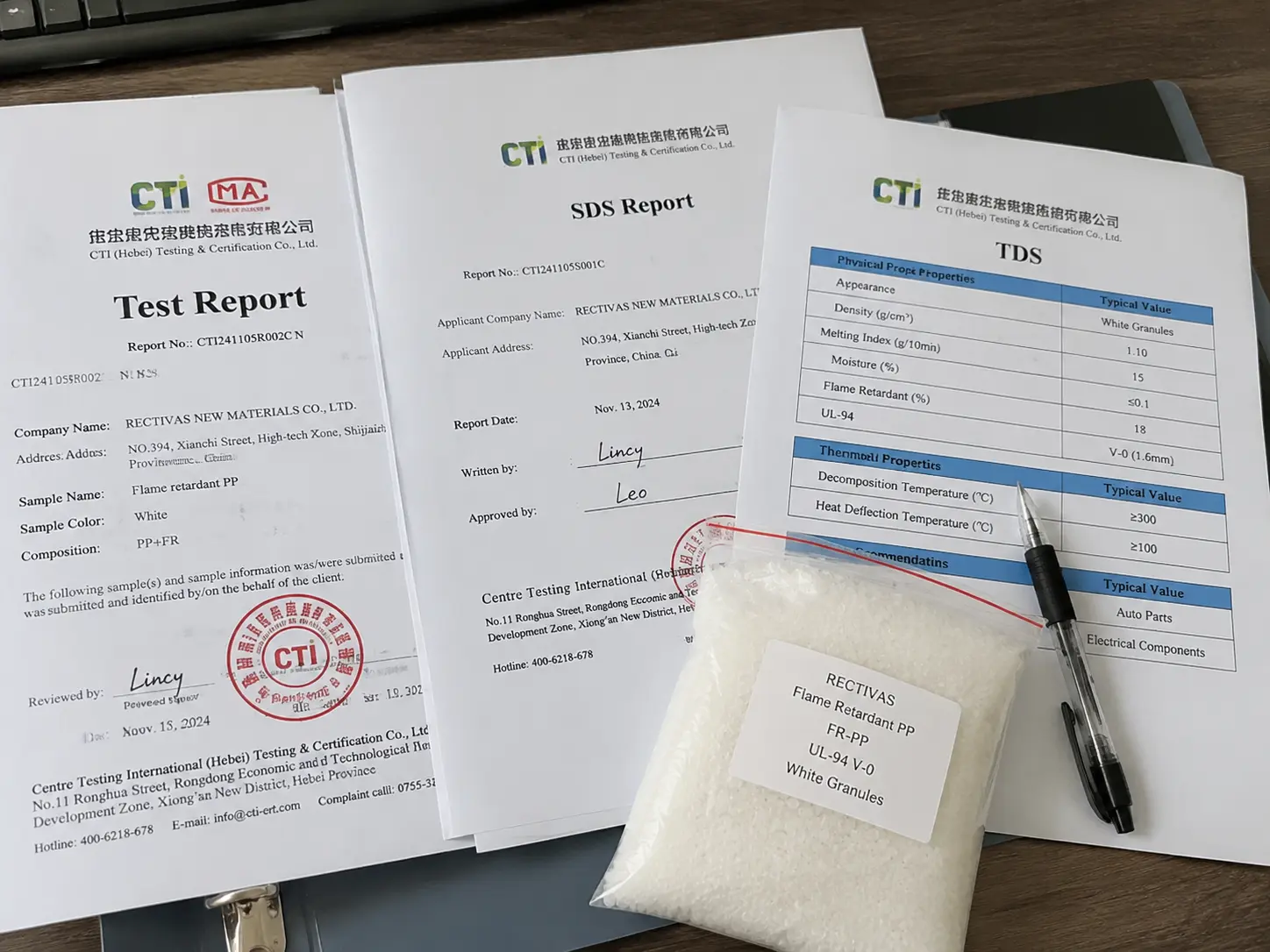
And the obvious caveat, restated: we sell these materials, so do not take my word as the final authority. Ask us for the SDS and the third-party test reports — ours come through an accredited laboratory — and check the substance yourself against ECHA or your own regulatory advisers. A supplier who reacts badly to that request has told you something useful. Ask us for documentation on any product here; the standard document set is on our downloads page.
FAQ
Are flame retardants in plastic products dangerous to consumers?
For the chemistries in mainstream use today — mineral, phosphorus, nitrogen and polymeric brominated systems — exposure from a finished part is low, and the additives that raised the greatest concern historically were restricted precisely because they migrated and accumulated. Products still in service from the era of those legacy chemicals are a separate matter from what is being manufactured now.
Is antimony trioxide safe to use?
It is used industrially at very large scale with established occupational controls, but it carries an IARC Group 2B classification based on inhalation studies, so powder handling requires real dust control and PPE. If you would rather avoid it, zinc borate reduces the required amount substantially and zinc stannate can eliminate it in some systems.
Are halogen-free flame retardants non-toxic?
No — “halogen-free” describes chemistry, not safety. It reliably means less smoke and no halogen acid gas in a fire, which is a genuine benefit. It does not mean the substance has no hazard profile of its own. Each one has to be assessed individually.
Would it be safer to use no flame retardant at all?
That trade is not usually available: for most of the applications discussed on this site the flame rating is a legal or contractual requirement, because untreated plastic in an enclosure or a wall cavity is itself a serious fire risk. Where a specification genuinely does not require flame retardancy — and some do not, as we point out for automotive interior parts under FMVSS 302 — then not adding one is the right answer, and we will say so.
One clarification belongs alongside all of this: a hazard classification and a legal restriction are different instruments moving on different timetables, and conflating them is how panic gets manufactured. For what is actually prohibited today versus merely under review, see brominated flame retardant regulations.
Final Thoughts
If you take one thing from this: the substances that were banned were banned for persistence and bioaccumulation, not for acute toxicity, and that distinction changes what you should actually worry about. We supply both brominated and halogen-free systems and will give you the honest read on either, including the parts that do not favour us. Ask for the SDS before you ask for the price – see our document pack.
—— Rectivas Materials 团队 阿丽